Everyone has the same job in the market
Try to remain as neutral and objective as possible with the information on hand. To ride it out when right, and admit when you’re wrong as quickly as possible.
And put yourself in the best position to win based off that
🚨 YOU DON'T NEED TO BE A GENIUS TO PRINT MONEY ON $BTC!
$BTC BELOW MA200 → BUY & ACCUMULATE
$BTC BREAKS ABOVE MA200 → SELL ON 1000 DAYS
THIS BEATS 97% CRYPTO TRADERS OVER 4 YEARS
WE ARE ALREADY CLOSE TO DROPPING BELOW MA200!
As a reminder, I warned about the bull trap at $82K and the summer drop
MY NEXT CALL WILL BE THE BIGGEST ONE OF THIS CYCLE
TURN ON NOTIFICATIONS. MOST PEOPLE WILL FOLLOW ME TOO LATE
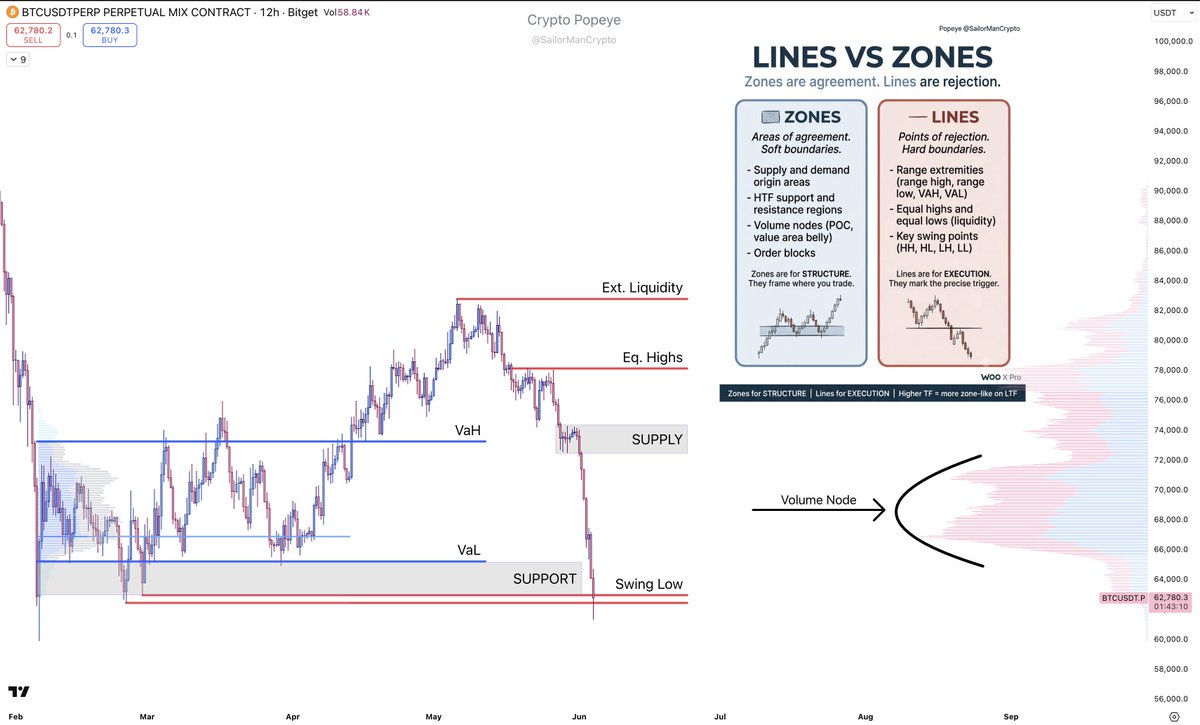
When to Mark Lines and When to Mark Zones - Cheat Sheet
This post is sponsored by WOO X Pro. Trade with zero fees on spot: https://t.co/iWxTrgYsA3
Most traders mark price levels the same way no matter what they're looking at. That is why their charts look messy and their reads are inconsistent.
The fix is simple: zones and lines do different jobs.
𝗭𝗼𝗻𝗲𝘀 𝗮𝗿𝗲 𝗮𝗴𝗿𝗲𝗲𝗺𝗲𝗻𝘁. Where the market camped, accepted, traded back and forth. Soft boundaries. Mark a zone when you see:
- Supply and demand origin areas
- Support and resistance regions, especially HTF
- Volume nodes (POC, value area belly)
- Order blocks
𝗟𝗶𝗻𝗲𝘀 𝗮𝗿𝗲 𝗿𝗲𝗷𝗲𝗰𝘁𝗶𝗼𝗻. Where the market sharply turned. Hard boundaries. Mark a line when you see:
- Range extremities (range high, range low, VAH, VAL)
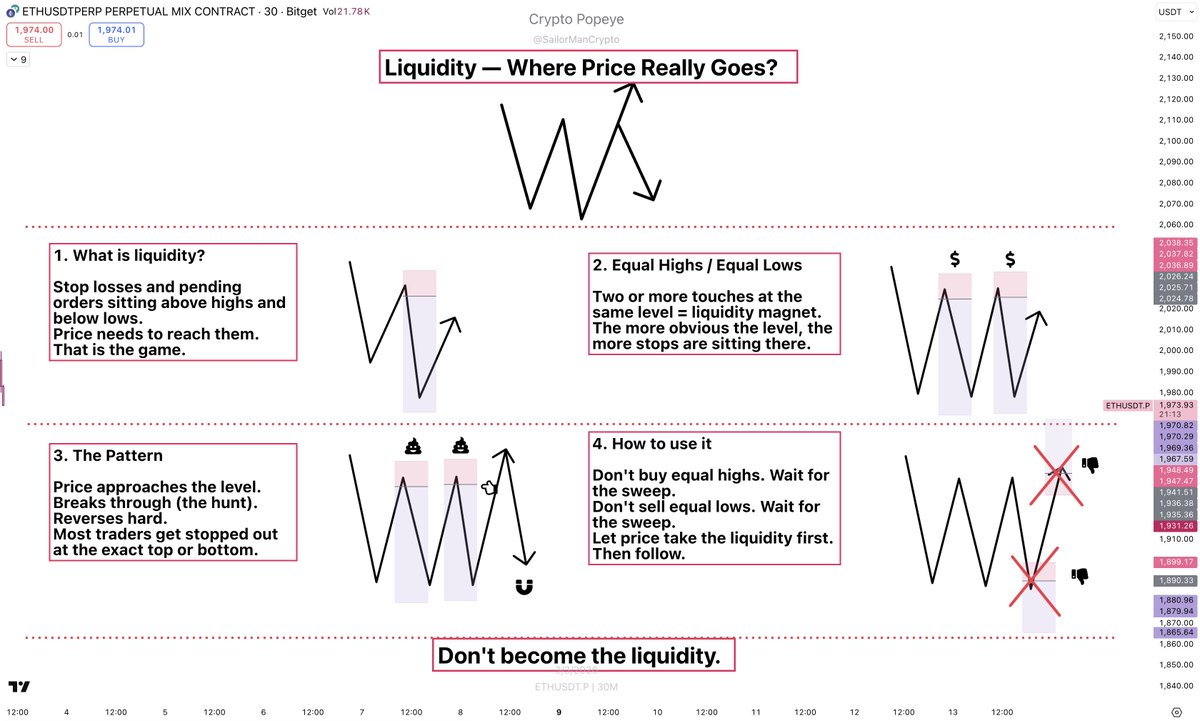
- Equal highs and equal lows (liquidity)
- Key swing points (HH, HL, LH, LL)
𝗛𝗼𝘄 𝘁𝗵𝗲𝘆 𝘄𝗼𝗿𝗸 𝘁𝗼𝗴𝗲𝘁𝗵𝗲𝗿:
Zones are for STRUCTURE. They tell you where you would want to trade.
Lines are for EXECUTION. They tell you the precise level for entry, stop, and target.
You do not pick one or the other. You map zones first to frame the picture. Then you mark lines inside or at those zones for the trigger.
𝗧𝗶𝗺𝗲𝗳𝗿𝗮𝗺𝗲 𝗻𝘂𝗮𝗻𝗰𝗲:
The same level can be a line on HTF and a zone on LTF. A swing high looks like a clean line on the 4-hour but reveals itself as a zone on the 5-minute because the wick takes multiple candles to form. Same with VAH and VAL.
Rule of thumb: the higher the timeframe you derived the level from, the more zone-like it behaves when you drop down.
𝗖𝗼𝗺𝗺𝗼𝗻 𝗺𝗶𝘀𝘁𝗮𝗸𝗲𝘀:
- Drawing a supply zone as a single line. You will get wicked through every time.
- Marking equal highs as a zone. You lose the liquidity precision.
- Treating an HTF S/R level as a sharp line on LTF execution. Use it as a zone and let price work inside it.
- Using lines where zones belong and vice versa. The whole framework starts with knowing which is which.
Levels are not all equal. Some are areas of agreement. Some are points of rejection. Treat them differently and your reads get cleaner overnight.
Popeye
WOO X Pro, zero fees on spot: https://t.co/iWxTrgYsA3
Feel the urge to take a setup? Pause. There is always another trade, never just one way in. Patience and a plan beat impulse.
Zoom out, then decide.
Protect your capital
If I have learned something in the previous cycle, it is that the first movers remain the best movers. The strong performers keep outperforming. The laggards keep lagging, and the weaker stay weaker.
Based on what I have seen over the past weeks, this is how a holding portfolio would look going into the next cycle.
It is a mix of everything, from quality to meme.
$HYPE
$INJ
$ONDO
$USELESS
$PENGU
$ZEC
$NEAR
I have zero knowledge of fundamentals and I am no interested on micro caps.
Plan to accumulate these when we get a proper dip, not now.
Bookmark it 🔖
Read these slowly.
Then read them again:
1. Anything can happen. The perfect setup still loses. The market owes you nothing. Ever.
2. You do not need to know what happens next to make money. Your job is not prediction. Your job is execution. Trust the edge, not the outcome.
3. Wins and losses are randomly distributed. Three losses in a row does not mean your edge is broken. It means you are inside a normal distribution. Stay in the process.
4. An edge is nothing more than a higher probability of one thing happening over another. Not a guarantee. Not certainty. A probability. Trade it like one.
5. Every moment in the market is unique. The setup that looks identical to last week is not last week. The market never repeats exactly. Trade what is in front of you, not what you remember.
Most traders know these.
Very few actually trade like they believe them.
The gap between knowing and believing is where accounts go to die.
Close the gap.
The 3 Drives Pattern Cheat Sheet
You voted for it. Here's how I trade it.
This educational thread is sponsored by @_WOO_X — where I trade crypto with zero fees on spot.
3 Drives is a reversal pattern. It signals exhaustion at the end of a trend. When you see it form clean, the trend is dying.
Two flavors:
Bullish 3-Drives → three higher highs → bearish reversal
Bearish 3-Drives → three lower lows → bullish reversal
Comes from Elliott Wave and Fibonacci, but I keep it simple.
The 3 textbook components.
Structure. Three sequential drives in the same direction.
In a bullish 3-Drives, you need three higher highs with higher lows between them.
In a bearish, three lower lows with lower highs between them.
No structure = no pattern.
Time.
Each drive should take roughly the same time to complete.
The textbook says exactly the same.
I say similar. If the first two drives form in 5 candles each and the third takes 15, the pattern is weakened or invalid.
Be flexible, not dogmatic.
Fibonacci.
Between drives, the pullback should retrace into the 0.618-0.75 zone — the golden pocket.
Each new drive should extend 1.27 to 1.618 of the previous.
Same flexibility rule.
Price doesn't move by textbook.
My pro tips.
The textbook gives you the pattern.
The pro tips give you the edge.
Trade it at known levels.
A 3-Drives in price discovery is much weaker than a 3-Drives running into a known resistance or supply zone.
The level gives the pattern a place to react from.
Pattern + level = confluence. Pattern alone = guess.
Add momentum. You want to see exhaustion.
RSI divergence is the cleanest signal — price making new highs while RSI prints lower highs.
Or volume drying up across the drives — less pressure on each push.
Either signal alone adds conviction.
Both = setup of the year.
How to trade it.
Two entry styles.
Pick your trade-off.
Aggressive entry — better price, riskier.
You enter at the end of the 3rd drive. Use the Fibonacci 1.27-1.618 extension or the S/R level to estimate where the drive completes.
The pattern is not confirmed yet — you're betting on the reversal.
Stop goes above the high (or below the low) of the 3rd drive.
Conservative entry — better confirmation, worse price.
You wait. After the 3rd drive forms, you watch for a market structure break.
Then you enter on the first lower high (bearish reversal) or higher low (bullish reversal) that confirms the structure flip.
You give up entry price for confidence.
Both work. Neither is wrong. Choose based on your style and what your stop tolerance allows.
The bottom line.
3 Drives is powerful when all the components line up.
Structure, time, Fibonacci, level, momentum. Stack the confluence.
Be patient. Be selective.
Don't force the pattern on every chart — it doesn't show up that often when all the rules are met.
One clean 3-Drives setup is worth ten guesses.
Trade what's in front of you. Not what you wish was there.
WOO X Pro — zero fees on spot: https://t.co/iWxTrgYsA3
bitcoin:native
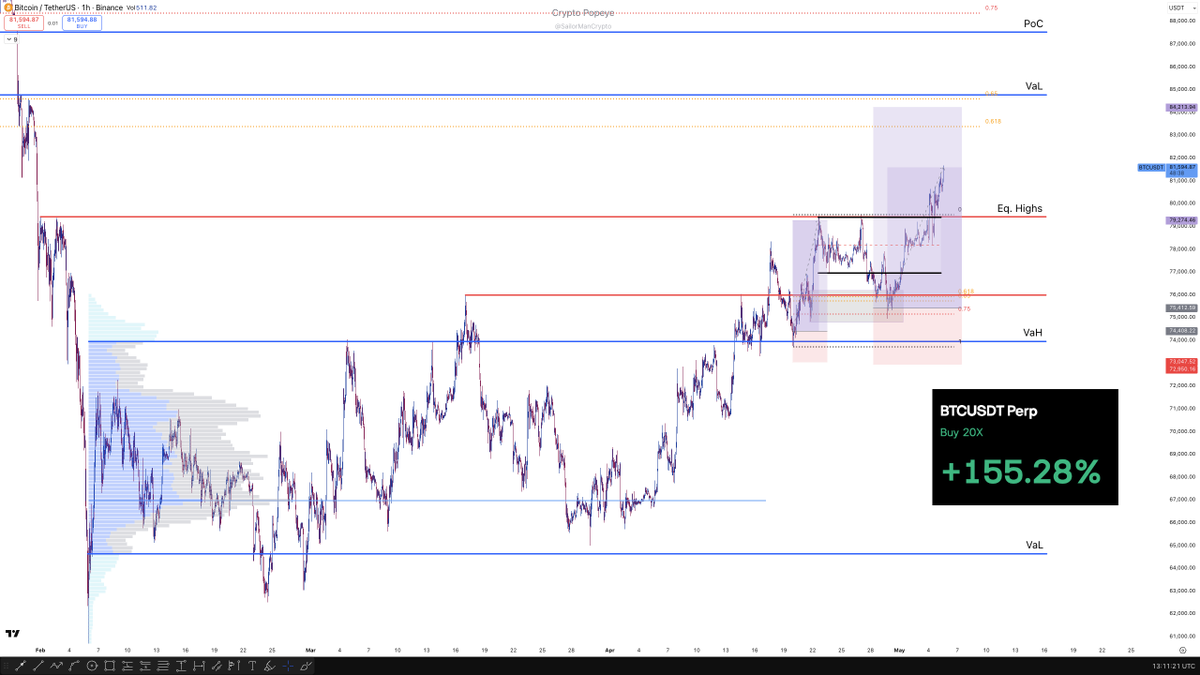
I have been shorting the range until it lasted.
Once it broke, I had no reason to short it; market dynamics are clear: compression is followed by expansion.
Ranges are followed by trends, and trading the trend has been my priority over the past weeks.
My execution since breaking outside of the range has been unprecedentedly clean.
I am honestly proud of myself.
The 4 Market Phases — and How to Trade Each One
Every market moves in cycles. If you don't know which phase you're in, you're guessing. And guessing costs money.
This educational post is sponsored by @_WOO_X, where I trade crypto with zero fees on spot.
Here's the framework.
Phase 1 — Accumulation
This is where a downtrend dies. Price stops making new lows and starts moving sideways in a tight range. Volume dries up. Volatility compresses.
Most retail traders are still bearish here because the downtrend is fresh in their memory.
Smart money is quietly buying. You will often see a deviation below the range low — a liquidity grab that traps late shorts before price reverses hard. That wick below the range is not a breakdown. It is a trap.
What not to do: don't short the range low. That is exactly where smart money wants your stop loss.
Phase 2 — Markup
Breakout from the accumulation range. Higher highs, higher lows. Volume increases on the up moves. This is where trends are born.
The only job here is to ride it. Don't fight it, don't try to call the top, don't fade every push higher because "it went too far." Trend is your friend until structure breaks.
What not to do: don't short into strength hoping for a reversal. Respect the structure until it gives you a reason not to.
Phase 3 — Distribution
This is where an uptrend dies. Price stops making new highs and starts chopping sideways at the top. Smart money is selling into retail buying. Volume spikes on the drops and weakens on the rallies — that tells you who is in control.
You will often see a deviation above the range high — a liquidity grab that traps late longs before price rolls over. That wick above the range is not a breakout. It is distribution.
What not to do: don't buy the breakout at the top. That is FOMO, and smart money is selling directly into it.
Phase 4 — Markdown
Breakdown from the distribution range. Lower highs, lower lows. Volume expands on the sell-offs. This is where most retail gets trapped buying every dip hoping for a bounce.
The only job here is to stay out or trade with the trend. Don't catch the knife. Don't convince yourself every support level will hold. Wait for accumulation structure to form before thinking about longs.
What not to do: don't buy every dip in a downtrend. Wait for the cycle to reset. Wait for accumulation.
These four phases repeat on every timeframe and every asset. Learn to identify them and you will always know what the market is doing — and more importantly, what it is about to do.
Know which phase you're in before you trade.
All this free educational content is sponsored by @_WOO_X — trade with zero fees on spot.
https://t.co/iWxTrgYsA3
If you don’t have the patience to let price come to you and focus on excelent execution
Then you got no place in day trading
Most of the times you’ll chase and let emotions drive your execution
More executions, more mistakes, more fee’s
less profits 🌊
If I had $25k to invest…
I wouldn’t buy stocks.
I wouldn’t buy real estate.
I wouldn’t even buy Bitcoin.
I’d do exactly what my clients at JP Morgan did.
I’ll expose it for you: