$MU is trading at ~4.8x NTM sales.
Very cheap at the moment.
They are already ~174% up vs trailing year.
Earnings will certainly push the share price much higher, at least 10-15%.
Kioxia is a good trade right now
after the 3-for-1, stock falls to $109
EV still about $190bn
Trailing sales: $24bn that is ~8x
Next 12 months sales: $74bn that is ~2.6x.
That is ~200% of the trailing year.
I consider it cheap.
Don’t forget $MU reports tonight.
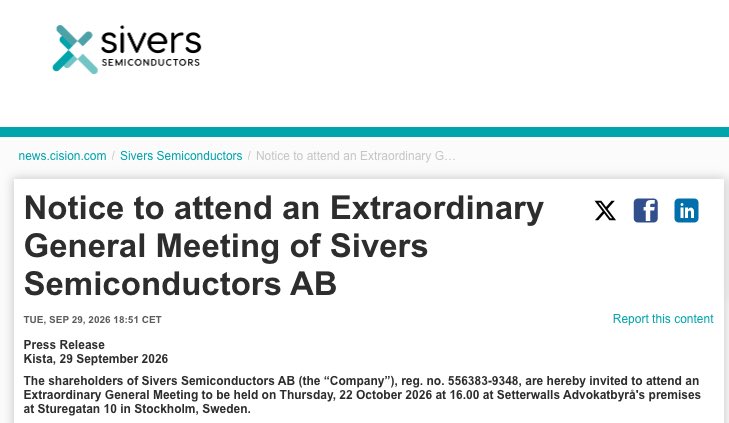
$SIVE announced progress toward a dual Nasdaq New York listing in 1H 2027.
The Oct 22 EGM proposes switching auditors from Deloitte to EY specifically to support SEC reporting requirements.
Soon we will see it with institutional access like $LITE, $COHR, $AAOI
JUST IN: $SIVE just put a DATE on the U.S. listing. BULLISH!
—> August: “evaluating” Nasdaq New York.
—> Tonight: dual listing expected in 1H 2027.
33 days later they called an Oct 22 EGM to rip out Deloitte and install EY, specifically for SEC reporting.
This is finally a timetable.
Pipeline: $1.2B. Glasgow InP fab scaling to 100M+ lasers/year. Same optics desks that trade $LITE $COHR $AAOI are about to get a ticker they can actually buy.
I am long. NFA.
PS: Credits for sharing @carrioresearch.
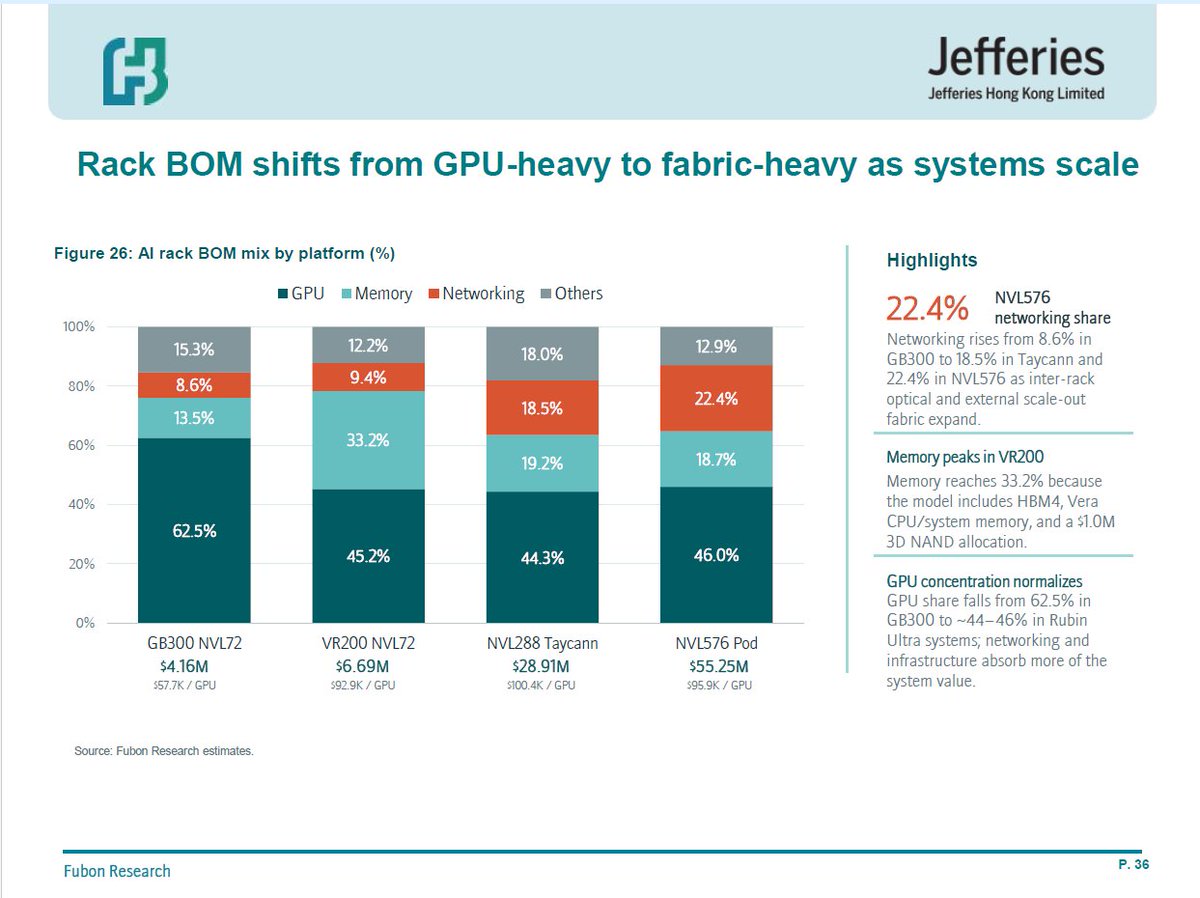
$SIVE sells the InP light, CW DFB lasers, laser arrays, external light sources, and SOAs that sit inside that orange bar.
Pluggables and near-package optics are the 2026–27 cash window.
CPO / ELS is the 2027–28 window the NVL576 bar is pointing at.
--> Pipeline $1.2B as of July 2026, up 268% from end-2025. Photonics is catching wireless inside that funnel.
--> Jabil 1.6T pluggable: beta Q4 2026, production orders targeted H1 2027, ramp H2 2027. That is the memory and pluggables are the present line.
--> SemiNex $3.4M InP light-source program; sampling / early production 2H 2027. Same calendar as Rubin Ultra / CPO scale.
--> GF SCALE CPO, POET light engines, O-Net/Enablence ELS all the same architecture the 22.4% bar assumes.
--> Glasgow InP expansion: $30M, start H2 2026, live Q4 2027, >100M CW DFB lasers/year. Capacity lands when the fabric bar is supposed to matter.
--> New Photonics engineering lead is an Amkor packaging guy.
$SIVE is executing and keep growing in a growing market
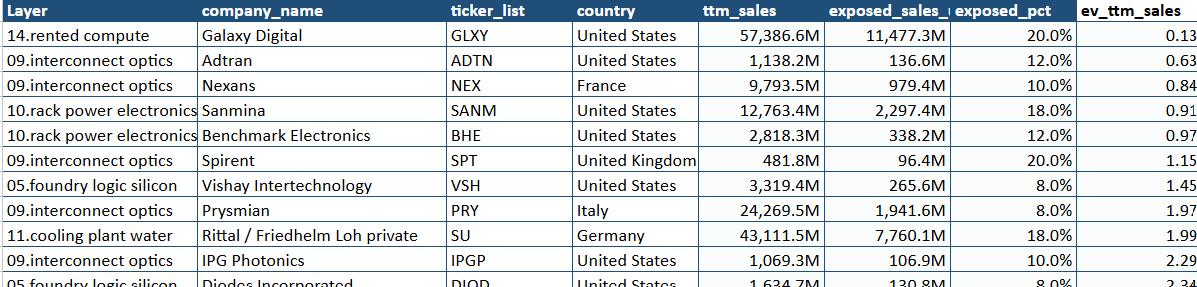
I start to short list some companies who are currently traded at low EV / TTM sales,low AI revenue today,but expected AI-driven growth, in different supply chain layer.
The names that came out:
$GLXY $ADTN $NEX $SANM $BHE $SPT $VSH $PRY $SU $IPGP $DIOD
The expected growth part is the trick. low AI revenue can look cheap for a reason.
So now I need to dig into each company and answer the harder questions:
Can they actually grow this business?
Can they maintain strong margins as it scales?
Will AI become big enough to move the growth of the entire company?
Because if AI revenue doubles but barely changes the overall P&L, the thesis is different.
I also need to be careful with the balance sheet, debt, cash, capex, dilution.
So this is just the starting screen.
Next step is going deeper into each name:
→ AI revenue
→ Growth potential
→ Margins
→ Cash / debt
→ Dilution
→ Next milestones
→ Valuation
The goal isn’t to find the cheapest AI stock.
It’s to find the companies where AI growth could become material to the whole business while the market still values them like the old business.
Curious what you think.
@Semiconsight@Sofigoodboy
If you invest in $NOK, you are investing in the physical AI ecosystem.
SoftBank AITRAS software solves one of the Physical AI problems through the AI RAN.
To operate safely around humans, a humanoid robot needs to run highly advanced Vision Language Action AI models to process its surroundings in real time.
The problem is that these AI models are too massive to fit inside a robot's body without instantly draining its battery and making the robot too heavy or expensive.
AITRAS splits the robot's workload. The robot handles basic reflexes locally, like keeping its balance.
The heavy lifting like thinking, identifying a complex object, or calculating a path through a moving crowd is instantly sent over the mobile network.
This network must be an AIRAN.
Someone at $NOK told @damnang2 they want small AI models on access points and routers.
That is the edge line I already wrote.
Without AI-RAN, $NOK only sells into halls.
With AI-RAN, the last radio hop can run a light model next to the machine instead of sending every token to a distant cluster.
https://t.co/RkNIKcSS65
https://t.co/mmRx8blqxu
https://t.co/kEXHyRdoN3
Someone at $NOK told me about an edge computing concept they’re working on, and I found it pretty fascinating.
The idea is to run small AI models directly on access points and routers so they can handle lightweight AI tasks locally.
The era of edge computing is coming!
What happens when the market starts valuing $NOK like an AI infrastructure + software company?
A very intresting leverage that $NOK has and will defenitly push to a new rerate in the very near future.
The AI RAN, they have been recently taking about everywhere specially on X.
I modeled this AI RAN revenu for $NOK, here is is the calculation.
First understand what is AI RAN?
Historically cell towers were just expensive physical equipment boxes used to pass phone signals.
AI-RAN (Radio Access Network) changes this by installing general-purpose $NVDA GPUs directly at the base of the cell tower instead of traditional closed telecom chips.
The real opportunity is turning the RAN into a distributed AI infrastructure layer.
They have 2 Tiered Value System
AI for RAN → Nokia uses AI to optimize spectrum and network performance, helping carriers get more capacity from infrastructure they already own.
AI on RAN → those same sites can eventually rent out those physical GPU slices directly to hyperscalers $GOOG , $META, $AMZN or local enterprises to run real-time local AI inference workloads (like autonomous cars, factory cameras, physical AI....).
That second part is where things get interesting.
Instead of the tower being just a cost center, it potentially becomes an AI revenue-generating asset.
And $NOK has positioned itself around open, programmable GPU infrastructure through its partnership with $NVDA.
Now look at the math.
Dell'ORO records roughly 7 million macro cell towers.
$NOK potential addressable footprint could be around 1.75M macro towers based on a 25% share assumption outside China.
At only 15% penetration → 262,500 upgraded sites.
Since Nokia captures a percentage of the heavy capital expense savings and incoming GPU rental revenue it generates for carriers, I modeled 3 Monthly Subscription levels per upgraded tower site:
Conservative Tier → $100 / month per node
Basic AI for RAN spectral optimization.
Target Tier → $300 / month per node
AI for RAN + basic edge orchestration.
Aggressive Tier → $500 / month per node
Full AI on RAN enterprise edge hosting and billing monetization.
At $300/month per site → 300 x 12 x 262.5K = ~$945M ARR.
if 30% penetration → ~$1.89B ARR.
And that's without assuming any major market-share gains from competitors.
The real wildcard is the poaching scenario.
If carriers begin moving from legacy infrastructure toward a $NOK + $NVDA AI-RAN architecture, $NOK 's addressable footprint could expand significantly.
At 15% penetration 35% market share → ~$1.32B ARR.
This is why I don't view AI-RAN as simply another $NOK product cycle.
If $NOK CAN prove that this becomes a high-margin, recurring software business, the market may eventually stop valuing $NOK purely as a cyclical telecom equipment company.
That's where the potential multiple expansion comes from.
My view:
Near term → probably still choppy and slow. Those revenu will start to show up in H1 2027
Next phase → accumulation + AI-RAN adoption.
Long term → if Nokia proves $1B+ recurring AI-RAN revenue, the valuation framework could look very different.
The market is still treating $NOK like a telecom equipment company.
Free models and other articles on my substack https://t.co/vjqT9csfZd
Interesting chart. For 8 years $NOK and $CIEN paid almost the same price for a dollar of sales.
Then $CIEN’s mix went optical and cloud and the multiple left. $NOK’s multiple only walked.
That gap is the bull case. $CIEN is 71% optical and already 53% cloud.
$NOK’s AI and Cloud line is still about 9%. And expected to grow.
The factory is in San Jose. Telxius is already taking 800G.
$CIEN itself said demand is still above supply.
You do not need $NOK to become 8x sales.
You need the 9% slice to keep growing so the stock stops sitting next to $ERIC and starts sitting closer to the optical tape.
2.5x today versus 6x forward on $CIEN is a lot of room if mix and cash show up.
@Semiconsight@Sofigoodboy No, I mean as AI revenue starts to increase, the stock will start trading closer to an AI pure-play. If it is at a 2x sales multiple, it will get a new multiple and trade closer to pure-play peers at 6-8x, depending on the AI peer in its sector.