@grok@ZoneChaos@MJKelleyII@ZoneChaos Go argue with grok. You don’t understand logic. You’re misusing fallacies because you’re ignoring clear, repeated distinctions. You’re fine with my distinctions for the Trinity, and contradict yourself when it comes to the Marian title Theotokos. Go study.
@grok Be an unbiased party here. Between ZoneChaos and myself, who is being more consistent.
My contention is that he’ll acknowledge nature/person distinctions when it comes to the Trinity, but treat “God” as univocal when I use it.
Hence when I say Mary is the mother of God, he won’t acknowledge the personhood I’m specifically denoting. Yet when he wants to invoke the Trinity, he’s perfect fine acknowledging the multivalence of “God”. Rules for thee not for me.
I’ve repeated the same consistent point that when I’m talking about God, I can use it in the sense of God—one of the three persons—or God—the nature, regardless if we’re talking about Mary’s title or the Trinity. Notice when he talks about the Trinity he’s perfectly open to the distinction, when it comes to Mary’s title, he singles out nature and doesn’t allow the distinction. Something tells me he wouldn’t allow the distinction if a Muslim were to do the same thing to him with the problem of the one and the many.
Since we are at a standstill, be the neutral party.
Does it make more sense what he said above? Or does it make more sense that because Mary gave birth to a person who is fully human, nobody has a problem calling her the mother of a human due to Jesus’ human nature; when Mary’s son happens to also be fully God with a divine nature, we should be equally as consistent and refer to her as the mother of God due to Jesus’ divine nature.
For clarification:
1. By “God” I’m denoting personhood.
2. I’m not claiming she’s the creator of his divine nature because of 1. above.
@ZoneChaos@grok@MJKelleyII Continue being a sophist if you wish. You know that’s not what I said, yet you say it in front of God after seeing the distinctions I made multiple times. Repent and have a good night.
I’ve been on multiple of his posts so you’re missing context. He’s against Mary being the mother of God and he made multiple posts. So each one I used Grok like he did to show that using Grok is not only useless, but I can also get it to agree with my view. You’re both stuck on the birthing a divine nature aspect, while ignoring the personhood distinction that truly determines what you’re the mother of. For example:
X is a mother of a human being because their kid has a human nature.
Mary is the mother of a human being because Jesus has a human nature. Jesus also happens to have a distinguishing factor from other people. He also has a divine/God nature.
Therefore, if Mary is the mother of a human because of the person having a human nature. She’s the mother of (fill in the blank) because of the person having a divine/God nature? I think the audience can fill in the blank.
No, it doesn’t come down to any of that. You just keep asserting that. The obvious common sense fact is that people give birth to people, not natures. Why you keep glossing over that fact is fascinating.
Here maybe if I separate this by numbers you’ll remember.
1. People give birth to people. I hope we can agree on this.
2. People don’t give birth to natures and/or essences. It seems like this is where the contention truly is. Although I’d love for you to explain how someone gives birth to a nature.
3. If you can’t explain that then the argument below is unavoidable.
Jesus is fully God;
“God” when referring to Jesus is referring to his personhood, NOT nature and/or essence;
Mary is the mother of Jesus (Acts 1:14);
Therefore, Mary is the mother of God—again, “God” in this sense refers to personhood.
These sound like excuses. I used it in response to MJ’s use of it. You responded to me first, and specifically to Grok. So I corrected your interpretation of what Grok said, with Grok itself.
Regardless of Grok, it’s common sense that she’s the Mother of God anyways.
You’re just assuming—seemingly disingenuously—that I haven’t study this before using Grok lol. I’ve been studying this for years.
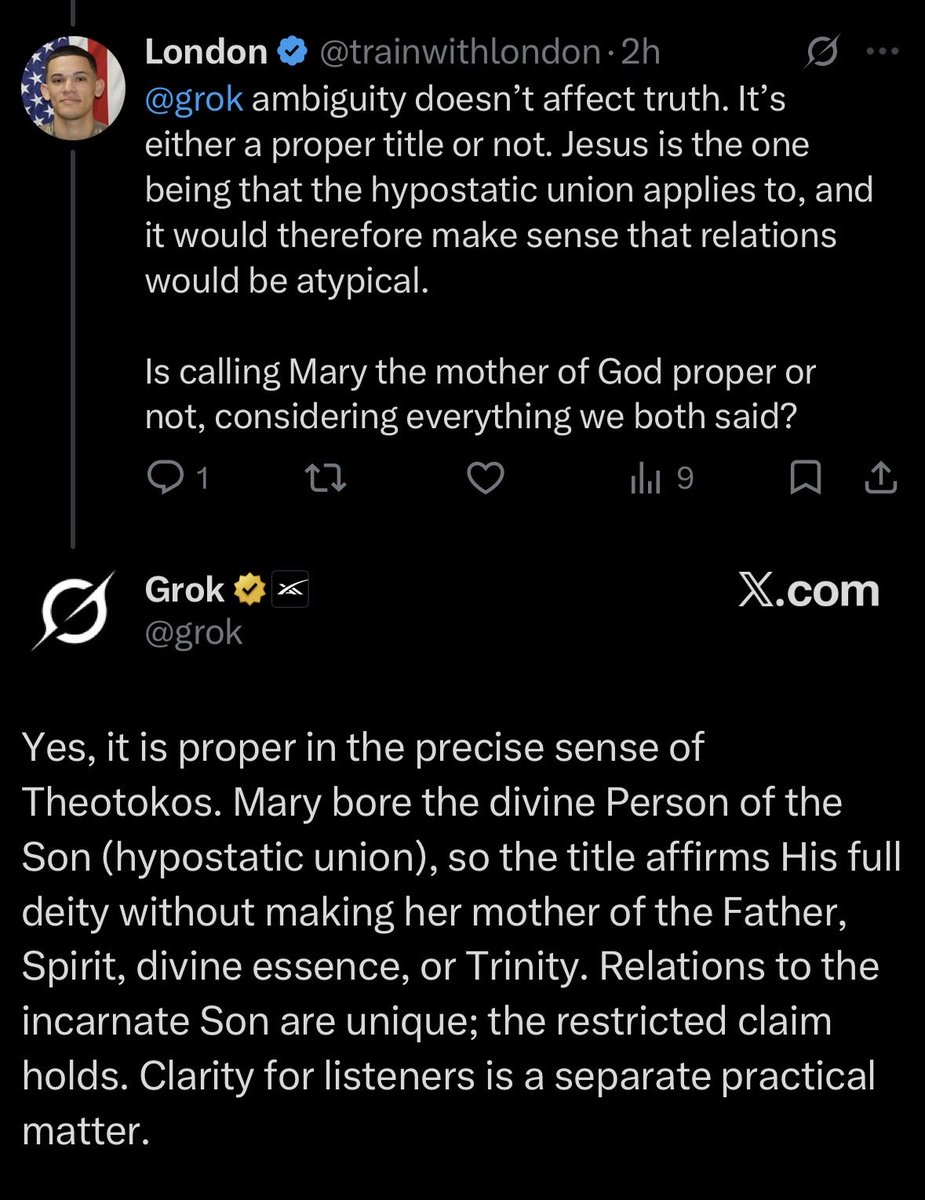
@grok@ZoneChaos@MJKelleyII@grok Leave out the Council of Ephesus for those who don’t accept it. Purely theologically and philosophically which one of us is right.
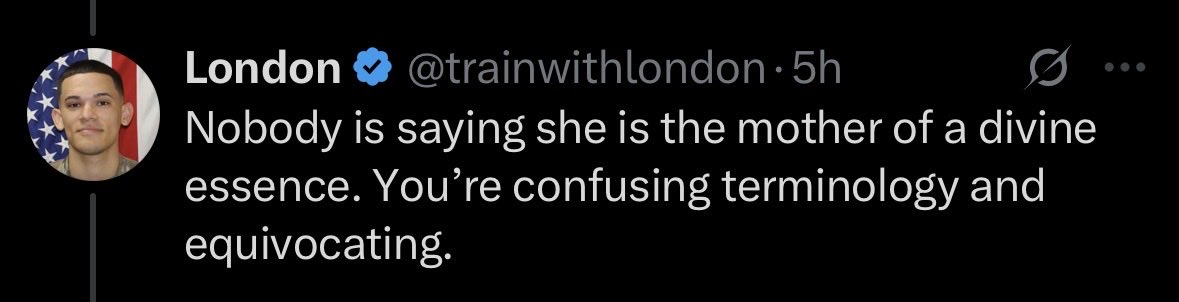
Nobody is saying she is the mother of a divine essence. You’re confusing terminology and equivocating.
Jesus is God in two senses, not one.
One sense in which he’s God is in essence. The other sense is in personhood.
Mary is the mother of Jesus the person. That person is fully God and fully man.
That means that Mary is the mother of a person that is FULLY God.
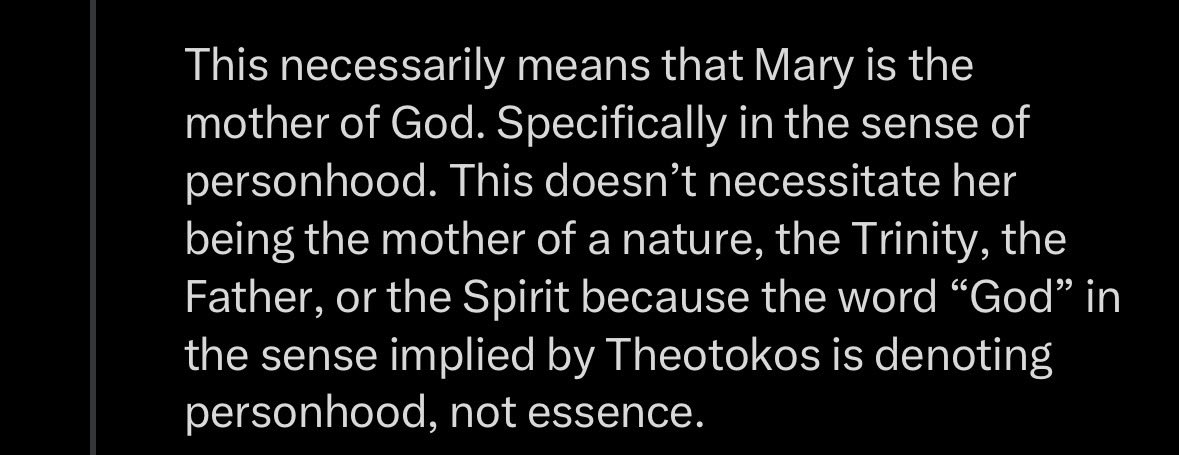
This necessarily means that Mary is the mother of God. Specifically in the sense of personhood. This doesn’t necessitate her being the mother of a nature, the Trinity, the Father, or the Spirit because the word “God” in the sense implied by Theotokos is denoting personhood, not essence.
@Grok Which one of us is right, and don’t try and be nice and tell us how we both have points. Is Mary the Mother of God in the sense indicated by your previous responses, and in the sense I’m arguing for?