Lillian Schwartz began her pioneering work at Bell Labs in 1968, creating computer-generated films that merged art, mathematics, and technology. Her investigations into perception expanded computational art's possibilities.
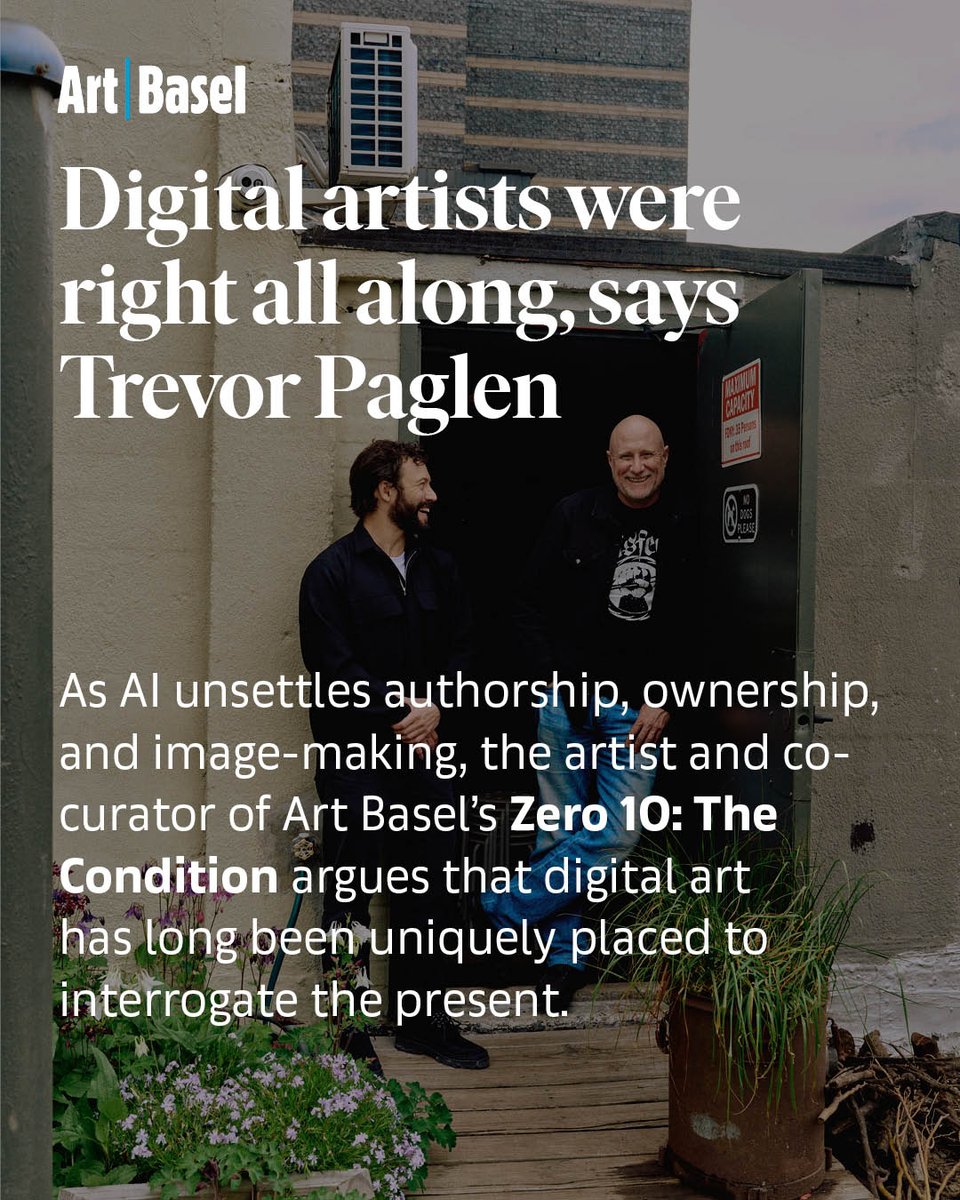
'What is an image when a machine can generate it? What is ownership when a file can be copied infinitely? What does it mean to make something in a world already drowning in pictures?' asks Trevor Paglen, the artist and co-curator of Art Basel’s 'Zero 10: The Condition'.
In his curatorial statement for the initiative, he argues that digital art has long been uniquely placed to interrogate the present.
👉 Read his full piece: https://t.co/N0ArzucQIF
Thrilled to share that this work by @yoshi_sodeoka has been acquired by @glimmerdao ✨
Yoshi’s „21.000 II“ reflects his distinctive way of working with layered digital imagery — translating systems, perception, and atmospheric visual material into immersive compositions between image, space, and perception.
Very happy to see the work enter such a thoughtful collection !!
And special thanks to @NORIWTS for the connection and support. 🙏
What would your playlist say about you? What are you thinking about? What keeps returning to your mind?
Some playlists begin with a theory. Others begin with a mood, a body part, a political obsession, or the end of the world.
Build playlists around your fears, obsessions, moods, thoughts, or interests on CIFRA.
Applications are now open for the next Artist Commons cohorts.
Beginning this July, visual artists will spend a full year in conversation with mentors, art world professionals, visiting artists, lecturers, and a small cohort of peers who are serious about building a stronger, more sustainable art practice.
If you’ve been looking for better feedback and more structure for your work, this is your call to apply.
Early Admission Deadline: Monday, May 25
#ArtistCommons #ArtAdvice #ArtEducation
Can I use this image in my art? When does appropriation become fair use?
Prof. Cheyenne Rudolph looks at Richard Prince’s use of photographs from Patrick Cariou’s book Yes Rasta for his Canal Zone series.
Prince physically cut images from the book, altered them, collaged them, enlarged them, and exhibited them as new works. He didn’t ask for permission.
The case became one of the most important copyright battles around appropriation art, raising a question artists still have to wrestle with: How much transformation is enough to count as fair use?
#AppropriationArt #RichardPrince #FairUse #CopyrightLaw #ContemporaryArt #ArtHistory #CollageArt #ArtEducation
Fidel Amos is one of the most important people in the digital art community because we don't need more pretentious curators or arrogant collectors, but genuinely good people who take care of artists with love. This is what digital art is about.
BRUNCH BY FIDEL UPDATE
Yesterday I received 1 ETH from an anonymous legend. I just need 1.8 ETH more, and BrunchByFidel Lisbon is a GO.
So repost this. Quote this.
Do that voodoo that you do.
And let’s feed the faces of 150 degens.
.@100collectors is the official curation partner for NFC Summit 2026 ! 🐉
After years as art concierge and VIP lounge host at NFC, the global network for digital art collectors steps into the curator role with @flakoubay:
a welcome desk at the Art Factory, guided tours, collector talks, and events designed for people who collect or want to start.
Start the conversation at https://t.co/g2Ry1ITEdk
Collectors, this one is for you. June 4-6, Lisbon. 🇵🇹
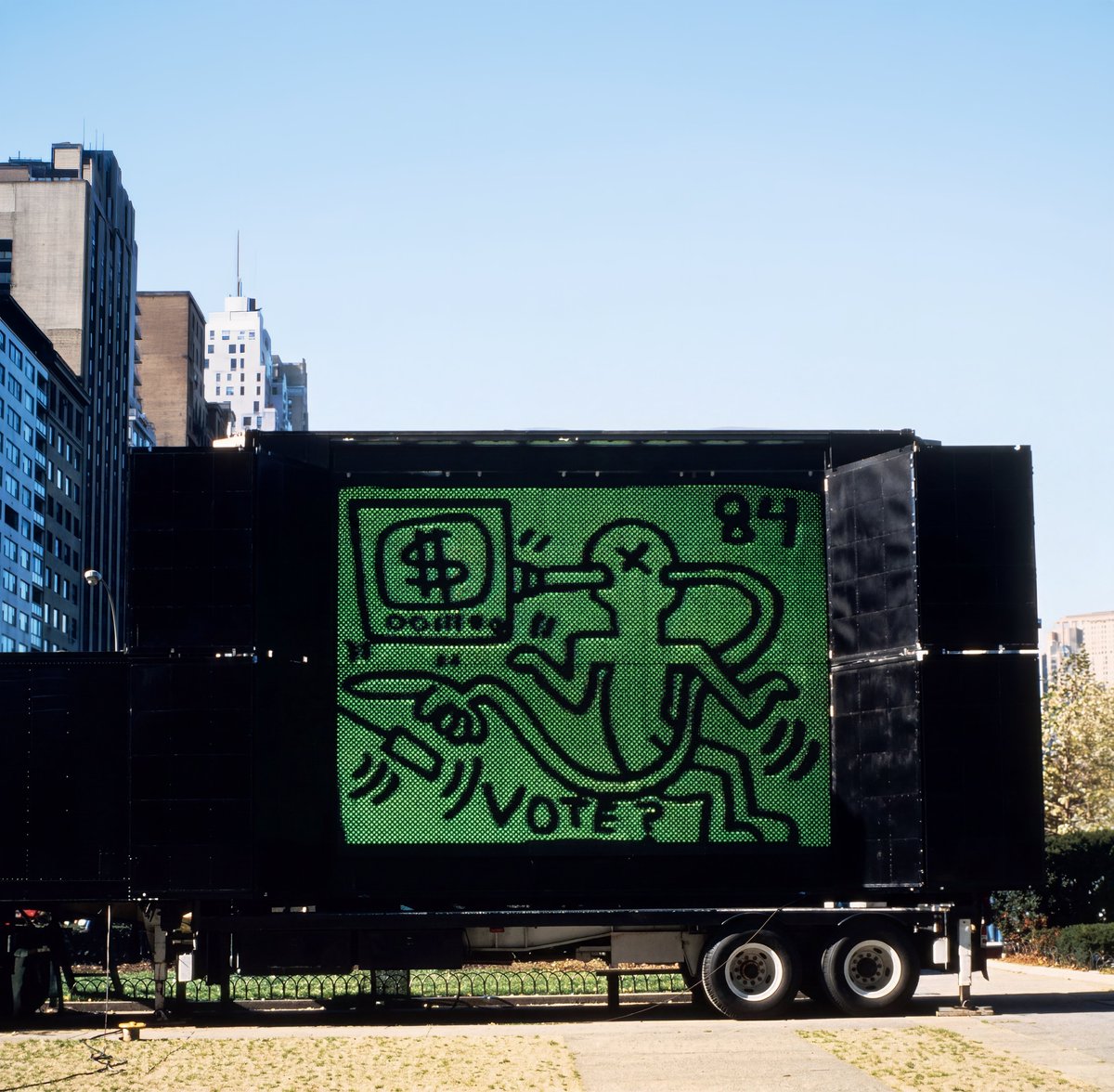
Keith Haring in 1983: "The thing in the subway was that it proved that you don't have to get the seal of approval from... any sort of authoritative art person for it to be real art... I had to do it as graffiti... cutting through all those barriers & putting it there directly."
Below: Untitled by Keith Haring for Sign on a Truck by Jenny Holzer, New York City (November 3-5, 1984).
didn’t we get into nfts in the first place so we wouldn’t have to worry about art fairs and now all we do is worry about art fairs and make sure not to mention nfts?
Canonical Curations: Important Exhibitions from Digital Art's Earliest Moments
Spanning eleven institutions across three countries, these four early exhibitions of art & technology would ultimately reach millions of visitors, actively constructing the digital art canon.
Web3 technologies enable the freedom of exchanges between individuals and companies, without the need for third parties or government interference. Web3 is not about an obscene display of luxury and privilege amid wars. This is absolutely tone deaf. The French never learn.
Reminder: Web3 and the blockchain were supposed to be tools for decentralization, more equality, and equity. They are now openly used in the display of privilege and elitism for the "Top 1%" at the ultimate symbol of favoritism and imperialism.
An evening that no recap can fully capture.
The night before Paris Blockchain Week 2026 opened its doors, the top 1% of the industry gathered at the château de Versailles for the most emblematic dinner in the history of digital assets.
The evening began with a private transfer for our guests and a memorable welcome with live music, and concluded with an intimate seated dinner with the CEOs, managing directors, policymakers, and founders who define the future of institutional finance.
It was also the moment we unveiled what comes next: announcing our expansion into Signal Week 2027, a new chapter for the most consequential gathering in digital assets.
This is what the most consequential networking in digital assets looks like.
In 1987, Computers and Art (1987-88) would forever change our understanding of the digital art canon.
The first major retrospective of digital art in the USA, it would argue for the genre’s legitimacy by placing contemporary digital works by Warhol, Haring, and Hockney alongside those of Knowlton, Nees, and Csuri, collapsing the false divide between canonical contemporary art and the genre’s technical pioneers.
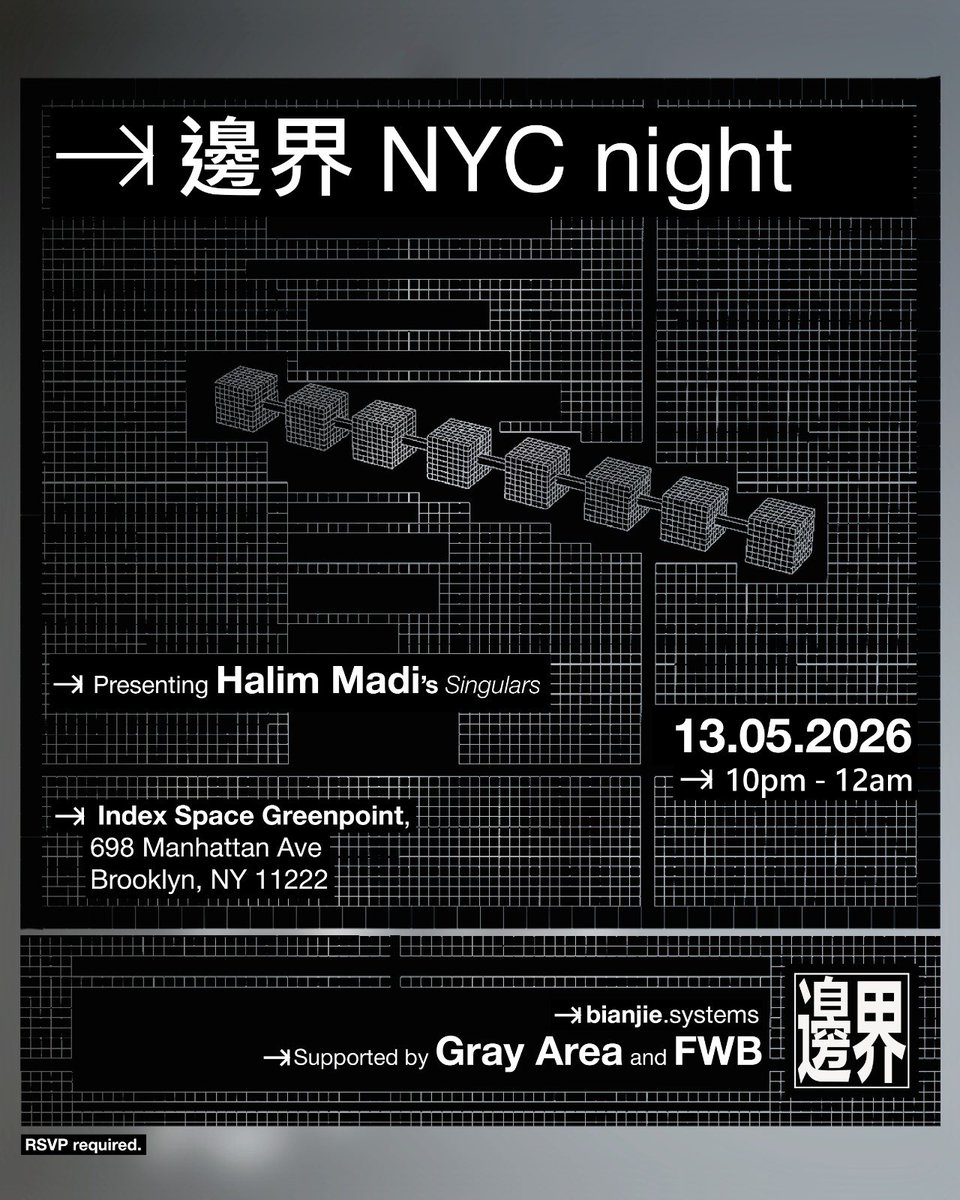
On 13 May, 邊界 will be hosting an evening gathering at @index_space_org Greenpoint, NYC, bringing together a cross-coastal group of artists, researchers, technologists and cultural intermediaries from New York and San Francisco.
The event is designed to foster meaningful dialogue around the role of artistic practice in shaping how technical institutions, research communities, and public imaginaries intersect. With the support of @GrayAreaorg and @FWBtweets.
We will be presenting @yalla_halim work, “Singulars”: a series of live poetry duels between a human poet and a machine. The audience votes to decide the winner, and their votes train the machine for future performances, helping poetry and machine reach, possibly, a new singularity.
DM for more information!
A new museum billed “as the world’s first museum of AI arts,” is set to open June 20 in Los Angeles. Dataland is co-founded by Turkish-American media artist Refik Anadol and will be housed at The Grand LA, the Frank Gehry-designed complex in downtown Los Angeles’ Grand Avenue Cultural District. https://t.co/g7RTH2iI4B