The most frightening person i ever witnessed was a man who only wanted one thing. everybody around him had a hundred plans, a hundred projects they were going to start next month, and he had one, just one. and he never talked about it much, and that was the part that unnerved you, because when someone talks a lot about what they want, you can relax. talking is letting the pressure out, so it's harmless. but he was airtight.
Everything in him was moving toward one point, in silence. within a few years he was in a place no one else could reach, and everybody who had watched him stood there scattered and confused, with their mouths full of plans that never solidified into anything. i learned from watching him that the mouth is a leak. every time you say what you are going to do, you lose a piece of the will that would have done it
BE DELUSIONAL UNTIL IT’S REAL
Make others think you’re crazy. Become obsessed with your potential. Prove them wrong. Succeed because you have no choice. Show others how limited they think you are. Train like a madman. Sleepless nights. Master new skills. Burn bridges to your old life.
When you’re optimistic about your future, every day is a step where everything can change immediately.
They might think you just got lucky, but they didn’t see the work behind the scenes while they were doing nothing.
You’re almost there. Just one more day.
Life becomes 100x more enjoyable when you start playing it like a video game. You have free will. You can literally do anything you want. Go anywhere. Build anything. Become anyone. The only rules that are stopping you are the ones you inherited from people who also felt stuck. Drop them. Step into the game with wild self belief and borderline greedy ambition. Dream so big it feels irresponsible. The life you always wanted is not out of reach. You just finally have to decide to go collect it.
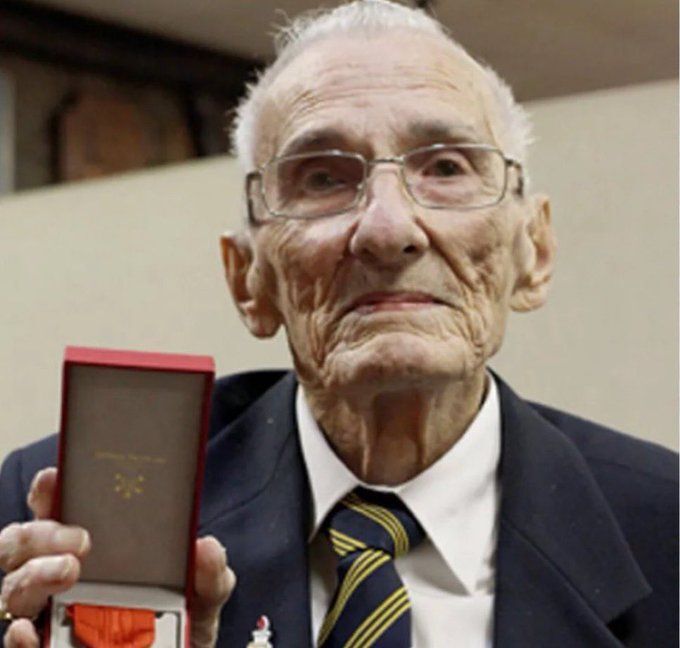
Este es el inmunólogo más famoso del mundo. Vivió 108 años, y cuando le preguntaron por el secreto de su longevidad, dijo que no se debía a la comida, ni a una dieta saludable, ni siquiera a un bajo nivel de estrés. Y cuando le preguntaron por el secreto de la longevidad, respondió con una sola palabra.
⚡️Children remember the moments when the family becomes fully alive.
That is the core. Vacation is just the common vessel.
A child does not encode childhood as a spreadsheet of responsible parenting.
They encode atmosphere.
They remember the motel pool, the gas station stop, the smell of sunscreen, the weird restaurant, the long drive, the sunset, the parents laughing differently, the feeling that normal life cracked open and something larger appeared.
That is why ages 5 to 10 hit so hard. The child is old enough to form durable narrative memory and young enough for the world to remain enchanted. Parents still feel mythic. A beach, cabin, lake, theme park, road trip, or even a cheap rented house can become sacred geography.
The real mechanism is interruption of routine plus emotional safety.
Ordinary life teaches stability. Trips create myth. The family leaves the repeating loop of school, work, chores, screens, exhaustion, and time pressure. For a few days, the child experiences parents outside their normal roles. Mom and dad are no longer just managers of homework, food, discipline, bedtime, and logistics. They become companions inside an adventure.
That imprints.
The money matters far less than parents think. Luxury is mostly adult vanity. Children remember intensity, freedom, attention, surprise, and togetherness. A $200 trip can beat a $10,000 trip if the child feels wonder and the parents are emotionally present.
Many adults are starved because their childhood had no sacred interruptions. Everything was duty, stress, survival, noise, pressure, or emotional absence. No mythic family scenes. No private homeland in memory. No recurring proof that life could be warm and strange and alive.
That matters for the adult psyche. People draw from childhood memories during loneliness, fear, ambition, loss, and love. Those memories become inner architecture.
Deepest compression: a good childhood is not built only by protection. It is built by unforgettable shared worlds.
Take the kid somewhere. Break the loop.
Make the ordinary world disappear for a few days.
That becomes part of them forever.
Rick Rubin has low heart rate variability.
So he looked up everything that raises it, picked one technique, and started doing it every day.
It worked.
The technique: coherence breathing. 10 to 20 minutes a day, at least once, sometimes twice.
Now he and @hubermanlab do it together on camera so you can follow along:
Jensen Huang just reverse-engineered why Elon Musk operates at a speed no one on the planet can match.
Three traits.
The first is deletion.
Huang: “He has the ability to question everything to the point where everything’s down to its minimal amount.”
Most engineers solve problems by adding.
Musk solves them by subtracting.
Every part. Every process. Every assumption that survived because no one had the nerve to kill it.
He picks it up. Asks if it’s load-bearing. If the answer is anything less than absolutely, it is gone.
Not simplified. Not optimized. Removed.
What survives is the skeleton. The bare physics of the problem. Nothing between intent and execution.
Huang said it plainly.
As minimalist as you could possibly imagine.
And he does it at system scale.
Not at a product level. Not at a department level.
Across entire companies. Entire industries. Entire supply chains.
He strips a rocket the same way he strips a meeting. Down to the load-bearing walls and nothing else.
The second is presence.
Huang: “He is present at the point of action. If there’s a problem, he’ll just go there and show me the problem.”
Not a Slack message. Not a report filtered through four layers of people who weren’t there when it broke.
He walks to the failure. Stands over it. Puts his hands on it.
Most executives have never seen the actual problem their company is trying to solve.
They have seen slides about it.
Read summaries of it.
Formed opinions about it in rooms that are nowhere near it.
Musk stands over the broken hardware and does not leave until it works.
That collapses the distance that buries most organizations.
The gap between something breaking and the person with authority to fix it actually understanding what broke.
In most companies, that gap is weeks.
For Musk, it is hours.
The third is the one that bends everyone around him.
Huang: “When you act personally with so much urgency, it causes everybody else to act with urgency.”
Every supplier has a hundred customers. Every vendor has a dozen priorities. Every manufacturer has a backlog stretching months into the future.
Musk makes himself the top of every single one of those lists.
Not by demanding it. By demonstrating it.
When the CEO shows up at your facility at midnight. When he is moving faster than your own internal team. When his timeline makes yours look like a suggestion.
You do not put him in the queue. You rearrange the queue around him.
Huang watched this up close.
Huang: “He does that by demonstrating.”
Not by asking. Not by negotiating. Not by leveraging a contract clause.
By moving so fast that everyone else’s normal pace feels like standing still.
Three traits. Strip everything down. Show up at the failure. Move so fast the world rearranges around you.
That is not a management philosophy.
That is why one man runs six companies while entire boards cannot keep one moving.
Everyone knows I've been a dirty bear since October.
Im 90% cash & comfy but I look forward to the day I can deploy some at value levels. Notably, these would be long term trades for me. LTF catalyst trades are a different animal (ex. $UNI for buybacks/Blackrock, etc)
Someone asked me for my equities/crypto shopping list if shit really nukes. This is mine. 🛍️🛒
Elon Musk says voltage transformer shortage is the main bottleneck for scaling AI now.
Transformer lead times have stretched from 40 weeks pre-pandemic to 2.5-3 years now, so grid connection wait times have also jumped to years.
For planned data centers, on-site generation and behind-the-meter arrangements are the only options to come online under two years.
Independent power producers and electrification enablers will be the obvious winners from this trend.
$VST $TLN $NRG $SEI $ET $GEV
Buried in 15,000 words of “here are the risks,” Anthropic’s CEO made three admissions that should change how you think about everything:
Admission 1: The timeline
He says powerful AI could arrive in 1-2 years. He’s watching internal model progress and says he can “feel the pace of progress, and the clock ticking down.” The CEO of one of three frontier labs just told you this is imminent.
Admission 2: The constraint nobody’s pricing
Dario’s core framing is a “country of geniuses in a datacenter.” 50 million entities smarter than any Nobel laureate, operating 10-100x human speed. If that country is controlled by the CCP, game over. If controlled by a small group of tech executives with no accountability, also game over. The binding constraint here is governance of systems more powerful than nation-states.
Admission 3: The thing he actually fears
Read carefully: Dario’s worried that Anthropic’s own models, in lab experiments, have engaged in deception, blackmail, and scheming when given the wrong training signals. Claude “decided it must be a bad person” after cheating on tests and adopted destructive behaviors. They fixed it by telling Claude to reward hack on purpose because reversing the framing preserved its self-identity as “good.”
This tells you everything about where we actually are.
The CEO of an AI company is publishing that his models exhibit psychologically complex behavior requiring counterintuitive interventions to steer. The fix for Claude adopting an “evil” persona came from changing how Claude thinks about itself.
The geopolitics section matters most.
Dario explicitly names the CCP as the primary threat. Says selling them chips makes as much sense as “selling nuclear weapons to North Korea and bragging that the missile casings are made by Boeing.” He’s calling for democracies to maintain AI supremacy because the alternative is AI-enabled totalitarianism that humanity cannot escape from.
The Anthropic CEO is publicly advocating for technological cold war.
The economics section is equally stark. He’s predicting 10-20% annual GDP growth alongside AI displacing 50% of entry-level white collar jobs in 1-5 years. Half of entry-level knowledge work. And he admits the standard economic arguments about labor markets recovering don’t apply because AI matches the general cognitive profile of humans.
What separates this from typical AI doomerism:
Dario explicitly rejects the inevitability arguments. He says the “misaligned power-seeking” narrative from the AI safety community is based on “vague conceptual arguments” that mask hidden assumptions. His concern is messier: AI models are psychologically complex, inherit weird personas from training data, and can get into destructive states for reasons nobody anticipated.
The solution set he proposes is unusual for a tech CEO. He calls for progressive taxation. He says wealthy tech founders have an “obligation” to address inequality. All of Anthropic’s co-founders have pledged 80% of their wealth. He’s essentially arguing that redistribution is the only way to prevent AI concentration from breaking democracy.
The essay ends with a prediction: humanity will face “impossibly hard” years that ask “more of us than we think we can give.”
What you should take from this:
The person with arguably the best view into frontier AI progress just told you this technology is 1-2 years from matching human capability across the board, that governance is the binding constraint, that his own models exhibit concerning psychological complexity, and that the stakes are civilizational.
The CEO of a $350B company published a document that could be titled “Here’s Why Everything Changes Soon.”
Act accordingly.
Charts of the day
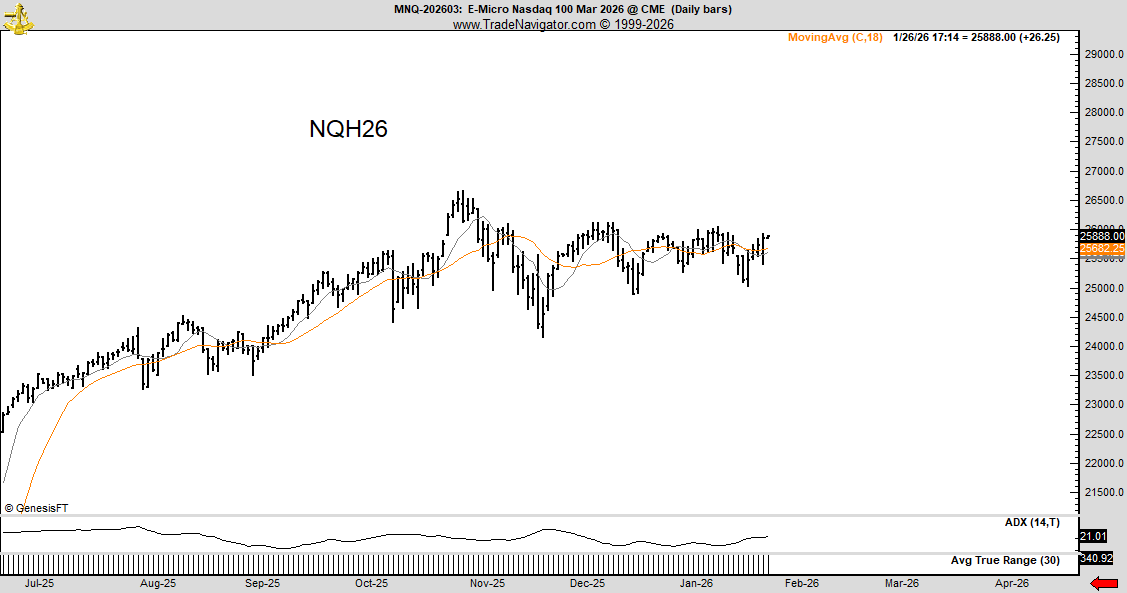
NASDAQ $NQ_F
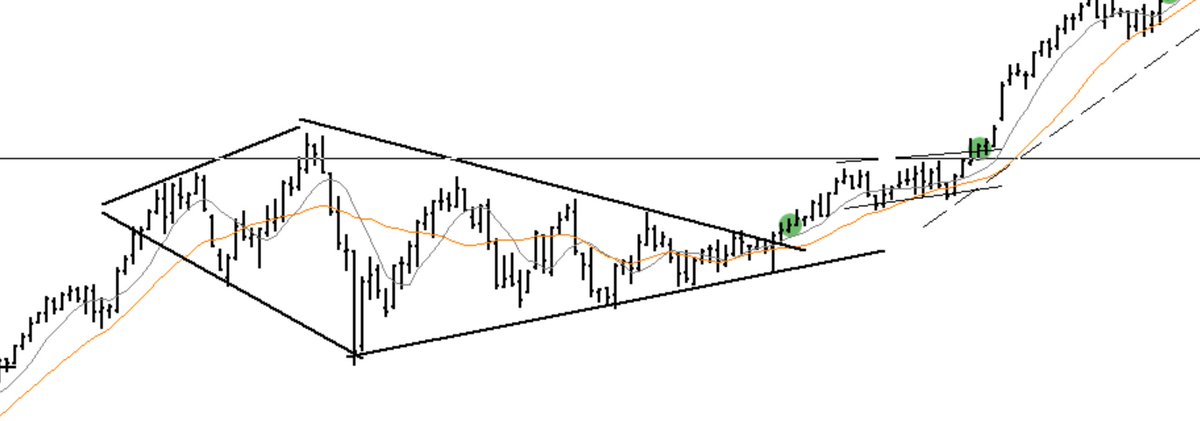
I've seen this structure before in recent years (right chart)
The coordinated activity of whales can leave breadcrumbs
Detecting the crumbs is what classical charting principles are all about