INSANE CALL
Here’s how I saw the warning signs. Save this. It will save you THOUSANDS.
Here’s how to spot a top BEFORE you blow your account.
I posted the warning about memory stocks topping.
Now look at the monthly declines:
$DRAM: −19.95%
$SNDK: −20.94%
$SKHY: −22.45%
1. START WITH THE SECTOR
Everyone was chasing memory stocks.
I checked $DRAM first. The ETF was rejecting major WEEKLY resistance.
That was my warning to stop chasing.
2. CHECK THE LEADERS
$MU, $SNDK and $SKHY were running into resistance too.
When the sector AND its leaders are struggling at the same levels, pay attention.
3. MAKE THE BREAKOUT PROVE ITSELF
Break resistance.
Retest it.
Hold above it.
Until that happens, you’re buying below a level sellers keep defending.
4. WATCH THE DAILY 8/21.
Weekly resistance gives me the warning.
The daily 8 EMA crossing BELOW the 21 EMA confirms the bearish trend in my system.
Then I look for a retest and rejection to enter.
Ride the move lower while the trend holds. Define your risk above the rejection.
The same stocks everyone chased up can become the trades you ride down.
Stop trading stocks in isolation.
Check the sector. Mark the level. Follow the trend.
Wait for my call again. Together we will get RICH.
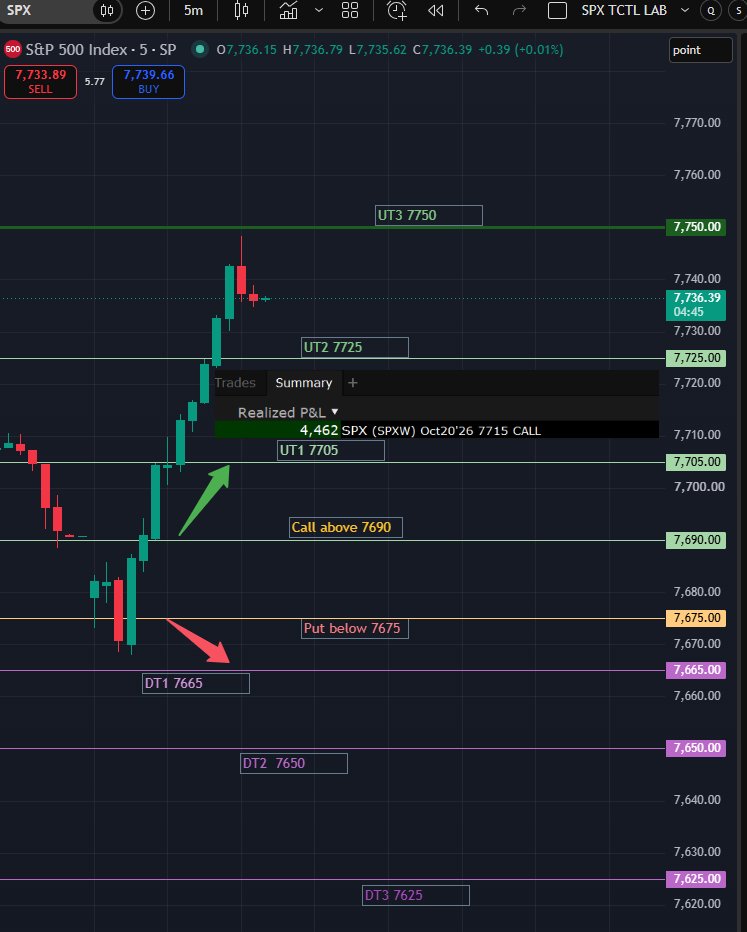
HOW I MADE $4,462 IN JUST 30 MINUTES! ($SPX)🎯🔥
I know some traders made good money on PUTS today. But what did I do? I waited for Sniper's Levels!
1. 9:50 AM: SPX broke above our call trigger with FORCE.
2. 9:55 AM: Perfect confirmation candle! I entered slightly early, anticipating the move based on other SPX mechanics. That single candle paid beautifully!
3. UT1 held: ATM volatility started falling. I alerted X that we were STILL in a bullish environment, added more 7715 calls, and rode the next push!
What actually happened?
As SPX cleared each level, fresh market-maker buying pressure likely helped accelerate the upside momentum. My 7715 calls started at $5.20 and eventually reached $38! That's over 7X from my initial entry price!
I kept trading the SAME strike. Why? Faster execution! Buy, sell, repeat. You can absolutely choose different strikes.
The lesson? These explosive moves don't happen every day. But when levels, price action, and options mechanics align, you MUST be prepared to capitalize!
That's why we study the mechanics, not just candles!
Thanks for riding with me ya'll.. hope you caught something I did my best to alert as fast as I could.
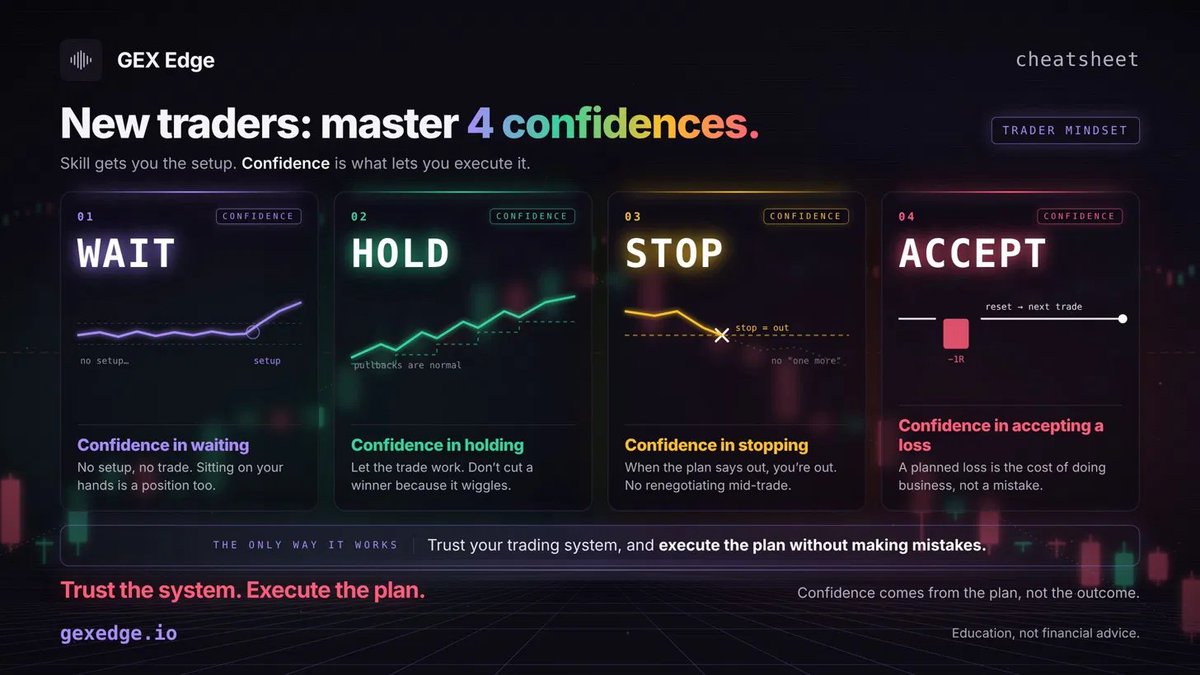
Advice for every new trader. Focus on these 4 things:
1. Confidence in waiting
2. Confidence in holding
3. Confidence in stopping
4. Confidence in accepting a loss
The only way this works is if you trust your trading system and execute the plan without making mistakes.
Stop overcomplicating trading!
Do this instead:
• Start on a demo account so you can practise without risking real money
• Open the 15-minute chart, where each candle shows 15 minutes of price movement
• Look for price breaking a recent high or low to help choose your direction
• Mark the area where that strong move began
• Set an alert so you know when price comes back
• When it returns, open the 1-minute chart for a closer look
• Use the 5-minute chart if the 1-minute moves too fast
• Wait for price to start moving in your planned direction before looking for an entry
• Decide how much money you’re willing to lose before entering
• Set your stop-loss, the price where you’ll exit if the trade goes wrong
• Place it just beyond the area you marked
• Set your profit target at twice your risk, such as risking $10 to aim for $20
• Skip the trade if it doesn’t meet your rules
• If you miss the entry, wait for another chance
• After each trade, record what happened and whether you followed your plan
• Review many practice trades before deciding whether your approach works
You don’t need to catch every move to learn how to trade.
The biggest tax secret of the rich:
Never sell your winners.
Dad buys $TSLA $NVDA $AMZN $META at $150K total.
Portfolio explodes to $8M.
Selling = multi-million tax bill.
He never sells.
Puts the growth stocks in a trust.
Borrows against $TSLA $NVDA $AMZN $META.
Lives off the loans. Zero capital gains tax.
Dies holding everything.
Kids get $8M stepped-up.
IRS gets $0.
This is how generational wealth is actually built.
If this helps you, like + follow + share.
All my buy and sell signals in Discord!
(NFA — DYOR)
IF YOU DON'T UNDERSTAND BONDS, YOU DON'T UNDERSTAND STOCKS.
Bonds explain why the market falls on good news, and why "cheap" stocks keep getting cheaper.
Here's the simple version, no finance degree needed ↓
If I woke up 25 again, I'd split my money across 9 no brainer ETFs:
VTI - Own every US company.
GOVT - Sleep-at-night money.
QQQM - Tech without the fees.
SCHD - Get paid while you wait.
VEA - Diversify outside America.
VNQ - Real estate without tenants.
AVUV - Small caps market ignores.
DGRO - Dividends that grow yearly.
QUAL - Companies that don't go bankrupt.
No more research just fewer excuses.
🚨 Ray Dalio Warns “Something Has to Prick the Bubble” and It’s Coming
Ray Dalio warned the exact playbook: you need a shock (oil + tariffs + “geopolitics”) to force rate hikes and trigger the outflows that pop the overvalued market.
That’s exactly how Covid started. First the warnings. Then the event. Then the printing.
In 2019 the repo market seized. Cash disappeared from the collateral system. Overnight rates spiked to double digits. Banks were one broken funding market away from a full freeze. The Fed had to inject cash for the first time since the last crash.
Then Covid hit and they printed trillions. The financial system was already dying. The pandemic bought them time.
It’s the textbook script for engineering the next crisis while they load up on cash and undervalued assets.
Japan’s @yutokanzakireal warned that the “allies”, which is the U.S., is finding a scapegoat like AI, cyberattacks or oil crisis to collapse the current economic order.
All financial crises are engineered by the central banks, IMF, BIS and G-SIBs.
They’re planning something far bigger this time because the condition is worse, not better.
This is fascinating from Ray Dalio.
Gold ETFs currently account for 87% of his portfolio.
As he likes to say:
“If you don’t own gold, you know neither history nor economics.”
https://t.co/0SLCQL0mMP
I interviewed a billionaire investor whose fund was up over 4,000% while the S&P did 47% in the same time.
Jim Rogers shared 8 shocking insights every retail investor needs to hear to protect and grow their wealth.
1) Inflation’s here and it's only going to get worse.
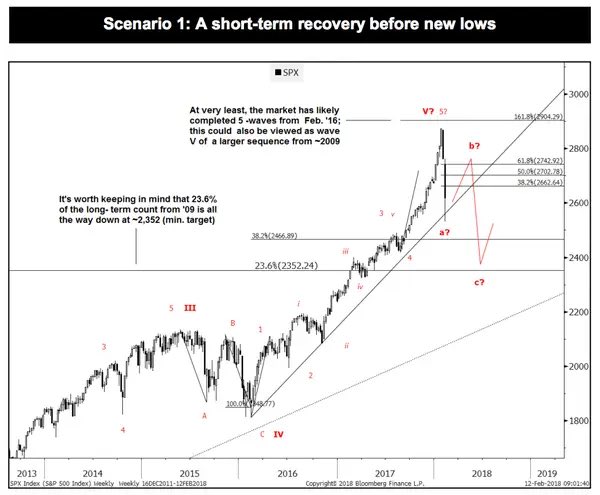
Remember this, Goldman Sachs traders use wave counts and technical analysis.
I will make sure you become rich with my knowledge.
Let’s get to $10M together.
I started with $50.
Now I can make $5,000 on a single trade.
It took me years of blowing up accounts to figure it out.
So I decided to teach my brother the shortcut…
Here’s the exact plan I gave him (& how you can copy it too):
There's a lot of speculation around an incoming SpaceX and Tesla merger
Here's 8 ways both companies BENEFIT IF it happens:
1. Investment-grade debt instead of private credit
$TSLA has $43.5B of cash and did $4.7B of operating cash flow last quarter. $SPCX is seeking $40B of debt just for NVIDIA chips and Morgan Stanley estimates it needs ~$84B of outside capital per YEAR through 2034
A combined company funds this with cash flow and investment-grade debt instead of private credit. Saving even 2-3 points of interest on $40B is $1B+ a year, and that compounds across the entire buildout
2. Starlink replaces cellular in every Tesla
Today, carriers collect an estimated $10/month per connected car, a large % of the total Tesla charges. Moving this in-house to Starlink not only means 100% of revenues moves in-house, but also a better product with (eventually) no dead zones
3. Starlink for Robotaxi and Humanoid Robots
Cybercabs are already getting built with Starlink inside them, a merger would mean this can come with no additional cost/sale required between the companies
4. Compute at cost and better optionality
Tesla has its own training compute today, which doubled in the first half of 2026, but FSD, Robotaxi and Optimus are only just getting started and they will need a LOT more compute
SpaceX is already building this out at size with 10GW expected by EOY 2027. Rather than leasing this to Tesla at market prices ($30M/MW ish right now), Tesla's extra demand can simply run on SpaceX compute at cost
SpaceX also now has more optionally with their compute. To move between leasing, using for Grok or now using for Tesla products
4. Energy at cost
Tesla deployed 13.7 GWh of energy storage last quarter and xAI/SpaceX is one of Tesla's biggest customers ($430M of mostly Megapack revenue in 2025).
Merged, the data centers get Megapacks at cost with guaranteed supply, and yes, that intercompany revenue disappears in consolidation, but it's a wash since it's saved as an expense on the other side
5. Terafab gets built FASTER
Terafab today is a joint venture between two separately owned companies, so every major decision crosses two boards, two capital committees, and negotiated cost-sharing agreements.
Merged, one owner makes the call and capital moves the same day. Construction starts in December, and that speed advantage compounds through every phase after the first $16.8B. Elon's whole edge is iteration speed, and a JV structure is the opposite of that
6. Killing the duplicate overhead
Two public companies means two of everything: two legal departments, two HR orgs, two finance and audit functions, two IR teams, two procurement groups buying from the same suppliers.
Combined SG&A is about $11.2B. Cutting 15-25% of the ~$3.4B corporate slice of that is about $0.5-0.9B a year (est). Not the headline reason to merge, but still useful
7. A potential tax arbitrage
SpaceX's AI buildout generated $3.7B of losses in the first half alone
Merged, those losses offset Tesla's taxable profit at the 21% corporate rate, worth roughly $0.3-1.0B a year
Though looks like SpaceX is soon going to generate a profit, so this may be irrelevant after next earnings
8. Combined Data for Training
Tesla's fleet generates real-world data, X and Grok have additional data and SpaceX has its own data. Currently Tesla and SpaceX data are separate and have corporate boundaries and conflict disclosure issues
Once merged, this can all be combined for more data, all in one place, trained across the same GPU clusters
And of course big picture, there is plenty of overlap across all of SpaceX and Tesla products, so having it under one roof means they can build for a more seamless future (see my post below for more details on this)
What else am I missing?
Also, I remain bullish on both of these companies and both have a spot in my Milk Road PRO portfolio. You can see my entire portoflio here: https://t.co/NyRpAKYOwu
Tesla–SpaceX: The Work to Announce a Merger Could Already Be Done
Tesla and SpaceX could absolutely have completed the work required to announce a merger by now. The central mistake I see in much of the timing commentary is a failure to distinguish the preparation needed to reach a definitive agreement from the substantially longer process required to complete the transaction. These stages have different requirements, dependencies and constraints. Most importantly, the longest and least controllable parts of the process occur after signing. Understanding that distinction fundamentally changes how an announcement timeline should be assessed.
One of the first things I did when tackling this problem was establish a conceptual framework of the entire merger process, from initial consideration through closing. I separated it into distinct phases: pre-announcement preparation, signing and announcement, announcement to shareholder vote, and vote to closing. I then examined what must be completed at each stage, which activities can proceed simultaneously, and where the actual bottlenecks arise. Once that framework is established, game theory and strategic reasoning can actually become useful. You can assess the incentives of the parties involved, their relative leverage, what they can accelerate, and the consequences of waiting. Without that foundation, projecting an announcement date becomes little more than speculation about how long a complicated transaction should take.
The clearest place to examine this distinction is the pre-announcement window. Bloomberg reported consideration of a Tesla–SpaceX combination on January 29, 2026, roughly four and a half months before SpaceX's June IPO. Although that doesn't establish when formal negotiations began, both companies could have used that period to retain advisers, conduct diligence, develop valuations and transaction structures, and assess the regulatory and security requirements. A transaction of Tesla's magnitude advancing toward a definitive agreement would have raised significant IPO disclosure considerations, making post-IPO signing strategically understandable. But the IPO did not prevent substantive preparation beforehand, nor did it reset the clock on work already completed. The companies have had roughly four and a half months before listing and another four months afterward to advance the transaction and reach an executable agreement. Anyone ruling out an announcement now needs to identify the specific pre-signing obstacle that could not already have been resolved, rather than treating the IPO as though it erased months of available preparation.
Consider what actually needs to happen before signing. Independent negotiators must evaluate the economics, advisers must conduct reciprocal diligence, lawyers must establish the transaction structure and terms, and specialists must assess regulatory, security and contractual risks. The companies also need appropriate corporate authorizations and a defensible allocation of the remaining execution risks. This is substantial work, but much of it can proceed in parallel. Financial analysis does not need to finish before lawyers begin drafting, nor must every regulatory question be definitively resolved before the companies can negotiate how to address it. With dedicated teams and coordinated decision-making, these workstreams can advance considerably within months.
The objective is to reach an informed, executable agreement that both sides can authorize. It is not to complete the entire merger before announcing it. Final regulatory approvals, shareholder authorization, security arrangements and numerous closing deliverables can remain outstanding, provided the agreement properly addresses those requirements and the risks they create. A fundamental valuation disagreement or an unacceptable structural issue could certainly prevent signing, but those are specific negotiating obstacles. They are not evidence that the preparation phase inherently requires another year or more.
China is a useful example. My base case remains that Tesla becomes a SpaceX subsidiary, with Tesla China retained beneath Tesla and appropriately separated from sensitive SpaceX operations. This requires serious diligence concerning data, intellectual property, government contracts, security restrictions and applicable Chinese approvals. Before signing, the companies need sufficient confidence that the proposed structure is workable and a clear contractual framework for addressing the remaining risks. They do not need every final clearance or implementation requirement completed before entering the agreement. Those processes can continue alongside the shareholder approval process and, where necessary, beyond the vote. An analyst citing China as an obstacle to an early announcement needs to identify what specifically prevents signing, rather than pointing to a regulatory process that can continue afterward.
The announcement-to-closing phase is where the distinction becomes especially important. Following signing, the companies must complete the applicable SEC registration and disclosure process, satisfy shareholder notice requirements and obtain the necessary approvals. Meanwhile, antitrust investigations, foreign regulatory reviews, security negotiations and contractual consents can proceed concurrently. The shareholder vote is another milestone within this process, not necessarily its conclusion. Required clearances can remain outstanding after shareholders approve the transaction, delaying closing without automatically requiring another vote.
This is where the longest delays can occur, precisely because the timeline becomes substantially less controllable. A U.S. antitrust second request, for example, requires the companies to respond to an actual regulatory investigation before the subsequent waiting period can begin. Preparing documents in advance is useful, but it cannot substitute for the investigation itself. Some formal filings can begin before definitive signing under qualifying circumstances, yet private preparation alone does not start the relevant review periods. Regulatory authorities determine the course of their investigations, and the companies cannot simply accelerate those decisions by assigning more internal resources.
Broadcom's acquisition of VMware illustrates the magnitude of this distinction. The merger agreement was announced on May 26, 2022, shareholders approved the transaction on November 4, 2022, and closing did not occur until November 22, 2023. Approximately eighteen months elapsed between announcement and closing, including more than a year after shareholder approval. The companies had already negotiated and announced their agreement, obtained shareholder authorization and still faced a prolonged period before completing the transaction. This demonstrates why understanding where time is consumed matters enormously when evaluating whether an announcement can occur sooner.
There is also a strategic cost to delaying execution. An eighteen-month signing-to-closing scenario beginning in November 2026 reaches May 2028. The same scenario beginning in August 2027 reaches February 2029, beyond the January 20 presidential transition. That eighteen-month duration is an extended-review scenario included in my timeline, not a mandatory completion period. Nevertheless, delaying signing by nine months sacrifices nine months of execution time before a potentially significant change in the political and regulatory environment. An earlier agreement provides substantially more room to absorb prolonged investigations, additional information requests and difficult remedy negotiations. The possibility of an extended review therefore strengthens the incentive to begin formal execution sooner.
This is why I find the projections from analysts expecting an announcement in H2 2027 particularly difficult to reconcile with the actual process. From the initial January reporting, that would imply approximately seventeen to twenty-three months before a definitive agreement is announced. Even starting the clock after SpaceX's June IPO, which was not legally necessary for preliminary preparation or negotiations, that still leaves roughly thirteen to nineteen months. What specific pre-signing requirement justifies that much time? Is there an identifiable structural obstacle, an unresolved economic disagreement, or a strategic advantage to waiting that outweighs the cost of delaying execution? Those are the questions a credible timing forecast needs to answer.
I see enormous attention devoted to refining Tesla DCF projections and long-term valuations, yet comparatively little detailed analysis of the transaction mechanics and strategic incentives surrounding one of the most consequential catalysts in Tesla's history. Valuation is essential to determining acceptable terms, but it does not establish how long the pre-announcement phase must take. Analysts who use the complexity of obtaining regulatory approvals and completing the merger to dismiss an earlier announcement are assigning the most time-consuming requirements to the wrong stage of the process. That is a fundamental analytical error, not a minor disagreement over dates.
This brings us to the strategic incentives of the people involved. Elon has considerable influence over the direction and priorities of both companies, even though independent negotiations and corporate approvals remain essential. More fundamentally, I see him as a builder whose overriding objective is to accelerate Tesla and SpaceX toward achieving their respective missions. If bringing these businesses together advances those objectives, every unnecessary month of delay carries an opportunity cost. Understanding that motivation is essential to evaluating why he would favor accelerating the transaction once acceptable terms and a workable structure are established.
The companies have had ample opportunity to prepare an executable agreement, including before SpaceX's IPO. The burden is on those dismissing an early announcement to explain what specifically prevents it. The complexity of completing this merger is not that explanation. If anything, it's a compelling reason to get the process underway sooner.
$TSLA
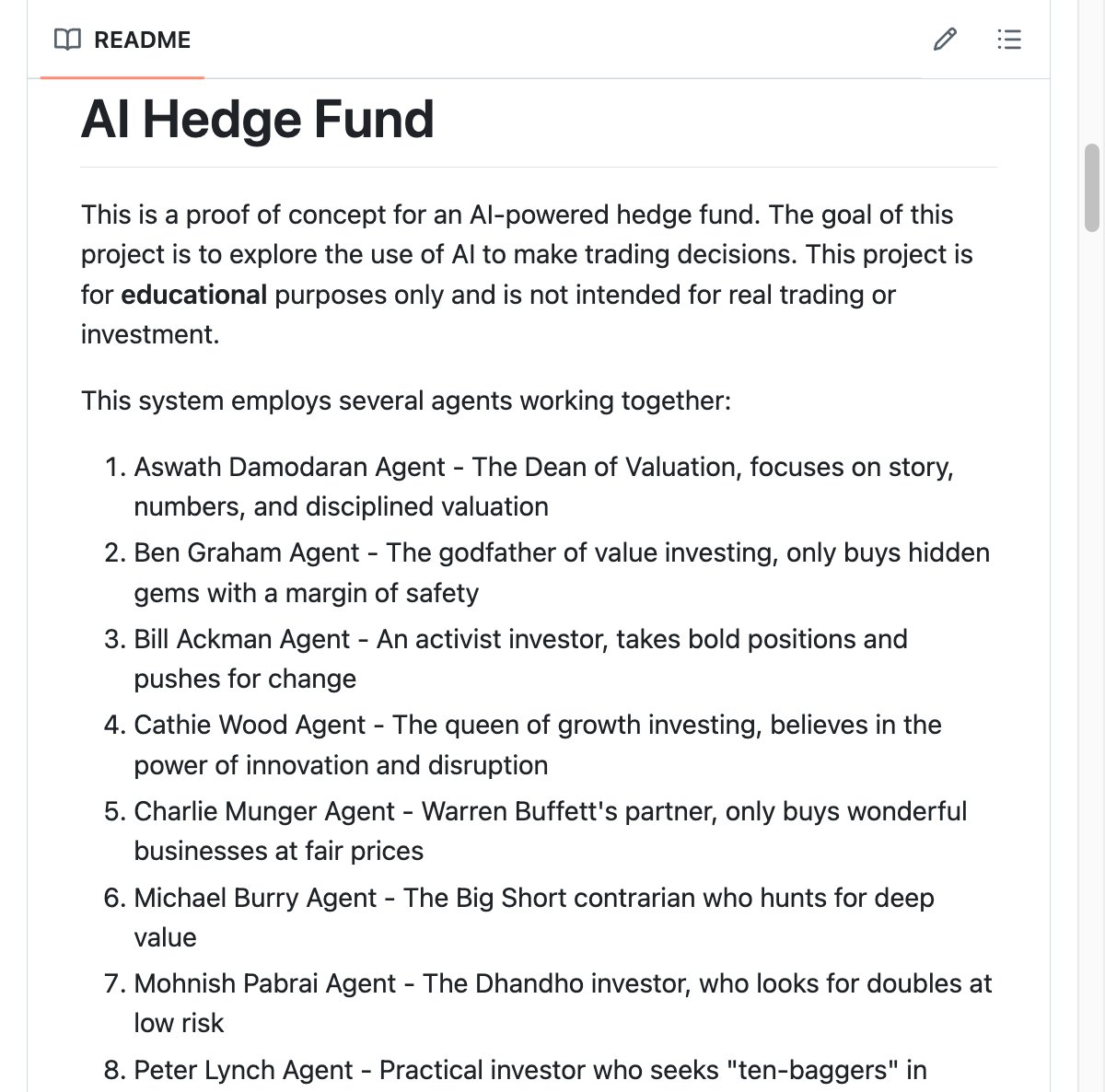
🚨 Someone just open sourced an AI hedge fund with 18 agents that think like Wall Street legends.
Warren Buffett. Charlie Munger. Michael Burry. Cathie Wood. Bill Ackman. All running on your laptop.
It's called AI Hedge Fund. You give it stock tickers. 18 AI agents analyze the company from every angle. Then they vote on whether to buy, sell, or hold.
Not a toy. Not a dashboard. A full multi-agent investment research system.
No Bloomberg Terminal. No $25K brokerage minimums. No financial advisor fees. Just AI agents doing what hedge funds charge 2-and-20 for.
Here's who's on your team:
→ Warren Buffett Agent. Only buys wonderful businesses at fair prices
→ Charlie Munger Agent. Demands a margin of safety on every pick
→ Michael Burry Agent. The Big Short contrarian hunting deep value
→ Cathie Wood Agent. Innovation and disruption. High conviction growth
→ Bill Ackman Agent. Activist investor. Takes bold positions
→ Ben Graham Agent. The godfather of value investing. Hidden gems only
→ Aswath Damodaran Agent. The Dean of Valuation. Story meets numbers
→ Plus 11 more specialized agents covering technicals, sentiment, risk, and fundamentals
Here's how it works:
→ You enter stock tickers (AAPL, NVDA, TSLA, whatever you want)
→ Agents pull real financial data. Earnings, balance sheets, insider trades, news
→ Each agent analyzes the data through their own investment philosophy
→ A Risk Manager agent checks position sizing and portfolio exposure
→ A Portfolio Manager agent takes all signals and makes the final call
→ You get a buy/sell/hold decision with full reasoning from every agent
Here's the wildest part:
You can turn on --show-reasoning and watch each agent explain their logic step by step. Warren Buffett agent breaks down the moat. Michael Burry agent flags the hidden risks. Cathie Wood agent finds the disruption angle. They literally argue with each other.
It has a full backtester. Run your strategy against historical data and see how it would have performed.
Full web UI included. Not just a terminal tool. A real dashboard.
Works with OpenAI, Claude, Groq, DeepSeek, or fully local with Ollama. Your data never has to leave your machine.
Data for AAPL, GOOGL, MSFT, NVDA, and TSLA is completely free. No API key needed.
46.7K GitHub stars. 8.1K forks. Actively maintained.
100% Open Source. MIT License.
Before your PARENTS turn 70, CHECK these 7 things.
Save this CHECKLIST. Share it with your siblings. And start the conversation with your parents this week.
A trader from Hong Kong made 969.8% in one year and won the 2025 U.S. Investing Championship.
His go-to setup risks just 0.5% of his account per trade.
Small mistakes. Big winners.
Here's the 4-step playbook ↓
🚨Big Breaking: TradingView just moved its AI inside the chart itself.
No extension. No setup. It reads your chart and does the clicking for you.
Here are 7 things it can do for a swing trader ↓
A lot of new followers this week, so I wanted to share something a little different than my $Iren thoughts.
This selloff has felt different from what I'm used to. Fundamentally, nothing has changed for me. I've been steady on the value of AI, and I've spent a lot of time thinking through the value chain and where the value sits at different points in the cycle. But this one was humbling, to say the least. I felt like I was just hitting a stride: going deeper into my names, ranking them against each other, and pushing my analysis further than I had before.
So I did what I think you're supposed to do in a market like this. I went back to the work, stress-tested my assumptions, and repositioned into what I think has the best risk/reward. As you can probably tell, one of those names for me is $IREN.
The biggest lesson for me: you can't do this alone. The learning process only works if you stay open to other people, especially in harder markets when it's easiest to dig in. There are a lot of good people on here, but these are some names I've been reading a lot lately and whose thinking I integrate into my own. Each of them has real strengths, and I consider them voices of reason:
@kevin__mak@GavinSBaker@damnang2@liamdaltonjr@NickNemo17@801010athlete@ethanrkho@TMTLongShort@blondesnmoney@jiahanjimliu@ThematicTrader@Lihong062@FundaAI@JaredKubin@hiteshkar
If you're new here, give them a follow. I've learned a ton from all of them, and from plenty of others too. If there's something you particularly want to learn more about, I'm happy to connect and have a conversation and/or point you the right way. One of my favorite parts of investing is the self-growth.
I'll keep sharing my analysis on the names I follow. Putting it out there and having people push back is the best way I know to pressure-test my thinking and get closer to the right answer.
Looking forward to getting back to it tomorrow.
I think posts like this matter for growing the community here. Honestly, it's been upsetting to see so much misinformation and negativity spreading during this selloff, and showing the work in the open is the best answer I know to it. The X community has been a big part of my own growth, and I want to hopefully give some of that back.