THE PERKINI REPORT: THE 2028 REALITY CRISIS
What if the most obvious financial bubble in all of history turns out to be.... a bubble... and what if that is just really.... bearish?
there were signs, there are always signs 🤣
free link:
https://t.co/NB7rGw3PJP
inspired by @citrini
Hedge Fund Manager David Orr (@orrdavid) on why he’ll back a delivery guy over a Harvard grad, as long as the track record is real.
David Orr runs Militia Capital, a ~$480M hedge fund. ~50% annualized, Sharpe 2.
“If you didn’t go to Harvard, they’re not going to give you money. They’re gonna lead you on for years.”
We cover:
- Edge is just reps. He's placed a few hundred independent bets every year since 2019, more in one year than a lot of hedge fund managers get in a decade.
- The two-hour rule: if he can't decide on a stock in an hour or two, he skips it. When a trade goes against him, he quits. "The market said I'm wrong, I'm wrong."
- 500 positions in his partition and zero notes. Some of his best shorts are down 40% and he's forgotten what the company does.
- The Gogo lesson: he spent 100 hours on a short and was right on the fundamentals (it's now $2), but it ripped to $20 first. All that research made him stubborn on the way up.
- The AI risk system: it groups the book into custom baskets like "Banks Done Right" and "yield traps," recalculated daily. A 25% bet can quietly become 45% in two weeks.
- How Militia recruits PMs: 95% of track records are junk, and one cherry-picker ran 30 accounts and sent the best one. The PMs who make it include a game show winner, a Spanish government worker and a programmer, with 0.15 cross-correlation.
- The best short seller in the world, quietly: 40% a year short only for years, and he still gets a tiny allocation at his fund.
- Why multi-managers' real business is marketing. Collect $2B a year in fees on $100B and it's "mission accomplished," whatever the returns.
- The long/short tax trick: harvest losses on losing shorts, and never cover one that's down 90%. No tax is due until it's delisted, which can take 10 years.
- $150M raised from one email asking LPs for $100M. He says he could raise a billion but won't, and admits they "must have gotten at least somewhat lucky."
- His AI stock map: hyperscalers locked customers into take-or-pay deals at ~35% return on capital. If compute prices crash 80%, the end customers get wiped out, not the hyperscalers.
- Is investing 99% talent? For big alpha, almost entirely. Pod shop alpha is teachable, maybe for 1 in 50 people rather than 1 in 10,000.
Highlights:
00:00 Intro
00:44 How AI custom factor baskets track dynamic correlation in levered portfolios
03:24 Sourcing non-consensus PM talent and verifying live Sharpe track records
07:24 Structuring carry and tax deferral to attract elite proprietary traders
12:50 Why institutional multi-manager platforms fail to back pure alpha
20:22 The two-hour research limit: Avoiding sunk-cost bias in short selling
27:58 Momentum screening vs deep value: Why top longs hit new highs
29:40 Why traditional finance books fail and what operator biographies teach
37:16 Why rapid technological adaptation beats traditional economic moats
39:26 Analyzing the AI trade: Why hyperscalers offer superior downside protection
44:57 Internalizing stock borrow desks to maximize net-of-fee fund compounding
55:25 Avoiding confirmation bias and why shorting revenue growth fails
01:01:42 Pod shop leverage factories vs raw discretionary alpha generation
01:07:12 Unplugging from market narrative feeds to preserve independent conviction
Stanley Druckenmiller says Duquesne correctly positioned for the last four recessions - and the fund’s returns going into them were consistently above its long-term average: “the best economist I know is the inside of the stock market”
this is him explaining why he watches what’s happening beneath the index instead of relying on headline economic data. cyclicals, banks, autos, housing and small caps can start weakening months before the broader market makes the slowdown obvious
Druckenmiller says some of his biggest bear-market gains didn’t even come from shorting stocks - they came from buying Treasuries when growth was breaking down, because falling rates gave him a cleaner way to express the same macro view
bookmark & watch the full breakdown below
Warren Buffett: “If you find 3 wonderful businesses in your life, you’ll get very rich…”
“If you look at how the fortunes were built in this country, they weren’t built out of a portfolio of 50 companies. They were built by someone who identified a wonderful business.”
$SPCX will disrupt 5-8 industries all at once.
It will 100x-200x by 2035 when Elon Musk...
Disrupts these industries 1 by 1:
Communications
1. $IRDM — Satellite communications. Benefits from global connectivity expansion.
2. $ASTS — Space cellular networks. Accelerates satellite-phone adoption.
3. $GSAT — Satellite spectrum owner. Valuable in space communications.
Mobile Phones
1. $QCOM — Smartphone chips. Powers direct-to-cell satellite connectivity.
2. $AAPL — iPhone ecosystem. Satellite features become standard worldwide.
3. $GOOG — Android ecosystem. Space-based connectivity expands reach.
AI Infrastructure
1. $NVDA — AI compute leader. SpaceX needs massive AI processing.
2. $MU — AI memory leader. Every AI cluster needs memory.
3. $AVGO — AI networking chips. Connects hyperscale AI systems.
4. $MRVL — Data center silicon. Critical for AI networking.
Space Economy
1. $RKLB — Launch + satellites. Benefits from expanding space economy.
2. $RDW — Space manufacturing. More missions create more demand.
3. $LUNR — Lunar infrastructure. SpaceX enables Moon commercialization.
4. $BKSY — Earth observation. More satellites increase data demand.
Cloud & Data Centers
1. $EQIX — Data center landlord. AI and Starlink drive demand.
2. $VRT — Data center cooling. AI infrastructure needs power.
3. $ANET — AI networking gear. Connects next-generation AI clusters.
Energy
1. $CEG — Nuclear power. AI data centers need electricity.
2. $ETN — Power infrastructure. Supports AI and data centers.
3. $PWR — Grid expansion. Needed for massive compute growth.
Remember this:
Starlink = cash flow.
Starship = transportation.
AI = compute layer.
When Elon Musk executes, SpaceX becomes:
📡 Telecom
☁️ Cloud
🤖 AI
🚀 Space Infrastructure
⚡ Energy Demand Driver
The biggest public beneficiaries may be:
$MU $NVDA $AVGO $MRVL $QCOM $RKLB $ASTS $VRT $EQIX $TE
♻️ RESHARE this post and reply 1 comment, I'll DM you price I'll get $SPCX and hold it for 10 years.
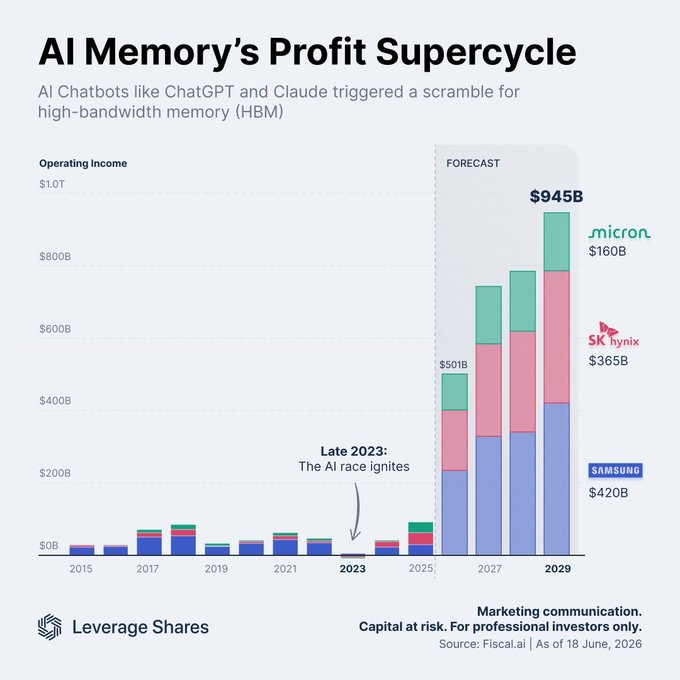
AI memory is turning into one of the biggest profit pools in the entire semiconductor stack.
HBM has genuinely converted memory into qualification-gated AI infrastructure with $MU, Samsung and SK Hynix expected to generate nearly $1T of operating income by 2029.
QVR quant models set relied on historical correlations. Sounds like how LTCM blew up in 1998. #1 rule in leverage finance - correlation goes to 1 when sh!t hits the fan.
“LTCM assumed markets would behave “normally” and correlations between assets would stay relatively stable.”
Bill Ackman says diversification protects you when you don’t fully understand what you own but concentration becomes an edge when you do.
Once your best ideas get diluted, outperforming gets a lot harder which is why his top 3 to 4 positions make up ~50% of the portfolio.
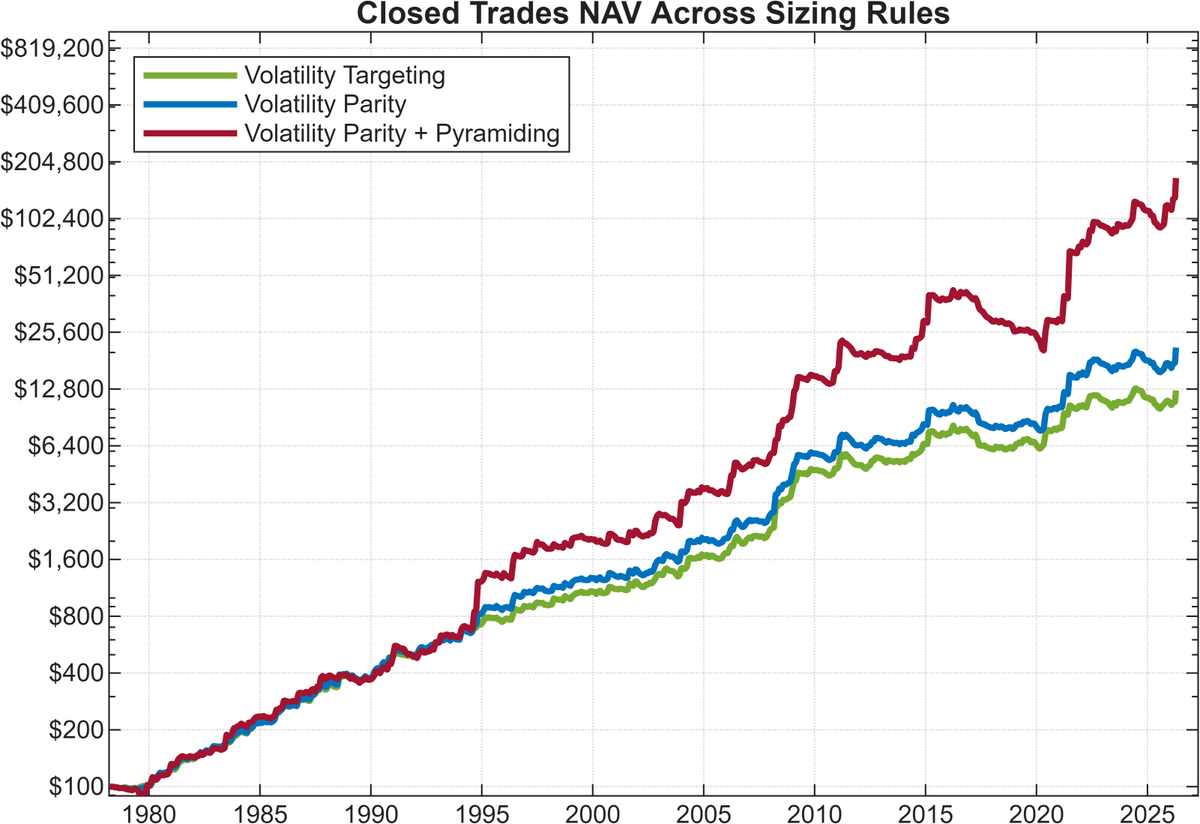
How should you size your trend trades?
If you run a trend-following strategy, you already know that signals are only part of the story.
What really drives outcomes is everything that comes after, and position sizing sits at the center of it all.
In this new research piece, we analyze different sizing approaches used by well-known trend-following investors, from Mulvaney to Quantica, from AQR to @basso_tom.
The right approach may not be absolute, but strictly dependent on your observation perspective.
Read the full article 👇
@jackschwager@RichB118@Covel@GaryAntonacci
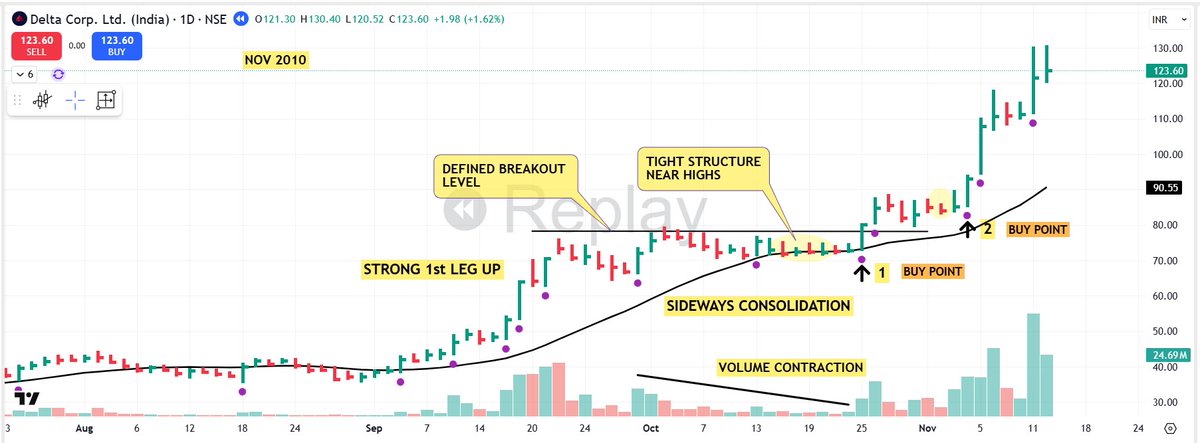
📌Most traders settle for “okay” setups. Big mistake.
I only trade 5 Star setups — here’s what they look like👇
1⃣Tight Structure Near Highs –
Price action is calm and controlled, sitting just below breakout levels.
2⃣Defined Breakout Level –
A clear spot where buyers must show up. No guessing.
3⃣Sector & Story Strength –
In sync with hot themes or a clear catalyst.
4⃣Volume Clues in the Base –
Multiple up-days with 1.5–2x average volume. Funds are already interested.
5⃣Asymmetric Reward –
Potential for +50–100% with limited risk.
I study these patterns daily and only act when the market gives me one.
Most traders look at one thing -- the chart. Clement Ang stacked five.
The 2025 USIC top performer (150%+ in the Million Dollar Division) built his biggest trade of the year on Ethereum by layering relative strength, group strength from Bitcoin, commitment of traders showing max short positioning, volume dry-up in the base, and a clean technical setup.
He risked a full percent of his account. Beginners trade setups. Championship-level traders trade confluence.