A take on "Vibe managers" and a hidden talent pool that no one ever knew existed
I was reading the new BCG study today (about enterprise AI adoption and how it doesn't necessarily improve efficiency yet) and had an idea I wanted to share
There's a lot of buzz about how AI improves enteprise efficiency, yet most people are spending the same or even more time managing AI agents instead of doing actual work, making the advantages unclear.
However, there is a different perspective to consider: by forcing people to manage agents, even in low-level jobs, we can identify managerial talent early and promote people much faster.
Many introverted individuals do not think of themselves as good managers, yet they manage their agents exceptionally well.
Developers who are autistic (a great trait for systematic thinking) or introverted may not want to manage other people, but they excel at task/goal structuring and giving clear directions to agents. This allows us to spot that talent early.
We could then adapt interfaces to help these individuals manage humans as well. Instead of requiring high emotional intelligence or soft skills for communication, these "Vibe-Managers" could serve as highly effective orchestrators for both AI and human management. The communication-facing role would simply be handled by someone else, similar to how Forward Deployed Engineers (FDEs) close the client-developer gap.
Example:
A junior developer is exceptional at managing AI agents and makes extraordinary progress on development work, but has low soft skills and finds direct communication overwhelming. This person could write highly efficient management directives, splitting the tech lead role with a second person who excels at communication (joining calls and explaining things to the team). The orchestrator is the junior developer, who proved great at building management structures.
In this model, a manager, tech lead, or CTO role is split between 2 or more people - or even between a person and an agent that handles the communication and soft-skill layer.
While an AI clone of a leader (such as Meta's internal AI clone of Mark Zuckerberg) might seem like a gimmick that can never replace a real person, it could actually be the first step toward solving the interface and soft-skill problem between a highly introverted, talented vibe manager and their direct subordinates. Perhaps AI clones may not be such a bad idea after all...
https://t.co/Y6XASsAbAd
One question I get a lot is whether privacy will just be a fad like all other narratives in crypto. The answer is NO. It's here to stay, because it's needed for global adoption of blockchain, whether in finance, governments and elsewhere. Confidential blockchain transactions will follow the same adoption curve as HTTPS, with 95% of transaction eventually encrypted with FHE.
📣🚨 BAT SIGNAL: A law in France that would mandate a backdoor in end to end encrypted communications is set for a vote within the next day, after some start-stop skirmishes.
The French Narcotraffic law would require encrypted communications providers—like Signal—create a backdoor by giving the government the ability to add themselves to any group or chat they like. In the name of (checks notes) fighting drug trafficking.
While those hyping this bad law have rushed to assure French politicians that the proposal isn’t’ ‘breaking encryption’ their arguments are as tedious as they are stale as they are laughable. For those catching up, let’s review the basics: end to end encryption must only have two ‘ends’—sender and recipient(s). Otherwise, it is backdoored. Whatever method is devised to add a ‘third end’ —from a perverted PRNG in a cryptographic protocol, to vendor-provided government software grafted onto the side of secure communications that allow said government to add themselves to your chats—it rips a hole in the hull of private communications and is a backdoor.
Indeed, the ghost participant proposal was roundly rebuked (humiliated, even) when it was first proposed in 2019 in the UK. The technical community was united, and it was never implemented in law or otherwise.
We cannot accept any backdoor, however it’s dressed up. Communications don’t stay within jurisdictional boundaries. Which means a hole created in France becomes a vector for anyone wanting to undermine Signal’s robust privacy guarantees, anywhere. Instead of contending with unbreakable math, they only have to compromise a French government employee, or the vendor-provided software used to sideload government operatives into your private chats.
This is why, as always, Signal would exit the French market before it would comply with this law as written. At this moment especially, there is simply too much riding on Signal, on our being able to forge a future in which private communication persists, to allow such pernicious undermining.
We hope—WE HOPE—that this callow, dishonest attack will fail, and will be the last. We would love to get back to the work of maintaining and improving our core technologies, instead of fighting legislation which is distinguished in nothing as much as its refusal to listen to decades of expert consensus in its drive to imperil global cybersecurity and the human right of privacy.
All trend lines point to one conclusion: Network States are the logical endpoint for governance.
Decentralization, jurisdictional arbitrage, and cryptographic trust are converging to reshape how we organize society.
Here's why the future of governance may already be here:
No you don’t understand
> o1 reasoning engine -> gets better with reinforcement training
> underlies SearchGPT which then becomes a self-improving search engine reasoning through every query with data from the web
> then has access to share screen from your desktop so that it can watch what you do
> then has access to multimodality so that it can talk, generate images and videos
> then starts to reason about how to control your desktop
> meanwhile talking to you over your Apple phone
> starts generating little UI pieces when it needs to, buttons, graphs
> memory gets better, you start using it as Notepad, calculator, calendar etc.
The pieces are all there… but scaling and fixing the issues and debugging and latency and putting it into a product and distributing and making money from it are not.
But they will be.
It’d be interesting to see something like this with:
- privacy by design: a built-in FHE compiler/orchestrator in a couple of years when FHE is more efficient
- pricing: quick cold-start of instances like Runpod, allowing you to use a decentralised GPU cluster like a microservice with your custom models
Introducing Prime Intellect Compute: The Compute Exchange
We're excited to announce that our platform for aggregating and orchestrating global GPU resources is now fully public.
Our mission is to make instant compute and intelligence accessible to all.
https://t.co/jvTooHLkvP
Hint to the AI labs: the first models to work well with structured financial data (especially Excel spreadsheets with formulas) is going to unlock a lot of high-value use cases among firms with a lot of money to spend.
@HarryStebbings@AravSrinivas@perplexity_ai Does he think that current RAG will be substituted by infinite context in LLMs and how does that affect perplexity moving forward
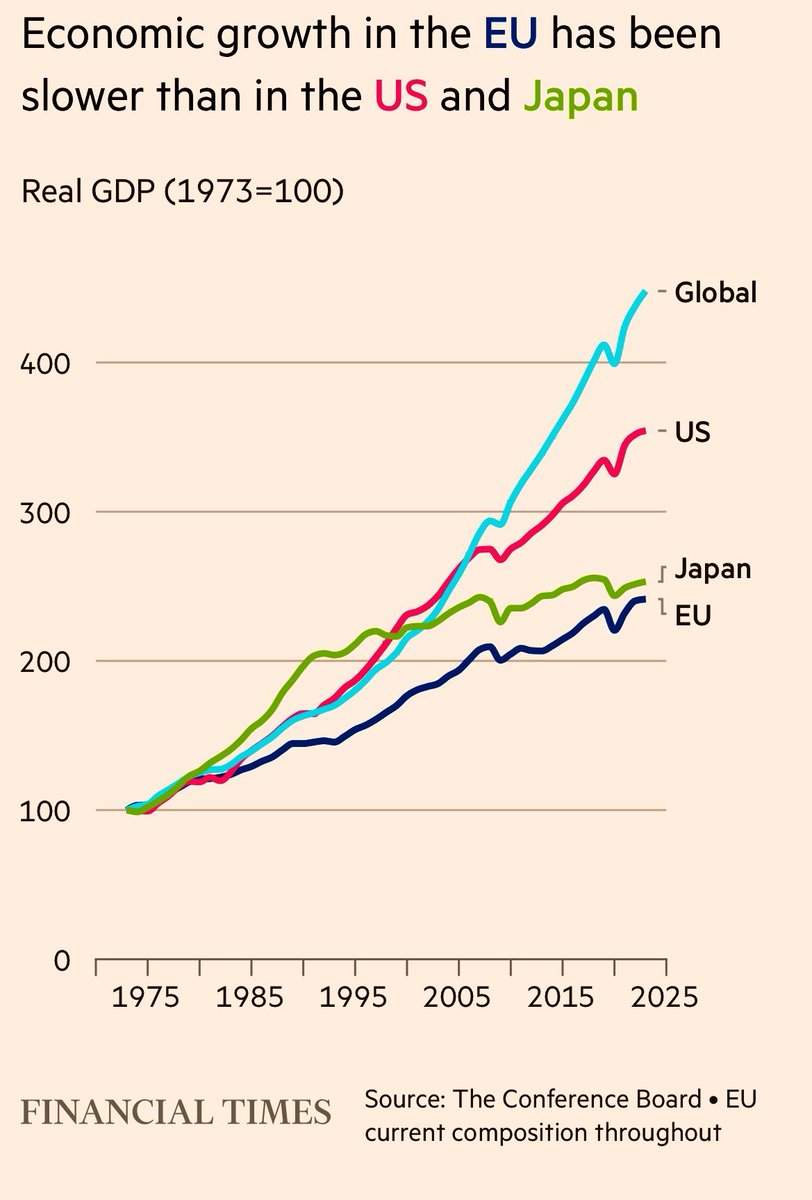
The most concerning part about this is that most Europeans don't realize how stagnant Europe has now become
Europeans are literally blue-pilled and are mostly concerned with climate change, immigration and the Ukraine war
Nobody in Europe is thinking why increasingly everything they use is made in China running on American software
The knee jerk reaction is to proudly pass regulation against American tech
The chad reaction would be to reduce regulation so that European entrepreneurs would actually stay in Europe to build European startups increasing Europe's GDP and making Europeans richer!
I am European and I have regular conversations about this with people here, it's just not on top of mind AT ALL! While it should be because Europe's GDP is stagnant and the real innovation now happens in US and China and elsewhere, not in Europe
People in Europe do love to complain about rising cost of living and the increasing unaffordability of living, but they don't realize why. They point at foreigners/immigrants as the problem, which can't be the whole story
Other Europeans I talk to get visibly upset if I ask them about stagnant GDP numbers: "why should everything be about money?" they say in a thick German accent
The whole story is that Europe has made it very difficult for people to start a business, raise capital, innovate and get the reward for taking that risk, so why would anybody?
And for the Europeans that do, it's way easier to open a US Delaware company, raise capital in US, sell your stock or IPO in the US, because why even do that in EU, where it's too hard? The proof is in the pudding, if it was so easy in EU then why is startup funding in US $270B AUM with 330 million people vs $44B AUM with 746 million people? That's almost 14x bigger startup funding market per capita
Why doesn't EU have ANY trillion dollar companies? While US has six? Why isn't there any European company in the top 10 of largest companies? While 80% is American?
Why is Stripe, a company founded by two Irish brothers, an American company and not a European one? It could have been
Very few Europeans will agree with this post because they can't see it, if they would've seen it, we wouldn't be here in the first place!
What's the role left for Europe in the future?
Signed,
- A techno-optimist European who'd love to see Europe become wealthy again
Lots of confusion about what a world model is. Here is my definition:
Given:
- an observation x(t)
- a previous estimate of the state of the world s(t)
- an action proposal a(t)
- a latent variable proposal z(t)
A world model computes:
- representation: h(t) = Enc(x(t))
- prediction: s(t+1) = Pred( h(t), s(t), z(t), a(t) )
Where
- Enc() is an encoder (a trainable deterministic function, e.g. a neural net)
- Pred() is a hidden state predictor (also a trainable deterministic function).
- the latent variable z(t) represents the unknown information that would allow us to predict exactly what happens. It must be sampled from a distribution or or varied over a set. It parameterizes the set (or distribution) of plausible predictions.
The trick is to train the entire thing from observation triplets (x(t),a(t),x(t+1)) while preventing the Encoder from collapsing to a trivial solution on which it ignores the input.
Auto-regressive generative models (such as LLMs) are a simplified special case in which
1. the Encoder is the identity function: h(t) = x(t),
2. the state is a window of past inputs
3. there is no action variable a(t)
4. x(t) is discrete
5. the Predictor computes a distribution over outcomes for x(t+1) and uses the latent z(t) to select one value from that distribution.
The equations reduce to:
s(t) = [x(t),x(t-1),...x(t-k)]
x(t+1) = Pred( s(t), z(t), a(t) )
There is no collapse issue in that case.
There’s an interesting, growing debate in the ML community on whether SORA is just a better video generator MODEL, or if it’s a new kind of « SIMULATOR », using a lot of synthetic data & learning its own model of physics (like the fluid dynamics example below)…
Letting AI learn the fundamentals of physics (intuitive physics) using gradient descent is a very interesting approach, next step in deep learning. Could the same approach be used to learn the fundamentals of cognition? The «e=mc^2» fundamental laws of our brain and decision making?
Maybe the idea is to keep « bruteforcing » AI with # of parameters and scale to get to the point when we discover those fundamentals and simplify our models back using those fundamental laws…
I guess we’ll see when @sama raises the $7 trillion for his GPUs😎
If you think OpenAI Sora is a creative toy like DALLE, ... think again. Sora is a data-driven physics engine. It is a simulation of many worlds, real or fantastical. The simulator learns intricate rendering, "intuitive" physics, long-horizon reasoning, and semantic grounding, all by some denoising and gradient maths.
I won't be surprised if Sora is trained on lots of synthetic data using Unreal Engine 5. It has to be!
Let's breakdown the following video. Prompt: "Photorealistic closeup video of two pirate ships battling each other as they sail inside a cup of coffee."
- The simulator instantiates two exquisite 3D assets: pirate ships with different decorations. Sora has to solve text-to-3D implicitly in its latent space.
- The 3D objects are consistently animated as they sail and avoid each other's paths.
- Fluid dynamics of the coffee, even the foams that form around the ships. Fluid simulation is an entire sub-field of computer graphics, which traditionally requires very complex algorithms and equations.
- Photorealism, almost like rendering with raytracing.
- The simulator takes into account the small size of the cup compared to oceans, and applies tilt-shift photography to give a "minuscule" vibe.
- The semantics of the scene does not exist in the real world, but the engine still implements the correct physical rules that we expect.
Next up: add more modalities and conditioning, then we have a full data-driven UE that will replace all the hand-engineered graphics pipelines.
https://t.co/7BikSgE7iN