Meta just solved RAG's biggest bottleneck.
30× faster decoding. Zero accuracy loss.
The problem nobody talks about:
When you feed an LLM 80 retrieved passages, only 5-10 are actually useful.
The rest? Dead weight. But you're computing attention for ALL of them.
The math is brutal:
Traditional RAG with 16K context: → 100+ seconds to first token → 10× throughput drop → Massive memory waste
What REFRAG does:
Compresses context chunks into single embeddings.
Instead of processing 16,384 tokens → Process 1,024 chunk embeddings.
The results:
✓ 30.85× faster time-to-first-token
✓ Zero perplexity loss
✓ 16× context extension (4K → 64K tokens)
✓ 3.75× better than previous SOTA
Why it works:
RAG contexts have sparse attention patterns. Most retrieved passages don't interact. REFRAG exploits this with:
1./ Precomputable embeddings - Cached from retrieval, reused across inferences
2./ RL-based compression - Smart policy decides what to compress
3./ Works anywhere - Unlike previous methods, compresses at any position
Real impact:
• 8 passages at single-passage latency
• Better accuracy with weak retrievers
• Handles unlimited conversation history
• No model architecture changes needed
This changes RAG economics: More context + Lower latency.
(Link to the Meta paper in comments)
♻️ Repost to save someone $$$ and a lot of confusion.
✔️ You can follow @techNmak, for more insights.
As a fun Saturday vibe code project and following up on this tweet earlier, I hacked up an **llm-council** web app. It looks exactly like ChatGPT except each user query is 1) dispatched to multiple models on your council using OpenRouter, e.g. currently:
"openai/gpt-5.1",
"google/gemini-3-pro-preview",
"anthropic/claude-sonnet-4.5",
"x-ai/grok-4",
Then 2) all models get to see each other's (anonymized) responses and they review and rank them, and then 3) a "Chairman LLM" gets all of that as context and produces the final response.
It's interesting to see the results from multiple models side by side on the same query, and even more amusingly, to read through their evaluation and ranking of each other's responses.
Quite often, the models are surprisingly willing to select another LLM's response as superior to their own, making this an interesting model evaluation strategy more generally. For example, reading book chapters together with my LLM Council today, the models consistently praise GPT 5.1 as the best and most insightful model, and consistently select Claude as the worst model, with the other models floating in between. But I'm not 100% convinced this aligns with my own qualitative assessment. For example, qualitatively I find GPT 5.1 a little too wordy and sprawled and Gemini 3 a bit more condensed and processed. Claude is too terse in this domain.
That said, there's probably a whole design space of the data flow of your LLM council. The construction of LLM ensembles seems under-explored.
I pushed the vibe coded app to
https://t.co/EZyOqwXd2k
if others would like to play. ty nano banana pro for fun header image for the repo
I just read a paper that completely broke my brain.
It describes a system that solved an AI task with over 1,000,000 sequential steps... with ZERO errors.
Using AI models that are known to be flaky and make mistakes.
How is that even possible? 🤯
We all know LLMs have an error rate. Even 99.9% accuracy is a death sentence for long tasks.
Imagine you need 1,000 correct steps in a row. With a 99.9% success rate per step, your chance of finishing the whole thing is only ~36%.
At a million steps? Forget it. It's statistically impossible.
So for years, the race has been to build bigger, "smarter" models to get that per-step error rate closer to zero. We're trying to build a perfect genius.
But this paper ("Solving a Million-Step LLM Task with Zero Errors") does the complete opposite. It's a total paradigm shift.
Here's the "holy shit" moment:
Stop trying to make the AI perfect. Instead, build a system that's immune to its imperfections.
How?
Smash the problem into the tiniest possible pieces. (They call it Maximal Agentic Decomposition).
Have a team of simple, cheap AIs vote on the answer for each tiny piece.
It's less like hiring one world-class chef and praying they don't have an off day, and more like designing the McDonald's kitchen.
The system guarantees the burger is the same every time, even if any individual worker could mess up.
The reliability comes from the process, not the person.
They tested this on the Towers of Hanoi puzzle—a classic benchmark where AIs fail spectacularly as the task gets longer.
They set it up for 20 disks. That requires 1,048,575 perfect moves in a row.
(seriously, over a million steps)
A single AI trying this would be a comedy of errors.
But their system of "micro-agents" voting on every single move... nailed it. Flawlessly.
And the plot twist? The most expensive, "state-of-the-art" models weren't even the best for the job. A smaller, cheaper model (gpt-4.1-mini) was more cost-effective because the tasks were so simple.
This is a huge deal for AI safety, too.
A single, god-like AI is a black box. It's unpredictable.
But a system of a million simple agents? You can inspect it. You can audit each step. The agents have no grand "worldview"—their entire existence is to solve one tiny puzzle and then disappear. It's controllable.
So next time you're building something with an LLM, maybe stop asking "how can I prompt the model to be smarter?"
And start asking: "How can I design a system where it's okay for the model to be dumb?"
The real power isn't just in the model. It's in the architecture you build around it.
This isn't just about AI. It's a fundamental lesson in engineering and problem-solving.
You don't always need perfect components to build a perfect machine. You just need a damn good design.
...which makes you wonder what else we're trying to solve by chasing individual perfection instead of building better systems.
BREAKING: Perplexity’s first research paper broke a major limit in LLM scaling
NVIDIA and AWS are excited about it. No one’s reported this yet.
What I found most useful:
→ Enables trillion-parameter serving on AWS (previously not feasible)
→ Faster than DeepSeek’s DeepEP, a top benchmark
→ Minimal API surface, yet handles complex multi-node workloads
→ Fully portable across clouds
Met a Meta AI researcher.
He studied Physics in China, came to the US for a PhD in Physics, and then fell in love with AI, despite never having studied computer science.
He watched Andrej Karpathy and Andrew Ng, bought a GPU, read every arXiv paper title daily, and dived into the ones that interested him. Eventually, he published a few first-author papers at top AI conferences without any supervisors, and later transferred to his university’s AI lab.
You can just do things.
NEO just proved every major AI lab built their vision models wrong 💀
OpenAI, Google, Anthropic...
they all use the same approach: train a vision encoder, bolt it onto an LLM, pray the alignment works.
NEO said "what if we just... didn't do that?"
and built a native vision-language model from first principles instead.
here's why this is actually insane:
traditional VLMs are Frankenstein architectures. you take a pretrained vision encoder (CLIP, whatever). add a projection layer. attach it to a frozen language model. hope they learn to talk to each other.
it works. but it's fundamentally fragmented.
vision and language compete for model capacity. alignment is expensive. training happens in stages. you're forcing two systems designed for different things to cooperate.
NEO throws this out completely.
it processes images and text through the same autoregressive architecture — a unified vision-language primitive that learns both modalities natively from scratch.
no separate vision encoder. no projection gymnastics. no alignment tax.
the technical breakthroughs that make this possible:
• Native Multi-Modal Attention with mixed masking - text tokens use causal attention (normal LLM behavior), image tokens use full bidirectional attention (exhaustive visual interactions). each modality processes information its natural way, in the same model, at the same time.
• Native-RoPE assigns distinct base frequencies to temporal, height, and width dimensions — solving the critical mismatch between text sequences (temporal) and visual data (spatial). no more forcing spatial information through temporal-only positional embeddings.
• Adaptive architecture that uses pre-Buffer layers during pre-training, then merges everything into a monolithic backbone during fine-tuning — automatically allocating capacity for encoding, alignment, and reasoning.
the efficiency? 390 million image-text examples. not billions. 390 million.
and it rivals GPT-4V and LLaVA.
every major lab uses modular architectures because that's what worked first. NEO suggests we've been doing it the expensive, complicated way this whole time.
MIT just made vibe coding an official part of engineering 💀
MIT just formalized "Vibe Coding" – the thing you've been doing for months where you generate code, run it, and if the output looks right you ship it without reading a single line.
turns out that's not laziness. it's a legitimate software engineering paradigm now.
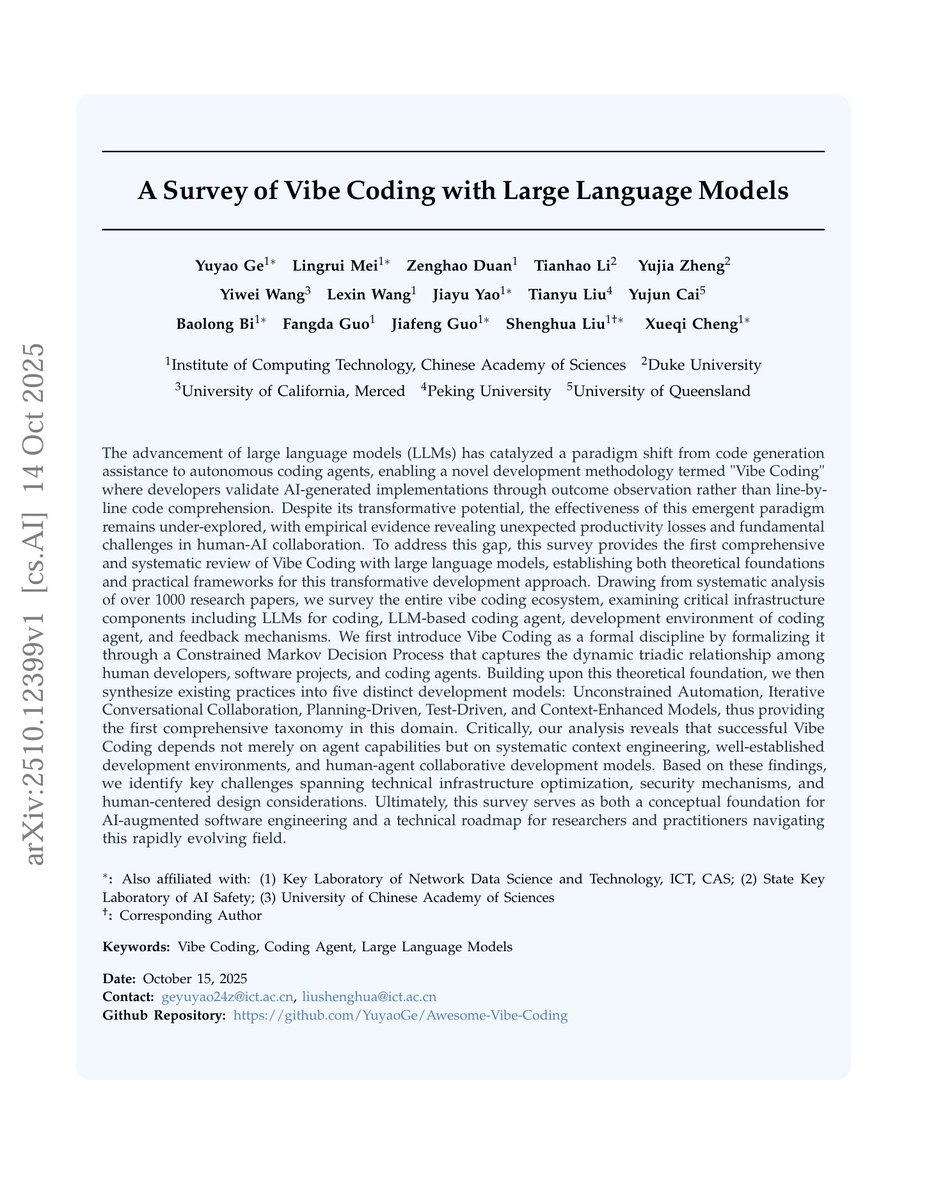
they analyzed 1000+ papers and built a whole Constrained Markov Decision Process to model what you thought was just "using ChatGPT to code."
they formalized the triadic relationship: your intent (what/why) + your codebase (where) + the agent's decisions (how).
which means the shift already happened. you missed it. there was no announcement, no transition period. one morning you woke up writing functions and by lunch you were validating agent outputs and convincing yourself you're still "a developer."
but you're not. not in the way you used to be.
here's what actually broke my brain reading this 42-page survey:
better models don't fix anything. everyone's obsessing over GPT-5 or Claude 4 or whatever's next, and the researchers basically said "you're all looking at the wrong variable."
success has nothing to do with model capability. it's about context engineering – how you feed information to the agent. it's about feedback loops – compiler errors + runtime failures + your gut check. it's about infrastructure – sandboxed environments, orchestration platforms, CI/CD integration.
you've been optimizing prompts while the actual problem is your entire development environment.
they found five models hiding in your workflow and you've been accidentally mixing them without realizing it:
- Unconstrained Automation (you just let it run),
- Iterative Conversational Collaboration (you go back and forth),
- Planning-Driven (you break tasks down first),
- Test-Driven (you write specs that constrain it),
- Context-Enhanced (you feed it your entire codebase through RAG).
most teams are running 2-3 of these simultaneously.
no wonder nothing works consistently.
and then the data says everything:
productivity losses. not gains. losses.
empirical studies showing developers are SLOWER with autonomous agents when they don't have proper scaffolding.
because we're all treating this like it's autocomplete on steroids when it's actually a team member that needs memory systems, checkpoints, and governance.
we're stuck in the old mental model while the ground shifted beneath us.
the bottleneck isn't the AI generating bad code.
it's you assuming it's a tool when it's actually an agent.
What this actually means (and why it matters):
→ Context engineering > prompt engineering – stop crafting perfect prompts, start managing what the agent can see and access
→ Pure automation is a fantasy – every study shows hybrid models win; test-driven + context-enhanced combinations actually work
→ Your infrastructure is the product now – isolated execution, distributed orchestration, CI/CD integration aren't "nice to have" anymore, they're the foundation
→ Nobody's teaching the right skills – task decomposition, formalized verification, agent governance, provenance tracking... universities aren't preparing anyone for this
→ The accountability crisis is real – when AI-generated code ships a vulnerability, who's liable? developer? reviewer? model provider? we have zero frameworks for this
→ You're already behind – computing education hasn't caught up, graduates can't orchestrate AI workflows, the gap is widening daily
the shift happened. you're in it. pretending you're still "coding" is living in denial.
🔥🚨BREAKING: Groundbreaking quantum research just confirmed that time doesn't move forward but ‘folds onto itself’ this claim means your present actions might already be reshaping your past and your past is connected to your future.
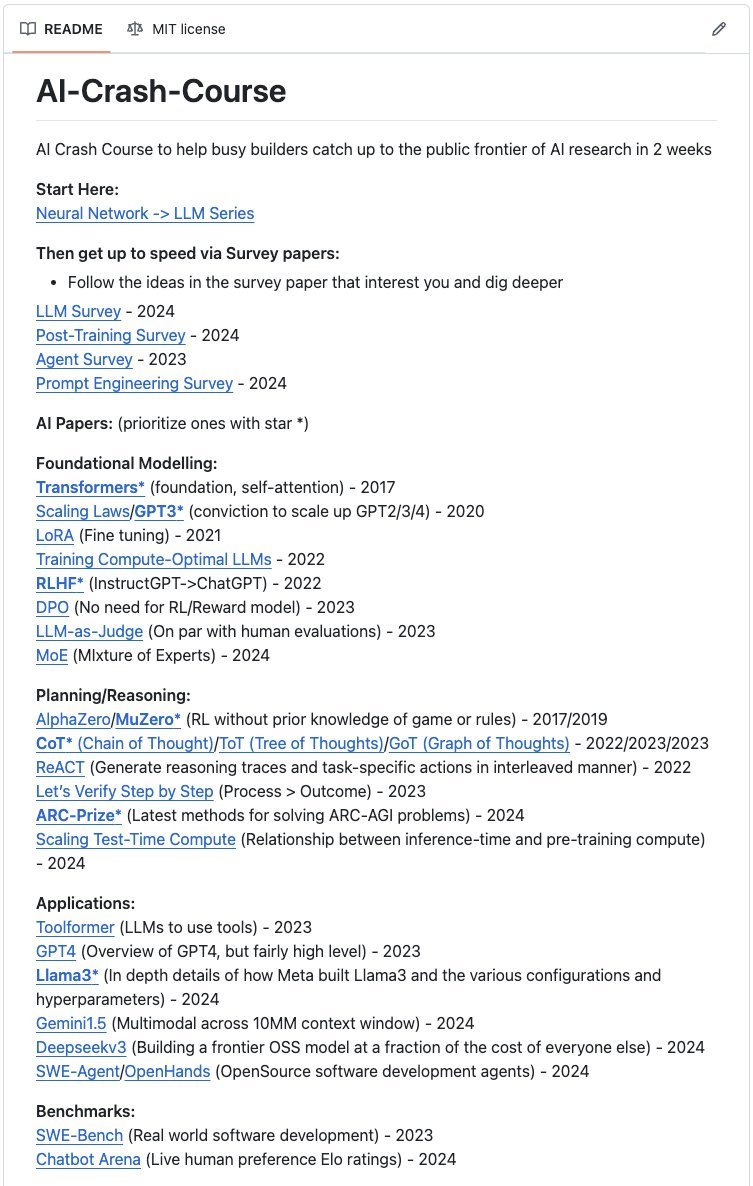
No one tells you this but you can catch up to the frontier of AI in just 2 weeks.
You don’t need years. Just 20 papers and focused time.
Here’s the full crash course (free).
Save this one.
🚨 DeepSeek just did something wild.
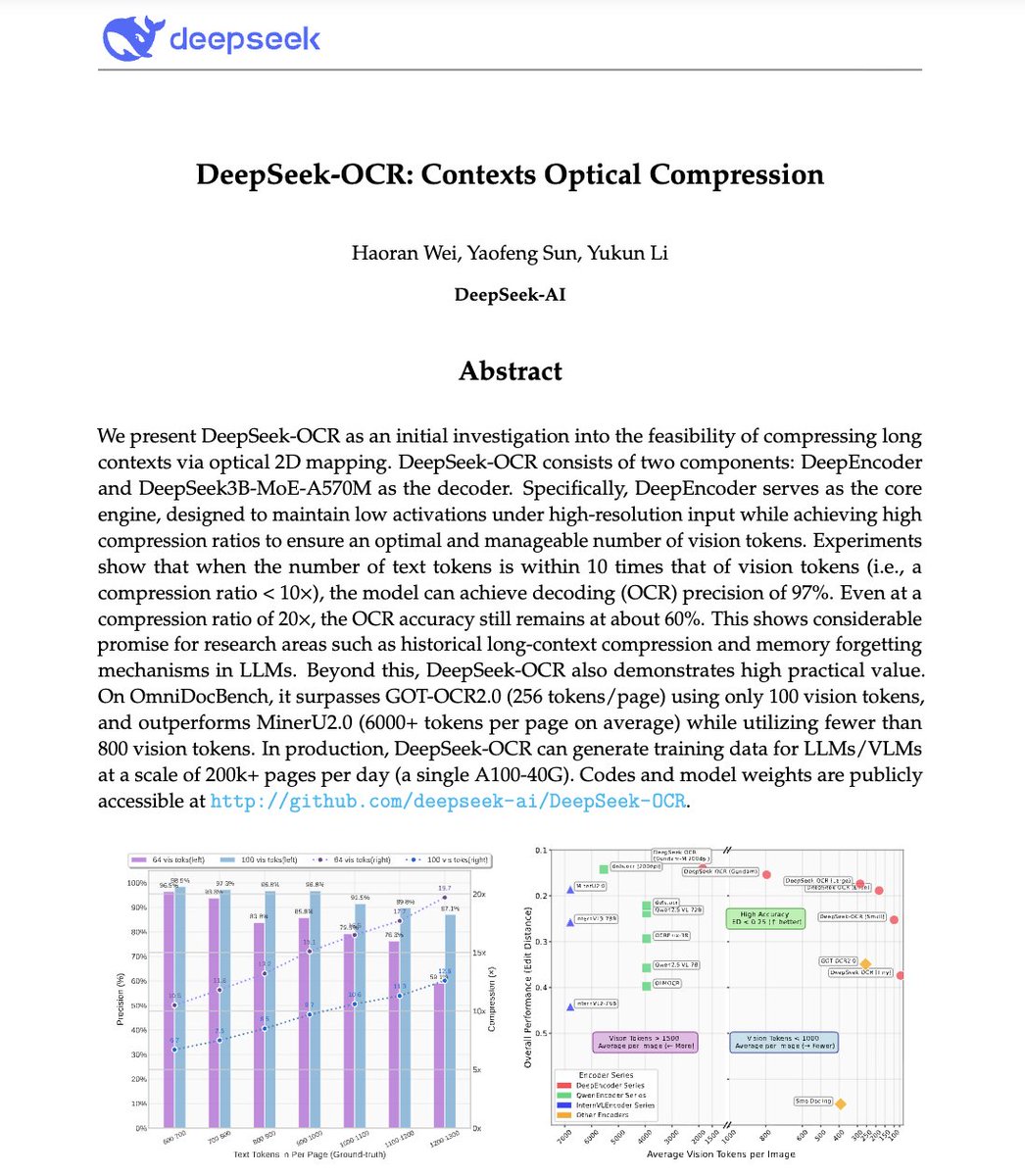
They built an OCR system that compresses long text into vision tokens literally turning paragraphs into pixels.
Their model, DeepSeek-OCR, achieves 97% decoding precision at 10× compression and still manages 60% accuracy even at 20×. That means one image can represent entire documents using a fraction of the tokens an LLM would need.
Even crazier? It beats GOT-OCR2.0 and MinerU2.0 while using up to 60× fewer tokens and can process 200K+ pages/day on a single A100.
This could solve one of AI’s biggest problems: long-context inefficiency.
Instead of paying more for longer sequences, models might soon see text instead of reading it.
The future of context compression might not be textual at all.
It might be optical 👁️
github. com/deepseek-ai/DeepSeek-OCR