Everyone wants to build AI agents.
Very few understand how they actually work.
Right now, most people are learning Agentic AI in reverse.
They start with the flashy topics:
• Multi-agent systems
• Self-improving agents
• Long-term memory
• Autonomous workflows
• Agentic RAG
It looks impressive.
Until the first production deployment.
Then the conversation changes overnight.
Nobody asks:
"Can it use 20 tools?"
Instead, everyone asks:
→ What context did the agent actually receive?
→ Why did it choose this tool instead of another?
→ What information was retrieved?
→ Which memories were stored?
→ Why did it fail this step?
→ Can we replay the entire execution?
→ How much did retries increase latency and cost?
→ Who approved the final action?
→ Can we audit every decision?
This is the difference between AI demos and AI systems.
A demo proves an agent *can* do something.
Production proves it can do it reliably, safely, and repeatedly.
That's why treating Agentic AI as a checklist of buzzwords is a mistake.
It isn't a collection of disconnected concepts.
It's a dependency graph.
Everything builds on something else.
Foundations come first.
You need to understand:
• LLM fundamentals
• Prompting
• Tool calling
• Structured outputs
• Context management
Only then do retrieval and memory start making sense.
Once those are solid, agent patterns become easier:
• Planning
• Reflection
• Routing
• Multi-agent collaboration
• Human-in-the-loop
And only after that should you think about production:
• Observability
• Evaluations
• Permissions
• Guardrails
• Governance
• Cost optimization
• Security
• Reliability
Finally comes the frontier:
• Self-improving agents
• Persistent memory
• Agent swarms
• Computer use
• Autonomous organizations
Most people try to skip the foundations.
That works until the first bug.
Then they spend days debugging something that would've taken minutes if they understood the dependency underneath.
The best AI engineers I know don't memorize every new framework.
Frameworks change every few months.
Principles don't.
If you understand the dependencies, you can learn any framework in a weekend.
If you only know the framework, you'll have to relearn everything when the next one arrives.
That's why I created this Agentic AI knowledge graph.
Not as another roadmap.
But as a map of how every concept connects to the next.
Because learning Agentic AI isn't about climbing a ladder.
It's about understanding the graph beneath it.
The sooner you learn the dependencies, the faster every advanced topic starts making sense.
📌 Save this for later.
You'll appreciate it the next time an "intelligent" agent behaves in a completely unexpected way.
Hermes Agent just killed the $20/month AI subscription model (and for good reason).
You're paying monthly, hitting usage caps, and your agent forgets you every single session.
Here's how to cut your AI costs by 80%+ in under 60 seconds using Hermes:
Step 1. Download Hermes Desktop
Skip the terminal entirely.
Go to https://t.co/tWE0eS9M2s download the desktop app.
Step 2. Pick a budget model
This is where the savings happen.
Inside the app, swap your default model to DeepSeek V4 Flash (it costs $0.14 per million input tokens and $0.28 per million output tokens).
The same workload on Claude Opus costs roughly 30x more.
Step 3. Switch from gateway to CLI
Running Hermes through messaging apps like Telegram or Discord sends 15,000 to 20,000 tokens of tool definitions per request.
The CLI sends 6,000 to 8,000. Same output. 2-3x cheaper per request.
Step 4. Enable the learning loop
Toggle on persistent memory and skill generation.
After 20+ self-created skills, Hermes completes similar future tasks 40% faster, meaning 40% fewer tokens burned.
Costs drop the longer you run it.
Step 5. Set your VPS and forget it
A Hetzner CX22 runs at around $4/month. Your agent runs 24/7, hibernates when idle, and costs nearly nothing between tasks. OpenHosst
Step 6. Test it
Send a research task, build a workflow, anything. Watch it run for cents instead of dollars.
That's it.
A full-budget Hermes setup costs $5 to $10 per month, all-in.
Save this and actually set this up.
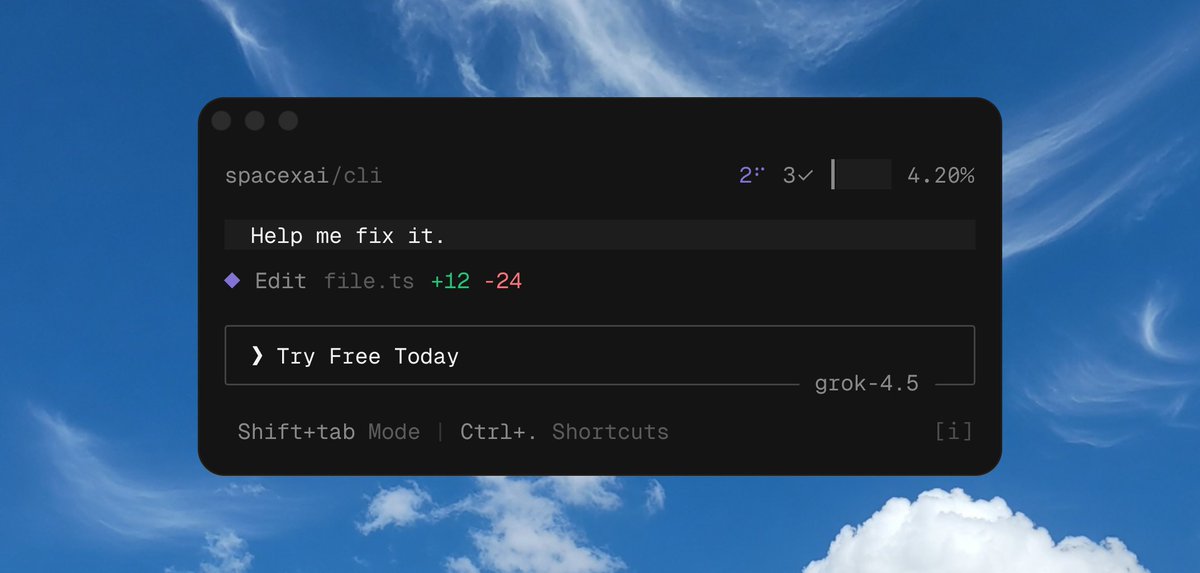
Grok 4.5 is now available to try on the free tier. Use Grok Build with any X or Grok account.
We’re excited to hear your feedback.
https://t.co/NYsa0Ar9eo
This is a new paradigm for interacting with Claude that is significantly more "inline" with all the other human activity org-wide. Once you do all of the under the hood engineering work to make this "just work" (e.g. across tools, integrations, compute environments, memory, security, etc.), Claude basically joins the team in a seamless way - you can talk to it as you would talk to a person and it can help with a very large variety of workloads.
Imo this is the 3rd major redesign of LLM UIUX. The first paradigm was that the LLM is a website you go to, the second was that it is an app you download to your computer. This third one is that it is a self-contained, persistent, asynchronous entity with org-wide tools and context, working alongside teams of humans. It really takes a while to wrap your head around it, but it works and it is awesome.
We're coming out of stealth.
We've built our first racks after a successful A0 tapeout, $1B+ in customer contracts, and $800m raised.
Early customer tests show us achieving SOTA throughput, latency, and power efficiency on inference workloads.
Our first racks ship this summer.
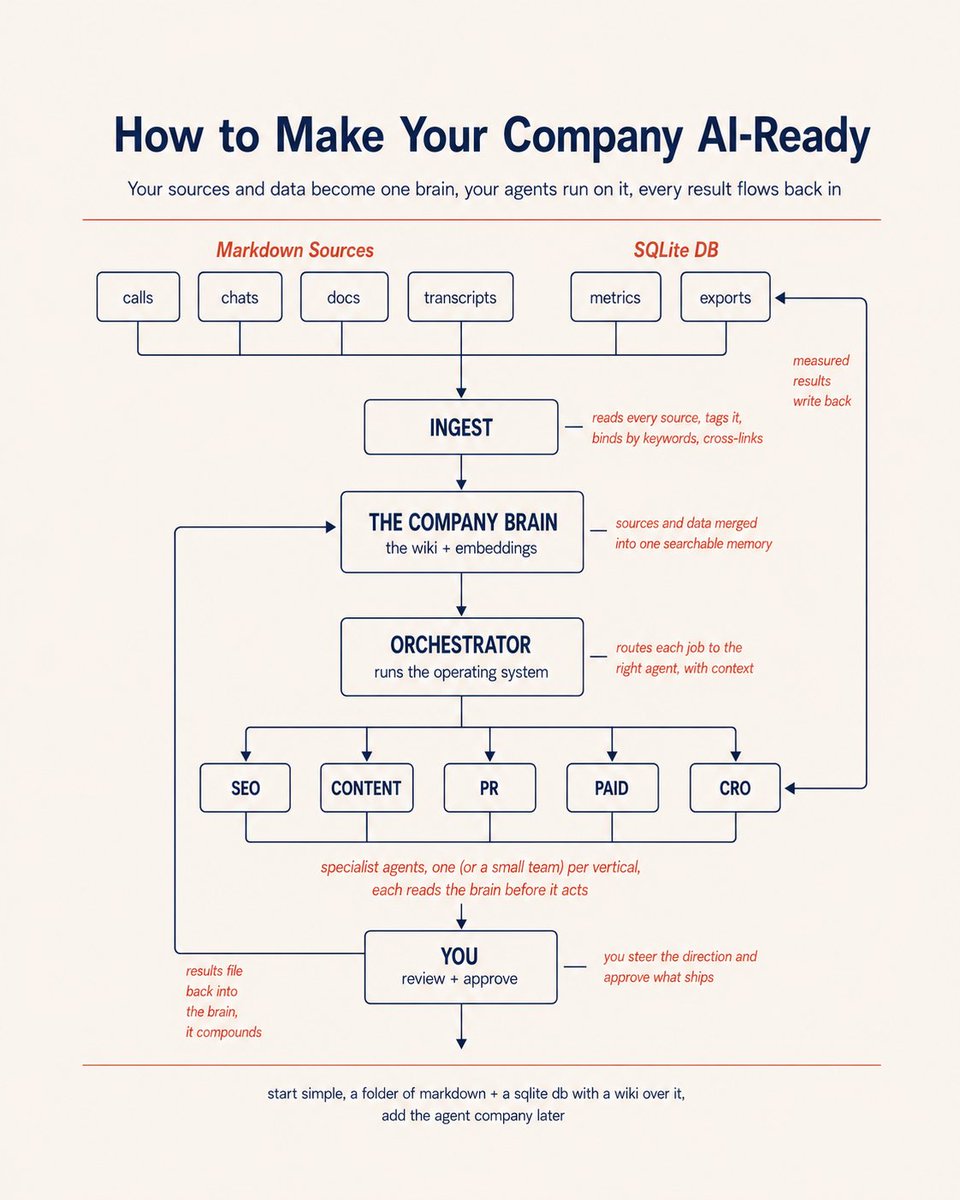
Every result your AI agents produce files back into the company brain. The next agent reads a smarter brain. It compounds with every run.
This map breaks down the full architecture: markdown sources and metrics merge into one searchable memory, an orchestrator routes jobs to 5 specialist agents (SEO, Content, PR, Paid, CRO), and you approve what ships.
Save the map, then read the guide below.
Classical physics gave us a world of certainty: if we know the present exactly, the future should follow like a clock. But quantum mechanics showed that nature is not always a clock. At the microscopic level, energy comes in packets, particles behave like waves, and possibility is not ignorance, it is part of reality.
This is the quiet revolution of quantum physics: the universe is not less logical than we thought, but deeper than our old logic allowed. Classical physics describes the world we see. Quantum mechanics reveals the hidden rules from which that world is built.