I’m really proud to welcome @ashtsyganov back as a guest lecturer in my course just a year after he was a student on it 🚀
Week 3 of my Deep Learning 2 course: “The Evolution of Transformers.”
Materials are out:
https://t.co/wuLbyou6h0
What does a week at ICML in Seoul 🇰🇷 actually look like?
I documented all 6 days of ICML 2026 — talks, posters, people, and a bit of the city.
The result is my first conference vlog [in Russian] 🎥
▶️ https://t.co/JFbGNJDldX
Hope you enjoy it!
Could Deep Learning 1 fit into one lecture? We tried 🚀
Week 1 of my Deep Learning 2 course — “DL1 Compressed” — is now open-source: slides + seminar notebook.
Thanks for all the ⭐! Use and adapt freely:
https://t.co/MEQHqCXGtt
and what i realized - it won't help me
i already know it and if I get hit in my head by a hammer and forget everything I can just GPT my way through it
BUT I came to a conclusion that in our modern world of chatting with LLMs and using agents in our work
it's important have ability to slowdown, ponder on the problem, go step by step
right now these toy problems acted as a quick screen detox, but they will lead to harder problems later in this book
and that can really boost me as a researcher when I finish all of them
because sometimes I feel how vibecoding destroys my ability for deep reflection on some complex open problem
and such activities may act as some sort of cure for it
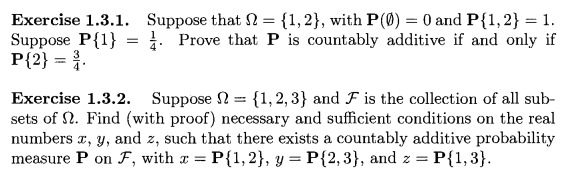
LARPING DAY 2
I decided to take a break from the screen and dig through my precious "A First Look at Rigorous Probability Theory" book by J.S.Rosenthal
I read section 1 - "The need for measure theory" and jumped straight to the exercises
Of course they were pretty simple but they got me thinking:
ok, I already had my basic probability and statistics course in uni
I have some decent understanding of this thing
what's the need for solving these problems right now?
How will it help me on my position of DL RESEARCHER @ HDI LAB
If you're also interested in touching this HOT FIELD OF DIFFUSION MODELS but don't know where to start check this lab yourself
https://t.co/vSUovzD8Vh
link taken from official course site so not scamming
TRUST ME
LARPING DAY 1
ok so I was really busy this week with my work as a DL RESEARCHER @ HDI LAB so I got a little lazy today
but larping should never stop so I started working on the lab 2 for MIT 6.S184
for now it's pretty braindead - I had to plug in formulas for Gaussian Conditional Probability paths into their pipeline
nonetheless it's always cool to see theory from lectures transform into lines of code
And now I want to remind you that INSTEAD OF WATCHING NETFLIX SERIES TONIGHT
YOU CAN SKIM TROUGH THIS SHORT MIT COURSE THAT TEACHES YOU HOW DIFFUSION MODELS WORK
those models that generate you daily ai slop on tiktok, yes
So rn I'll focus on 4 topics
1. MIT 6.S184 course on Flow Matching and Diffusion models(because I'm a noob in them)
2. Stanford CS329A course on Self-Imroving AI Agents(because it's ultimate larp field for a ML researcher rn)
3. GPU Programming(because it's cool and aura farming)
4. A book First Look at Rigorous Probability Theory by J.S.Rosenthal(because there's nothing better in this world than being good at math you know)
Today I'm starting my ultimate LARPING challenge!
There's been pretty much stuff that I wanted to study, but I was too lazy to start
So I was scrolling through X and saw this genre of posts where people document their learning journey
Want to try it myself and hope It will act as motivation to keep going
LARPING DAY 0
My course Deep Learning 2 is back on Sep 1 🚀
Updated materials, modern DL topics, and guest lectures from researchers & industry experts.
Everything is open-source, and the repo just passed 100⭐
https://t.co/r4BGUDtcfr
The first thing that clicked for me: I was thinking about stopping as something outside the process. A threshold. A fixed budget. Some rule we impose.
This paper flips that around: what if “should I stop?” is itself something the process can learn?
🍌🍌🍌
1/ The original GFlowNets paper tried PPO for sampling, but it failed. We figured out why and fixed it. And now PPO beats all objectives on standard problems including molecular graph generation in large spaces.
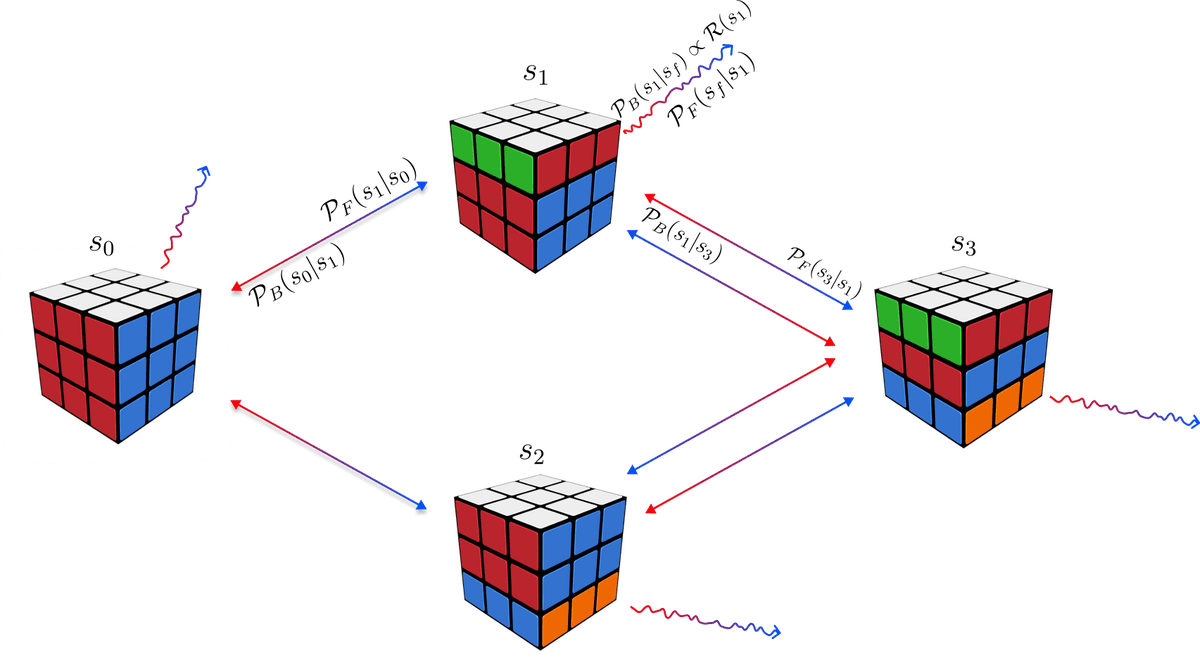
(1/n) Excited to share our latest work “Learning Shortest Paths with Generative Flow Networks”!
We uncover a novel theoretical connection between flow minimization in GFlowNets and finding shortest paths, and develop a learning approach that rivals SOTA in solving Rubik's Cubes!
LLM Knowledge Bases
Something I'm finding very useful recently: using LLMs to build personal knowledge bases for various topics of research interest. In this way, a large fraction of my recent token throughput is going less into manipulating code, and more into manipulating knowledge (stored as markdown and images). The latest LLMs are quite good at it. So:
Data ingest:
I index source documents (articles, papers, repos, datasets, images, etc.) into a raw/ directory, then I use an LLM to incrementally "compile" a wiki, which is just a collection of .md files in a directory structure. The wiki includes summaries of all the data in raw/, backlinks, and then it categorizes data into concepts, writes articles for them, and links them all. To convert web articles into .md files I like to use the Obsidian Web Clipper extension, and then I also use a hotkey to download all the related images to local so that my LLM can easily reference them.
IDE:
I use Obsidian as the IDE "frontend" where I can view the raw data, the the compiled wiki, and the derived visualizations. Important to note that the LLM writes and maintains all of the data of the wiki, I rarely touch it directly. I've played with a few Obsidian plugins to render and view data in other ways (e.g. Marp for slides).
Q&A:
Where things get interesting is that once your wiki is big enough (e.g. mine on some recent research is ~100 articles and ~400K words), you can ask your LLM agent all kinds of complex questions against the wiki, and it will go off, research the answers, etc. I thought I had to reach for fancy RAG, but the LLM has been pretty good about auto-maintaining index files and brief summaries of all the documents and it reads all the important related data fairly easily at this ~small scale.
Output:
Instead of getting answers in text/terminal, I like to have it render markdown files for me, or slide shows (Marp format), or matplotlib images, all of which I then view again in Obsidian. You can imagine many other visual output formats depending on the query. Often, I end up "filing" the outputs back into the wiki to enhance it for further queries. So my own explorations and queries always "add up" in the knowledge base.
Linting:
I've run some LLM "health checks" over the wiki to e.g. find inconsistent data, impute missing data (with web searchers), find interesting connections for new article candidates, etc., to incrementally clean up the wiki and enhance its overall data integrity. The LLMs are quite good at suggesting further questions to ask and look into.
Extra tools:
I find myself developing additional tools to process the data, e.g. I vibe coded a small and naive search engine over the wiki, which I both use directly (in a web ui), but more often I want to hand it off to an LLM via CLI as a tool for larger queries.
Further explorations:
As the repo grows, the natural desire is to also think about synthetic data generation + finetuning to have your LLM "know" the data in its weights instead of just context windows.
TLDR: raw data from a given number of sources is collected, then compiled by an LLM into a .md wiki, then operated on by various CLIs by the LLM to do Q&A and to incrementally enhance the wiki, and all of it viewable in Obsidian. You rarely ever write or edit the wiki manually, it's the domain of the LLM. I think there is room here for an incredible new product instead of a hacky collection of scripts.