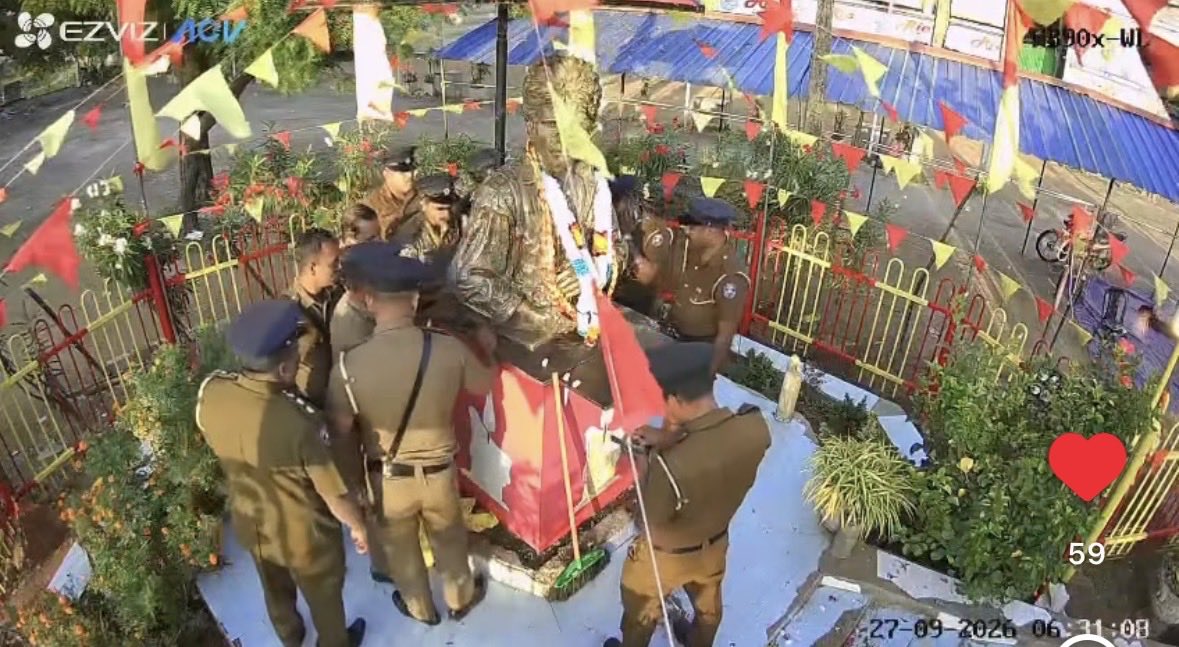
After yesterday’s large commemoration of Lt Col Thileepan‘s hunger strike death in Jaffna, Sri Lankan police today forcibly removed his recently installed statue from the plinth. Since Thileepan‘s death in 1987 , the Sri Lankan state has repeatedly destroyed memorials erected to honour him, including at this site near Nallur temple. (Screenshots via @GGPonnambalam)
🚨 BREAKING - Sri Lankan police remove Thileepan statue from Nallur memorial
Sri Lankan police officers have forcibly removed a statue of Lt. Col. Thileepan from his memorial in Nallur, Jaffna, just a day after the Tamil nation commemorated 39 years since his fast unto death.
Over 20 Sri Lankan police officers including Jaffna's Officer in Charge (OIC) arrived in the early hours of the morning and swiftly removed the statue.
The removal comes a day after hundreds of Tamils gathered at the memorial to remember Thileepan, who fasted unto death in a protest appealing to the Indian government to deliver on the pledges it made to the Tamil people.
https://t.co/vd29zrbASM
A state that won’t let us mourn our people is a state that continues to oppress our people.
And yet, Sri Lankans question why we refuse to identify with that same state?
How can anyone look at this and see anything but cowards?
The Sri Lankan army destroyed his memorial in 1996, in 2007, and again in 2012. Now they are trying to erase him once more.
It has not worked.
Each time, Tamils have rebuilt.
The statue of Thiyagi Thileepan was forcibly removed from the Thileepan Memorial Square in Nallur, Jaffna, by Jaffna Police early this morning.
The incident was captured on CCTV cameras installed at the memorial site by the Thileepan Commemoration Committee.
The removal took place in the early hours of September 27, just one day after the conclusion of this year’s Thileepan commemorations at the memorial site.
The reasons and legal basis for the police removal have not yet been publicly confirmed.
#Thiyagithileepan
people actually getting more mad at Maitreyi Ramakrishnan, member of the Eelam Tamil diaspora, for playing an Eelam Tamil diaspora character than they are at the Sri Lankan government for committing genocide
Sri Lankans are more angry about a Canadian actress speaking about her Eelam Tamil identity, than they are about the bodies of murdered children being dug out of mass graves.
I lost my account with 30,000 followers, an archive dedicated to preserving the history of Tamil Eelam.
It had a good run. Over a year of people trying to get the account banned, and we still made it to 30,000 followers.
Now I’m starting from scratch. If you want to support the archive and help preserve this history, make sure to follow and share the account.
https://t.co/TI2CrwL1G3
They literally a posted a recipe for bone soup in the wake of the bodies of Tamils being dug up in Chemmani.
If your country is entirely founded on the idea that Tamils stole your land and are an existential threat, the dehumanization you guys do to them results in this only
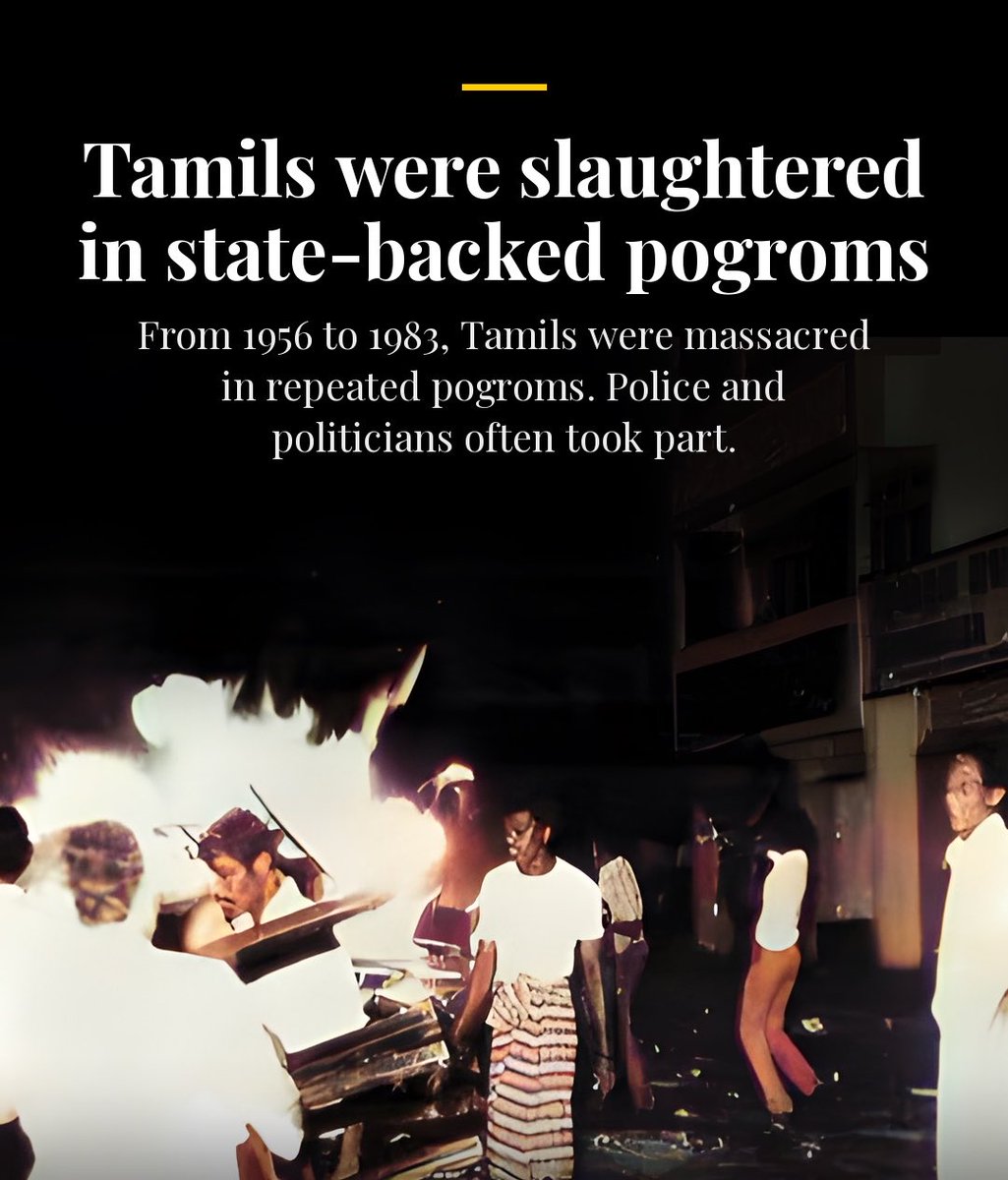
43 years ago, the biggest anti-Tamil pogrom on the island occurred.
The Black July pogrom!
A picture that would make any Tamil with self-respect boil with anger. It shows a Tamil student whose last dignity was stripped away before he was brutally killed by Sinhalese mobs after the picture was taken.
Up to 3,000–4,000 Tamils were brutally murdered, hunted, burned, raped, disappeared, and shot.
There were also reports of horrific acts committed against the dead. Tamil meat was sold in the streets of Colombo.
Hundreds of Tamil-owned shops and houses were meticulously burned, with the help and involvement of the government led by J.R. Jayewardene. The economic cost of the riots was estimated at around $300 million, making it an economic disaster for the Tamil community on the island.
This pogrom played a major role in creating the Tamil diaspora that exists around the world today, as hundreds of thousands of Tamils lost their homes and were forced to flee their homeland.
However, it was not only ordinary Tamil men and women who were affected. Tamil political prisoners, many of whom were imprisoned on what false charges, were also massacred.
This was most famously seen in the Welikada Prison massacre, where several Tamil political prisoners were massacred,
with the involvement of prison officials who worked alongside Sinhalese rioters.
Among the most famous victims were Thangathurai, Kuttimani, and Jegan, leaders of TELO and figures within the Eelam Tamil national liberation movement.
Kuttimani’s eyes were gouged out by Sinhalese prisoners, and Thangathurai’s tongue was cut out in response to his famous statement during his trial:
“I request that I should be hanged in Tamil Eelam. I request that my eyes be donated to some blind person, so that Kuttimani will be able to see through those eyes the reality of Tamil Eelam.”
His tongue was cut out, and prisoners reportedly drank his blood, stating that they were drinking the blood of a Tiger.
Many Tamils regard Black July as their Holocaust. The International Commission of Jurists described the violence as having “amounted to acts of genocide,” and some political leaders, including Indira Gandhi, referred to it as genocide.
The international community condemned the pogrom, but failed to take meaningful action. Many Tamil refugees were not welcomed, and some were even deported back.
Others spent decades in limbo, while many had to rebuild their lives in societies where they faced racism, language barriers, and separation from their families.
If the international community had acted in the interests of the Tamil people and supported their inalienable right to self-determination, then decades of massacres against Eelam Tamils that followed could have been prevented.
For many Eelam Tamils, Black July was the final breaking point. After decades of oppression, even those who believed that non-violent political agitation could succeed came to believe that armed struggle was the only way to pursue liberation against the genocidal state.
What is quite fascinating is that the Sinhalese who want to take away and deny the right to self-determination of Tamils, which is inalienable to them and with which they were born.
The Northeast is not just some ordinary place. It is the region where Tamils have governed for many centuries, with their kings, chieftains, and principalities. Even during this racial holocaust, the only place in the whole of Sri Lanka where Tamils felt safe, and where Tamils who were deported en masse returned to, was the Northeast.
Never forget and never forgive!