Google Drive on Linux, done properly: rclone mount + working thumbnails, no flaky web client. Files show up like a native folder. Here's the setup that actually sticks 👇
https://t.co/go38CkFZaE
Personal update: I've joined Anthropic. I think the next few years at the frontier of LLMs will be especially formative. I am very excited to join the team here and get back to R&D. I remain deeply passionate about education and plan to resume my work on it in time.
💠 Haze 2.0-alpha01 is out!
This is a big release, splitting Haze up into layers, with the goal of enabling pluggable visual effects.
Let me know what you think!
🔗: https://t.co/VlPTqecFrx
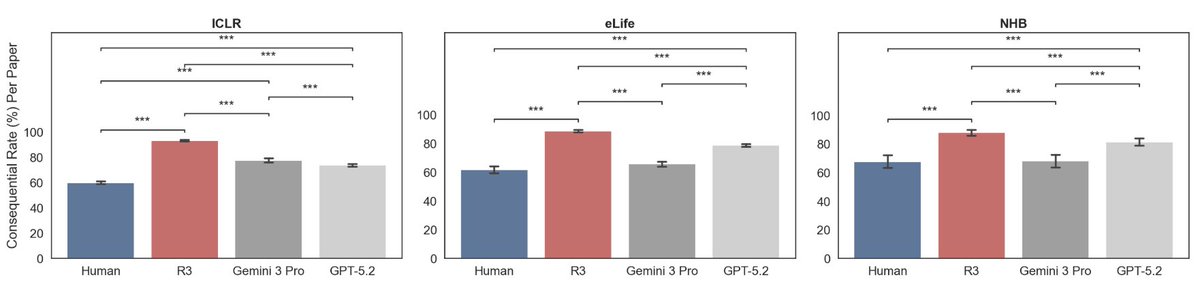
AI is starting to outperform humans in peer review
We benchmarked 145,000+ human and AI review comments across social science (@NatureHumBehav), computer science (@iclr_conf), and life science (@eLife) papers
R3 leads frontier LLMs and humans across disciplines, providing feedback that is consequential to a major claim within a paper ~90% of the time.
Human peer review is no longer the ceiling.
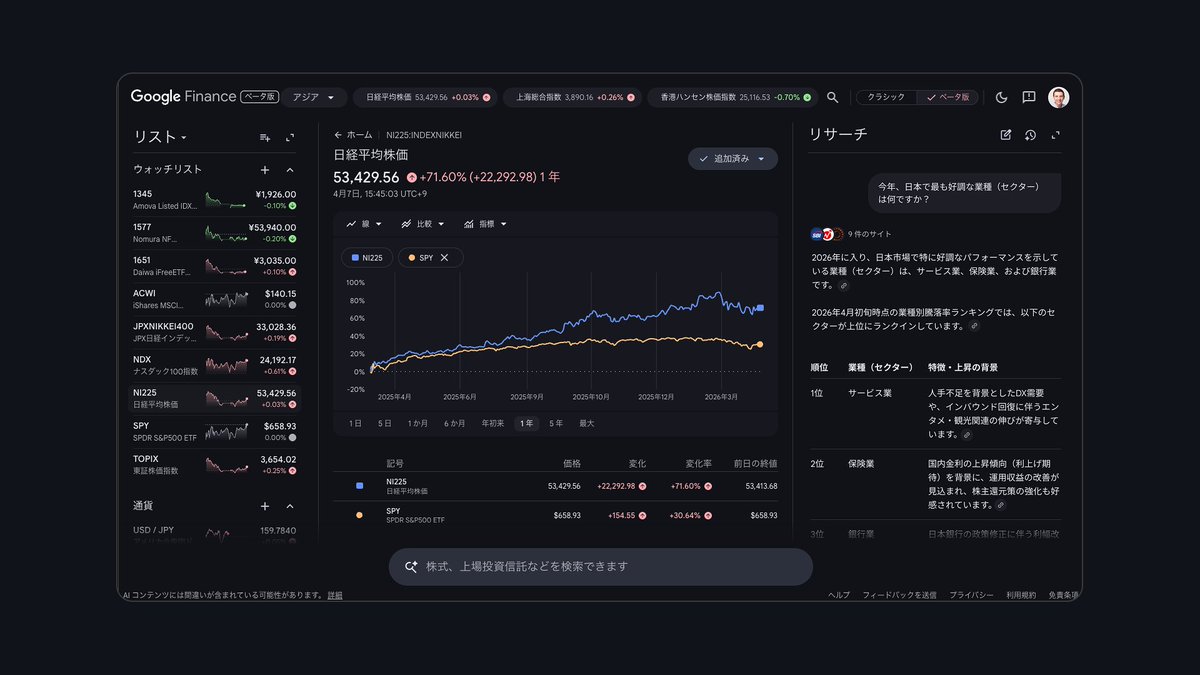
The new AI-powered Google Finance is going global and shipping to 100+ countries… it’s a total reinvention of Google Finance with AI at the core 🚀🚀🚀
+ AI-powered market research
+ Advanced charting
+ Live earnings calls
+ Expanded real-time data
Try it: https://t.co/DUtHFXM0cH
🚨 BREAKING: Someone just built the exact tool Andrej Karpathy said someone should build.
48 hours after Karpathy posted his LLM Knowledge Bases workflow, this showed up on GitHub.
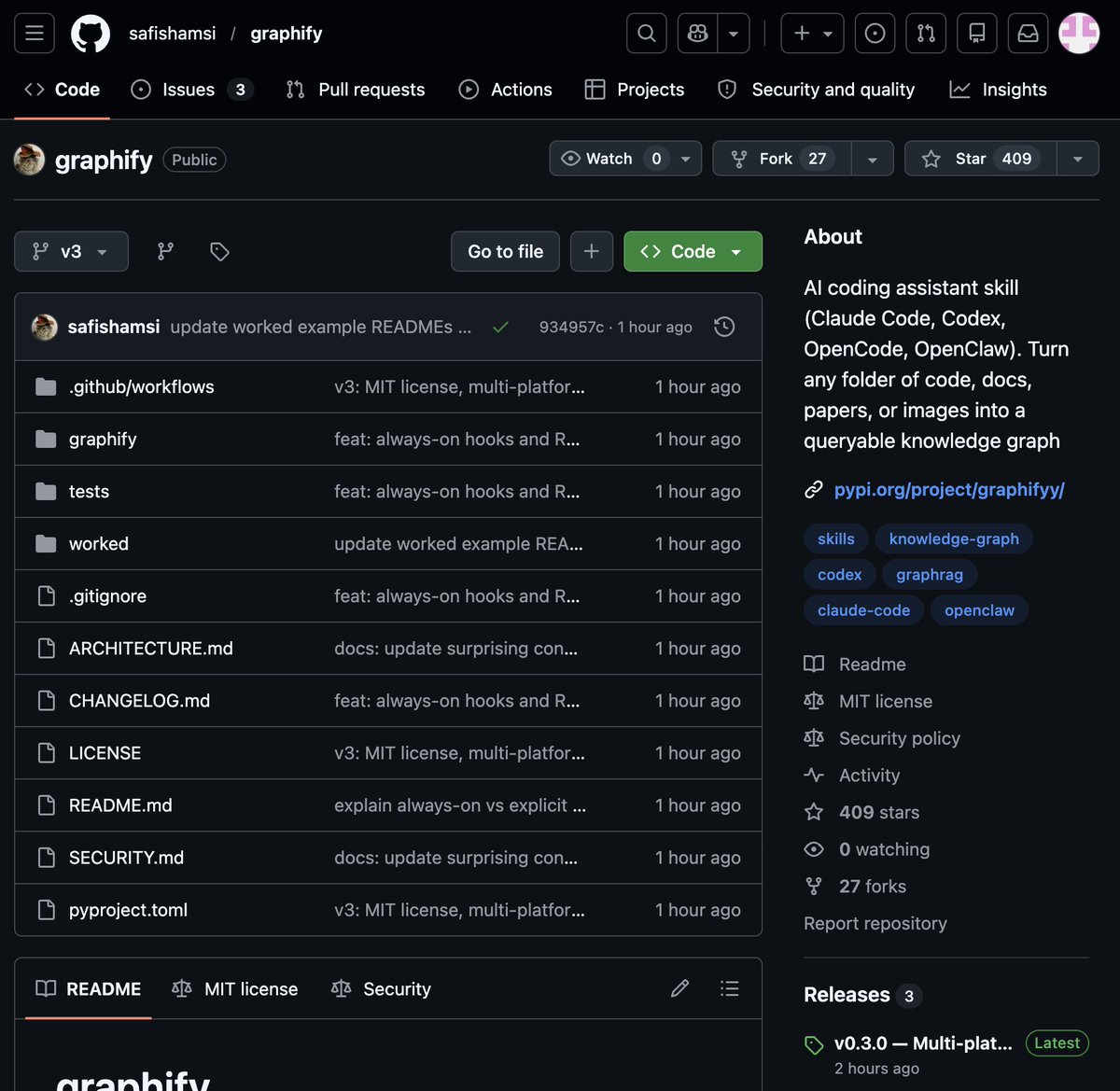
It's called Graphify. One command. Any folder. Full knowledge graph.
Point it at any folder. Run /graphify inside Claude Code. Walk away.
Here is what comes out the other side:
-> A navigable knowledge graph of everything in that folder
-> An Obsidian vault with backlinked articles
-> A wiki that starts at index. md and maps every concept cluster
-> Plain English Q&A over your entire codebase or research folder
You can ask it things like:
"What calls this function?"
"What connects these two concepts?"
"What are the most important nodes in this project?"
No vector database. No setup. No config files.
The token efficiency number is what got me:
71.5x fewer tokens per query compared to reading raw files.
That is not a small improvement. That is a completely different paradigm for how AI agents reason over large codebases.
What it supports:
-> Code in 13 programming languages
-> PDFs
-> Images via Claude Vision
-> Markdown files
Install in one line:
pip install graphify && graphify install
Then type /graphify in Claude Code and point it at anything.
Karpathy asked. Someone delivered in 48 hours.
That is the pace of 2026.
Open Source. Free.
compose-skill v2.0.0 is out
The open-source AI skill for Compose development just went multiplatform.
What's new:
- Compose Multiplatform support — CMP architecture, expect/actual patterns, platform-specific guides (Desktop, iOS, Web/WASM)
- Design-to-Compose workflow — Figma decomposition algorithm, property mapping, design token translation
- Production crash playbook — 6 crash patterns with root cause + fix, defensive patterns like SafeShimmerItem
- 9 animation recipes — shimmer, staggered lists, swipe-to-dismiss, FAB morph, parallax header + more
- CMP source code receipts from compose-multiplatform-core
Works with Claude Code, Codex CLI, Gemini CLI, Cursor, Copilot, Windsurf, and Amazon Q.
https://t.co/lF0npCgbf3
Gemma 4 is now available in Android Studio!
By running Gemma 4 locally on your machine you get access to AI code-assistance that doesn't require an internet connection or an API key for its core operations — so you’ll never run out of token quota → https://t.co/1XFsPIDP6P
After 8 years of Android KTX, it's being killed.
"The KTX libraries were killed because the adoption of Kotlin has been such a resounding success. All extensions have now been merged directly into their respective main library"
https://t.co/aihrn9N4OK
🚨 Google just wiped out the entire call center industry.
→ Their new voice API handles sub-second latency voice AI
→ Multi-lingual calls perfectly.
→ 90+ languages.
→ Replaces receptionists with a Python script.
Want to profit?
Do this:
#1 Target salons, clinics or similar
#2 Build an AI agent to handle FAQs & bookings
#3 Charge $1000/mo (Human receptionists cost $3k/mo).
The window closes in 6 months or less. Build it today 😏
I looked into "Remote Compose". I've been seeing it for quite some time. But I got surprised by the "server-driven UI" bit, so I got curious and looked into it.
TL:DR: Remote Compose is next-gen Remote Views on Android :)
First of all, the name: The AndroidX library lives under `androidx.compose.remote`. But Android's framework *also* has its own copy of the Remote Compose player, baked into the system. They share the same protocol. It essentially makes the AndroidX library "AndroidX Compose Remote Compose"... but we'll stick to "AndroidX Remote Compose" :) This will make sense in a minute.
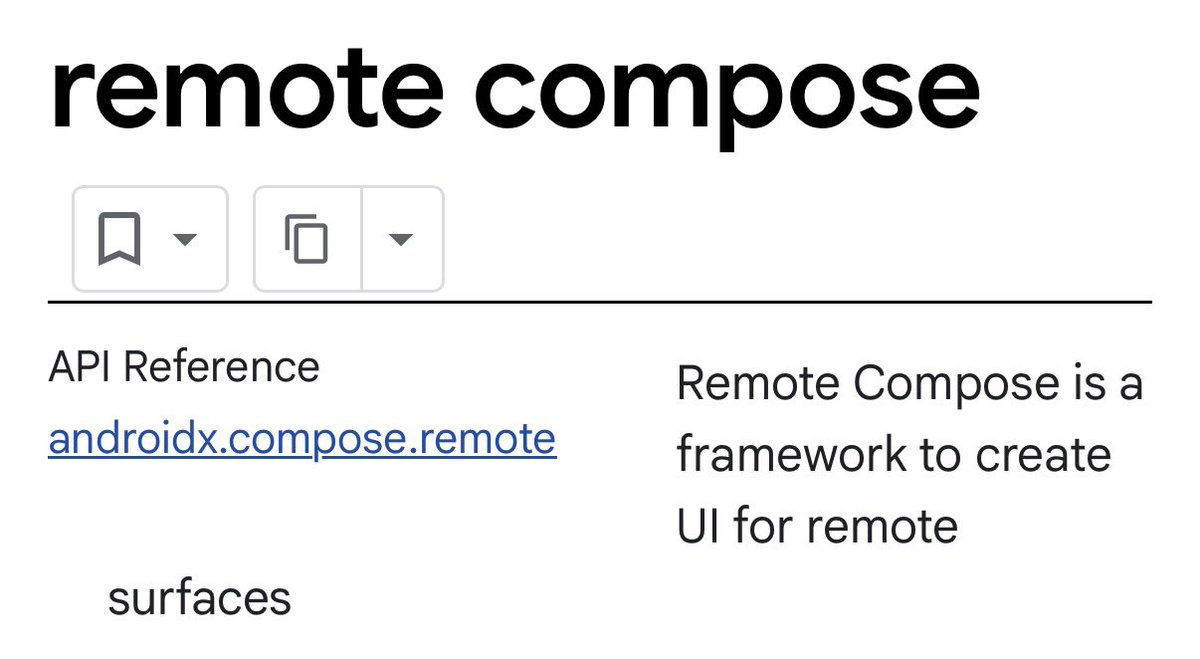
To make it short, Remote Compose is *not* made for server-driven UI. "Remote" here refers to remote surfaces: Widgets, Wear Tiles, etc. This is exactly what the official description says: "Remote Compose is a framework to create UI for remote surfaces."
Since API 35, `RemoteViews` has a new constructor that takes `DrawInstructions`. The framework also ships its own Remote Compose player. When a widget host (like Launcher) receives `DrawInstructions`, it creates a `RemoteComposePlayer` and feeds it the bytes. No XML inflation, no View tree.
`DrawInstructions` contain a series of bytes (operations) that tell the player what to draw. The player handles layout, drawing, touch, animations, all via Canvas. Once the bytes are decoded they form a "Document," which essentially bundles everything needed for the Player.
But what if a writer uses operations the player doesn't support? Operations are essentially versioned. The document declares its version, and the player checks if it can handle it. If not it rejects the document entirely.
Now the question is: Why does this matter? Until now, Glance translated Compose-like code into `RemoteViews`, which are View-based and limited. With Remote Compose, you skip that translation. You're directly telling the player what to draw: shapes, text, animations, touch handlers, all in a compact binary format.
AndroidX libraries like Glance Widgets and Wear Tiles can now either emit traditional `RemoteViews` (the old way) or emit `DrawInstructions` with Remote Compose (the new way) when supported by the host!
One question remains: if Android has its own player in the framework, why is there an AndroidX Remote Compose player if not for server-driven UI? That would be a fair question to be honest.
Non-system apps can't use `https://t.co/yAZ6RHqB1e.internal` classes. So third-party launchers need the AndroidX player to render Remote Compose widgets. It also means they can potentially support newer operations than whatever shipped with the device's Android version.
I don't believe the purpose of this was for server-driven UI. I believe server-driven UI is something that is possible but wasn't the primary intention.
By the way, there's a good chance we're going to see Remote Compose previews in Android Studio at some point. But this is just a guess.
AndroidX quietly dropped Remote Compose 👀
It’s the next level of server driven UI. It sends actual native UI drawing operations from server to client.
You update or even ship new UI from server and render it natively on Android. Powerful.