The CEO of Uganda’s largest telecoms company was asked to talk about technology. She talked about mindset instead.
I was at the Business Networking Breakfast at Rotary’s 7th All Africa Zone Institute in Kampala yesterday, where Sylvia Mulinge, CEO of MTN Uganda, gave a keynote that deserves a wider audience than the room it was given in. Her opening question set the tone: are we leading the businesses of tomorrow with the mindsets of yesterday?
Three ideas stuck with me:
1/ First, a business never sustainably outperforms the mindset of its leader, so the real transformation is mental before it is technological.
2/ Second, "potential is not performance": Africa has to stop describing itself by what it could become.
3/ Third, coverage is not inclusion. Her own numbers make the case: MTN Uganda’s 4G network covers 88.6% of the population, yet fewer than half of its 26.4 million subscribers are active data users. Across Sub-Saharan Africa, the GSMA says 66% of people live under a mobile broadband signal and do not use it.
She also applied Rotary’s Four-Way Test to algorithms and data, which may be the shortest AI ethics framework I have come across. In the Q&A with Jimmy Mugerwa she told SMEs that AI can now produce the poster they once paid a designer or an agency for. As someone who has run a digital agency for 24 years, I agree on the cost and disagree on the conclusion: AI has made posting almost free, but it has not made positioning any easier.
I have unpacked the full keynote, the numbers behind it and where I would push back on my blog:
https://t.co/iOs8IsD8nc
Which of her three challenges is hardest in your organization: reinventing before you are forced to, building people and not just businesses, or growing beyond yourself?
#AfricaRising #Leadership #Rotary #DigitalInclusion #AI #ArtificialIntelligence #Rotary #MTNUganda #Uganda
@mtnug@sylmulinge@Rotary@rotaryd9213@rotaryd9214
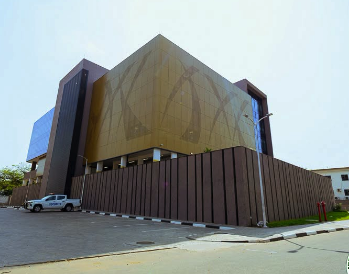
Ghana’s Minister for Government Communications, Felix Kwakye Ofosu, released images of the Women’s Development Bank is a new bank built just for women entrepreneurs! Launching early 2027, it skips the usual banking headaches—offering easy, low-collateral loans that fit real cash flows, plus hands-on business coaching to help female founders thrive. Men shouldn't bother applying.
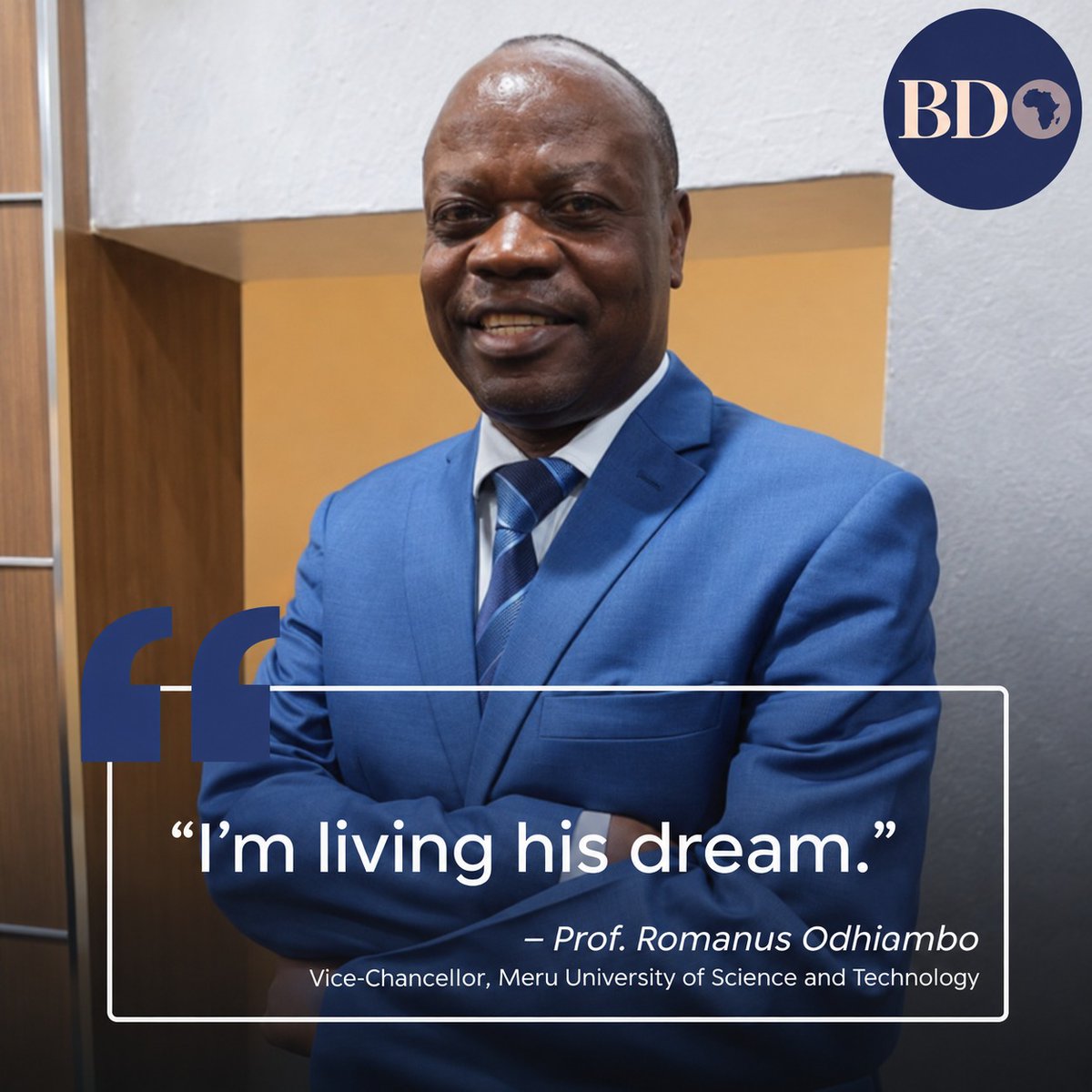
“I wanted to be a teacher to buy a bicycle.”
That was one of Prof. Romanus Odhiambo’s first ambitions. Then his teachers helped pay his school fees, and he found another reason to teach. He wanted to give other students the same chance.
Today, the watchman’s son is Vice-Chancellor of Meru University of Science and Technology. In this Business Daily Africa profile, he shares how his father and teachers shaped the choices that got him there.
Read the full profile
https://t.co/vSeOKZZJTp
After Thomas Joseph 'TJ' Odhiambo Mboya was gunned down on Saturday 5 July 1969 along Government Road (now Moi Avenue), newspapers had one afternoon to get their stories ready for the Sunday paper.
The 'Daily Nation' combined a formidable team of Philip Ochieng’ and Brian Tetley to work on the story.
But the two of them were young, hard and distracted drinkers.
So the editors locked them in a room with a crate of beer and strict instructions that they couldn’t leave the room until the story was done.
They would indicate this by banging on the door once the typewriters had gone quiet.
The story got done and it’s likely the crate itself was empty by that time.
In the golden age of newspapers, such sequestering of brilliant but distracted journalists was common.
Some of the best stories of that age were actually written by drunk people with some extreme cases involving a present paper boy whose work was to seize each sheet as the writer finished it and deliver it to the editor.
In extreme cases such as that of American journalist Hunter S. Thompson, that could take as long as a week.
Ochieng’ and Tetley were colleagues both at work and on the rave.
Tetley’s drinking was legendary and booze occupied such a big part of his life that he got married several times at Starlight Night Club.
Starlight Night Club was located at the current Ethics and Anti-Corruption Commission headquarters in Milimani.
After he died on the same hijacked plane as his friend Mohammed 'Mo' Amin off the coast of Comoros in Moroni in 1996, his friends placed several Whitecap Lager bottles in his coffin.
This week, I sat down with @FredMuitiriri of @ntvkenya to reflect on the leadership of our country and the road to the 2027 elections.
What stood out was the need to place young people at the centre of Kenya’s leadership conversation.
As we approach 2027, we must create more space for young people to participate and shape the Kenya they want to see.
When we talk about poverty, we mostly focus on the deprivations visible to the world but I’m curious, what are some of the inconspicuous ways it has stifled you as a person? The ones whose origins only you can trace?
Mine is definitely the freedom to be mediocre at something
Some deaths leave you with a debt that can never be paid. Every time you try to move towards the obligation, your feet turn to lead, your mind freezes, and once again, the opportunity passes. The burden of inaction is like a spiritual force…
Turkey tried to push Africa around at COP31 and picked the wrong woman. Dr. Zanetor Agyeman-Rawlings, Ghana’s Minister of Environment, Science and Technology, was speaking for 54 African countries when the chair cut her off. She walked straight back to that podium, called out the disrespect to his face, and walked away with an apology. Poise, power and zero fear. That is what real leadership looks like, and Africa should be proud.