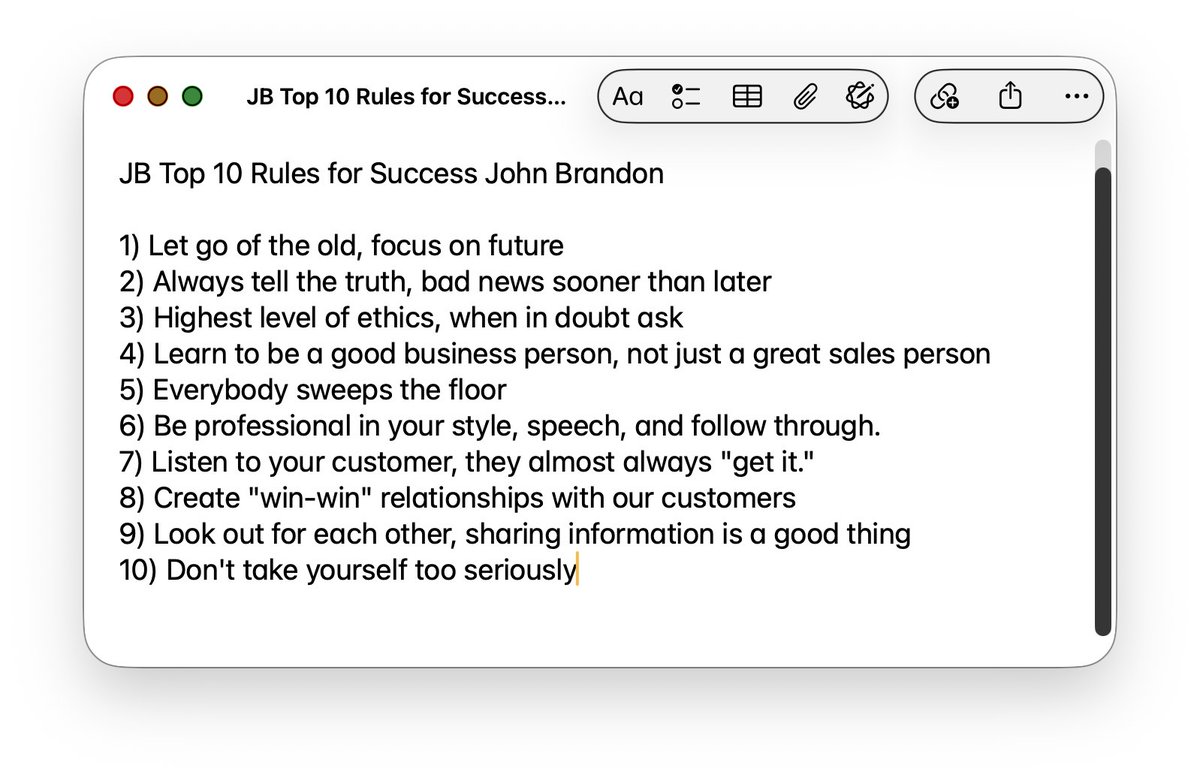
Here’s an Apple secret:
Success comes from culture, not technology.
Like many at Apple, I worked for many years under John Brandon, our longtime head of sales. He had his “Top Ten Rules for Success” which I carried around and lived by.
It’s easy to spot someone from Brandon’s team by how they collaborate. I tried to be one of them. I mopped the floor (literally at times), I shared everything I knew without gatekeeping, I always assumed the customer knew their business.
I think about AI the same way. Most AI advice right now is for builders. Almost nobody is helping the marketers, sales engineers, and execs who actually have to put AI in front of customers. That’s the gap I work in.
I left Apple last month after 22 years. After some thinking and a lot of conversations, I’m now doing what I did inside Apple, but for other organizations: AI positioning, helping businesses understand AI, and creating Apple-level presentations and content.
It's ok, but you're very obviously in front of a virtual background, especially where your hair on top is in front of a light colored book. You're also oversharpened, looks artificial, especially the bridge of your nose. Also the book background is a little too soft focus IMO.
This doesn't look better to me than macOS built-in background removal. But it's interesting! I will check it out.
Shower thought: for the next 12-18 months, IT budget is going to shift from productivity and coding AI to security AI.
The reason is the wave of AI-driven hacks, which I expect to accelerate. One attacker pointed AI agents at more than 1,200 websites and got into about 100 companies, including Deere and Cummins, for roughly $50 in tokens per break-in. AI agents also hit South Korean banks and OpenCode, and AI found PHP2Shell, a PHP bug that affects about 70% of websites, with hacking attempts going up after it went public.
Ben’s CISO survey says 51% expect security spend to grow faster than IT. Budgets are already fixed for anyone whose fiscal year isn’t the calendar year, so it’s a zero-sum game for CIOs and CISOs, and they have to get the money from somewhere.
Potential positive for:
- OpenAI and Anthropic and their private-access security models
- Chinese open models that companies can host themselves, without the guardrails that refuse security work
- Security-focused AI and networking vendors (Palo Alto Networks)
- Identity and secrets management (Okta, 1Password, CyberArk)
- 24/7 managed detection (CrowdStrike, Arctic Wolf)
Potential negative for:
- Company-wide AI seats (Microsoft 365 Copilot, ChatGPT Enterprise, Claude Enterprise, Gemini Enterprise, Grammarly), where the 500 seat pilot just doesn’t turn into 20,000 seats
- Enterprise search and knowledge (Glean, Box AI, Atlassian Rovo)
- IT service AI (ServiceNow Now Assist)
- Line of business AI (Harvey, Legora, Sierra, Decagon, Rogo)
- Coding AI (Cursor, GitHub Copilot)
- AI pilots and consulting (Accenture, Deloitte)
Yes, OpenAI and Anthropic are on both lists: they could win on security and lose on seats.
Our CISO survey couldn't be more timely. Will publish report in next few weeks full deep dive @DiligenceStack and more in depth data in CS Atlas. But here is a tease.
https://t.co/dSLbGXjdaJ
@vylrex@ivanfioravanti@Samsung I did, and saw zero acr or musicid traffic. I will say turning this off is a dark pattern and I could see even experienced people missing it. No apparent microphone activity, I tried playing music around the tv and no action.
@bwilson85tech I had Claude just patch them - they are just local qa testing images with no outside exposure so no biggie in my case but good to be sure
Just spent the last 7 days on the front lines of the vulnpocalypse fending off an active cyber attack on one of our products.
Some thoughts:
- Software factories are going to be required equipment for everyone. There’s just no way to keep up with the pace of highly automated adversaries without one.
- We were lucky because we had spent the last few months getting our software factory running well. It is nice to have for product development but proved to be absolutely essential this week.
- At the minimum you need to have a coding server in the cloud pre-provisioned with read only access to all your logs and all the services you depend on for observability. With that in place you are a prompt away from reasonably good situational awareness, ongoing monitoring with loops, and ability for coding agents to validate fixes against your actual, observed attack patterns.
- Shared coding server also unlocks multiplayer incident response where everyone can see every session and jump in as needed. Sharing session links that can be forked is much higher bandwidth than re-explaining things.
- You don’t need to be Ramp/Stripe/Uber scale to have a working software factory in the cloud. We are a team of 3. Ours is built with an @opencode server (thanks @thdxr!), a forked version of compound engineering optimized for automated workflows (thanks @kieranklaassen!) and a multiplayer agent in slack that handles crons (we have our own harness but pick your favorite here).
- To get our software factory up and running well, we had to stop all new product development for ~6 weeks and just focus on getting the validation systems working that enabled us to reliably shipping PR without human code review. This felt very painful in the moment but was totally worth the eventual speedup in velocity.
- KYC for @AnthropicAI & @OpenAI cyber programs is now easy and quick (at least for defensive access), but a day felt like a lifetime this week. Submit your app now before you really need it.
- Getting Mythos access unlocked a deeper level of analysis that helped us shift from reactive mitigation to proactive patching. Wish we had done this a few weeks earlier. Get started now!
@Scott_Weidig if you have a Mac running grok bot at home, tell it "install https://t.co/7Do7v2PSFI and use that to read my Messages. Never send a message, only read."
This is my final setup (probably) for the next few months. (I already posted this once, but an agent deleted it by accident)
A 15U 10-inch rack with:
4 Sparks (NVIDIA GB10), 128 GB each
2x ASUS Ascent GX10
1x Gigabyte AI TOP ATOM
1x Lenovo ThinkStation PGX
Mac Studio M5 Ultra, 256 GB, my new workstation
Next to it:
System A: RTX 5090 32 GB, Ryzen 9 9950X, 96 GB RAM
System B: 2x RTX 5060 Ti 16 GB, i7-12700K, 32 GB RAM
MacBook Air 13-inch M4, 16 GB
I run local AI on this rack at home and post the real outputs and numbers here on X.
Until now my only workstation was the 16 GB MacBook Air. I kept switching between the standing desk (right in the last photo) and the main desk (left).