Grew up in Southeast Asia, studied and lived many years in Japan, now working in Germany. Pushing for long in computational science, now start pulling E2.0
@elsua That's a great move; a conscious choice, fully away and out of comfort zone. Does St. Patrick do that?
Looking back, I have kind of 18-year cycle, so what's next:
1985 - move to Japan 🇯🇵;
2003 - move to Germany 🇩🇪;
2021 - ??
@danieldekay Budget?? We actually save ca. 500K per year, moving away from old platform (to Yammer). Does that count? This time, we only have volunteers... that's great, cause they're driven by real business needs, not hype... :)
@danieldekay@ESNchat We have many in-house Academies (in communications, hr, finance, business units, etc.), this time, offering their learning programs (not about ENS) making use of our #ESN platform that helped us growing.
@CelineSchill@elsua Sound good... and we are invited to the front row seat - right in front of our PC, watching Luis walking on the wonderful beach while talking about waves of topics he likes, right?? Who would be the guest speaker??
@gbrettmiller@elsua@rhappe Yeah... our body and our mind can't always agreed with each other, right?? Rigrt now, even in the same time zone (CET), my body is showing up in another MS teams Meeting, my mind is wondering what Luis is presenting, at this moment.
Apparently, he couldn't do live-tweeting.. :(
@rhappe@elsua No..no.. Now I know.. Luis will tweet quicker as he usually do!
He will walk the talk.. and talk as he tweet.. That's it!!
How else can he do that? Any one has a better idea.. ??
@elsua 14 years!? Was There any Twitter, so long ago??
If it's not you saying that, I wouldn't believe it... no kidding.. :)
How can you stay in one platform for so loooooog!?
And how do you feel?? Is everything still okay, as before and after this 14 years??
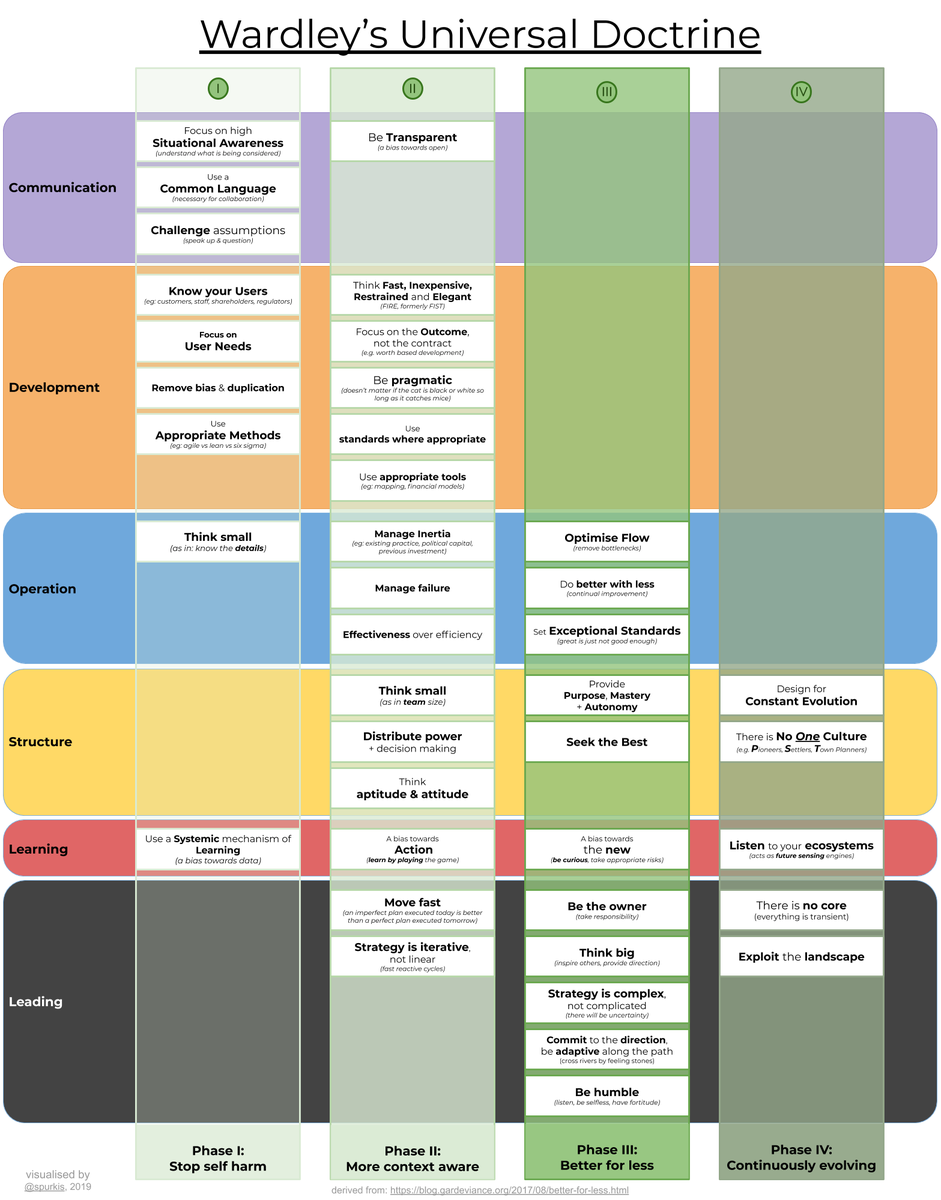
Want to learn how to Wardley Map? Try ...
4)Courses
"Mapping"
by Chris (@wardleymaps)
https://t.co/FOj6AHotLU
"Pragmatic Wardley Mapping"
@BenMosior
https://t.co/LTOuhDh0vU
3) Awesome list
@jhngrant
https://t.co/yEAsJtxe0L
2) Book
https://t.co/nFt3hsynUB
1) Practice!
@jonhusband Oh WoW.. Jon, only 5 in person?
Hmm... I guess I have seen 10 times more delivery person, over last 6 months :-(
Home office is not really my thing, but I'm in productive mode far more often than before.. :)
@rhappe And you learn a lot about a behavior, especially when you try to make it tiny for someone else.
This book focused on "personal behavior" and only a chapter on "group behavior", but it is very helpful for designing new behavior in combination with community building practices.
@rhappe@TheCR@hillaryboucher Yes, thanks @hillaryboucher for her ideas. And we now build it into the BJ.Fogg behavior model - you have introduced to us long ago, as a way to prompt and make it easy to take actions. :-)
PS. I add some new learnings from Prof. Fogg's new book "Tiny Habit", too.
@rhappe Agreed. Therefore we are developing programs for community leaders to learn how to setup their path-finding Quests to onboard new members; to gain new contributors, etc.
PS. Thanks good examples of Quests shared in @TheCR networks.. :)
@rachadbn Yes, agreed. It depends on how the leaders are actually acting, too. They can be old-school to miss use a "community" for pushing their agenda, or be progressive by building a "flat hierarchy" for a collaborative organization, right?
@rhappe@rachadbn Oops.. sorry for not pointing to the actual page - the slide "Types of communities" is in page 14. That was an observation from hundreds of online communities freely created on our internal social network platform in BASF - piloted in 2009, and officially launched in May 2020.
@rhappe@rachadbn Thanks for sharing, Rachel. That's a nice work!
The types of communities are somewhat similar to what I've shared, in 2010, on SlideShare: https://t.co/y6PhnlBxRB
As a different observation, it seems to confirm a patern of community formation inside an organization.