Journalist & Translator | Based in Germany
Focus Areas: Current Affairs in Germany | Politics | Political Parties | Justice | Philosophy |
Personal Account
BBC and the Internalisation of Islamic Republic Narratives
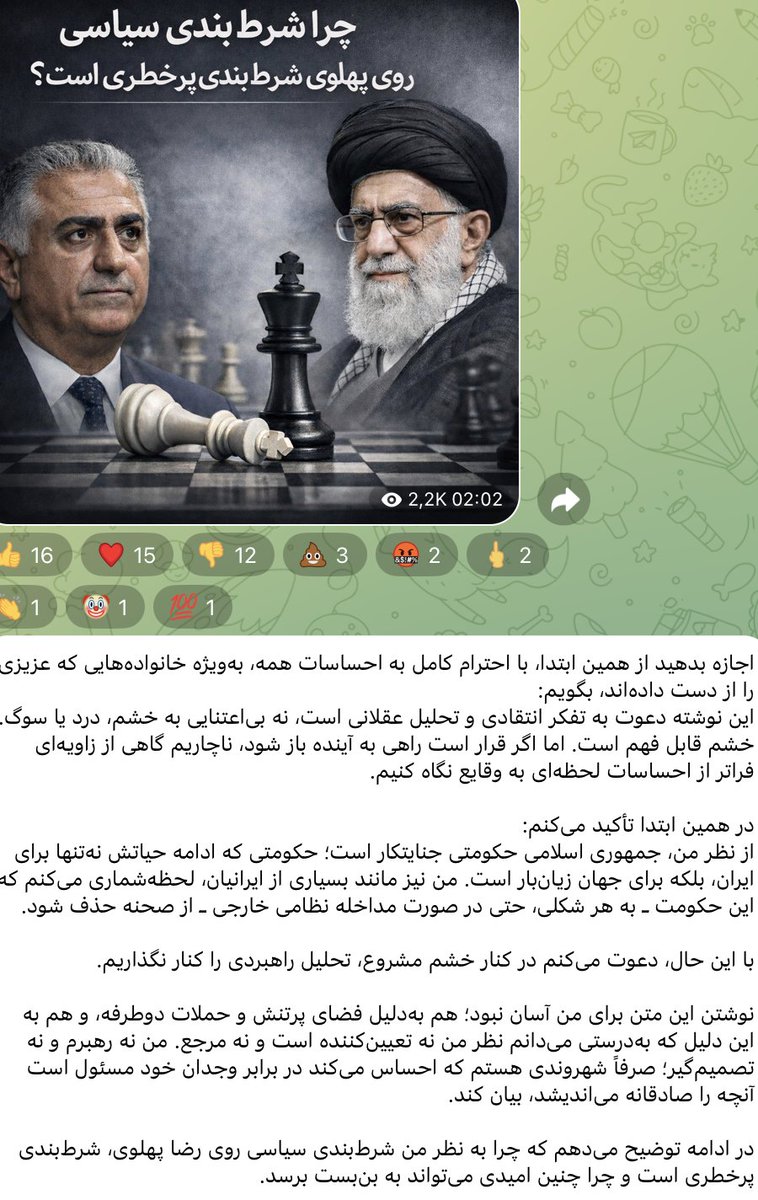
The line‑up of pundits who have worked – and in some cases still work – for the BBC @bbcworldservice, @BBCWorld, @BBCNews and now jointly speak out against Reza Pahlavi has become more or less complete: Nader Soltanpour @NaderSoltanpour, Siavash Ardalan @BBCArdalan, Panah Farhadbahman @PanahFB, Keyvan Hosseini @Kayvan_Hosseini, Mehrdad Farahmand @MRD_Farahmand, and Rana Rahimpour @ranarahimpour, who has published a text under the title: “Why placing a political bet on Pahlavi is a dangerous gamble?”
The title is an ironic allusion to one of Reza Pahlavi’s own remarks during the nationwide uprising of 2022 in Iran, when he addressed the regime’s repressive forces and told them: “Don’t bet on the losing horse.”
The “opinions” voiced by these current and former BBC staffers – namely that monarchists and their preferred option are “unsuitable” or “dangerous” – are, unsurprisingly, remarkably aligned.
They insinuate – without offering any serious evidence – that if Reza Pahlavi @PahlaviComms ever came to power, Iran would automatically slide into a new dictatorship. This is pure speculative alarmism, indistinguishable from the Islamic Republic’s own talking points: instead of grappling with actual programmes or behaviour, it teaches the audience to pre‑emptively fear any organised alternative and to see every path beyond the current regime as another route to tyranny.
Morgan Ortagus and the structural problem
Several years ago, former U.S. @StateDept spokesperson Morgan Ortagus @MorganOrtagus pointed quite directly to a structural problem at BBC in a live interview – a warning many inside the newsroom seem to have shrugged off, perhaps simply because she had worked in a Trump administration:
Link to the mentioned part of the interview in Persian: https://t.co/udj4DZ7pV8
Yet her diagnosis was accurate. The conscious or unconscious internalisation of the Islamic Republic’s propaganda, and treating its premises as self‑evident, is at the heart of the problem on display in this new piece: a kind of political “taqiyya” (religious strategic self‑concealment and dissimulation): The result is a permanent regime of self‑limitation: you censor yourself, narrow your own life, and voluntarily give up rights and freedoms in advance, all to accommodate the dictator. Always calibrate your opposition, your slogans, and even your very presence to the regime’s red lines; hide your real objectives behind layers of caution, because “the dictator will never back down.” Show respect for what the Islamic Republic wants. When it channels the financial windfalls of sanctions relief under @BarackObama into further building up proxy militias in the Middle East, fuelling anti‑Israel campaigns, or prolonging slaughter and displacement in Syria, do not disturb it – stay in the nuclear deal at all costs.
Why BBC English reporting from Iran lacks real journalistic value
This is also why recent @BBCWorld reports and interviews from Iran – including Lyse Doucet’s @bbclysedoucet pieces – have little real journalistic value. They are produced under conditions that are structurally discriminatory against Persian‑speaking colleagues and shaped largely by terms dictated by the regime itself, as some BBC Persian staff have pointed out in the past.
That may satisfy editorial demand in London, but it does not amount to independent reporting from inside a dictatorship after many cases of mass murder. And even this is only the legal‑ethical side of the problem; it does not touch on the propaganda function such coverage performs for the Islamic Republic, by normalising its rule and presenting everyday life in Iran as if it were almost “ordinary.”
The argument about “dangerous links” to exiled figures
Rana Rahimpour’s text remembers Ortagus’ warning precisely at this point. She writes: “In such circumstances, any direct or symbolic link between protests inside the country and a specific figure abroad can multiply the cost of dissent for ordinary people. Once the name of an individual or a particular group is attached to a social movement, the regime can easily portray all protesters as foreign‑backed, security threats or external enemies – which, in practice, puts people’s lives at greater risk.”
Stripped of its rhetoric, the logic that Ortagus criticised – and which the former BBC presenter now reproduces in a different form – would today read as follows, conveniently forgetting that during the November 2019 massacre no one abroad had issued any “call” for protests: “If Reza Pahlavi had not called for demonstrations, the situation would never have escalated to the point of today’s massacre.” Yet the Islamic Republic has repeatedly gunned down unarmed protesters regardless of whether any exiled figure issued such a “call” – most starkly in November 2019, when no call from abroad existed at all.
Repeating the regime’s narrative about the opposition
On an analytical, social, and political level, this former BBC employee’s argument suffers from several fundamental flaws and ultimately reinforces the narrative that the Islamic Republic has been producing and recycling in Western media for years.
The text suggests that the opposition is reckless and without a plan, that it is a threat to Iran’s future, that exiled leaders are frivolous and irresponsible, and that the only ‘rational’ path is to lower expectations (see attached screenshot and the full text on Telegram: https://t.co/VG3fhazCld).
From “plurality” of leaders to paralysis
In practice, the piece also dresses up a demand for “plurality” at the leadership level, which, under the current balance of forces, simply means fragmenting the public around every actor with a tangible social base. Pluralism in parties and parliament is a democratic virtue; fragmenting symbolic leadership in the middle of an existential struggle is not pluralism, it is paralysis – precisely what certain so‑called “republican” factions in the diaspora have been doing for a couple of years.
The result, as we saw after the rigged 2009 “election” in Iran, is political deadlock: endless quarrels over collective leadership, internal struggles within would‑be leadership groups, and, in the end, the continuation of the Islamic Republic.
When the dictator sets the rules of “safe” dissent
By repeating and adapting the regime’s talking points, the BBC and its former or current employees help internalise the dictator’s preferred behaviour in the minds of protesters and dissidents. What the regime dictates becomes part of the very grammar of “criticism” and “opposition”, rather than what opponents themselves genuinely want and believe.
From this point onward, it is the dictator who defines the boundaries of the playing field, the permissible scope of protest, and the acceptable forms it may take – or at least shapes them as far as the opposition’s discourse allows. The failure of any attempt at serious protest or regime change begins exactly where everyone starts accommodating the dictator and adjusting themselves to him. That accommodation can take the form of clinging to the nuclear deal at any price – or of protesters moderating their demands and refraining from rallying around any recognisable leadership figure.
The constitutional fact that is never mentioned
Whether one is monarchist or not, one simple constitutional fact from before 1979 is usually airbrushed out of such commentary: absent the catastrophe of 1979 and its so‑called Islamic Revolution, the very person now cast as a “dangerous gamble” would, under the legal order that revolution overthrew, be the lawful head of state of Iran.
This is how far the mindset of some current and former BBC employees has drifted towards the Islamic Republic’s propaganda – to the point of internalising it and selling it back to the audience as cautious, reasonable “analysis.”
@Ofcom@UKParliament@CommonsCMS@TIME@Channel4News@PiersUncensored@piersmorgan@reuters@AP@TheAtlantic
#IranRevolution2026 #DigitalBlackoutlran #IranMassacre #R2PforIran
https://t.co/eziU4bAVxx .
Whether accurate or not, it is deeply troubling and concerning that someone within this industry is claiming that the market for natural hair of Iranian origin has seen an increase in sales.
Had VOA’s Persian Service, @VOAfarsi, not been in the hands of an ill-intentioned liar and propagandist like #AliJavanmardi @Javanmardi75, a claim like this—whether a rumor, #misinformation, or whatever else one might call it—would have warranted proper verification and fact-checking, precisely because it comes from a source operating within the #industry.
@StateDept@SecScottBessent@FBIDirectorKash@NewYorkFBI@FBI_Response@FBI
#DigitalBlackOutIran #IranMassacre #IranWar
https://t.co/qSd0PYyTdP
Very alarming: Question regarding the following video: Is there credible evidence to support the viral TikTok claim by wig maker #MorganFathi that a recent “massive influx” of Iranian hair into the US market may be linked to the regime allegedly using corpses of killed protesters to generate revenue – a claim that, if true, would have grave implications for health, human dignity and the lives of those whose bodies are being commodified?
@FBI_Response@FBI@NewYorkFBI
Morgan Fathi says: "I have been a wig maker for nearly 15 years. So you can imagine that I have gone through every avenue of sourcing hair. The generic regions where hair would come from is Indonesia, Asia, and then you’d see European and Slavic is actually kind of newer in at least the US space. And what I’ve been noticing as of late is a massive, not just a couple ponytails, but a massive influx of Iranian hair. And normally, I wouldn’t think much of this, but my husband is Iranian and we have been keenly aware of what has been going on in Iran. So in January, for those of you that don’t know, about 40,000 Iranians were killed by their own government. And one of the many things that the government did was force the families to pay 4,000 dollars to get the bodies of their dead family members back. And then make them pay for the bullets that killed them. And that just scratches the surface.
So when I zoom out and think about this, this is all way too coincidental.
So here’s what we know. One, a lot of Iranian protesters were killed in January. Two, we know that the government of Iran was using corpses to make money for the regime. And then three, about what, four months later, we get a massive influx of Iranian hair in the US. No?
And we all know that the ethics of hair sourcing has always been up in the air. So this one’s just feeling a little too close to home and a little too sus for me.
Let me know what you think. Am I crazy?"
#IranMassacre #IranWar #DigitalBlackOutIran
Dieser Text erinnert an den Missbrauch, den Shadi Amin im Fall der Ermordung von Nika Shakarami begangen hat, und dokumentiert anhand von Quellen ein Beispiel für die Falschdarstellungen und Verdrehungen von Soheila Amin‑Torabi. Er verweist auch auf die öffentliche Gegenreaktion und die Protestpetition gegen sie und kann bei Bedarf als Teil der Unterlagen Anwält:innen und Gerichten vorgelegt werden; erfreulicherweise lebt Nika Shakaramis Mutter außerhalb Irans und könnte – sofern sie es möchte – die Unrichtigkeit von Shadi Amins Darstellung bezeugen. Shadi Amin ist nach eigenen Angaben Koordinatorin des iranischen LGBT‑Netzwerks 6Rang.
https://t.co/Ac7ukxflT8
Am 18. November 2022 erhielt sie in Spanien den „International Lesbian Visibility Award“ (Internationaler Preis für lesbische Sichtbarkeit).
https://t.co/0LqXn7S9j6
https://t.co/ccJiprcipW
https://t.co/NOJUIWH6UX
In einem englischsprachigen Bericht von 6Rang über diese Auszeichnung wird Nika Shakarami als „16-year-old queer woman“ (16-jährige queere Frau) bezeichnet, die von Sicherheitskräften ermordet worden sei; Amin widmet den Preis ausdrücklich „Nika Shakarami and her dreams“ (Nika Shakarami und ihren Träumen) sowie „all the young people who live in fear of their true identities and sexualities being unveiled“ (allen jungen Menschen, die in Angst leben, dass ihre wahre Identität und sexuelle Orientierung enthüllt werden).
https://t.co/0LqXn7S9j6
In einem UN-Beitrag von 6Rang wird festgehalten, Amin habe ihren Award (Preis) LGBTI-Jugendlichen gewidmet, „who lost their lives in the protests“ (die bei den Protesten ihr Leben verloren haben), und Nika als eine dieser „martyrs“ (Märtyrerinnen) namentlich genannt.
https://t.co/SJo6eEMfx6
Weitere Berichte (u. a. Washington Blade, Dinamopress) wiederholen, dass Amin den Preis Nika gewidmet und sie als Teil der LGBT-Bewegung bezeichnet habe.
https://t.co/mf4Xz2jHzK
https://t.co/B2MKTk1RNT
Gegen diese Darstellung richtet sich seit 2023 eine Online-Petition mit dem Titel „Shadi Amin is not a representative of the LGBTQ+ community in Iran“ (Shadi Amin ist keine Vertreterin der LGBTQ+-Gemeinschaft im Iran).
https://t.co/1VQGzPxYQj
Dort wird Amin (unter ihrem bürgerlichen Namen Soheila Amintorabi) vorgeworfen, die Privatsphäre mehrerer getöteter Demonstrierender – namentlich Nika Shakarami, Mehrshad Shahidi, Sarina Esmaeilzadeh und Hadis Najafi – verletzt und „rumours“ (Gerüchte) über deren sexuelle Orientierung bzw. Geschlechtsidentität verbreitet zu haben, „solely for self-promotion and the promotion of their organization“ (ausschließlich zur Selbstvermarktung und zur Förderung ihrer Organisation).
https://t.co/1VQGzPxYQj
Die Petition führt aus, Nika Shakaramis Familie habe ausdrücklich erklärt, dass Nika sich anders identifiziert habe als von Amin dargestellt; dennoch habe Amin ihren Namen genutzt und andere Personen in diese Darstellung hineingezogen.
https://t.co/1VQGzPxYQj
Außerdem wird dort darauf hingewiesen, dass der Vater von Mehrshad Shahidi entsprechende Gerüchte öffentlich dementiert habe.
https://t.co/1VQGzPxYQj
Unabhängige Berichte über Nika Shakaramis Leben und Tod – etwa BBC-Recherchen, IranWire und Menschenrechtsdokumentationen – schildern ihre Teilnahme an den „Woman, Life, Freedom“-Protesten („Frau, Leben, Freiheit“), ihre Verhaftung, mutmaßliche Misshandlungen und Tötung durch Sicherheitskräfte sowie den massiven Druck auf die Familie, machen aber keine eigenständigen, belegten Aussagen, die Nikas sexuelle Orientierung zum politischen Thema erheben.
https://t.co/KMzUkmqFaU
https://t.co/z6Pxqc5U6P
https://t.co/DSq1hLYs4v
https://t.co/PKnH14pIN4
https://t.co/z348s8jrjE
https://t.co/DoFLGJZ1ft
Vor diesem Hintergrund lässt sich aus den vorliegenden Quellen zusammenfassend ableiten:
Amin und 6Rang haben Nika öffentlich als „queer“ (queer) bzw. als Teil der LGBT-Bewegung dargestellt und ihren Namen zur Symbolfigur in diesem Kontext gemacht.
https://t.co/0LqXn7S9j6
https://t.co/SJo6eEMfx6
https://t.co/mf4Xz2jHzK
Eine Gruppe von Unterzeichner:innen wirft Amin in einer ausführlich begründeten Petition vor, diese Zuordnung ohne Zustimmung und gegen die erklärten Vorstellungen von Familienangehörigen vorgenommen, die Privatsphäre verletzt und die Faktenlage verzerrt zu haben. Auch die Familie von Shakarami hat laut BBC öffentlich die Schilderungen Amins bestritten.
https://t.co/1VQGzPxYQj
Die verfügbaren Menschenrechts- und Medienberichte zu Nika Shakarami konzentrieren sich auf den staatlichen Mord, Zwangsmaßnahmen gegen die Familie und den politischen Kontext der Proteste, ohne die von Amin behauptete Identität zu belegen.
https://t.co/KMzUkmqFaU
https://t.co/z6Pxqc5U6P
https://t.co/DSq1hLYs4v
https://t.co/PKnH14pIN4
How VOA’s New Advisor Targets Iran’s Opposition and Foreign‑Based Media
At a moment when Iranians are under massacre and mass‑arrest risk simply for protesting on the streets, Washington’s messaging is moving the other way. In recent weeks, Voice of America has begun accusing media outlets that are giving Iranians a voice of spreading propaganda, even as its own Persian service faces internal whistleblowers who say it is censoring coverage of Iran’s opposition leader, Crown Prince Reza Pahlavi.
Meanwhile, a newly appointed advisor for the Persian, Kurdish, and Afghan sections — Ali Javanmardi, who has openly stated on @X that he was kept informed about efforts to lobby German decision‑makers to keep Prince Reza Pahlavi out of the Munich Security Conference in 2025 — is purporting to speak for the U.S. government and playing the role of a de facto White House spokesperson in his reporting, a role that is incompatible with any claim to impartiality toward Pahlavi and the broader opposition. In his constantly repeated monologues, which he tries to sell as TV interviews and realistic reports, he claims to understand and speak for Iran’s entire situation, which is not true, as the following sections of this analysis will show.
He constantly censors those who see Pahlavi as an opposition leader and/or a central part of a future political system, and by framing him and figures like him as “another Ahmad Chalabi,” he conflates distinct cases and obscures the real debate over what legitimate external support for Iranians should look like. This piece traces how a taxpayer‑funded broadcaster and official surrogates are reshaping that narrative, what that means for editorial independence and democratic accountability, and why the stakes for activists inside Iran — and for Western credibility — couldn’t be higher.
1. “Engineered voices” and “fishing in troubled waters”
By calling an entire spectrum of anti‑regime voices “engineered” and “fishing in troubled waters” in yet another monologue on 26 January, he delegitimizes genuine political dissent and frames it as a conspiracy. This is the rhetoric of a partisan activist, not of a senior figure in a public‑service broadcaster who must remain professionally impartial and is bound by the VOA Charter and Journalistic Code to provide “accurate, objective, and comprehensive” coverage and to “avoid imbalance or bias” in news reports.
He turns specific, concrete criticism of VOA Persian’s limited coverage of pro‑monarchy and other opposition groups into a narrative of “orchestrated pressure,” smearing critics instead of addressing their arguments. This is an abuse of his institutional position within a U.S. taxpayer‑funded outlet and conflicts with VOA’s requirement that staff “avoid the use of unattributed negative terms or labels to describe persons or organizations” and “present a full and fair account of events.”
2. Linking opposition groups to “Chalabi‑making” and the Iraq/Libya scenario
By framing opposition figures and movements abroad under the label of “Chalabi‑making” and equating them with the Iraq/Libya scenarios, he implicitly portrays them as foreign puppets, erasing the legitimacy of genuine, grassroots demands for regime change and political alternatives. Such loaded political labeling clearly breaches VOA’s standards against partisanship and against “supporting one specific agenda,” and undermines the obligation to be seen as a “consistently reliable and authoritative source of news.”
The inside‑versus‑outside dichotomy that Javanmardi keeps hammering home in his monologues is part of the same move: it is exactly what Iran does not need, because there is one people, inside and outside the country, fighting a common enemy called the Islamic regime. This “Chalabi‑making” framing mirrors the Islamic Republic’s own #propaganda, which reduces every independent alternative to a foreign regime‑change plot. For a senior VOA adviser, reproducing this narrative directly violates editorial independence and the duty to present a pluralistic picture of Iran’s opposition, as required by VOA’s Best Practices Guide, which instructs journalists to be prepared with facts “to balance the statement of one side or the other” and to put aside their own “cultural values and personal beliefs” when preparing reports.
3. Systematic disparagement of activists and critical media figures
In these new VOA monologues, he collectively brands a wide range of media figures, politicians, and legal professionals as former servants of the Islamic regime's “totalitarianism” who are now allegedly part of a new “totalitarian project” to monopolize the diaspora space—without offering a single concrete piece of evidence. This is character assassination, not journalism, and directly contradicts VOA’s instruction that staff must not use “unattributed negative terms or labels” and must avoid “sensationalism, personal value judgment, or misleading emphases” in their reporting.
When such sweeping accusations are made by someone holding an official role at VOA, they effectively weaponize the institution’s name to discredit political and media rivals within the opposition. This raises serious conflict‑of‑interest concerns and violates basic ethical norms for any public broadcaster, because VOA and USAGM policy explicitly warn that journalists must avoid “conflicts of interest” and even the appearance of such conflicts, including situations where a journalist has “publicly personally expressed a political opinion” on an issue they cover.
There are already multiple reports of dissatisfaction about this situation among staff members, and the supervisors and the USAGM board should take them very seriously — especially in light of a public international petition with nearly 40,000 signatures calling for Ali Javanmardi’s removal from his position at VOA Persian over biased reporting and censorship of Iranian voices.
4. Accusing opponents of undermining “peaceful coexistence”
He effectively blames parts of the opposition who openly address Iran’s future relations with Israel and the regional order for undermining “peaceful coexistence,” as if discussing foreign policy choices were itself destabilizing. In reality, open debate on these issues is a core component of any democratic alternative, and VOA’s mission explicitly requires “balanced and comprehensive” presentation of significant currents of thought, not the silencing or stigmatizing of one opposition current in favor of another.
While he acknowledges unwavering U.S. support for Israel’s security, he delegitimizes opposition actors who incorporate this hard fact into their vision for Iran’s future foreign policy. This inconsistency reveals an attempt to police the opposition’s discourse rather than objectively inform the public, and runs counter to VOA’s mandate that journalists remain “fair, impartial, and objective in all public spaces,” including when they appear or speak outside strictly news formats.
5. Claiming a monopoly on interpreting U.S. (Trump) policy and weaponizing it
He speaks as if he were an unofficial spokesperson for a “new world order” in the Middle East and the ultimate interpreter of Trump’s Iran policy, using this stance to label monarchists and other critics as advocates of “returning Iran to the past.” Such rhetorical authority‑claiming is inappropriate and dangerous for someone in a public‑media role, because VOA “does not speak for the U.S. government,” and its staff are explicitly instructed not to take controversial political positions that would lead audiences to doubt VOA’s #neutrality and ability to cover all sides fairly.
By grounding his attacks on opposition options and other media outlets in his personal reading of U.S. policy, he aims to preemptively delegitimize any political model he dislikes, including the restoration of a constitutional monarchy or other alternatives. This effectively turns VOA into a tool for engineering the opposition landscape, contradicting the mandate of a public international broadcaster whose charter and standards emphasize independence from political pressure, adherence to “the highest professional standards of journalism,” and avoidance of partisanship or advocacy for a particular faction.
---
This article may be republished, in full, by newspapers, magazines, and online outlets, provided that the author is clearly credited and a link to the original publication is included. All edits or adaptations must be explicitly marked as such and must not distort the author’s argument or factual claims.
---
@HelloLauraKelly@VOANews@VOADirector@KariLake@VOAfarsi@FoxNews@thehill@TheHillOpinion@BBGWatch@usagmceo@StateDept@PressSec@AP@Reuters
#IranRevolution2026 #DigitalBlackoutlran #IranMassacre #R2PforIran
#AliJavanmardi's claim of neutrality does not survive his record—specifically, the pre-appointment record of that “senior adviser,” who is now placed in editorial authority over the very service that is now claiming impartiality.
VOA Persian states that its program “Maydan” hosts voices from across the Iranian opposition, that Reza Pahlavi was invited but did not respond, and that the invitation remains open!
These claims deserve scrutiny—not as a defense of any political figure, but as a matter of basic editorial accountability for a publicly funded broadcaster.
Public Animosity
On February 6, 2025—months before his appointment to a senior advisory role overseeing VOA Persian—Ali Javanmardi published a tweet in which he described Reza Pahlavi's cancelled Munich appearance as the result of a legitimate protest by “Iranian democracy advocates,” directly contradicting Pahlavi's account that the cancellation was orchestrated to appease the Islamic Republic.
Accused Pahlavi of attacking opponents, explicitly labeled his movement “Pahlavi Cult”—a term of delegitimization lifted directly from Islamic Republic propaganda vocabulary! Concluded with the declarative political judgment, “Tyranny in all its forms has no place in Iran's future”—framed as a direct verdict on Pahlavi's supporters' movement.
This is not a private opinion expressed in passing. It is a publicly documented, politically charged attack on one of the most prominent figures in the Iranian opposition, published under his own verified name. Months before he assumed editorial authority over the very service now claiming neutrality toward that same figure. It is only one of many statements Javanmardi has directed against a specific current of the opposition that today has a substantial social base inside Iran, and in the entire history of VOA Persian, there has never before been a petition that gathered tens of thousands of signatures demanding the removal of a single employee, as in Javanmardi’s case.
The Structural Problem
VOA Persian's statement that it presents “a full range of viewpoints without advocating for any one leader” cannot be reconciled with the appointment of a so-called senior adviser who had already publicly and explicitly advocated against one of the most prominent opposition leaders—using language indistinguishable from Islamic Republic talking points—before taking that role.
Editorial neutrality is not only a matter of which guests receive invitations. It is a matter of who holds editorial authority, what political positions they held before assuming that authority, and whether those positions created a structural conflict of interest that shapes coverage—including decisions about framing, emphasis, and which voices are treated as legitimate.
The “Maydan” Problem: Framing and Source Misuse
As documented separately, the program “Maydan,” which aired on February 16, 2026, broadcast a segment in which a guest cited a German YouTuber's video as independent journalistic evidence against Reza Pahlavi—without disclosing that the video was itself a repost of content produced by Trita Parsi, widely documented as a lobbyist for the Islamic Republic's interests in the West. The host did not correct, contextualize, or challenge this.
The Full Story: https://t.co/4J6mNs9YSB
The name “Maydan” is itself worth noting: in the political vocabulary of the Islamic Republic, as the regime apologist Javad Zarif himself acknowledged in his leaked remarks, “Maydan” denotes the operational domain of the IRGC—as opposed to diplomacy. Whether intentional or not, the choice of this name for a VOA Persian political program is a question the broadcaster has not addressed.
The Standard That Applies
VOA's own News Standards and Best Practices Guide explicitly prohibits advocacy journalism, defined as “presenting—or censoring—news to advance a particular viewpoint or agenda.” It requires independent sources, a balanced presentation of all relevant viewpoints, and editorial independence protected by a structural “firewall” from outside political influence.
The question is not whether Reza Pahlavi was formally invited, which was literally the case. The question is whether a broadcaster whose senior editorial employee had publicly labeled his movement a “cult” or “fascist” and celebrated the disruption of his public appearances can credibly claim to offer him—or his supporters—a level playing field. When an “adviser” calls people who also stand in the street and chant for an opposition leader a “cult,” he is effectively siding with the same gunmen who are firing on protesters.
Why Divisive Hosts Undermine Iran’s Struggle—and VOA’s Mission
The debate does not require any defense of monarchy. It requires only a consistent application of the standards VOA is legally bound to uphold—accuracy, balance, fairness, and equal treatment of competing political views. With divisive figures like Javanmardi, VOA will not reach any of those standards, given that he publicly defended efforts in 2025 to have Crown Prince Reza Pahlavi removed from the Munich Security Conference in Germany—the very same figure you now present as a “neutral” adviser, as the following tweet shows.
The opposition’s priority now must be the ongoing mass killings and the survival of protesters inside Iran, not importing every feud onto that battlefield, while your adviser is busy providing background dossiers and personal records on other opponents instead of amplifying their fight for survival.
Figures—like #AliJavanmardi—whose main political trademark is attacking a main opposition leader, and the one the Islamic regime publicly treats as a primary threat through constant vilification and censorship campaigns, are simply the wrong choice if a public broadcaster claims to serve all audiences and prepare them for the post‑mullah stage, where Iran and the United States will need to cooperate on reconstruction, justice, press freedom, journalistic training, and regional security.
@VOAFarsi@VOADirector@KariLake@HouseForeign@VOADirector@HouseForeign@LindseyGrahamSC@hdagres@savevoanow@pwidakuswara@StateDept@WashTimes@WSJopinion@thehill@TheHillOpinion@AP@ReutersIran@ReutersPolitics@business@washingtonpost@LauraLoomer@PressSec
#IranMassacre #IranRevolution2026 #PressFreedom #VOAPersian #R2Pforlran
The IRGC says that recent damage to Kuwait International Airport, killing one and injuring dozens, was caused by a US Patriot system that failed to intercept Iranian missiles
🟡منتشر کنیم تا دنیا ببیند!
-به این فیلم، به این کلمات و احساس، به این جسم های بی جان خوب دقت کنیم، درسته که پس از #کشتار_بیرحمانه_دیماه دیگر ما انسانهای عادی نخواهیم شد، اما بی شک پر انگیزه تر و پر اراده تر در مسیر انتقام خون عزیزانمان پیش میرویم.
هشتگ #Junuary8_9_2026 معرف کمپین
https://t.co/Ku0nYuZ4DKميباشد.
اسناد، مدارك و مشاهداتتان را با ما به اشتراك گذاشته كه روز عدالت نزديك است.