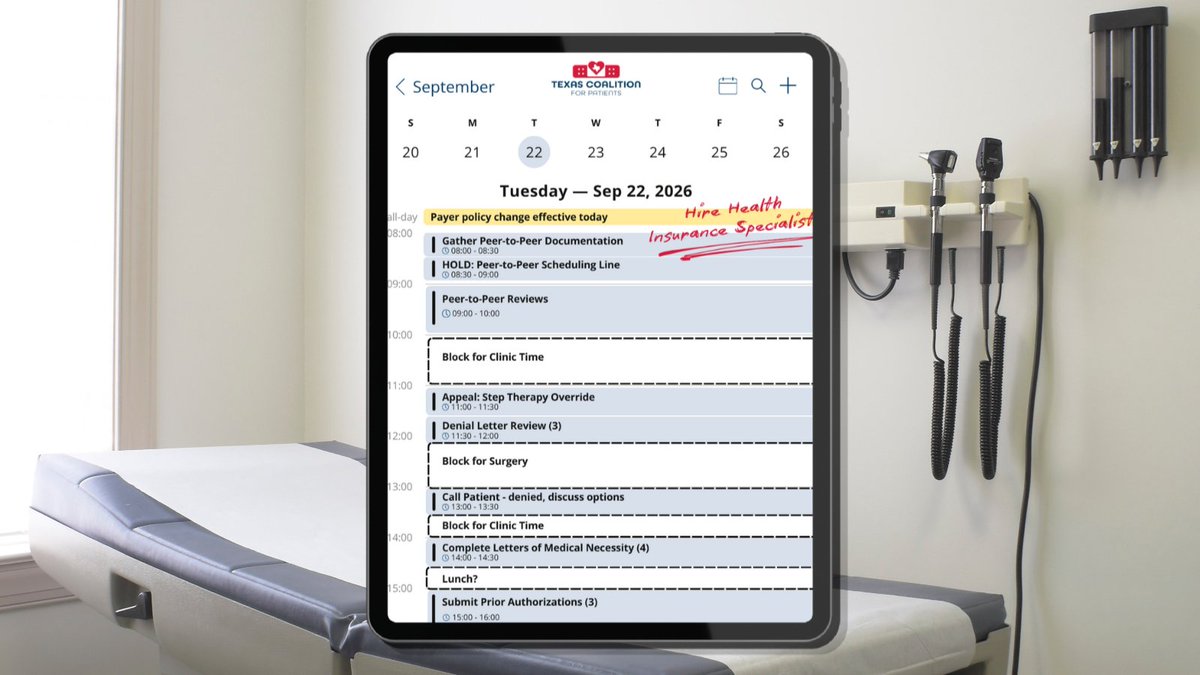
Your doctor's calendar has an uninvited guest: your insurance company.
Gather records. Wait on hold. Review a denial. Write an appeal. Call the patient still waiting for the care they need.
Physicians and their staff spend an average of 13 hours a week on prior authorization, according to the @AmerMedicalAssn's 2025 survey of 1,000 practicing physicians. Two in five physicians said they have staff who work on nothing else.
For the patient waiting on a prescription, a test or a procedure, the consequences are more than a scheduling inconvenience.
Patients need timely care, and their medical teams need time to provide it. #TexasPatientsOverProfits
Medicare Advantage plans have to spend at least 85 cents of every dollar on care.
The most recent year anyone outside a health plan can check is 2023.
Not 2025. Not 2024. 2023.
Plans report their spending to CMS. Those reports come out no sooner than 18 months after the year ends, and they're grouped by contract number rather than by the plan you're enrolled in.
About 2.7 million Texans are in #MedicareAdvantage, the third-largest state market in the country. Their coverage is paid for with public money, but the numbers can’t be checked for nearly three years.
H.R. 9644 could change this beginning in 2029, requiring plans to publish plan-level revenue and spending on their own websites. The House Ways and Means Committee advanced it 42-0 on July 15. @RepNateMoran of Texas introduced it. It has not passed the full House.
You can't check math you can't find.
#TexasPatientsOverProfits #TxLege #HealthInsurance
According to the @AmerMedicalAssn 2025 Prior Authorization Physician Survey, prior authorization takes about 13 hours a week from a physician's practice.
A primary care visit runs 15 to 20 minutes. That's roughly 39 appointments a week, gone to forms and hold music.
In 2020, 32 Texas counties had no primary care physician. Last year, that number went up to 40.
Two in five physicians now employ staff who do nothing but insurance approvals. Not scheduling. Not billing. Not patient care.
94% say it's contributing to burnout.
Thirteen hours a week. None of it is spent on care.
#TexasPatientsOverProfits
Medicare has a new program to root out waste with AI: prior authorizations. Months into the program, patients are getting delayed care, doctors aren’t getting paid, and there are AI hallucinations to deal with.
From @dariustahir ⤵️
https://t.co/do4lFfqrxF
For too long, Medicare Advantage plans have misused prior authorization to delay or deny medically necessary care. Legislation adopted by the House Energy and Commerce Committee today would bring greater transparency and accountability to the #prioraurth process and reduce burdens that stand in the way of patient care. AMA is committed to working with lawmakers of both parties until patients are no longer denied medically necessary care. @HouseCommerce@EnergyCommerce https://t.co/JbdCO2Elvo
New @JAMANetwork research reinforces what physicians and patients already know: prior authorization delays care. Patients and families who have to navigate approvals themselves are more likely to face delays, barriers, and miss out on prescribed treatment. https://t.co/jK1xqkf3qn
One year ago, dozens of health insurers promised to fix prior authorization.
@KFFHealthNews checked the results.
Insurers report cutting 6.5 million prior authorizations, an 11% reduction. But prescription drugs are excluded, no breakdown exists to verify which services were dropped, and the public dashboards federal officials promised were never published.
For patients, not much moved. Among adults who faced a prior authorization denial, 41% said it delayed their care. 28% said a health problem got worse.
@RepGregMurphy, a physician who stood behind the original announcement, now says the pledge has "no teeth." Two congressional committees have advanced prior authorization reporting bills in the past two weeks, both unanimously.
A year of voluntary commitments, and the only number we have is one nobody can check.
Patients deserve reform they can count on.
Has prior authorization gotten easier or harder for you this year?
Sources: KFF Health News, July 17, 2026; AHIP; Commonwealth Fund, 2025 Health Care Affordability Survey; House Bill 3459; House Bill 3812.
#TexasPatientsOverProfits #TXLege #Healthcare #HealthInsurance
In Texas, it costs more than $24,000 a year to insure one family through an employer health plan.
Under federal law, health insurers must spend at least 80 cents of every premium dollar on actual medical care. The remaining 20 cents can go to administration, marketing, executive compensation and profit.
On a Texas family premium, that adds up to $4,800 a year that never pays for a doctor visit, a prescription or a procedure. And it doesn't include what pharmacy benefit managers, often owned by the same insurance companies, take from the system on a separate track.
The @texastribune recently reported that, at one Waco restaurant, only 19 of 425 employees signed up for the company health plan. Most decided coverage wasn't worth the cost.
The Middleman Math only works when nobody checks it.
We think Texans deserve to see the full equation.
--
Sources: KFF Employer Health Benefits Survey, 2024 (TX state data); ACA MLR (42 U.S.C. § 300gg-18); Texas Tribune, July 2026.
#TexasPatientsOverProfits #TXLege #HealthCare
Did you know a soccer agent can only take up to 10% of a contract deal?
Your health insurer can keep up to 20% of every premium dollar.
Under the ACA, individual market insurers must spend at least 80% of premium revenue on medical claims and quality improvement. Up to 20% goes to everything else.
The agent's job is to close the deal for the player. The insurer's job is to decide whether your doctor's recommendation gets approved.
One takes a cut of the deal. The other takes a cut of your premium.
Where would you cap your health insurers’ cut?
#TexasPatientsOverProfits #TXLege #WorldCup2026
A new @HHSGov OIG report looked at the 19 largest Medicare Advantage organizations.
What they found should concern every MA patient in Texas and every family helping someone navigate post-hospital care: https://t.co/VDyRuZBJEy
Medicare Advantage plans denied 65% of requests to enter a long-term care hospital. They denied 54% of requests for rehab facilities.
These aren't experimental treatments. These are patients whose doctors said they needed post-hospital care.
Patients who appealed those denials typically waited 5 to 6 days in a hospital bed for a decision.
Every one of those days is a day without the rehab or care their doctor recommended. These delays in needed rehab can have long-term health effects.
When patients did appeal:
43% of rehab denials were overturned.
36% of long-term care denials were reversed.
The insurer's first answer wasn't the right one. It was just the fastest one.
If up to 43% of denials were overturned, what happened to the ones nobody challenged?
This data is public, but we suspect most patients will never see it.
And we think they should.
Know someone on Medicare Advantage or helping a parent after a hospital stay? Send them this.
#TexasPatientsOverProfits #TXLege #Medicare #MedicareAdvantage
Soccer built a system to fix its mistakes. Health insurance built a system that counts on mistakes going unchallenged.
We believe patients deserve better.
#TXLege#TexasPatientOverProfits#WorldCup2026
The #WorldCup is in Dallas this summer, and we think health insurers could learn a thing or two from the referee’s playbook. Specifically, the Video Assistant Referee (VAR). 🥅
Here’s why 🧵
Soccer built a review system that watches for bad calls. Health insurance built one that makes patients prove the call was bad.
And if 97,000 bad calls were caught on review, how many of the 85 million that went unreviewed were wrong too?
Health insurers on https://t.co/Kz2mgQI4AT denied 1 in 5 in-network claims in 2024.
That's 85 million denied claims.
Fewer than 1% of patients appealed.
Source: KFF analysis of CMS data, March 2026. 🧵
Two-thirds of insured adults told KFF that delays and denials by health insurers are a major problem. Texas lawmakers are hearing testimony on the same question.
The data is public. The question is whether anyone acts on it.