my information consumption is now 1/4 talking to ai, 1/4 using ai to curate and summarize tweets, 1/4 using ai to summarize podcast interviews of the smartest practitioners, and 1/4 using ai to summarize old books. the opportunity cost of anything else is far too high, and rising daily.
The highest IQ people I know are all either
> fully locked in and building or investing in AI. goal is to work towards generational wealth in the midst of a new technological revolution
> fully checked out of society and the corporate rat race. they are quitting their job, deleting social media and moving to the middle of nowhere to live a quiet life with no distractions
Literally no in between
Focus is probably even more important now than taste
AI will 10x your productivity but it will simultaneously hit you with weapons-grade nerdsnipes that consume 90% of your time
career decisions are not permanent! the biggest mistake you can make isn't picking the wrong job, it's evaluating jobs in isolation
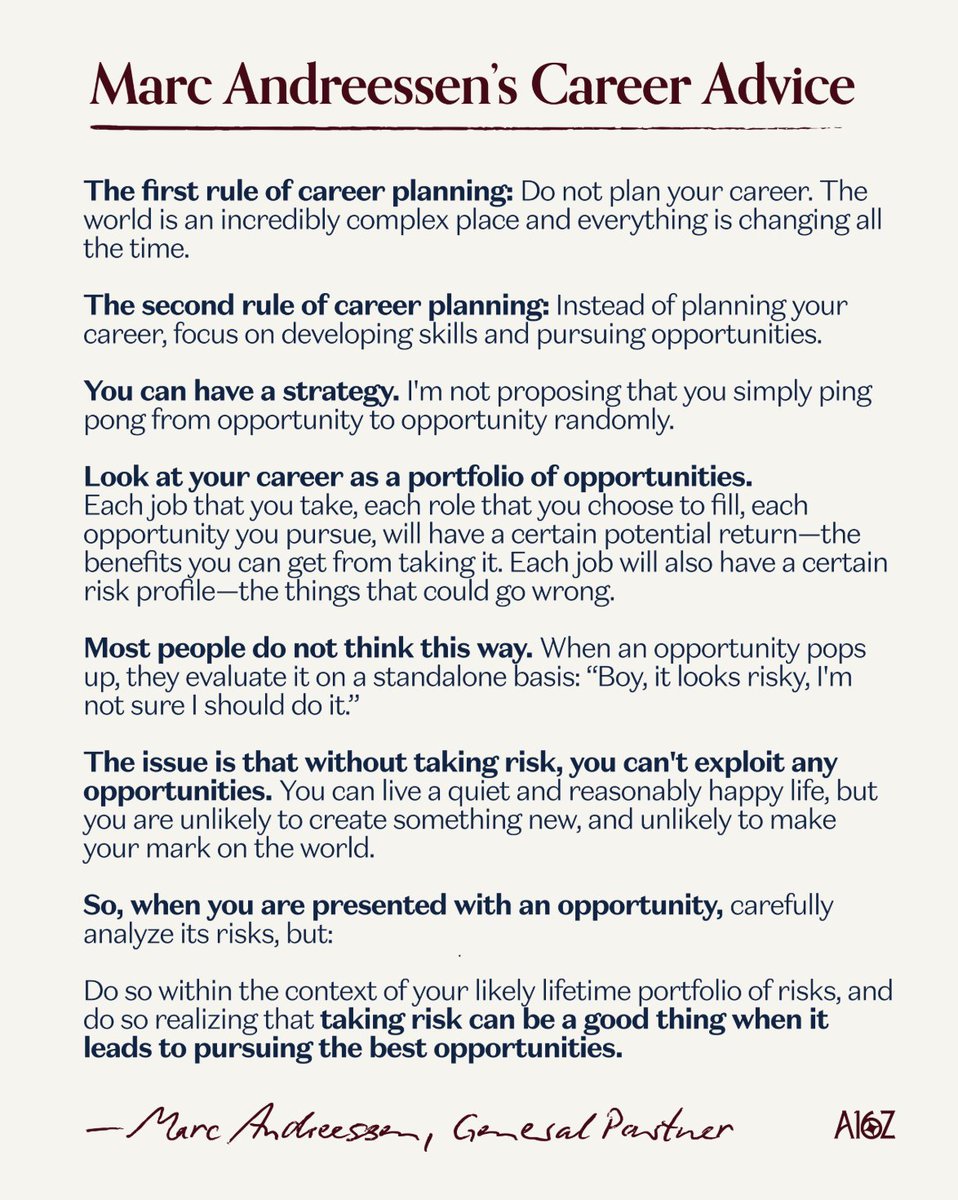
saw @pmarca's career advice & it's so spot on, portfolio careers are the new meta
your career is a portfolio of bets where you have to evaluate risk/reward/skills/network potential, and there are times when one may be worth outweighing the others
that pivot? might create a role that doesn't exist yet
startup equity gamble? might 10x your “safe” salary
moving to a new city? might change everything
sometimes work for a specific person or team compounds more than the title & yes, sometimes an unpaid or imperfect opportunity is the thing that finally gets your foot in the door you’ve been trying to unlock (i know, i know, so controversial!)
@garrytan said it best: if you aren't learning or making money...why are you still there? and if you aren't even having fun?? we literally spend most of our lives working
stability is admirable, but asymmetric bets are how great things happen
A growing number of top AI researchers are homeschooling their children
Not out of ideology, but because they believe the current education system will not prepare them for a world shaped by AI and robotics
Education must now be designed in reverse: start from the skills the future demands, and build backwards
Otherwise, we risk making our childrens’ skillsets obsolete before they even enter the workforce
I meet a lot of very smart AI critics who never seriously try to make AI work for them by spending a couple of hours with a frontier model. People can be (and should be & are) critical after realizing what AI can do, but experience leads to better-informed and sharper critiques.
There have always been casinos in crypto.
The first viral application on Bitcoin was Satoshi Dice (2012). The first viral smart contract on Ethereum was King of the Ether Throne (2015), which was basically a hot potato ponzi scheme.
Once you have programmable money, the first thing people will do is gamble and play stupid games. It's human nature.
There's always been a hot casino in crypto. Always. The ICO casino, the DeFi food coin casinos, the NFT casinos, and now the memecoin casino. It evolves over time, but gambling is deeply ingrained in human nature. Literally as soon as humanity invented writing (ancient Sumeria in 3000 BC), there's records of people gambling.
The casino is shiny and gets a lot of attention on social media (it's where fortunes are quickly won and lost, and it's easy to convince yourself that this is your lucky break), but if you only pay attention to the shimmer of the casinos, you're missing the bigger story.
The story I originally got into this industry for, that sounded like sci-fi to me ten years ago—that crypto is a better substrate for finance, that it will forever alter the nature of money, and that the balance of power between individuals and governments will be permanently changed—that story is actually happening.
Bitcoin is challenging nation states. They are now buying it on their own balance sheets. Stablecoins are bending monetary policy. Central banks are scrambling to respond. Permissionless smart contracts like Uniswap and AAVE are now bigger and more valuable than unicorn fintechs. The world is warping around crypto.
Maybe it took longer than you thought, but transformative technologies almost always take longer to diffuse than you think. I thought generative AI would completely transform the job market within a couple years, but three years after ChatGPT, it still doesn't show up in GDP or employment stats.
It's hard to change the world. Takes work. The industrial revolution began with the commercialization of the steam engine in 1781, but even the industrial revolution didn't have any impact on productivity, employment, or wage growth until 1830—that's 50 years later. The Internet, as we all know, took 20+ years. Did you think we'd be displacing all of finance, the most regulated and governmentally sensitive industry in the world, in the span of just 5 years?
If you're despondent that you were working on a memecoin L2 or whatever and didn't get rich, take a deep fucking breath. This industry doesn't owe you that.
And yet, all this spiritual capitulation on the timeline, believe it or not, is healthy.
A forest only stays robust when it periodically sheds the deadwood. Without occasional fires to clear it out, decay spreads and the whole forest rots. It's a harsh reality, but the only way to keep growing is to clear out whatever's no longer contributing.
All this negativity on the timeline needs to flush out one way or another. Let people keep shuffling out, and the air will clear. Either these people must change their minds and refocus on the future, or they need to leave so the rest of us can do our jobs.
Because the job is not yet done.
Marketing is a creative and adversarial game. Channels get discovered, exploited, and discarded. New products need new distribution.
It’s hard to hire rule-breakers, so the best marketers tend to be the founders themselves.
One of my favorite lessons I’ve learnt from working with smart people:
Action produces information. If you’re unsure of what to do, just do anything, even if it’s the wrong thing. This will give you information about what you should actually be doing.
Sounds simple on the surface - the hard part is making it part of your every day working process.
'Advice for guys in their 20's' -
Most dudes nowadays hit rock bottom in one way or another around age 27.
This is where you lose touch with all the "automatic" friend groups you had in HS and college (which were easy to form due to proximity - you were around them all day long)...
This is where your poor nutrition catches up with you...
This is where you notice the first signs of aging...
This is where you start really doing a normie job long-term for the first time and realize how soul-destroying it is...
As a result, this age often serves as a demarcation point for dudes.
The vast majority will fall into a life of "normal" choices and resulting misery from that point onward.
But a small % will completely reject this paradigm and go into schizo berserker mode instead and create an incredible life for themselves through sheer grit and determination.
The biggest paradox you need to internalize, however, is that the formula for a 'good life' at age 30 or 40 is going to be the exact OPPOSITE as at age 20.
You can do all the 'normal', societally-prescribed things today and have a genuinely awesome life at age 20 - go to school, play sports, hang out with your friends, go to parties, etc.
But if you do all the 'normal', societally-prescribed things from age 25 or so onward nowadays you will very likely have a miserable life.
You will end up 40 years old, significantly overweight, depressed, on multiple medications, 50% chance of divorce, in a job you hate under blue fluorescent lights all day, drowning in debt, and earning less than your father or grandfather did at the same age comparatively.
This is the sad reality of modern life (at least in the West).
The upside though is that there is more opportunity than ever before IF you are willing to be a contrarian and reject the normal choices and life path and look really weird and potentially even crazy to a lot of normies...
Embrace self-sovereign income, quit eating normie foods, count your calories, lift weights religiously, do combat sports or mountain climbing or some other sport that keeps you fit and gives you a community of like-minded dudes to hang out with, reject the pozzed insanity of modern politics and culture, utterly refuse to engage in the 'humiliation rituals' of modern life, read voraciously, go down rabbit holes, get into crypto or AI or etc, spend less than you earn, build wealth, and leave a legacy upon this earth.
Make the decision that you would rather fail 1000 times trying to lead a great life than to choose a life of shallow mediocrity and fear, and thereby insult your ancestors who sacrificed everything so you could be here, and insult the 8 year old version of you that dreamed of one day doing great things...
One of the underappreciated secrets to winning in any new sector is: just stick around.
If you just stick around long enough, the losers blow up early. Then the winners retire early. So eventually you win by just doing the work when nobody else can or wants to.
When people ask me how we built Dragonfly to became one of the biggest VCs in crypto, this is mostly the answer. We didn’t start with a big brand or any obvious advantages. Few people in the crypto world knew who I was before Dragonfly.
But we just kept doing the work. While others got too rich and retired, or just got bored or distracted, we kept doing the work. For 7 years.
It’s kind of that simple.
(This insight shamelessly stolen from @naval)
If you struggle with impulse control, do this 10x a day to make your brain stronger:
+ notice the impulse to check your phone
+ deny the request
+ wait 10 min before opening
Start with 10 reps a day and you’ll feel:
+ heightened will power
+ stronger self mastery
+ deeper self-respect
People check their phones ~150x daily.
And spend 4 hrs 30 min/day.
The Addiction Economy, who is your invisible enemy, has hijacked your reward system.
The anticipation of a notification spikes dopamine in your nucleus accumbens, activating craving while reducing activity in the prefrontal cortex, the brain region responsible for your executive control.
Each capitulation trades your sovereignty for sedation.
Every time you resist an impulse, it’s like a rep in the gym for your brain. This will strengthen the dorsolateral prefrontal cortex, the part of your brain responsible for discipline and delayed gratification.
A great first step to reclaim yourself.
When ppl claim this I always wonder how they think it happens, or have unrealistic expectations on how much $1bn actually is.
I joined crypto with $200. If I held my initial bitcoin since then and never traded, I would have ~$300k.
If, instead, from that moment I sold the top and bought the bottom of every crypto cycle on Bitcoin, and never paid any taxes, I would have ~$6m USD.
If I put my entire net worth into the Ethereum ICO and never touched it, today I would have ~$150m pre-tax.
While it was definitely possible to have made >$1bn with the opportunities in the market, these versions of reality would also require me to make no mistakes, and have no need to spend $ in real life, or take excessive risk via leverage.
In reality, I grew up in a working class family. I didn’t have a trust fund and I had to pay off my student loan myself. I had a job at Tescos while at high school. After university, I needed to pay rent and fund cost of living and eventually buy a place to live.
I worked at startups for relatively little $ salary, and while a couple have done okay, they still are illiquid and worth nothing until some exit.
Perhaps if I erase a couple of dumb mistakes and drawdowns, or if I had a lil more grind, then my answer would be different today. But it is easy to say this with perfect hindsight vision. It’s easy to see where you could have optimised better, and decisions you made look dumb when the past makes things so obvious.
The truth is I have always optimised for enjoying my life and not going to 0. I never felt like I had a safety net, so it was never possible for me to do anything in any other way. I would probably have less money if I had tried to add more risk or chased $ harder, because being all-in with your entire livelihood is a mental battle and I feel I only win that battle when the stakes are lower.
In writing this, maybe I do understand why CT folks believe this, because modern CT sees crypto as a late-stage lottery ticket farm, where the optimal strategy is to 5x leverage up your portfolio in a hope of catching a good 20% move and then leaving. Or, literally going all-in on the next coin they heard Ansem is buying. So perhaps to them, looking back at the charts, of course that’s what successful folks did.
In reality, I use leverage close to never (and typically to reduce risk rather than add risk — have used it to add risk maybe 3 times in the last 5 years, and maybe 15 times ever). I never go all-in on anything, have only ever done that on BTC and ETH before in the last decade. When I buy other things, I limit risk to tiny amounts, because I treat it as a 0 until proven otherwise (so, always <1% liquid portfolio). Liquid portfolio is also a smaller % of overall portfolio to future-proof against my own fuckups.
Obviously I made a lot of money, I have been here 12 years! CT doesn’t want to hear about “getting rich in a decade” though. I am happy with where I am and have never really cared or optimised for maximising $ earnings, but instead having a nice life that lets me enjoy the game we play together.
a lot of people seem to think someone big got wrecked last night but its not the case
marketmaker algos have systems to detect black swan events
in case of a black swan event they pull all orders, the books become ultra thin and liquidations push the books down to prices we saw
Major cheat code in life: Understanding you can reinvent yourself at any time. New habits, new standards, new friend group, new career, etc. There's no rule that says you have to stay the person you've always been. You're allowed to decide, "I'm done being this version of me."