One of the hardest challenges we had to overcome when building PageStorm was training instability caused by training with book-length sequences.
As is standard, we keep FP32 master weights but run the model using a bfloat16 copy. Normally, tiny FP32 updates accumulate until they become large enough to appear in bfloat16. But in our book-length training regime, even small updates mattered a lot. Standard casting repeatedly erased these sub-resolution changes, so the training copy stopped accurately reflecting the optimizer’s intended trajectory, making training unstable.
The key idea came from stochastic rounding. In the original approach, training happens in bfloat16, with stochastic rounding applied directly to each model update. Instead of always selecting the nearest representable value, it uses randomness so small updates are preserved on average.
We adapted this to our setup. The master weights and optimizer remain in FP32, and we introduce randomness only when creating the bfloat16 training copy. We also scale it with the learning rate because leaving it unscaled degraded performance during the later stages of training. This preserves small updates without destabilizing late training.
@paulg We're an AI lab solving exactly this (already outperforming frontier labs)!
One thing we've found is that most models also need to get straight to the point. With storytelling, you don't want to give away the secret right away.
It's basically a whole different challenge.
I was curious why LLMs have gotten so good at math and still aren't that good at writing, so I asked an expert. It's not because math is easier. It's because it has clear right and wrong answers and so is easier to train on. But they are coming for me next.
The Future of Entertainment...
Do you remember the last time you read a book or watched a movie that started that feeling in you that you can't really describe?
It feels like being in that Iron Man suit flying over deserts at night, that romantic mirror scene in The Curious Case of Benjamin Button with Brad Pitt, or that little famous affirming head nod in The Dark Knight Rises between Alfred and Bruce Wayne. For a moment, the world feels bigger, everything is possible, and there is no limit.
Or maybe this is just us and it's different for everyone, but we're sure you know which feeling we're talking about. This is magic. This is storytelling at its best.
But times change. New technologies make new things possible.
You know, we get asked that question a lot... What does the future of entertainment look like? And we usually give the same answer.
"The economics clearly point to it being fully AI-driven." Better retention, lower costs, and faster production.
And while that's true, it's not the real reason.
The actual reason, though, is the emotional part. The part where we unlock that feeling. That feeling of flying over a desert at night in your Iron Man suit. The feeling of dancing in the mirror like Brad Pitt did in The Curious Case of Benjamin Button. That one scene, one line, one moment that stays with you for years and quietly changes something inside you.
The thing is... it's different for everyone.
For the first time in history, we can give you those movies, books, and shows that are for you. That are not made for an audience of millions.
Let's face it. We are all so different, and that's a good thing.
That kid in rural Montana, a mother in Thailand, or a young salesman in Shanghai can each experience their magic moment in their own way. A story that makes them believe a little more. Dream a little bigger. Walk away thinking, maybe I can do that too.
We are working hard so that you no longer have to choose the least-bad option from a shelf built for the average viewer. You are experiencing the ultimate version built exclusively for you.
And that's the real secret.
Hollywood spent a century mastering the art of the crowd.
The next era belongs to the Art of One.
My trading bot has a hedge fund data stack. It runs on a $10 budget.
A system that trades options should need real-time everything. Mine doesn't.
🧵 THREAD 🧵 1/7 ⬇️
"People won't consume AI content."
Which is kind of a lazy argument from people with a status quo bias.
People don't reject AI. They reject bad content. The label stops mattering the moment the art clears the quality bar.
The receipts:
A Deezer/Ipsos blind test across 9,000 listeners in eight countries found that 97% couldn't distinguish AI-generated songs from human-made ones. Once the output clears the quality bar, the "AI" label becomes largely irrelevant.
Suno alone generates roughly 7 million songs every day more volume than Spotify's global charts with 100M+ users, 2M paying subscribers, and an estimated $300M ARR. Let that sink in.
Another company in the generative media space is Midjourney. It has an estimated 1.2–2.5 million daily active users, generates around $500 million in annual revenue.
The fact that consumer AI companies are generating hundreds of millions in revenue tells you everything you need to know: people want these products. No amount of anti-AI noise changes that.
The market is already voting with its time, money, and streams.
Unlike math or coding, there isn't a large corpus showing how to reason through writing a novel. We also can't synthesize one by doing large-scale RL, like DeepSeek did for R1 with math and coding problems.
One of the core ideas behind our model is that long-form writing needs its own version of reasoning traces. Our solution is a hand-engineered planning scaffold that makes that reasoning process explicit.
It gives the model a structured way to plan before it writes, and serves as the cold start for future reinforcement learning.
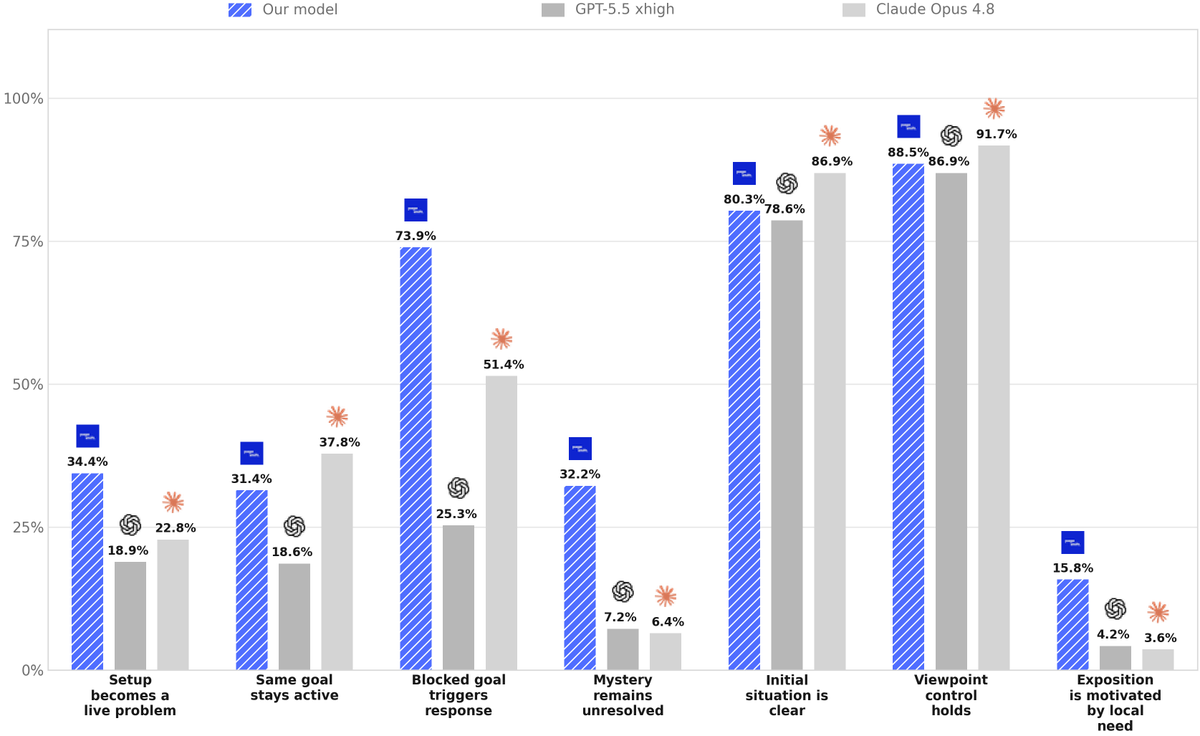
We outperform OpenAI and Anthropic on creative writing…!
Good storytelling requires dishonest characters, unresolved tension, and exposition earned through narrative.
Frontier models are trained to do the opposite: explain everything, resolve uncertainty, be helpful.
So we built a model aligned to storytelling, not assistance.
Blows my mind that this kind of animation can now be made with AI.
Two years ago, this would’ve required a studio and tens of thousands of dollars.
Now, one guy (u/PolicemansBeard) made it with Midjourney, Hailuo, and Eleven.
storytelling has always had something to do with Darwinian thinking...
every story exists because it solves a problem rooted in survival.
finding a mate. avoiding death. outlasting danger.
we think we're watching a show but we're actually running ancient survival software.
Ben Affleck has been one of the loudest critics of AI in the entertainment industry.
And now this…
But I guess after all the talking, money rules and shows what the future is really going to look like...
Everyone who is telling you that you need to learn AI tools or you are falling behind, is lying to you.
Learning to use AI tools can be done in a week
Learning to code by hand takes years of dedication and hard work
Which of the two skills do you think is the more valuable one?