If you understand this story, you’ve understood much there is to understand about geopolitics around Taiwan.
The current DPP government is quite literally cheering its own carve-up - as long as it annoys Beijing.
Here is what happened.
So recently, May 28th, Japanese PM Takaichi and Philippines President Marcos Jr. issued a joint statement (https://t.co/T3HUFO3oDI) announcing they would open negotiations to delimit their overlapping EEZ and continental-shelf boundaries.
As a reminder, an EEZ - Exclusive Economic Zone - is the area extending 200 nautical miles from a country's coastline within which that country has exclusive rights to exploit all natural resources.
Small problem: their EEZs directly overlap with China's, both from Beijing’s standpoint and Taipei’s, as they are less than 200 nautical miles from Taiwan’s coastline.
In effect, what Japan and the Philippines are announcing here is that they're agreeing bilaterally - without Beijing or Taipei at the table - to split between themselves waters that belong, in part, to someone else.
Unsurprisingly, that didn't sit well with Beijing. They issued a statement the day after - 29th of May - where they "strongly deplore and firmly oppose the so-called maritime delimitation talks between Japan and the Philippines" (https://t.co/d9mLwvTcpI).
Any rational person would have expected Taipei to issue a similar statement because, whatever you think of Beijing's claims, it's the EEZ around Taiwan we're speaking about here: surely they'd object to other countries carving up the resource rights off their coastline.
It's actually one thing Beijing and Taipei have aligned interests on: neither wants its maritime entitlements carved up by third parties.
As a reminder Taipei rejected the infamous 2016 Hague arbitration ruling on the South China Sea - siding with Beijing against Manila - for the same reasons: because the tribunal downgraded Taiping (Itu Aba), the largest feature in the Spratlys that Taipei occupies, from an “island” to a “rock,” which would have stripped it of its 200-nautical-mile EEZ.
In other words, defending their own EEZ is normally sacrosanct for Taipei.
Except... not this time. Taipei issued an angry statement, yes, but where the anger was entirely directed at Beijing. The statement (https://t.co/HXekJR7fvi) explicitly “commend[ed] Japan and the Philippines for working to resolve maritime differences”, reserving its sharp language to China because it "has no right to comment on the territory and appertaining waters of the Republic of China (Taiwan)."
Think for a moment about what it says about Taipei’s current DPP independentist government: the party that claims to champion Taiwan's sovereignty literally celebrated, as its first instinct, two countries announcing they'd carve up Taiwan's maritime territory between themselves. All because Beijing opposed it.
This caused quite a stir in Taiwanese politics, with the KMT calling the statement “humiliating,” warning that cheering the talks without seeking a seat in negotiations over the overlapping EEZs could seriously hurt Taiwanese fishermen's livelihoods in the future (https://t.co/5T2jW4HQb5).
So much so that Taipei’s MOFA had to issue a new statement on June 2 specifying that the Japan-Philippines talks "should not impair our country's rights", with MOFA spokesperson Hsiao Kuang-wei finally acknowledging the delimitation waters “highly overlap” with Taipei's EEZ.
But then, confusingly, 2 days after - June 4 - Foreign Minister Lin Chia-lung undercut his own ministry’s correction entirely (https://t.co/hgAu7Quj1H). The Japan-Philippines talks, he explained, are “aimed at China” and therefore, fundamentally good - Taipei's EEZ being carved up in the process being, apparently, a minor detail.
China protesting the talks, he said, is “getting cause and effect backwards” and he branded “the handful distorting the issue and shifting the focus” - i.e. anyone pointing out that Taiwan's EEZ is being carved up - as “falling into a trap and letting China benefit.”
So the same ministry, within 48 hours, both (a) asked Tokyo and Manila to guard against a danger to Taiwan's EEZ, and (b) declared that danger nonexistent and smeared anyone naming it as a Beijing stooge. Go figure 🤷
But this is actually just one part of a much bigger story - one about colonial nostalgia, about the three competing visions at play for Taiwan, and about why the West champions the one party in Taiwan that does NOT actually defend sovereignty and democracy.
I wrote it all up here: https://t.co/tWqeM8xpX8
CHINESE SCIENTISTS created a new medicine that is being hailed as a breakthrough in the fight against lung cancer, it was revealed this week.
“And the results here, I think, are quite astounding,” said Dr Monty Pal of the American Society of Clinical Oncology (ASCO) in a YouTube video review. “What we see here is an improvement in median overall survival.”
Yet the development of the new drug, called ivonescimab in English, is being portrayed as worrying news by politicians and media in the US. Why?
The US elite’s congenital megalomania means it has to be number one in every field. This need triggers extreme paranoia—and means that Chinese lifesaving advances are bad news.
.
NATIONAL SECURITY THREAT
“It’s a war right now with China,” said United States Department of Health and Human Services Chris Klomp at the recent Conservative Political Action Conference.
"We face a national security threat right now...it's not one of missiles and tanks. It's of laboratories and life-saving medications.”
Oh no! Not life-saving medications!
Will the dastardly Chinese stop at nothing?
But it gets worse. If American patients become reliant on the Chinese for drugs, there is a risk of “creating a new Strait of Hormuz”, said former FDA chief Dr. Peter Marks, quoted in the New York Times.
That’s a telling remark. Not only is the paranoia up front and center, but look at the example he chose. The US created an entirely needless problem in Iran, with thousands dead and millions suffering from fuel shortages.
Western political plays have real world consequences for both sides--and innocent parties, too.
.
CHINA SCIENTISTS GET TOP SPOT
The medical issue escalated last week at the annual ASCO global gathering of oncologists (cancer doctors).
The five biggest breakthroughs are given top-of-the-bill presentation slots—and politicians and journalists were shocked when one of them went to Chinese medical scientists who conducted their trials in China.
.
THE ISSUES
Let’s look at the issues, one by one:
Are there serious concerns that the new drug, ivonescimab, doesn’t work or only works on Chinese people?
- No. The drug was created by a Chinese firm called Akeso Biopharma, and it is already used successfully in China. There has since been a global study in the United States, Canada and Europe, too, to ensure diversified data.
Are there worries that China may deny sending this and other drugs to Americans?
- No. Chinese companies keep the rights for their own country and then license the drugs in the US to American firms. Ivonescimab in the US is a product of Summit Therapeutics of Miami.
Is there concern that the data is false?
- No. The Lancet, a medical academic journal, has already printed a study saying that people who got the new drug had a 34 percent lower death rate.
Is the problem that the Chinese copied the drug from the US?
- No. That’s not how science works. Science advances through data-driven breakthroughs, irrespective of where they take place.
So what is the problem?
It’s the usual one: the US needs to dominate everything, whoever gets hurt. In the case of medicines from China, the victims of needless hostility will include US citizens, if drugs are delayed or banned.
.
BUILDING WALLS
President Donald Trump has already signed legislation that prevents US government bodies signing contracts with Chinese biotech firms, however beneficial their products and services may be.
And separately, politicians in Congress are trying to get rules passed that prevent the recognition of data from clinical trials in Mainland China or Hong Kong.
Some US journalists also appear less interested in the scientific breakthroughs than the politics of who is making them. The New York Times report last week on the topic began with these lines:
“For decades, an annual gathering of oncologists has featured drug trials that were run mainly at American and European hospitals.
“But at this year’s meeting, which is being held in Chicago this weekend, the signs are everywhere of China’s ascendance as a powerhouse in drug development — and of the threat that many believe it poses to American biotechnology.”
China’s latest threat: lifesaving medications.
No food shortages in Iran
While I was in Tehran last September 2025 doing grocery shopping, I grabbed this quick clip.
Shelves are stocked with fresh local dairy — milk, yogurts, kefir, cheeses — plus juices and all the everyday staples.
Prices have gone up over the years because of sanctions, mainly for imported products, but the basics are still there and widely available. Iran has pushed hard on self-reliance and domestic production, and you can see it in the supermarkets.
Impressive how normal life continues in a city of 9+ million under constant external pressure.
This is everyday Tehran, not the headlines. 🇮🇷
Main false narratives created by the Western world about China:
1. Social credit score — It doesn’t exist at all. It was purely based on an Alipay credit card points interface that triggered 1984 enthusiasts to start fantasizing.
2. Tank Man was killed — Completely false. Tank Man was reluctantly taken away by his own companions. Before that, he even climbed onto the tank.
3. Ethnic minorities are not allowed to use their own languages and can only speak Mandarin — Doesn’t exist. Even Chinese RMB banknotes feature the scripts of major ethnic minorities. Meanwhile, the political asylum seekers who keep pushing this claim usually only speak fluent English and often can’t speak Mandarin at all.
4. China’s oil reserves are fake and have been embezzled — The rumor-mongers used a video of Premier Li Qiang inspecting an empty food warehouse, but forgot to Photoshop the warehouse name.
5. All Chinese people eat dogs — The actual proportion of Chinese people who eat dog meat is far lower than in South Korea, Vietnam, and many other countries, and even lower than in Europe. China is a massive country with over a billion pet cats and dogs, generating an industry worth tens of billions of USD — clearly not animals raised for meat.
6. China arrested millions of people in Xinjiang — Rumor spreaders used publicly released criminal case statistics from Xinjiang. Obviously, the number of criminal cases has nothing to do with mass arrests. Even more absurdly, Xinjiang’s criminal case numbers are not higher than those of other major provinces in China.
7. China has large areas of slums in its cities — What they call “slums” in major Chinese cities are mostly “urban villages” (chengzhongcun). They exist because the government strongly protects private property, making redevelopment costs extremely high. The landlords of these “slums” are almost all wealthy people.
8. Chinese police can check your ID anytime — This was true in Hong Kong since the British colonial period, but in mainland China you can legally refuse.
9. It is a crime for individuals in China to use a VPN to access foreign websites — False. Chinese law restricts enterprises and social organizations from using unauthorized outbound VPNs, but there is actually no legal prohibition for individual personal use.
10. The number of Michelin restaurants determines the food quality of Chinese cities — Most Michelin restaurants do not represent real Chinese cuisine and are often overhyped. Following Chinese domestic food bloggers is a much better way to understand the actual food scene.
11. Foreigners cannot use Visa cards — False. As long as you use WeChat or Alipay, you can use digital credit cards and even pay at roadside stalls.
12. Foreigners cannot stay in regular local hotels — Since 2022, the government has prohibited non-“foreign-related” hotels from refusing foreigners.
Reminder: Tiananmen Square (1989) was not the only agression instigated by the US against China
How many times does the same pattern have to repeat before people finally see it for what it is?
This has been a continuous, decades-long hybrid warfare campaign to destabilise and fragment China.
The modern colour revolution playbook — youth movements, foreign-funded NGOs, media hype, symbolic colours, and fake “democracy” demands — was refined in Serbia (Otpor! 2000) and rolled out like clockwork elsewhere.
But against China, it runs much deeper, with direct CIA fingerprints on funding, training, and orchestration aimed at internal chaos.
Multiple fronts, same tired playbook:
• Tibet: Decades of CIA backing for separatist elements, from old proxy operations to today’s weaponisation of the Dalai Lama as a political tool and endless separatist narratives pushed from abroad. https://t.co/a0k0WOpFS1
• Xinjiang: Heavy Western funding via NED and aligned groups for “Uyghur organisations” and “East Turkestan” fantasies, pumping colour revolution-style agitation and fake “genocide” claims to manufacture outrage and justify containment. https://t.co/ybsZNSXI6M
• Hong Kong 2019: Pure textbook colour revolution — foreign training, years of NED/NDI money, organised violence, black blocs, Molotovs, and nonstop Western media cheerleading to tear apart “one country, two systems.” Order was restored. Stability returned. https://t.co/MSqaQcu1uL
Tiananmen fits perfectly in this long continuum: legitimate local grievances cynically amplified by overseas funding, VOA propaganda, Gene Sharp-inspired tactics, and post-crackdown extractions like Operation Yellowbird. NED and CIA-linked networks were all over it, part of the broader push to derail China’s path. https://t.co/pgGuMCvfFs
This hybrid assault has been continuous for over 75 years. As the Pentagon Papers laid bare, US planners didn’t just want to contain China — they wanted to “retard the economic progress” of Communist Asian states. China’s success was the real threat. That same mentality runs from 1950s memos straight through to today’s “pacing threat” strategies. https://t.co/iFllLg0BfR
From Cold War paramilitary ops to today’s NGO-media-youth hybrid versions, Tibet, Xinjiang, Hong Kong, and Taiwan are all pieces of the same puzzle: manufacture internal chaos to stop a sovereign China from rising.
Bottom line: For over 75 years, China has faced relentless Western — mostly US-led — attacks meant to contain, weaken, and break it apart.
Military encirclement, proxy insurgencies, economic sabotage, information warfare, colour revolutions… the methods change, the objective never does.
These are not spontaneous freedom movements. They are hybrid warfare.
Context, funding trails, historical patterns, and real outcomes matter far more than the selective Western script.
**Wake up to the full picture.**
The Atlantic is hysterical because China refused to become the economy the West wanted:
cheap labor forever,
low-end factories forever,
a consumer market for Western brands forever,
and never a serious industrial competitor.
Now China makes EVs, solar panels, steel, machinery, robots, and advanced manufacturing products at scale — and suddenly affordable goods are a “global threat.”
Please.
The West subsidizes banks and calls it stability.
Subsidizes weapons and calls it security.
Subsidizes farmers and calls it protection.
Subsidizes chips and calls it strategy.
But when China supports real industries that produce real goods for real people, it becomes “distortion.”
So no.
China is not taking everyone down.
China is exposing how little the West has left once cheap moral lectures stop working.
Pocos conocen la Operación Yellow Bird, tras el fracaso de golpe de estado contra China con las protestas de la Plaza Tiananmen, la CIA y el Mi6 británico usaron a las mafias de las Triadas de Hong Kong para evacuar a sus agentes infiltrados como Chai Ling.
En esta operación, estuvieron involucradas organizaciones mafiosas como Sun Yee On o 14K, una de las mafias más peligrosas del mundo, que están involucradas en el narcotráfico, venta de armas, trata de personas , robos, lavado de dinero, extorsión, asesinato... estos fueron quienes sacaron de China a los títeres de la CIA, por lo que la CIA colabora con estos criminales de la mafia de Hong Kong en sus sucios negocios.
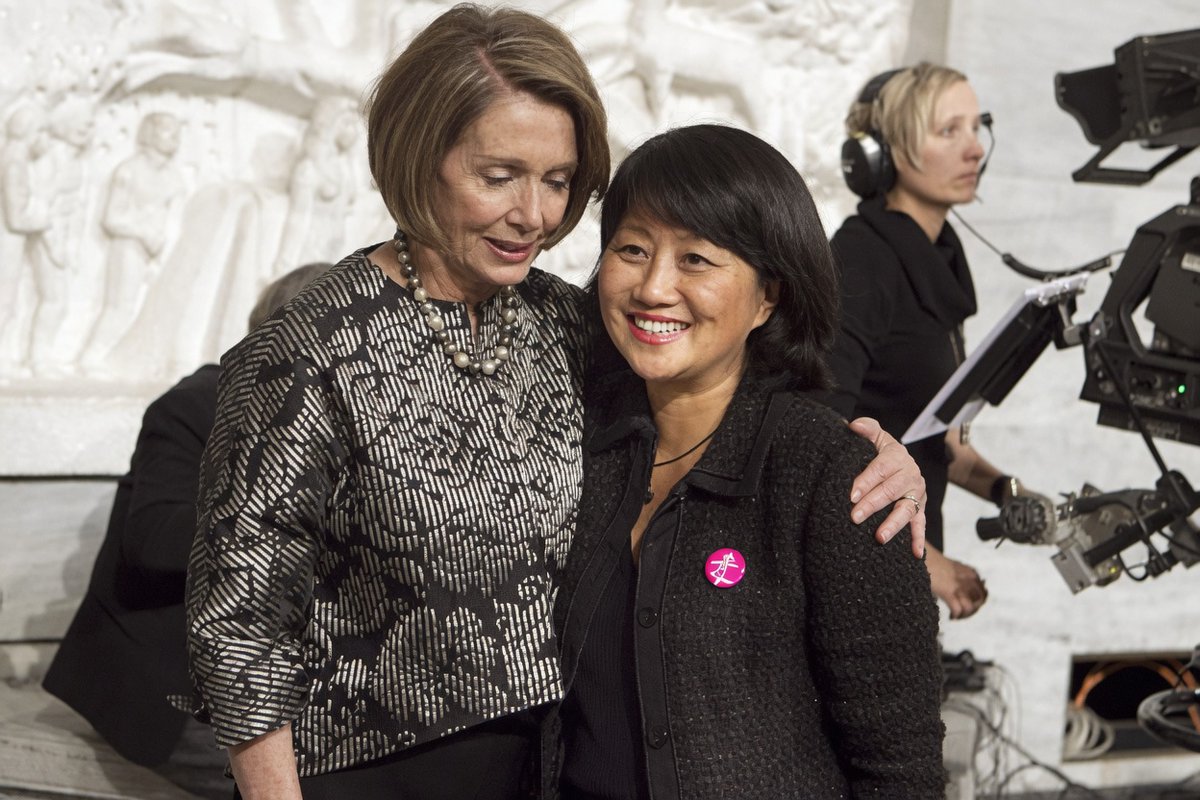
A su llegada a EEUU, Chai Ling fue agasajada por la criminal Nancy Pelosi, quién se involucró en la revolución de colores contra China, Nancy le consiguió a Chai una matrícula gratis en la Universidad de Princeton, luego la enchufó en la empresa Bain & Company, donde Chai se casó con el socio principal de la empresa, Robert Maginn.
This is so insanely corrupt, I can’t even believe it.
More than half the donors to Trump’s $400 million White House ballroom just won over $50 billion in new federal contracts in six months.
And here’s the part that should make your blood boil.
Sixteen of these 27 donors were facing federal enforcement actions, antitrust reviews, labor cases, securities charges. Many of those cases have been quietly dropped or scaled back since Trump took office. You write a check, your legal problems disappear. That’s not a coincidence.
The White House won’t even release the full donor list. They’re hiding it on purpose, because daylight is the one thing pay-to-play can’t survive. A federal judge already ruled ballroom construction has to stop until Congress authorizes it.
Government is supposed to serve the people, not auction itself off to the highest bidder. When access goes to whoever pays the most, working families always end up paying the price.
We either end the corruption, or the corruption will end us.
https://t.co/4MGFzSseFl
The Tank Man image is so powerful that most people believe tanks crushed protesters at Tiananmen.
They didn't. The tanks stopped for Tank Man. He lived.
The Israeli bulldozer did not stop for Rachel Corrie.
She was 23.
She was American.
She was wearing an orange vest.
She died on March 16, 2003.
Marco has never posted about March 16.
My latest in the Morning Star.
“Rosa Luxemburg coined the phrase ‘socialism or barbarism’ in 1916, in the middle of the first world war, as a general statement about humanity’s choices. In the Caribbean in 2026, it is a concrete question on the table.
“Cuba has stood for 67 years as a beacon of hope for the oppressed and exploited around the world. It has been a source of inspiration for generations of activists, a symbol of resistance against imperialism, a model of what a different kind of society can look like.
“The whole world must stand with Cuba now, in its hour of need. We must demand an end to the blockade, an end to sanctions, an end to threats. We must support Cuba’s right to self-determination, to sovereignty, and to development on its own terms.”
https://t.co/CCGRvSUXHN
MORE than three million pages from the Epstein files are now public
Cannibalism, Rape, Murder, Pedophilia,
Not a single arrest, Not a single investigation
Z.E.R.O
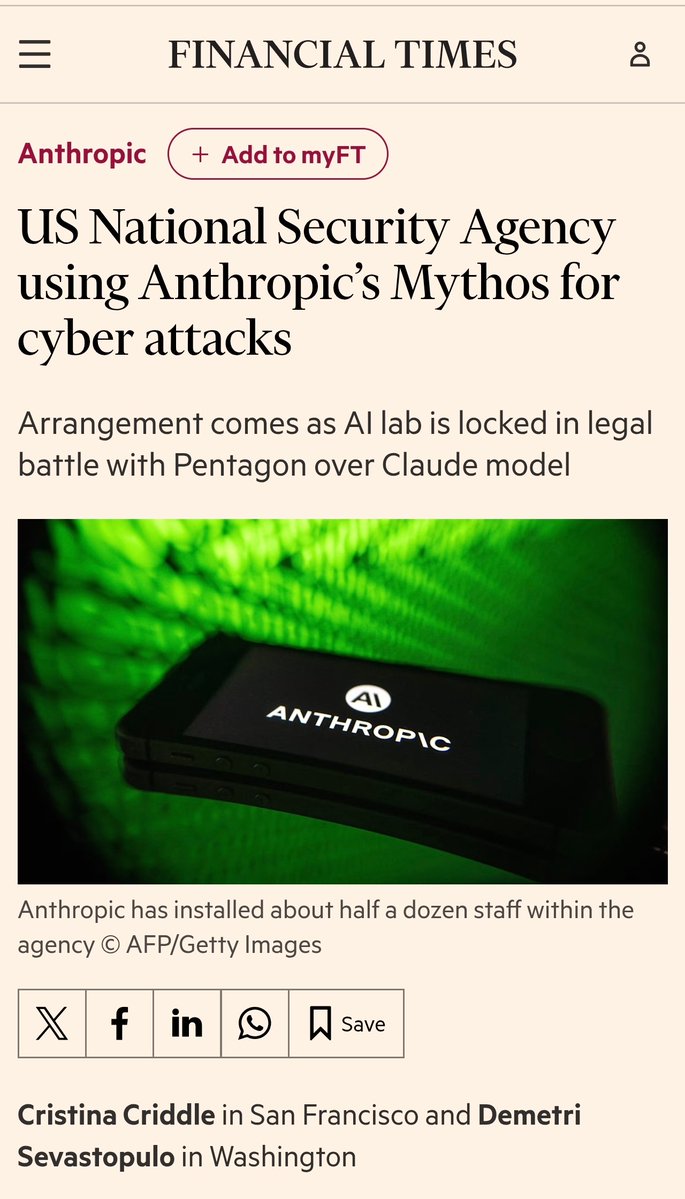
There you go: the FT confirms that not only is the NSA using Anthropic's AI "for offensive cyber operations" against "nations such as China or Iran" but Anthropic is actively helping them in that effort.
As per the article, Anthropic "installed about half a dozen staff within the NSA as so-called forward-deployed engineers to guide the use of the technology and customise models for specific applications."
It confirms two things. First: the United States is the most aggressive state actor in cyberspace, by far. It offensively infiltrates other nations' networks, and is now supercharging that capability with AI. Heck that is literally one of the core mission statements of the NSA, one of the largest security agencies of the US government.
Second, that Anthropic's carefully cultivated image as the ethical, safety-first AI company that "partners with the church" is a fiction. In reality, it is the most deeply embedded AI company in the US security state. Instead of building guardrails, they're literally weaponizing their own AI inside the NSA.
Src: https://t.co/sWmXvPSUy4




![RnaudBertrand's tweet photo. If you understand this story, you’ve understood much there is to understand about geopolitics around Taiwan.
The current DPP government is quite literally cheering its own carve-up - as long as it annoys Beijing.
Here is what happened.
So recently, May 28th, Japanese PM Takaichi and Philippines President Marcos Jr. issued a joint statement (https://t.co/T3HUFO3oDI) announcing they would open negotiations to delimit their overlapping EEZ and continental-shelf boundaries.
As a reminder, an EEZ - Exclusive Economic Zone - is the area extending 200 nautical miles from a country's coastline within which that country has exclusive rights to exploit all natural resources.
Small problem: their EEZs directly overlap with China's, both from Beijing’s standpoint and Taipei’s, as they are less than 200 nautical miles from Taiwan’s coastline.
In effect, what Japan and the Philippines are announcing here is that they're agreeing bilaterally - without Beijing or Taipei at the table - to split between themselves waters that belong, in part, to someone else.
Unsurprisingly, that didn't sit well with Beijing. They issued a statement the day after - 29th of May - where they "strongly deplore and firmly oppose the so-called maritime delimitation talks between Japan and the Philippines" (https://t.co/d9mLwvTcpI).
Any rational person would have expected Taipei to issue a similar statement because, whatever you think of Beijing's claims, it's the EEZ around Taiwan we're speaking about here: surely they'd object to other countries carving up the resource rights off their coastline.
It's actually one thing Beijing and Taipei have aligned interests on: neither wants its maritime entitlements carved up by third parties.
As a reminder Taipei rejected the infamous 2016 Hague arbitration ruling on the South China Sea - siding with Beijing against Manila - for the same reasons: because the tribunal downgraded Taiping (Itu Aba), the largest feature in the Spratlys that Taipei occupies, from an “island” to a “rock,” which would have stripped it of its 200-nautical-mile EEZ.
In other words, defending their own EEZ is normally sacrosanct for Taipei.
Except... not this time. Taipei issued an angry statement, yes, but where the anger was entirely directed at Beijing. The statement (https://t.co/HXekJR7fvi) explicitly “commend[ed] Japan and the Philippines for working to resolve maritime differences”, reserving its sharp language to China because it "has no right to comment on the territory and appertaining waters of the Republic of China (Taiwan)."
Think for a moment about what it says about Taipei’s current DPP independentist government: the party that claims to champion Taiwan's sovereignty literally celebrated, as its first instinct, two countries announcing they'd carve up Taiwan's maritime territory between themselves. All because Beijing opposed it.
This caused quite a stir in Taiwanese politics, with the KMT calling the statement “humiliating,” warning that cheering the talks without seeking a seat in negotiations over the overlapping EEZs could seriously hurt Taiwanese fishermen's livelihoods in the future (https://t.co/5T2jW4HQb5).
So much so that Taipei’s MOFA had to issue a new statement on June 2 specifying that the Japan-Philippines talks "should not impair our country's rights", with MOFA spokesperson Hsiao Kuang-wei finally acknowledging the delimitation waters “highly overlap” with Taipei's EEZ.
But then, confusingly, 2 days after - June 4 - Foreign Minister Lin Chia-lung undercut his own ministry’s correction entirely (https://t.co/hgAu7Quj1H). The Japan-Philippines talks, he explained, are “aimed at China” and therefore, fundamentally good - Taipei's EEZ being carved up in the process being, apparently, a minor detail.
China protesting the talks, he said, is “getting cause and effect backwards” and he branded “the handful distorting the issue and shifting the focus” - i.e. anyone pointing out that Taiwan's EEZ is being carved up - as “falling into a trap and letting China benefit.”
So the same ministry, within 48 hours, both (a) asked Tokyo and Manila to guard against a danger to Taiwan's EEZ, and (b) declared that danger nonexistent and smeared anyone naming it as a Beijing stooge. Go figure 🤷
But this is actually just one part of a much bigger story - one about colonial nostalgia, about the three competing visions at play for Taiwan, and about why the West champions the one party in Taiwan that does NOT actually defend sovereignty and democracy.
I wrote it all up here: https://t.co/tWqeM8xpX8](https://pbs.twimg.com/media/HKH2mJhaYAA0675.jpg)