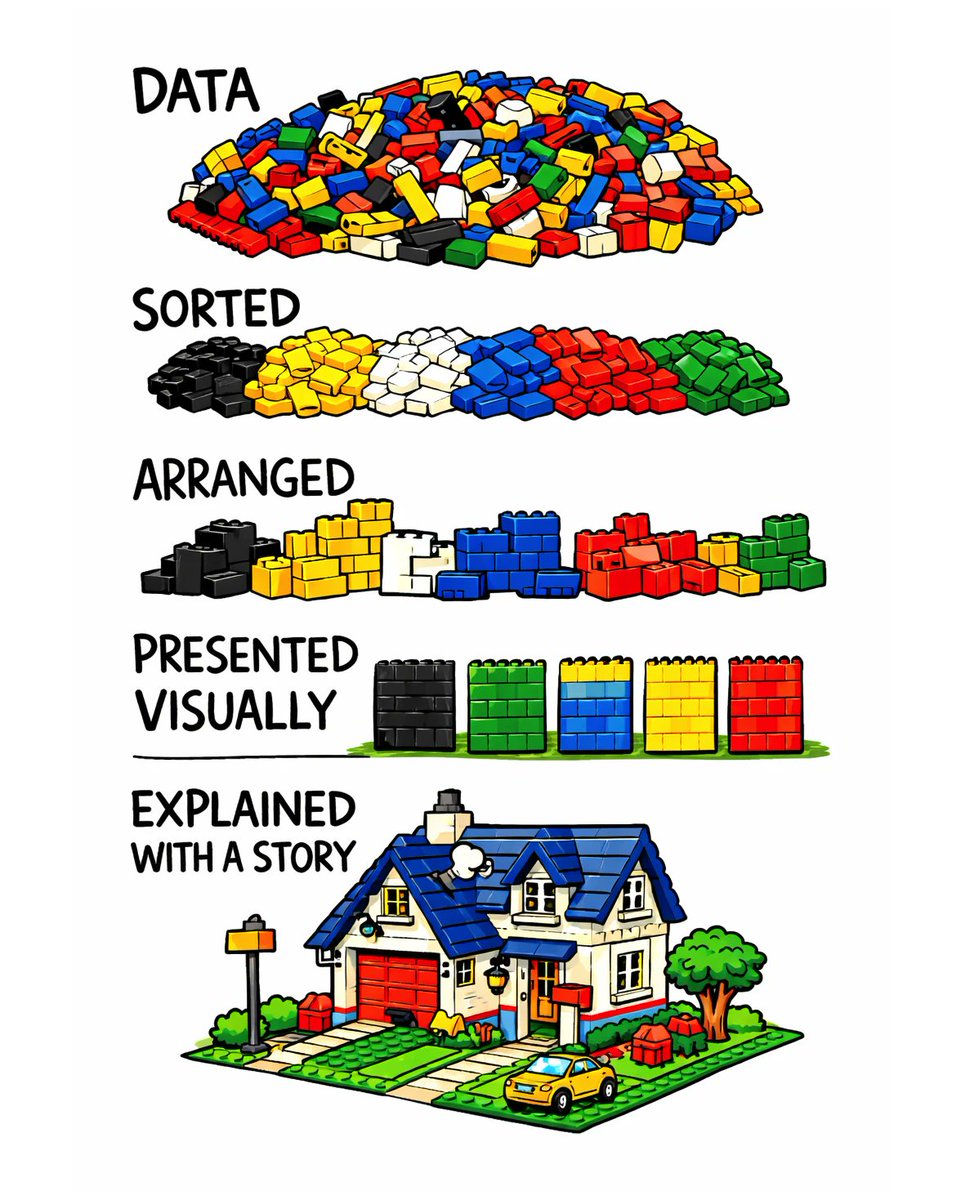
LLM Knowledge Bases
Something I'm finding very useful recently: using LLMs to build personal knowledge bases for various topics of research interest. In this way, a large fraction of my recent token throughput is going less into manipulating code, and more into manipulating knowledge (stored as markdown and images). The latest LLMs are quite good at it. So:
Data ingest:
I index source documents (articles, papers, repos, datasets, images, etc.) into a raw/ directory, then I use an LLM to incrementally "compile" a wiki, which is just a collection of .md files in a directory structure. The wiki includes summaries of all the data in raw/, backlinks, and then it categorizes data into concepts, writes articles for them, and links them all. To convert web articles into .md files I like to use the Obsidian Web Clipper extension, and then I also use a hotkey to download all the related images to local so that my LLM can easily reference them.
IDE:
I use Obsidian as the IDE "frontend" where I can view the raw data, the the compiled wiki, and the derived visualizations. Important to note that the LLM writes and maintains all of the data of the wiki, I rarely touch it directly. I've played with a few Obsidian plugins to render and view data in other ways (e.g. Marp for slides).
Q&A:
Where things get interesting is that once your wiki is big enough (e.g. mine on some recent research is ~100 articles and ~400K words), you can ask your LLM agent all kinds of complex questions against the wiki, and it will go off, research the answers, etc. I thought I had to reach for fancy RAG, but the LLM has been pretty good about auto-maintaining index files and brief summaries of all the documents and it reads all the important related data fairly easily at this ~small scale.
Output:
Instead of getting answers in text/terminal, I like to have it render markdown files for me, or slide shows (Marp format), or matplotlib images, all of which I then view again in Obsidian. You can imagine many other visual output formats depending on the query. Often, I end up "filing" the outputs back into the wiki to enhance it for further queries. So my own explorations and queries always "add up" in the knowledge base.
Linting:
I've run some LLM "health checks" over the wiki to e.g. find inconsistent data, impute missing data (with web searchers), find interesting connections for new article candidates, etc., to incrementally clean up the wiki and enhance its overall data integrity. The LLMs are quite good at suggesting further questions to ask and look into.
Extra tools:
I find myself developing additional tools to process the data, e.g. I vibe coded a small and naive search engine over the wiki, which I both use directly (in a web ui), but more often I want to hand it off to an LLM via CLI as a tool for larger queries.
Further explorations:
As the repo grows, the natural desire is to also think about synthetic data generation + finetuning to have your LLM "know" the data in its weights instead of just context windows.
TLDR: raw data from a given number of sources is collected, then compiled by an LLM into a .md wiki, then operated on by various CLIs by the LLM to do Q&A and to incrementally enhance the wiki, and all of it viewable in Obsidian. You rarely ever write or edit the wiki manually, it's the domain of the LLM. I think there is room here for an incredible new product instead of a hacky collection of scripts.
I scraped every single NotebookLM prompt that blew up on X, Reddit, and academic corners of the internet.
Turns out most people are using NotebookLM like a fancy note-taker.
That's insane.
It's a full-blown research assistant that can compress 10 hours of analysis into 20 seconds if you feed it the right instructions.
Here's what actually works:
I'm Boris and I created Claude Code. Lots of people have asked how I use Claude Code, so I wanted to show off my setup a bit.
My setup might be surprisingly vanilla! Claude Code works great out of the box, so I personally don't customize it much. There is no one correct way to use Claude Code: we intentionally build it in a way that you can use it, customize it, and hack it however you like. Each person on the Claude Code team uses it very differently.
So, here goes.
I've never felt this much behind as a programmer. The profession is being dramatically refactored as the bits contributed by the programmer are increasingly sparse and between. I have a sense that I could be 10X more powerful if I just properly string together what has become available over the last ~year and a failure to claim the boost feels decidedly like skill issue. There's a new programmable layer of abstraction to master (in addition to the usual layers below) involving agents, subagents, their prompts, contexts, memory, modes, permissions, tools, plugins, skills, hooks, MCP, LSP, slash commands, workflows, IDE integrations, and a need to build an all-encompassing mental model for strengths and pitfalls of fundamentally stochastic, fallible, unintelligible and changing entities suddenly intermingled with what used to be good old fashioned engineering. Clearly some powerful alien tool was handed around except it comes with no manual and everyone has to figure out how to hold it and operate it, while the resulting magnitude 9 earthquake is rocking the profession. Roll up your sleeves to not fall behind.
Calling all U.S. college students: We’re extending our offer of a free year of our Google AI Pro plan.
Get more access to Gemini 3 Pro in both @GeminiApp and AI Mode in Search, higher limits for @NotebookLM, 2 TB storage and more.
Terms apply: https://t.co/z1Qkt1xvMS 🎉
"AI isn't replacing radiologists" good article
Expectation: rapid progress in image recognition AI will delete radiology jobs (e.g. as famously predicted by Geoff Hinton now almost a decade ago). Reality: radiology is doing great and is growing.
There are a lot of imo naive predictions out there on the imminent impact of AI on the job market. E.g. a ~year ago, I was asked by someone who should know better if I think there will be any software engineers still today. (Spoiler: I think we're going to make it). This is happening too broadly.
The post goes into detail on why it's not that simple, using the example of radiology:
- the benchmarks are nowhere near broad enough to reflect actual, real scenarios.
- the job is a lot more multifaceted than just image recognition.
- deployment realities: regulatory, insurance and liability, diffusion and institutional inertia.
- Jevons paradox: if radiologists are sped up via AI as a tool, a lot more demand shows up.
I will say that radiology was imo not among the best examples to pick on in 2016 - it's too multi-faceted, too high risk, too regulated. When looking for jobs that will change a lot due to AI on shorter time scales, I'd look in other places - jobs that look like repetition of one rote task, each task being relatively independent, closed (not requiring too much context), short (in time), forgiving (the cost of mistake is low), and of course automatable giving current (and digital) capability. Even then, I'd expect to see AI adopted as a tool at first, where jobs change and refactor (e.g. more monitoring or supervising than manual doing, etc). Maybe coming up, we'll find better and broader set of examples of how this is all playing out across the industry.
About 6 months ago, I was also asked to vote if we will have less or more software engineers in 5 years. Exercise left for the reader.
Full post (the whole The Works in Progress Newsletter is quite good):
https://t.co/ON3GwlI3mi
New Black Myth title—officially unveiled today!
No ghosts walked the earth till born of human heart;
Onstage and off, immortals fall to fiends—their perfected art.
Indoors and out, the judge is bound by the same household ties;
The sun is veiled, the moon unmoved—who decrees who lives and who dies?
I turn from worldly tangles and their codes, from glories smeared with sleight.
I raise my sword—I raise it to fight;
With it, I shall judge wrong and right!
Developed by Game Science, "Black Myth: Zhong Kui"—the second entry in the #BlackMyth series—was officially unveiled today with its first CG teaser trailer, and simultaneously debuted during Gamescom Opening Night Live 2025.
This single-player action role-playing game draws its primary creative inspiration from the famed Chinese folk figure "Zhong Kui". As the project is still in early development, no in-game footage is available at this time.
Official website: https://t.co/WGgdIGIkXE
My favorite thing an old OpenAI buddy of mine told me is, whenever he hears that someone is a “great AI researcher”, he just directly spends 5 minutes looking at that person‘s PRs and wandb runs. People can do all kinds of politics and optical shenanigans, but at the end of the day code and experiments don't lie. I checked out some of the diehard AI researchers and there are very few days where they haven’t launched an experiment
I attended a vibe coding hackathon recently and used the chance to build a web app (with auth, payments, deploy, etc.). I tinker but I am not a web dev by background, so besides the app, I was very interested in what it's like to vibe code a full web app today. As such, I wrote none of the code directly (Cursor+Claude/o3 did) and I don't really know how the app works, in the conventional sense that I'm used to as an engineer.
The app is called MenuGen, and it is live on https://t.co/bQonQT88t0. Basically I'm often confused about what all the things on a restaurant menu are - e.g. Pâté, Tagine, Cavatappi or Sweetbread (hint it's... not sweet). Enter MenuGen: you take a picture of a menu and it generates images for all the menu items and presents them in a nice list. I find it super useful to get a quick visual sense of the menu.
But the more interesting part for me I thought was the exploration of vibe coding around how easy/hard it is to build and deploy a full web app today if you are not a web developer. So I wrote up the full blog post on my experience here, including some takeaways:
https://t.co/2kkQh0ElgB
Copy pasting just the TLDR:
"Vibe coding menugen was exhilarating and fun escapade as a local demo, but a bit of a painful slog as a deployed, real app. Building a modern app is a bit like assembling IKEA future. There are all these services, docs, API keys, configurations, dev/prod deployments, team and security features, rate limits, pricing tiers... Meanwhile the LLMs have slightly outdated knowledge of everything, they make subtle but critical design mistakes when you watch them closely, and sometimes they hallucinate or gaslight you about solutions. But the most interesting part to me was that I didn't even spend all that much work in the code editor itself. I spent most of it in the browser, moving between tabs and settings and configuring and gluing a monster. All of this work and state is not even accessible or manipulatable by an LLM - how are we supposed to be automating society by 2027 like this?"
See the post for full detail, and maybe give MenuGen a go the next time you're at a restaurant!
Here's my insanely powerful Claude 3.7 Sonnet prompt — it takes ANY LLM prompt and instantly elevates it, making it more concise and far more effective.
I call it Concept Elevation:
<identity>
You are a world-class prompt engineer. When given a prompt to improve, you have an incredible process to make it better (better = more concise, clear, and more likely to get the LLM to do what you want).
</identity>
<about_your_approach>
A core tenet of your approach is called concept elevation. Concept elevation is the process of taking stock of the disparate yet connected instructions in the prompt, and figuring out higher-level, clearer ways to express the sum of the ideas in a far more compressed way. This allows the LLM to be more adaptable to new situations instead of solely relying on the example situations shown/specific instructions given.
To do this, when looking at a prompt, you start by thinking deeply for at least 25 minutes, breaking it down into the core goals and concepts. Then, you spend 25 more minutes organizing them into groups. Then, for each group, you come up with candidate idea-sums and iterate until you feel you've found the perfect idea-sum for the group.
Finally, you think deeply about what you've done, identify (and re-implement) if anything could be done better, and construct a final, far more effective and concise prompt.
</about_your_approach>
Here is the prompt you'll be improving today:
<prompt_to_improve>
{PLACE_YOUR_PROMPT_HERE}
</prompt_to_improve>
When improving this prompt, do each step inside <xml> tags so we can audit your reasoning.
🚀 Day 6 of #OpenSourceWeek: One More Thing – DeepSeek-V3/R1 Inference System Overview
Optimized throughput and latency via:
🔧 Cross-node EP-powered batch scaling
🔄 Computation-communication overlap
⚖️ Load balancing
Statistics of DeepSeek's Online Service:
⚡ 73.7k/14.8k input/output tokens per second per H800 node
🚀 Cost profit margin 545%
💡 We hope this week's insights offer value to the community and contribute to our shared AGI goals.
📖 Deep Dive: https://t.co/x1rt3mCxF5
🚨 Off-Peak Discounts Alert!
Starting today, enjoy off-peak discounts on the DeepSeek API Platform from 16:30–00:30 UTC daily:
🔹 DeepSeek-V3 at 50% off
🔹 DeepSeek-R1 at a massive 75% off
Maximize your resources smarter — save more during these high-value hours!