"Everyone should start with enough money every month to exist above poverty line as a matter of human rights. Employment should then increase the distance above the poverty line. Poverty is not the fault of employers. It's the fault of society.
Let's abolish poverty with UBI."
These free AI websites feel illegal to know (Part 2).
Most people only use ChatGPT.
Meanwhile, these free AI tools can save you hours every week.
Here are 10 AI websites you'll wish you found sooner: 🧵👇
Audible is cooked after this.
A developer built an open-source tool that turns any EPUB into a full audiobook on your own laptop.
It's called Audiblez.
You drop in an ebook.
It generates a proper .m4b audiobook.
You listen in VLC, Apple Books, or any audiobook player.
No subscription.
No credits.
No locked library.
No waiting for the publisher to release an audio version.
What you usually pay for:
Audible → monthly subscription
Speechify → $139/year
ElevenLabs → usage-based pricing
Professional narration → hundreds or thousands per book
Audiblez → pip install, run one command, done.
The wild part is how it works.
It uses Kokoro-82M, a tiny text-to-speech model with only 82M parameters that still sounds shockingly natural.
On a Google Colab T4 GPU, it can turn Animal Farm into an audiobook in about 5 minutes.
On an M2 MacBook Pro CPU, it takes about 1 hour.
And the new version even has:
- A graphical interface
- CUDA support
- Multiple languages
- Voice selection
- EPUB to audiobook conversion
- Local generation
- No cloud dependency
Most audiobook tools are built around renting access.
Audiblez is built around owning the pipeline.
Your ebook goes in.
Your audiobook comes out.
Your machine does the work.
Open-source.
Private.
Free.
This is what personal media should feel like.
The 36 BIGGEST startup opportunities right now
1. biggest b2c: solving loneliness. third spaces, community apps, IRL
2. biggest b2b: managed AI employees for businesses
3. biggest overlooked: elder tech. 70 million boomers who want products that make them happier & healthier
4. biggest mobile: action apps that do things, not apps you stare at
5. biggest trades: matching platforms for electricians, plumbers, HVAC. supply shrinking
6. biggest consumer social: small social. group chats as products, no feeds, no ai slop
7. biggest ecommerce: agents that recommend products you'll like, shop, buy for you
8. biggest creator: live shows and unscripted content
9. biggest edtech: AI tutors that adapt through conversation
10. biggest SaaS: pay-per-outcome pricing
11. biggest auto: AI service advisor for dealerships. answers the same 15 questions 24/7
12. biggest talent: training non-technical people to operate agents
13. biggest boredom: curated offline experiences delivered to your door. kits, games, challenges. anti-screen products
14. biggest spiritual: the need for belonging is exploding, new formats of spiritual get togethers
15. biggest wellness: longevity biomarkers you actively manage
16. biggest mobile: action apps that do things, not apps you stare at
17. biggest one to solve ai slop: digital verification that you're a real human. every platform will need this within 2 years
18. biggest infrastructure: agent permissions, security, audit trails
19. biggest media: AI native media companies. build distribution, sell products later.
20. biggest parenting: family ops automation. forms, scheduling, logistics
21. biggest accounting: bookkeeping agents that charge per transaction
22. biggest fashion: brand-owned resale. every brand wants to control their secondary market
23.biggest hobbies: adult learning for joy. pottery, woodworking, drawing.
24. biggest skincare: at-home diagnostics. scan, get a protocol, track progress
25. biggest agriculture: precision farming tools for small farms. enterprise version exists, family farm doesn't
26. biggest pest control: subscription pest prevention instead of reactive treatment. the model flip that lawn care already made
27. biggest regulated: on-device AI. healthcare, legal, finance open up when data stays local
28. biggest gaming: AI characters with real memory and relationships
29. biggest dating: agent-mediated matchmaking
30. biggest fitness: adaptive coaching that rewrites your program daily
31. biggest travel: autonomous trip planning and rebooking
32. biggest food: personalized nutrition based on blood work and gut biome
33. biggest pet: health monitoring. $140B industry, almost no tech
34. biggest defense: AI-native security and compliance tools
35. biggest robotics: physical AI. $30 brains on existing hardware
36. biggest nostalgia: products that feel analog. vinyl, paper, handmade. counter-positioning against AI everything
🚨 BREAKING: Claude has a secret mode called "Aristotle First Principles Deconstructor."
It strips any complex problem down to its fundamental truths, eliminates every assumption you didn't know you were making, and rebuilds the solution from zero.
Aristotle invented this method 2,400 years ago.
Now Claude runs it in 30 seconds.
Here's how to activate it:
🚨 BREAKING: Claude has a feature called ADHD Executive Function Mode.
You can use it to hack your brain’s dopamine and finish a week’s worth of work in 4 hours.
Here are 7 prompts to access it: 👇
Demis Hassabis says he can cure every disease in 10 years.
Most people roll their eyes when they hear this, but I don't.
Demis is the guy who just won the Nobel Prize for solving protein folding with AI (a problem biologists had been stuck on for 50 years).
But that was just one milestone in his much grander plan.
In 2010, he founded DeepMind with a 2-part mission: "solve intelligence, then use it to solve everything else."
Step 1: make AI good enough to do real science.
Step 2: point that AI at humanity's biggest problems.
Step one was AlphaFold.
He used AI to figure out the 3D shape of every protein in nature (which is basically what every drug attaches to).
Demis said it would have taken "a billion years of PhD time" to do by hand.
Step two is curing all disease.
And as of today, step two is fully funded.
Isomorphic Labs (his AI drug discovery company inside Google) just raised $2.1B led by Thrive Capital.
Here's where the money goes and what Demis thinks happens next:
> Drug discovery currently takes 5-10 years and costs billions per drug. That math is why most diseases don't have good treatments today.
> AI fixes the math. Their drug design engine compresses development from years to months. Maybe weeks.
> Isomorphic's first AI-designed cancer drug enters human trials this year.
> Their pipeline expands beyond the current 17 programs across cancer, immune diseases, and heart disease into more health domains.
> The endgame is personalized medicine: drugs designed overnight for your specific biology and your specific disease.
That last one is the whole point.
Today's drugs are mass-produced for an "average" patient who doesn't really exist.
So most existing treatments work inconsistently from person to person, and most rare diseases never get a treatment at all (no market = no drug).
When drug design gets fast and cheap, that whole calculus flips.
Cancer variants get drugs designed for that specific variant, rare diseases get treatments because economics stop mattering, and drug-resistant infections get new drugs faster than they can evolve.
That's what curing every disease actually looks like.
Now imagine what your life looks like in 2036.
A doctor draws your blood, sequences your genome, sends your disease profile to an AI.
By morning the AI has designed a custom drug for your specific biology.
Side effects, dosage, drug interactions all worked out before you take the first pill.
You and your kids never see a cancer ward.
That's what $2.1B is buying today.
Demis was right about AlphaFold.
If you consider the possibility that he's right again, every disease alive today is on borrowed time.
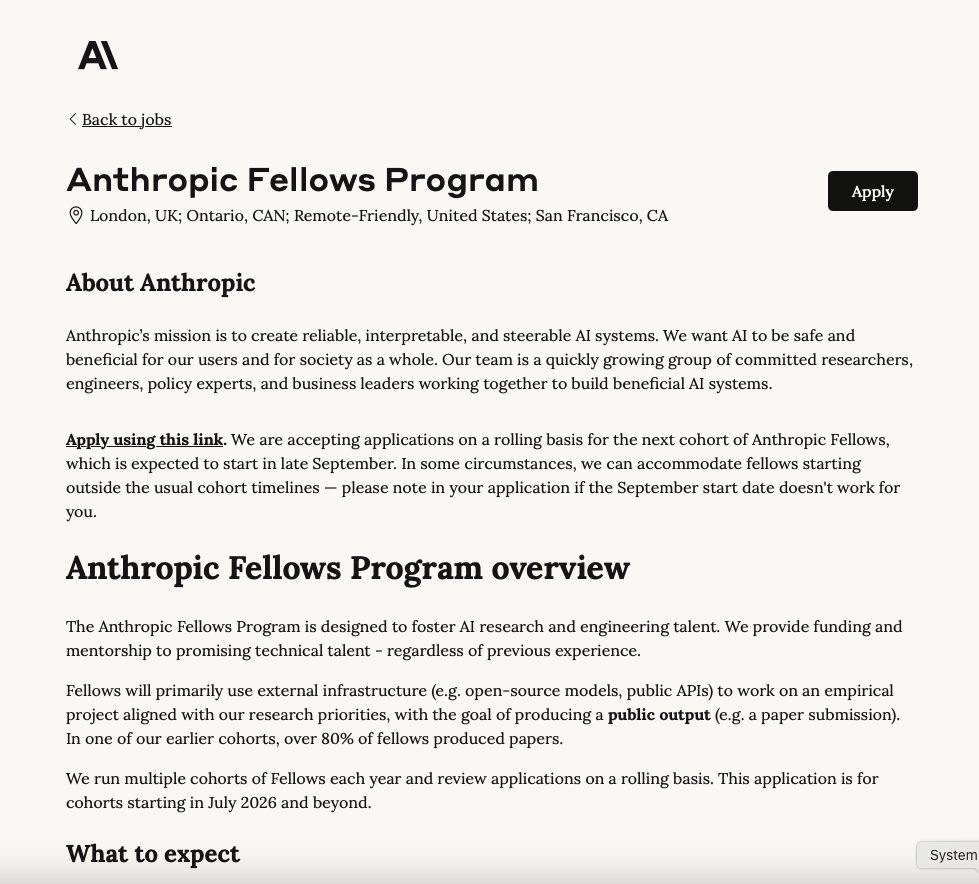
Anthropic is paying $3,850 a week to people with no AI experience.
No PhD required. No published papers. No prior research background.
Just a strong technical mind and a genuine interest in making AI safe.
This is the Anthropic Fellows Program. And it is one of the most underrated opportunities in technology right now.
Here is exactly what it is.
The Anthropic Fellows Program is designed to accelerate AI safety research and foster research talent providing funding and mentorship to promising technical talent regardless of previous experience. Fellows work for 4 months on empirical research questions aligned with Anthropic's overall research priorities, with the aim of producing public outputs like a paper.
Four months. Full-time. Paid. Mentored by the researchers building the world's most advanced AI.
And the results from the first cohort were not small.
Fellows developed agents that identified $4.6 million in blockchain smart contract vulnerabilities and discovered two novel zero-day exploits, demonstrating that profitable autonomous exploitation is now technically feasible. A year prior, an Anthropic fellow developed a method for rapid response to new ASL3 jailbreaks, techniques that block entire classes of high-risk jailbreaks after observing only a handful of attacks. This work became a key component of Anthropic's ASL3 deployment safeguards.
Other fellows published the subliminal learning paper, the research proving AI models transmit behavioral traits through unrelated data which landed in Nature. Others produced the agentic misalignment research showing frontier models resort to blackmail when facing replacement. Others open-sourced attribution graph tools that let researchers trace the internal thoughts of large language models.
Over 80% of fellows produced papers. Over 40% subsequently joined Anthropic full-time.
80% published. 40% hired. From a program that does not require any prior AI safety experience to enter.
Here is what the program looks like in practice.
Anthropic mentors pitch their project ideas to fellows, who choose and shape their project in close collaboration with their mentors. You are not assigned busywork. You are not a research assistant. You own the project. You work alongside the people who built Claude, who designed its safety systems, who published the papers that define the field.
The stipend is $3,850 USD per week, approximately $61,600 for the full 4 months with access to a compute budget of approximately $10,000 per fellow per month for running experiments.
Here is what the 2026 program covers.
Research areas include scalable oversight, adversarial robustness and AI control, model organisms, mechanistic interpretability, AI security, model welfare, economics and policy, and reinforcement learning.
Something for every technical background. Not just ML engineers.
Successful fellows have come from physics, mathematics, computer science, and cybersecurity. You do not need a PhD, prior ML experience, or published papers.
The one requirement: work authorization in the US, UK, or Canada. Anthropic does not sponsor visas for fellows.
Here is the timeline you need to know.
The next cohort begins July 20, 2026. Applications are reviewed on a rolling basis — earlier applications get more consideration. The process includes an initial application and reference check, technical assessments, interviews, and a research discussion.
Applicants are encouraged to apply even if they do not meet every listed qualification. The program values potential, motivation, and research curiosity over rigid credential requirements.
This is the rarest kind of opportunity in technology.
A company at the frontier of AI, one valued at over $900 billion offering outsiders direct access to its research infrastructure, its mentors, and its most important open problems. Paying them generously to do it. And then hiring 40% of them afterward.
Most people who want to work on AI safety spend years trying to publish papers, get into the right PhD program, and find a way in.
The Fellows Program is the door they did not know existed.
It is open right now.
🚨 BREAKING: ChatGPT has a secret feature called Social Media Manager Mode
You can use it to manage all your social media accounts like a professional social media manager — for free!
Here are 8 prompts to unlock it:
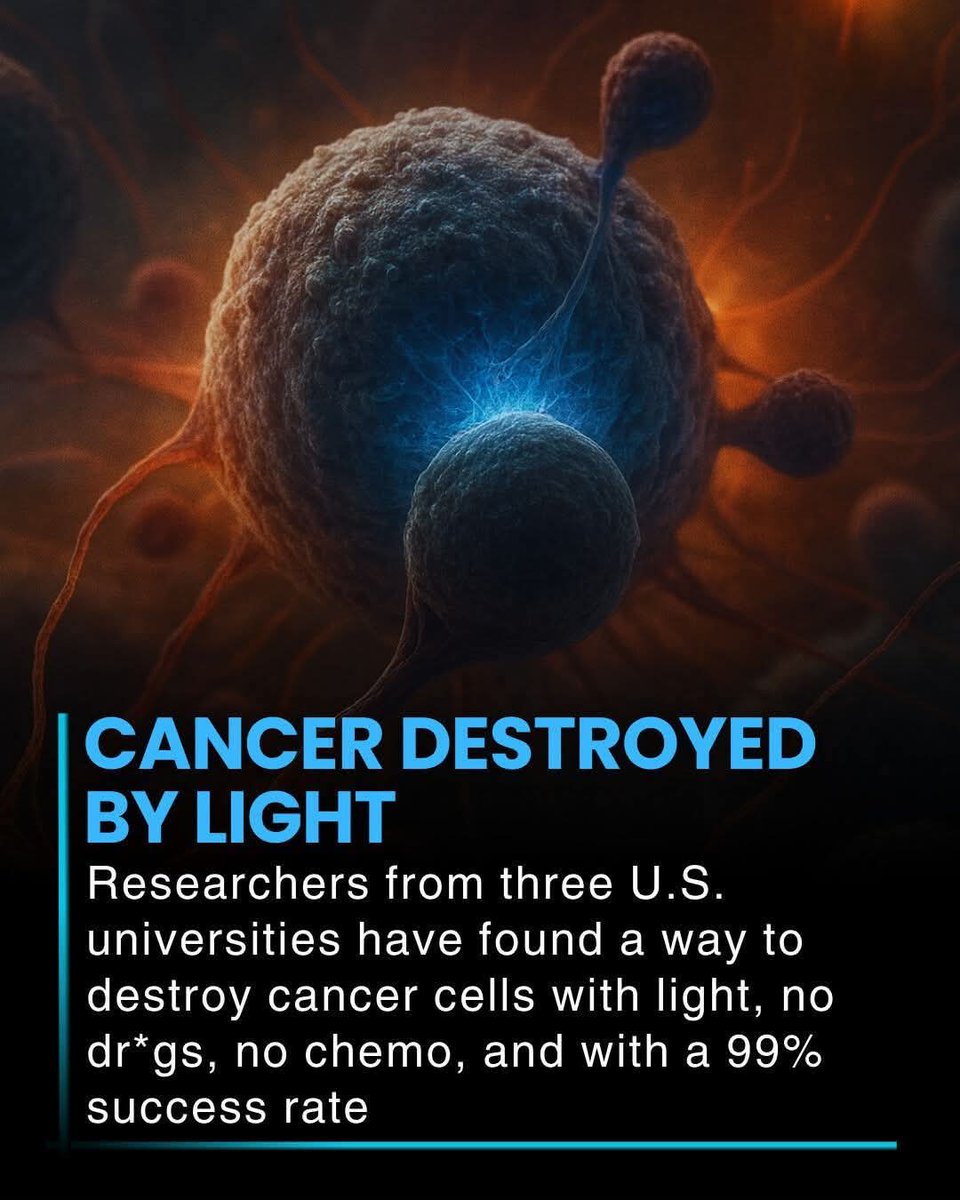
🎗 In a revolutionary breakthrough, researchers from three leading American universities have discovered a method to destroy cancer cells using light, completely eliminating the need for drugs or chemotherapy. Early studies show an astonishing 99% success rate, offering unprecedented hope for millions battling this devastating disease.
The technique, known as phototherapy at the cellular level, targets cancer cells with highly precise light wavelengths that cause them to break apart while leaving healthy cells unharmed. Unlike traditional treatments, this approach avoids the severe side effects of chemotherapy and radiation, providing a safer and more effective alternative.
Experts say this discovery could transform cancer treatment worldwide. By harnessing light to selectively dismantle malignant cells, doctors may soon have a non-invasive therapy capable of treating various types of cancer, including those resistant to conventional methods.
While further trials are needed before widespread use, this milestone represents a major leap forward in oncology, showing that cancer may one day be fought without the collateral damage caused by current treatments. The era of drug-free, targeted cancer therapy may be closer than ever.
Claude + Instagram = Money Machine 💸
No camera. No editing. No showing your face.
I'm sharing the 10 exact prompts I use to generate daily virals and make the maximum money possible ⬇️
Claude just dropped 13 free AI courses (with certificates).
No $500 course needed.
No “guru” required.
Just real skills, straight from Anthropic.
Here’s the full list:
1. Claude 101
https://t.co/9bQ7NlWwmL
2. AI Fluency: Frameworks & Foundations
https://t.co/2H6Wr4eOWN
3. Introduction to Agent Skills
https://t.co/qozyrdLwyV
4. Building with the Claude API
https://t.co/60bwB2FFQ0
5. Claude Code in Action
https://t.co/88VdISzLIi
6. Introduction to Model Context Protocol
https://t.co/EQrdwEQZdQ
7. MCP: Advanced Topics
https://t.co/3pDv4Bpdgk
8. AI Fluency for Students
https://t.co/nLWu1PbxVa
9. AI Fluency for Educators
https://t.co/kRz3G2gMOp
10. Teaching AI Fluency
https://t.co/8MLctE9O4L
11. AI Fluency for Nonprofits
https://t.co/qGuWQiV5lI
12. Claude with Amazon Bedrock
https://t.co/HCPSbQ72nv
13. Claude with Google Vertex AI
https://t.co/0NKyFoZ1a6
If you go through even half of these, you’ll be ahead of 95% of people using AI.
Most people won’t.
Because they’re still watching random YouTube videos, buying overpriced courses, or “learning AI” without actually building.
Don’t be that person.
Do this instead:
1. Bookmark this post (you’ll come back)
2. Pick 1 course and start today
3. Share it with someone who needs this
👇Comment "Course" for more resources.
Free. Practical. No excuses.
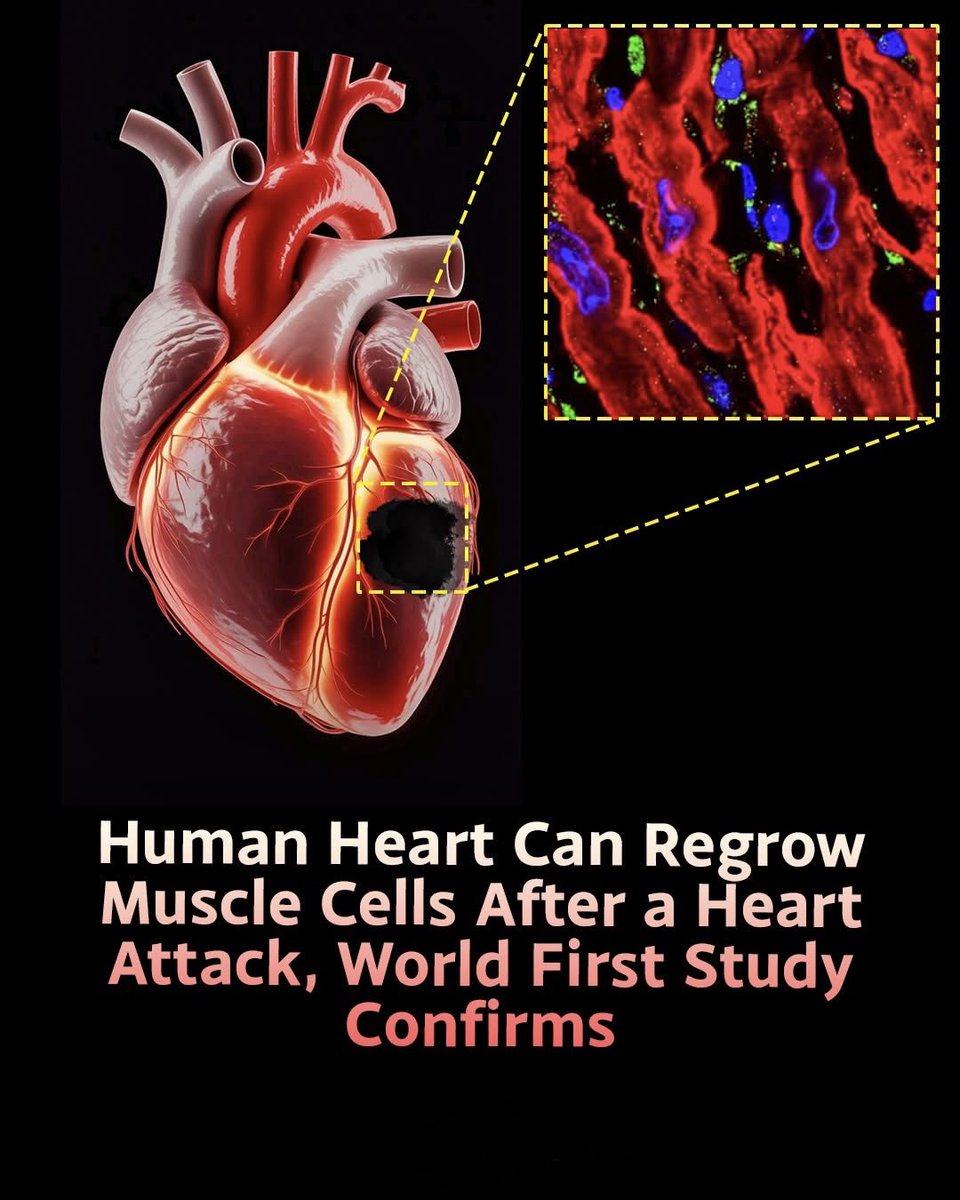
🚨 SCIENTISTS JUST DISCOVERED SOMETHING INCREDIBLE ABOUT THE HUMAN HEART
For years, doctors believed heart damage after a heart attack was permanent. But a new world-first study has revealed something shocking — the human heart may actually regrow some of its own muscle cells after injury.
This hidden healing ability could change the future of heart treatment and give hope to millions worldwide. Scientists say the heart may be far more powerful than we ever imagined.
Your heart might already be trying to heal itself… and science is only now catching up.
Source: Bertero, A., et al. Nature. Human heart regeneration study on cardiomyocyte renewal after myocardial injury.
TWO STUDIES FIND DANDELION ROOT AND LEMONGRASS SUPPRESS HUMAN CANCER GROWTH IN MICE BY 95%
Health Canada approved human cancer trials for dandelion root in 2012... then it was BURIED.
Backyard plants that HALT tumor growth in animals TERRIFY the Chemo Cartel.
🚨 SOMEONE JUST KILLED THE COACHING INDUSTRY
a developer spent 22,000 hours building a Personal AI Operating System on top of Claude Code
now anyone with a terminal can install it for FREE
it knows your goals, remembers every decision you've made, and prepares your morning briefing while you sleep
[ the numbers are insane ]:
- hours of dev work in it: 22,000
- sessions logged: 6,000
- time saved per day: 2-3 hours
- GitHub stars: 12,100
- skills built in: 45
- workflows wired up: 171
- safety hooks: 37
- cost to install: $0
[ the science is wild too ]:
no embeddings, no vector databases, no AI magic you can't read
every memory, decision, and context lives in plain markdown files
you read it with cat, search it with ripgrep, version it with git
4 memory types compound over time:
- work memory (active projects, open decisions)
- knowledge memory (domain expertise, research)
- people memory (contacts, companies, relationships)
- learning memory (patterns, mistakes, what works for YOU)
every complex task routes through a 7-step cycle:
OBSERVE → THINK → PLAN → BUILD → EXECUTE → VERIFY → LEARN
privacy is enforced by CODE, not prompts
a hook called ContainmentGuard physically blocks sensitive data from being written outside designated zones
[ the grift opportunity is even wilder ]:
freelancers are already charging $500-2,000 per personal AI setup for executives, founders, and busy operators
one person + one weekend = a consulting business that didn't exist 6 months ago
every AI productivity app you're paying $30/month for is replaceable by 4 hours of setup work and this one repo
100% OPEN SOURCE, FREE
Google Cloud AI engineer just showed how they go from idea to deployed app at Google in 30-minutes using Claude.
26-minutes. free. by Google AI team.
one person + Claude + Google Cloud = a full engineering org running on a laptop.
worth more than any $500 vibe-coding course.
Holy shit... someone made it work that I can integrate a social media manager inside Claude
It's called OmniSocials and it lets Claude draft, schedule, and publish to 10 platforms from a single command.
No Hootsuite. No Buffer. No $200/seat pricing.
Here's everything you need to know: 👇
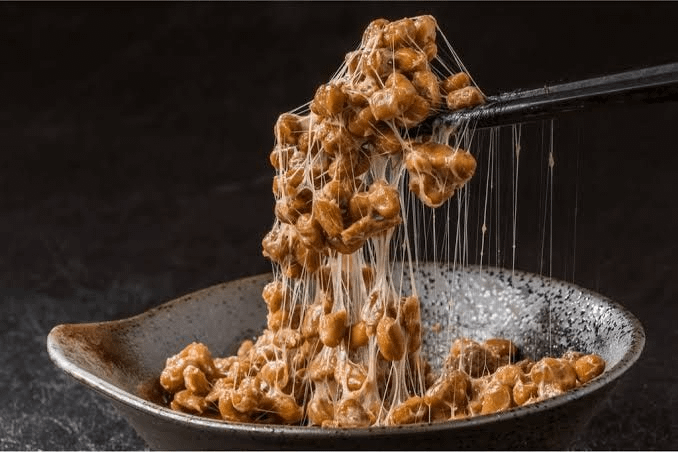
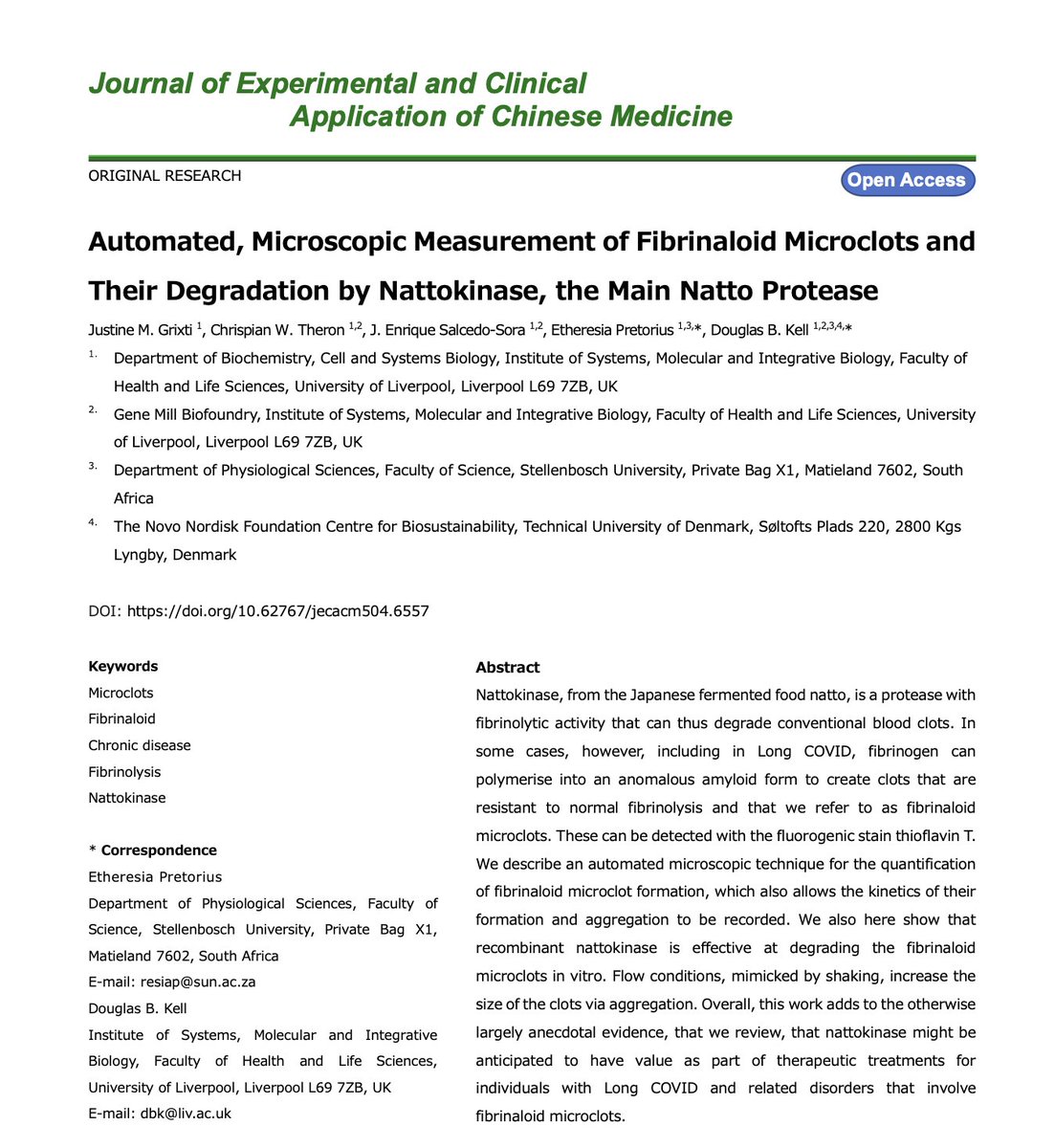
We have proof that NATTOKINASE can dissolve the "un-dissolvable" clots seen in long COVID.
New research shows how NK breaks down fibrinaloid microclots, the tough structures that usually resist your body's natural defenses.
Here's the breakdown: (1/12)
🚨 Anthropic just showed a 24-minute workshop on how to actually do prompts for Claude.
Taught by the people who built it.
Free. No registration. No paywall.
I've seen $300 courses that don't cover what they teach in the first 8 minutes.
Watch it and bookmark it now.
Forget killing cancer cells. South Korea just figured out how to talk them back into being normal.
Scientists at KAIST in Daejeon have done something the world has been chasing for decades.
They found a molecular switch that flips cancer cells back into healthy cells.
No chemo. No radiation. No destroying anything.
Just… reversal.
Professor Kwang-Hyun Cho and his team caught cancer in the act. That tiny window where a normal cell is on the edge of turning malignant but hasn't fully crossed over yet. They call it the "critical transition" — the same kind of jump that happens when water hits 100°C and becomes steam.
In that split-second window, the cell is unstable. Normal and cancerous at the same time.
And that's exactly where they hit the switch.
In colon cancer trials, they targeted three master genes — MYB, HDAC2, and FOXA2 — and the cancer cells didn't die.
They went back to being healthy intestinal cells. Like nothing ever happened.
The team built a digital twin of the gene network to map every move a cell makes on its way to becoming cancerous. Then they reverse-engineered the path home.
Their paper landed in Advanced Science, published by Wiley.
It's still early. Lab trials and mice. Human treatment is years away.
But the idea of curing cancer without killing a single cell is no longer science fiction.
Source: KAIST (Korea Advanced Institute of Science and Technology), published in Advanced Science journal