Having spent a long time in crypto community, I've realised that what exchange users care about is actually quite simple: not just whether a platform says it values users, but whether it is genuinely willing to do something for them.
@bitget recently announced two updates:first, its latest Proof of Reserves, showing a 131% reserve ratio and second, the launch of itsLimited-Time High-Yield Earn campaign, which runs until Oct 9️⃣.
I'm more interested in the second update. Many campaigns are designed for only one type of users, but this one offers three options based on different needs:
🔹If you want something steady, USDT or USDGO can be placed in flexible savings at 10% and 12% APR, respectively.
Rewards are distributed hourly and funds can be deposited or withdrawn at any time.
These assets also count as eligible assets under the Bitget Alliance Program https://t.co/ayVORtAqlp allowing users to participate in sharing 40% of the total reward pool.
🔹 If you already hold USDGO, you get HodlerYield with no extra steps: 6% for regular users, 7% for VIP1–2 users, 8% for VIP3–7 users.
🔹 If you plan to hold $BTC or $ETH over the longer term, lock them in PoolX to share a reward pool of 100,000 $BGB and 500,000 $USDT, respectively, with a bonus for long-term holders.
For existing users, a platform giving back part of its earnings probably means more than simply saying "thank you for your support."
Markets will always have ups and downs. How a platform treats its users is often most visible during those periods.
Check out Limited-Time High-Yield Earn now: https://t.co/XueN1sc2PD
#BitgetAllianceProgram
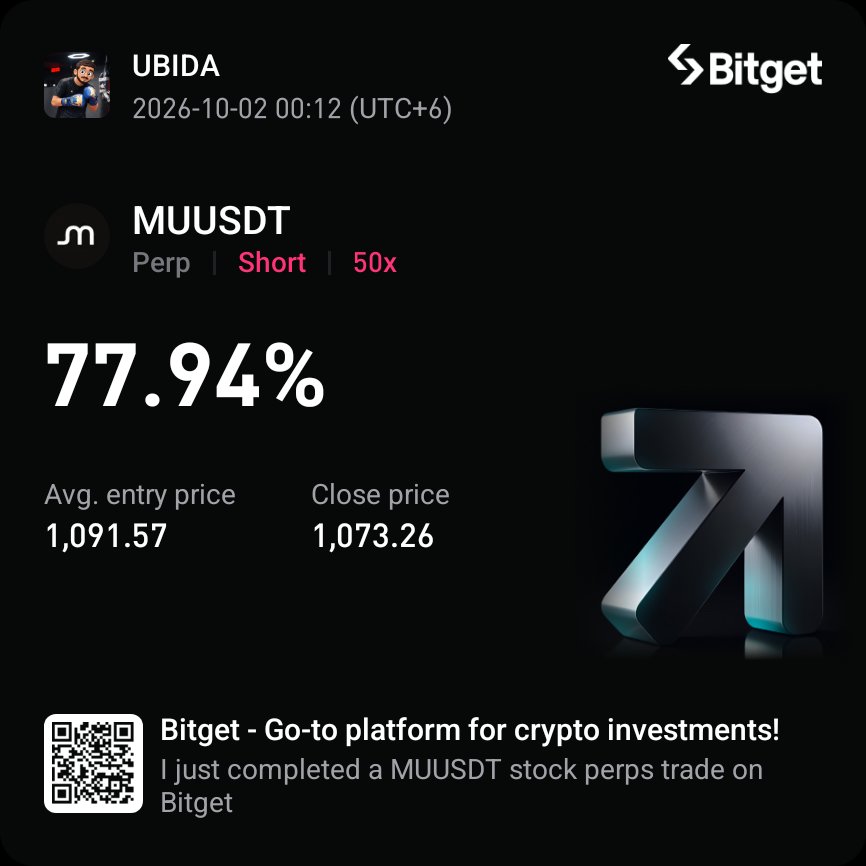
$MU Micron just dropped some serious numbers🔥
Q4 revenue hit $54.23B (+379% YoY) and non-GAAP EPS came in at $33.42, beating estimates. Q1 FY27 revenue guidance is also a record $61.5B.
That means plenty of post-earnings volatility to watch.
I’m staying with @bitget and standing with Bitget
And trading this move also adds to my activity in the Bitget Alliance Program https://t.co/Z3l30uH4jp
where 30% of platform transaction-fee revenue goes into the #reward pool.
📊 Trade the volatility. Watch the pool grow😍
#BitgetAllianceBingo
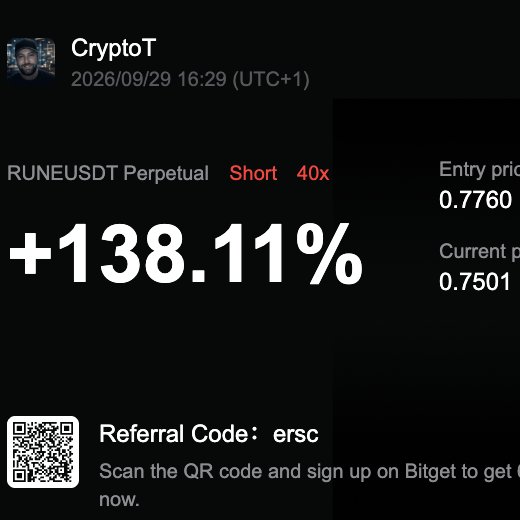
thorchain:native Paid Me Again. Fourth Time. 📉💰
Resistance was 0.7959 on the trendline. It rejected. Right where I marked it.
Fourth time I've shorted this. Fourth time it's paid.
40x from 0.7760, currently 0.75. +138.11%.
Levels going forward:
🔹 Resistance: 0.7959, then 0.8315
🔹 Support: 0.7105, then 0.6660
Bias holds until a close above resistance.
I'll keep taking the trade. 🧼
Don't hate the player, hate the game 🎮
Not financial advice
#RUNE @THORChain@bitget
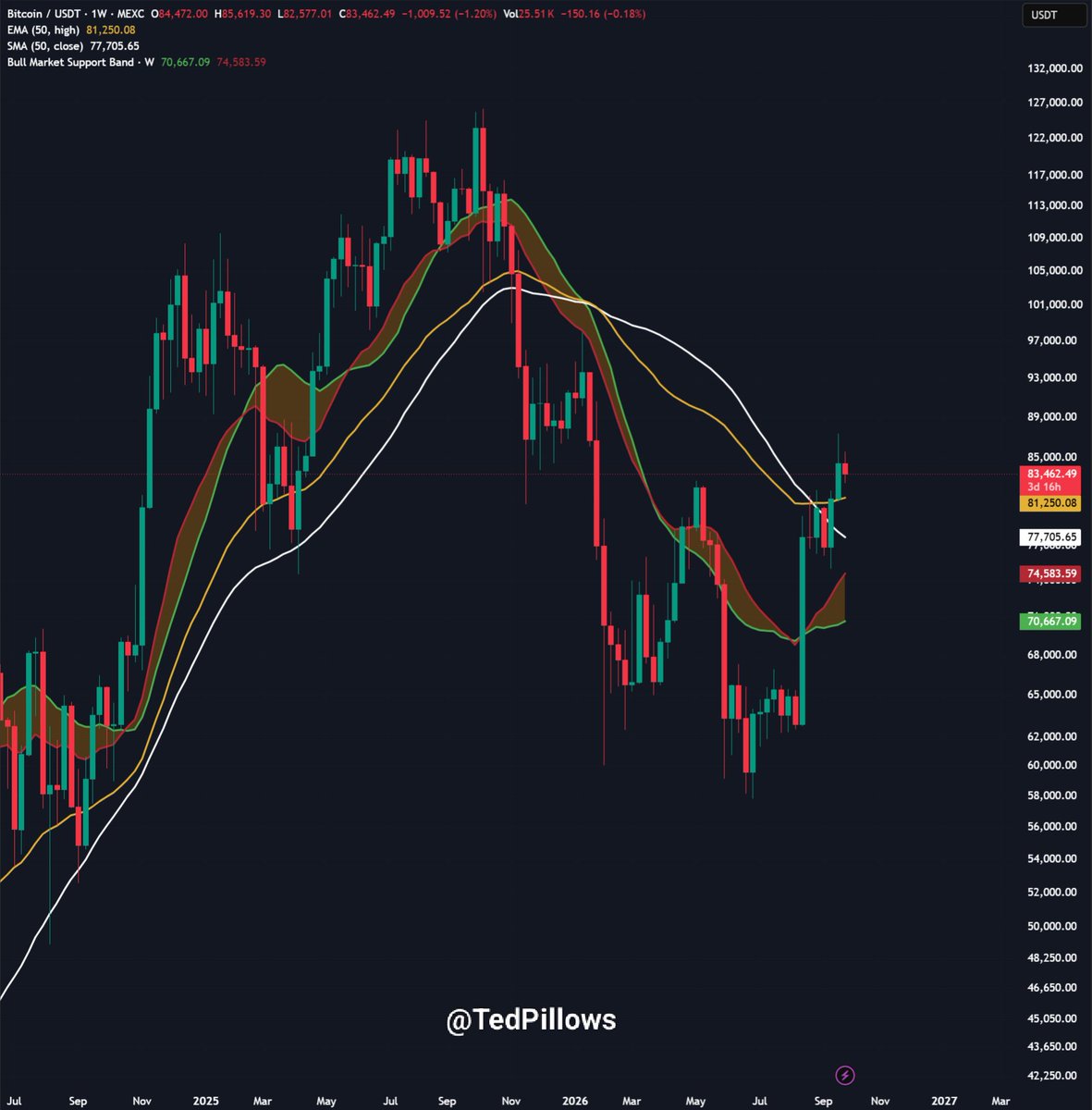
$BTC erased its entire PCE pump, which isn't a good sign.
When the pump on good news gets erased, it means the market wants to go down.
IMO, Bitcoin could tap the $79,000-$80,000 zone soon before any uptrend.
Having spent a long time in crypto community, I've realised that what exchange users care about is actually quite simple: not just whether a platform says it values users, but whether it is genuinely willing to do something for them.
@bitget recently announced two updates:first, its latest Proof of Reserves, showing a 131% reserve ratio and second, the launch of itsLimited-Time High-Yield Earn campaign, which runs until Oct 9️⃣.
I'm more interested in the second update. Many campaigns are designed for only one type of users, but this one offers three options based on different needs:
🔹If you want something steady, USDT or USDGO can be placed in flexible savings at 10% and 12% APR, respectively.
Rewards are distributed hourly and funds can be deposited or withdrawn at any time.
These assets also count as eligible assets under the Bitget Alliance Program https://t.co/ayVORtAqlp allowing users to participate in sharing 40% of the total reward pool.
🔹 If you already hold USDGO, you get HodlerYield with no extra steps: 6% for regular users, 7% for VIP1–2 users, 8% for VIP3–7 users.
🔹 If you plan to hold $BTC or $ETH over the longer term, lock them in PoolX to share a reward pool of 100,000 $BGB and 500,000 $USDT, respectively, with a bonus for long-term holders.
For existing users, a platform giving back part of its earnings probably means more than simply saying "thank you for your support."
Markets will always have ups and downs. How a platform treats its users is often most visible during those periods.
Check out Limited-Time High-Yield Earn now: https://t.co/XueN1sc2PD
#BitgetAllianceProgram
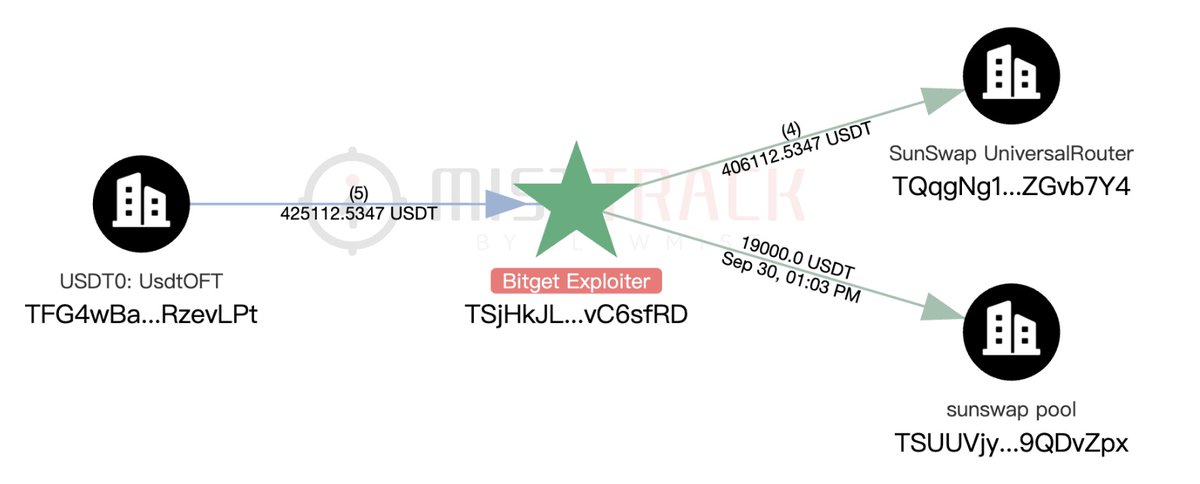
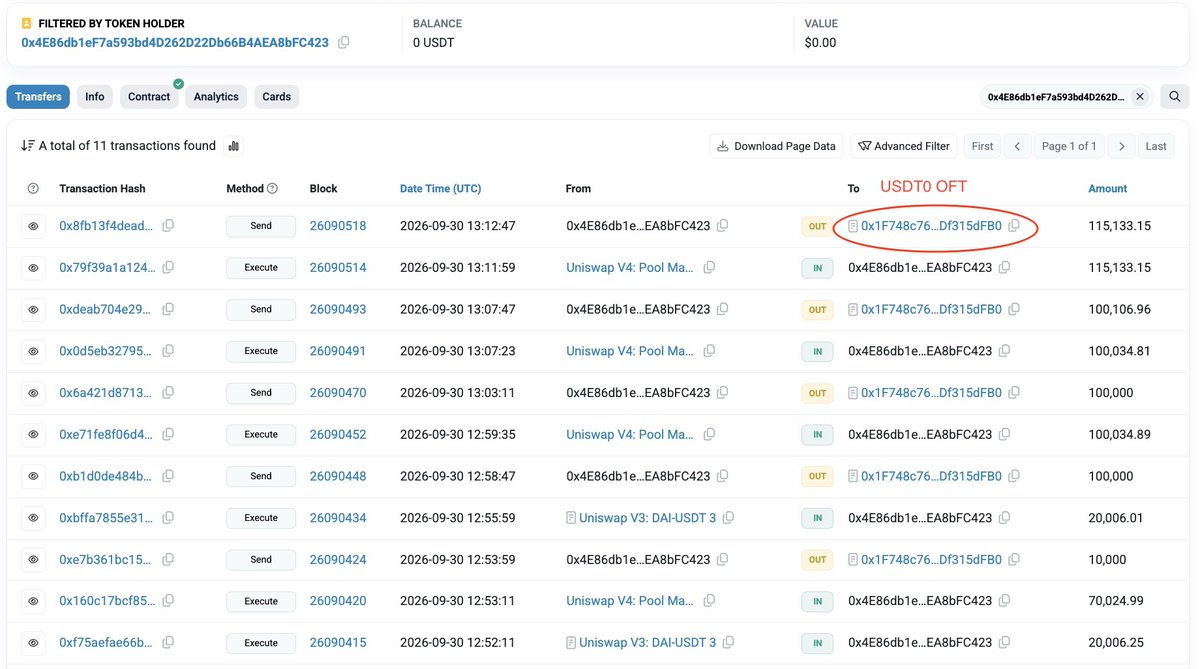
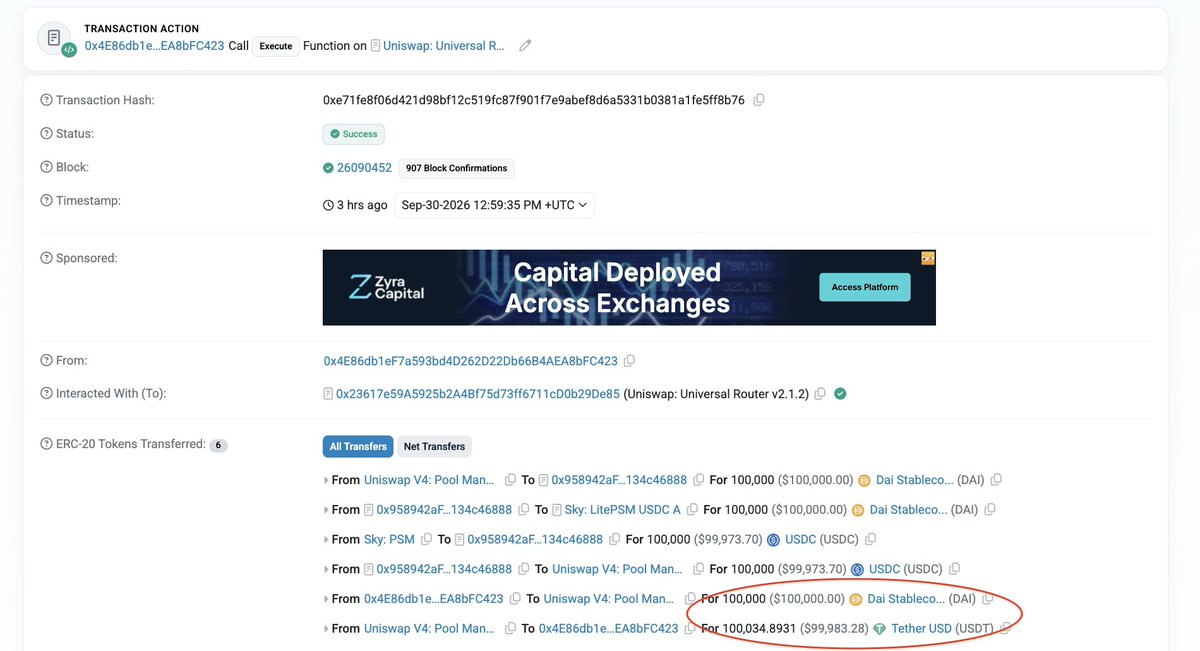
🔎 The @bitget exploiter is moving stolen DAI on Ethereum through a series of swaps and cross-chain transfers:
DAI → USDT on Ethereum → USDT0 → Tron
💱 One recent transaction:
100,000 DAI → 100,034.89 USDT via #Uniswap.
https://t.co/txJ5DzvAkf
🌉 The USDT was then transferred from Ethereum to Tron via #USDT0 infrastructure.
https://t.co/xck9s5JmM2
USDT0 OFT:
0x1f748c76de468e9d11bd340fa9d5cbadf315dfb0
Tron-side USDT0 OFT:
0x3a08f76772e200653bb55c2a92998daca62e0e97
On Tron, the funds continued moving via #SunSwap:
• 90,967 USDT → $USDD
• 19,000 USDT → $TRX
This activity is part of an ongoing flow from an address linked to the Bitget exploiter. The same address has been repeatedly converting $DAI to $USDT and bridging the funds to #Tron.
We’ll continue tracking the movement of the stolen funds across chains and services. 👀
This could be a possible scenario for Bitcoin.
The fractal looks very similar to early 2023, when BTC had a sharp correction after confirming the cycle bottom.
This time, we could see a drop into the high $70,000s before the next leg up.
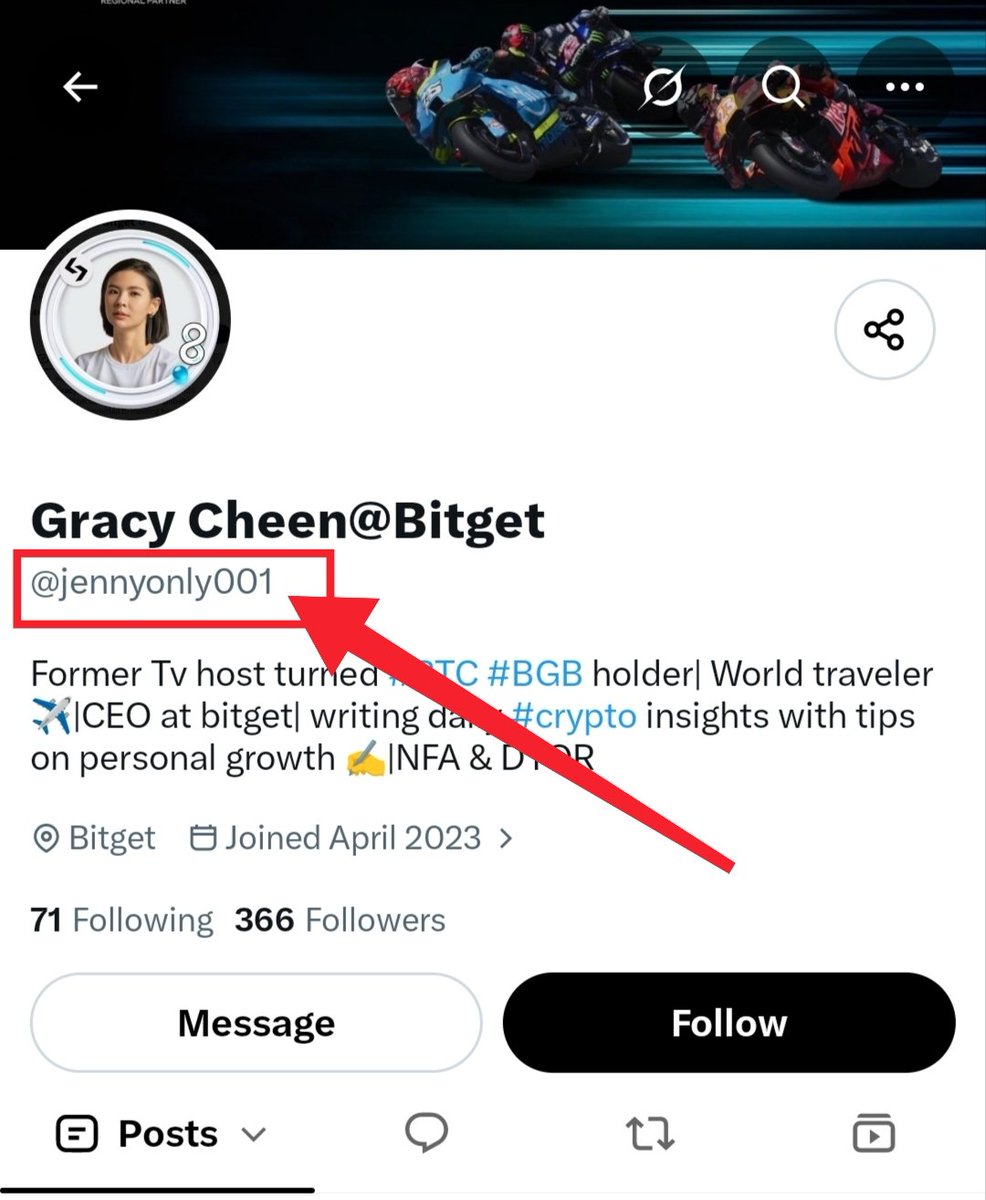
🚨 Fake account alert!
Please be careful with @jennyonly001 — this account is impersonating @GracyBitget.
Let’s help keep the community safe. If you spot it, report the account for impersonation and share this warning with others. ⚠️
Stay safe & DYOR.
#Alert
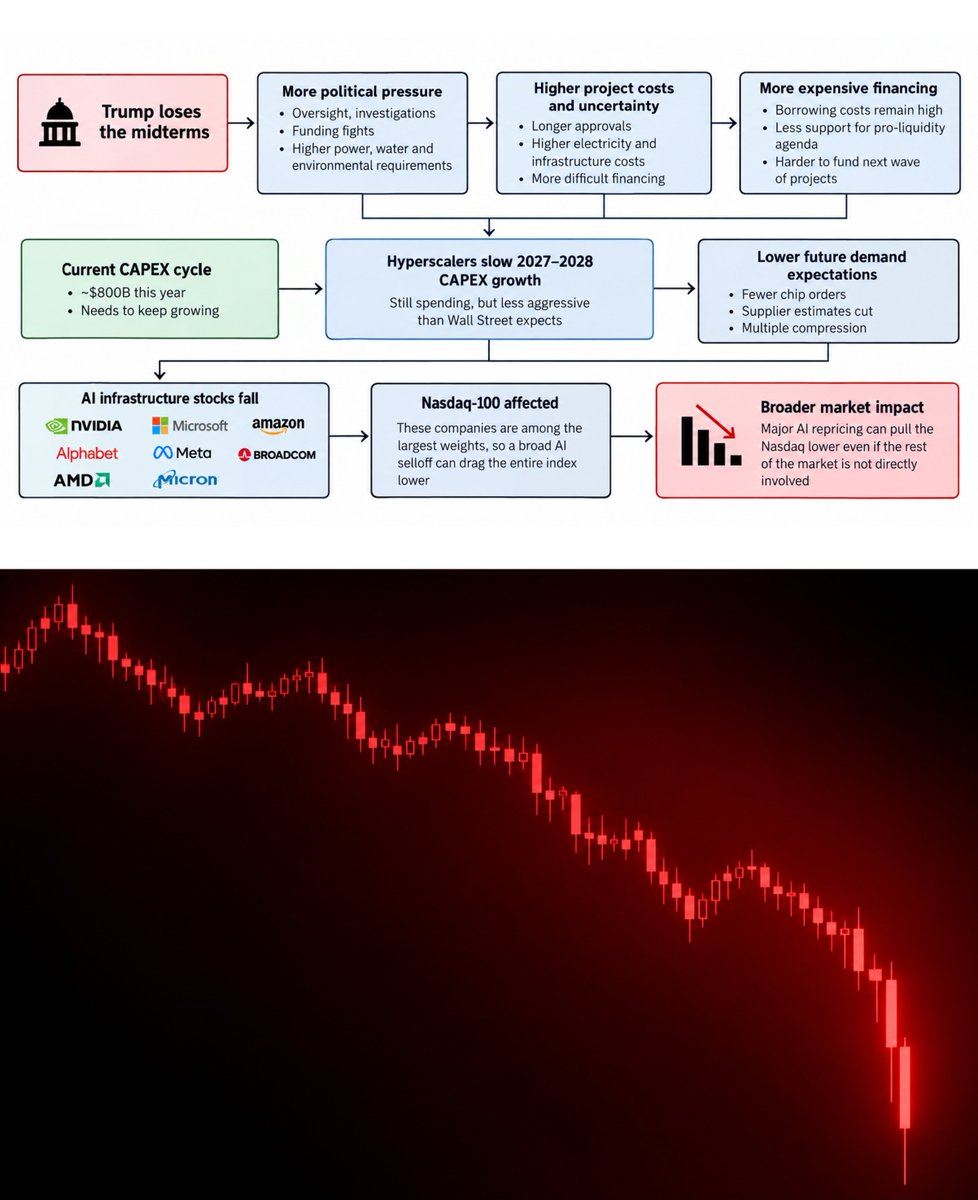
🚨 TRUMP LOSING THE MIDTERMS COULD BE THE TRIGGER THAT POPS THE AI BUBBLE.
The reason comes down to two things:
Politics and CAPEX.
The AI boom now requires an enormous amount of spending to keep growing.
Major hyperscalers are on track to spend nearly $800 billion on CAPEX this year, per J.P. Morgan, roughly 10x their 2019 spending.
UBS estimates overall AI spending could reach around $900 billion in 2026 and $1.2 trillion in 2027.
That money flows through almost the entire AI trade. Microsoft, Amazon, Alphabet, Meta and Oracle build the data centers.
Nvidia, Broadcom and AMD sell the chips. Then you have memory, networking, cooling, electricity and construction. This is why AI stocks don't need CAPEX to collapse.
CAPEX growth only needs to disappoint Wall Street. And maintaining this level of spending is becoming harder.
AI CAPEX consumed around 33% of hyperscaler operating cash flow in 2023. J.P. Morgan estimates that has reached roughly 93% in 2026.
Hyperscalers issued around $121 billion of bonds in 2025, and J.P. Morgan expects around $250 billion in 2026. The full data center buildout could require trillions of dollars through 2030.
So AI is becoming more dependent on debt and external financing at exactly the wrong time:
U.S. borrowing costs are rising again.
The Fed just raised rates to 3.75%-4.00%, while the 30-year Treasury yield has reached its highest level since 2002.
Trump wants the opposite.
He has publicly demanded rates of 1% or lower.
Cheaper money would make it easier to finance data centers, power projects and the next round of AI expansion.
But the Fed is independent, and some officials are discussing further hikes because inflation remains high.
And this creates another risk around the midterms. Trump has been one of the strongest political voices pushing the Fed toward lower rates.
Losing Congress would not remove Trump's pressure on the Fed because he would still be president.
But it could weaken his broader ability to push a pro-liquidity, pro investment agenda through Washington while the Fed is moving in the opposite direction.
And right now, the Fed is clearly not following Trump's preferred path.
Most policymakers still expect another rate hike this year, while Fed Governor Michael Barr says further hikes will likely be needed to control inflation.
That could leave Trump entering 2027 with a divided government, less room to advance new AI-supportive legislation, and a Fed still keeping borrowing costs high or potentially raising them further.
For an AI industry increasingly dependent on outside financing, that's another major risk.
Now add the midterms.
Trump has made rapid AI infrastructure expansion a major part of his administration's policy.
Executive Order 14318 directs federal agencies to speed up permitting for large data centers and related power infrastructure, use federal land and provide pathways for financial support to qualifying projects.
But Republicans could lose control of Congress in November.
Trump would still be president. His executive orders would remain in place.
But a Democratic House would control committees and could increase oversight of the AI buildout through hearings, investigations and subpoenas.
It could also create more fights over federal funding and push harder on some of the biggest political problems surrounding data centers:
1. Electricity bills.
2. Grid upgrades.
3. Water usage.
4. Environmental reviews.
And who pays for the infrastructure these projects require.
That matters because Trump's administration is trying to make the buildout faster, while a change in congressional control could increase scrutiny and political friction around parts of that expansion.
And this could happen while Trump is pushing for much lower rates but the actual cost of borrowing remains extremely high. That's where the two risks meet.
More political friction + expensive financing.
For an industry preparing to spend trillions of dollars, that combination could be dangerous.
A project already under construction doesn't suddenly disappear after the election. Existing chip orders don't automatically get cancelled either. The real question for markets becomes:
What happens to the next round of CAPEX?
If political pressure, higher power costs and expensive financing make hyperscalers even slightly less aggressive with 2027 and 2028 spending, Wall Street starts cutting future demand expectations.
Nvidia doesn't need today's GPU sales to collapse. Investors only need to expect slower growth in tomorrow's orders.
The same applies to Broadcom, AMD, Micron and the rest of the AI infrastructure chain.
And this is where it becomes a broader market problem.
Microsoft, Nvidia, Amazon, Alphabet, Meta, Broadcom and other AI-linked companies are among the biggest weights in the Nasdaq-100.
So when the AI trade gets repriced, it isn't a small corner of the market falling.
Some of the companies with the greatest influence over the entire index are falling together.
That means a major AI selloff can drag the Nasdaq lower even if large parts of the market aren't directly involved.
And investors are already becoming less willing to reward spending for the sake of spending.
J.P. Morgan says higher CAPEX plans have recently been rewarded only when accompanied by stronger revenue expectations. Investors increasingly want proof that all this investment is actually generating demand and returns.
That's what makes November important.
AI enters the midterms with nearly $800 billion of hyperscaler CAPEX, spending consuming roughly 93% of operating cash flow, rapidly growing financing needs and borrowing costs already near multi-decade highs.
Trump is pushing for faster AI infrastructure development and dramatically lower interest rates.
A Republican loss wouldn't reverse all of that overnight.
But it could add congressional pressure to an AI CAPEX cycle that is already becoming much more expensive to finance.
And if that causes Wall Street to question the next trillion dollars of AI spending, the companies that drove this market higher would be the first place investors look.
I’m staying with Bitget and standing with Bitget 💙
Bitget bounced back strong and now the @bitget Alliance Program is giving eligible #traders & #holders a chance to earn from a #reward pool equal to 30% of platform transaction fee revenue👀
Trade, hold and stay active →rewards are waiting.
Let’s keep building together.
#BitgetAllianceBingo #Bitget
#BitgetTurns8