curious wanderer, avid reader.
To understand is more important than to win arguments.
Tweets here on math, science.
non science tweets at @uc59_societyEtc.
Quakery vs Science
Quakery will continue to thrive until large part of population understands nature & power of scientific conclusions; that these conclusions are necessarily grounded in probability & statistics, yet ACCURATE & self correcting.
Quakery can't be generalized.
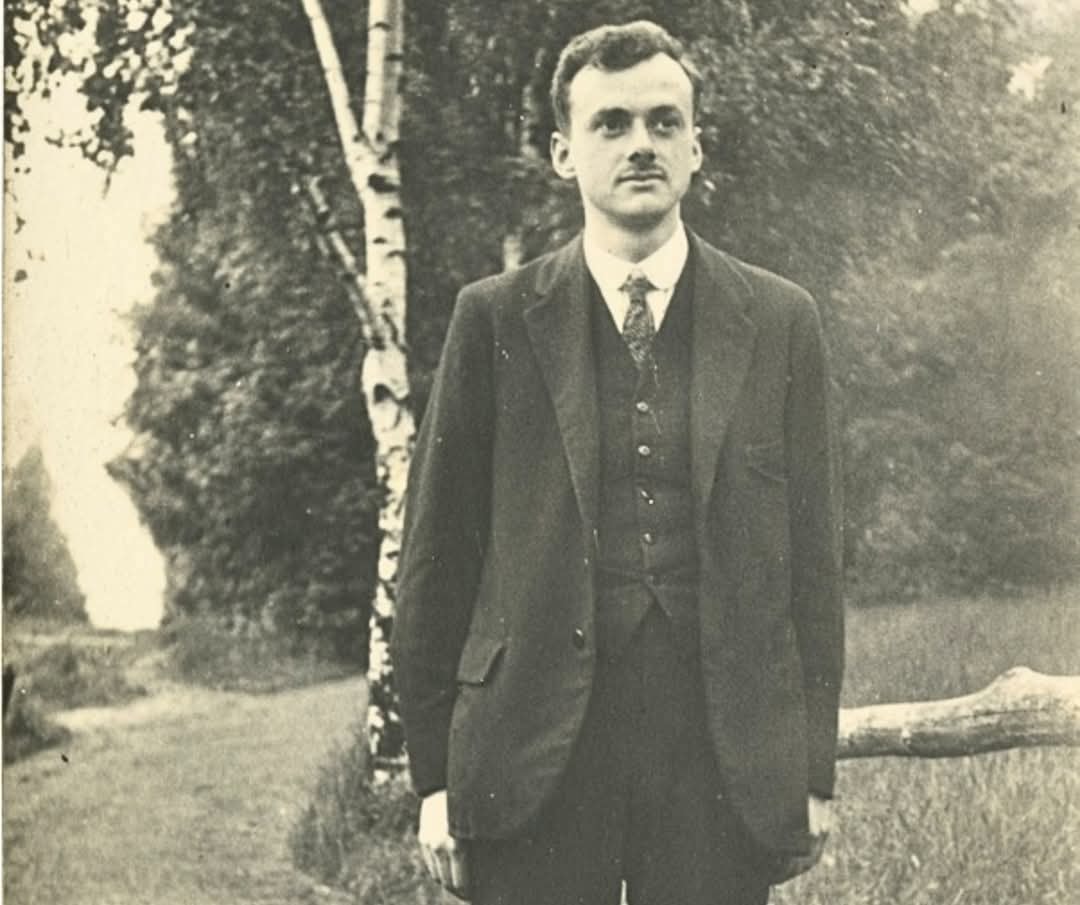
"In the winter of 1926... I was so desperate that I was ready to give up physics altogether. I felt that I was a completely untalented person who had chosen the wrong profession."
- Paul Dirac, reflecting on his early struggles with quantum mechanics
@ainvvy Yes, indeed 😛. But the misspelling does not have anything to do with my dislike of the book. I misspelled Munkres too, the author of the topology book, though I love that book.
The background and context of this lecture are fascinating and deserve a fuller exposition, parhaps a complete article.
Putting it on my list of articles to work on and complete.
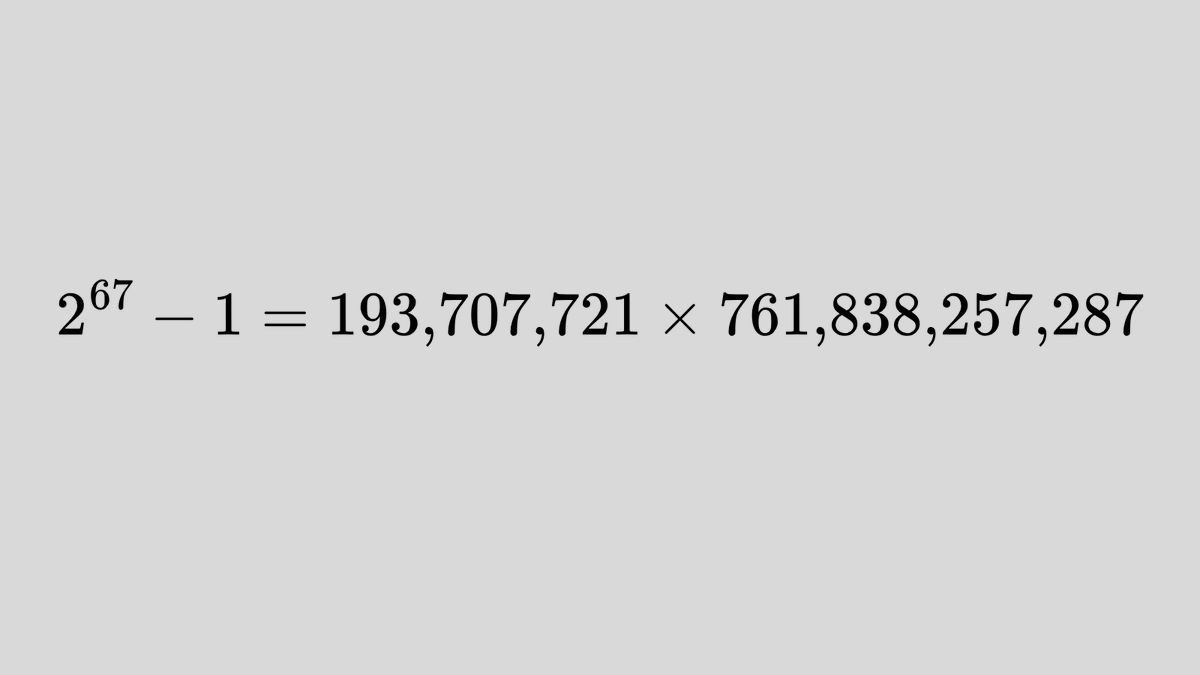
In 1903, Frank Nelson Cole, a professor of mathematics at Columbia University in New York, gave a rather curious talk at a meeting of the American Mathematical Society. Without saying a word, he wrote one of Mersenne’s numbers on one blackboard, and on another blackboard he wrote two smaller numbers and multiplied them together. Between them, he placed an equals sign—and then sat down. The audience rose to its feet and applauded, a rare outburst for a room full of mathematicians.
But to me, Urysohn's lemma's most magical consequence is that it leads to partition of unity,a fundamental tool that allows "glueing " local properties into a global whole.
Do you have a theorem you fell in love with?
Mine is: Urysohn's lemma.
In his text book Munkres calls this one the first deep theorem of the book; up until then a bright student may anticipate and prove all the results but NOT Urysohn's Lemma. It has the touch of a genius.
The Urysohn Lemma shows that any two disjoint closed sets in a normal space can be separated by a continuous function.
This leads to the Urysohn's metrization theorem
Every second countable T3 topological space is metrizable.
@NGKabra@AmazonHelp@amazonIN Read somewhere: Those who do not learn from History are condemned to repeat it.
Any real alternative, though? It is a bit of monopoly; it seems to me.
I know that mathematics gives everyone headache, even those who love math.
In this specific case however I am directly responsible because I was the instructor of the course that caused " His head hurt", as @GenWise_ would probably remember.
Quite happy for him.
Q: "Would you do it again?"
A; "In a thousand lifetimes, always yes."
That's Agastya Iyer — attended GenWise GSP in Grade 9 at Shiv Nadar School, Faridabad. Now studying Mathematics at IISER, Mohali.
Six hours a day of hardcore mathematics. His head hurt. But it was also the most fun he'd ever had.
He came back with a notebook full of phone numbers. His GenWise alumni network spans the globe. And something he hadn't felt before — zero fear of being judged.
"GenWise was when I first actually met my tribe."
Some summers are just summers. This one changes everything. Gift your child this summer.
@vishnu_agni@sjpatil@rpanchanathan@ashishponders
#GenWise #GSP #GiftedEducation #GiftedSummerProgram
It is also a pleasant surprise to me because it was my lectures over those three weeks, 15 days and six hours each day, the made this happen, namely,
"His head hurt."
On August 10, 1937, a quiet 21-year-old named Claude Shannon submitted an 85-page thesis at MIT. No headlines. No applause. Just another paper that seemed destined to be forgotten. But inside those pages was a revolutionary idea: machines could think using simple logic, 1s and 0s, ON and OFF. By linking Boolean algebra with electrical circuits, Shannon transformed switches into decision-makers. That single insight became the foundation of the digital world. Every computer, smartphone, and algorithm traces back to it. History did not roar that day. It whispered. And from that whisper, the modern world was born, one bit at a time.
(via Arindam Khan - CS Prof at @iiscbangalore on LinkedIn) -
𝗟𝗲𝗮𝗿𝗻𝗶𝗻𝗴 𝗖𝗼𝗺𝗽𝘂𝘁𝗮𝘁𝗶𝗼𝗻𝗮�� 𝗚𝗲𝗼𝗺𝗲𝘁𝗿𝘆 𝗳𝗿𝗼𝗺 𝗮 𝗠𝗮𝘀𝘁𝗲𝗿!
Prof. Mark de Berg (TU Eindhoven) is spending his sabbatical at IISc and this week he is delivering a minicourse on topics in computational geometry and randomized algorithms. The best part? It is designed to be accessible, even if you do not have a prior background in computational geometry.
If you have ever encountered computational geometry as a student, chances are you have come across his textbook. I still remember learning from it during my undergraduate days at IIT Kharagpur almost two decades ago.
Beyond his influential research, Prof. de Berg is known as an exceptional teacher. Thus, it's an opportunity to see how a field is explained by someone who helped build it, and to experience the clarity that has inspired generations of students.
If you enjoy algorithms, geometry, or simply good teaching, this is something you should not miss.
The lectures are recorded and streamed online.
The first lecture started with Backward Analysis of Quicksort and gave a meta-algorithm for randomized incremental construction, which gives algorithms for many problems, including quicksort, intersection, point location, and convex hull.
YouTube link: https://t.co/HcV1gF5iCL
Next lecture is tomorrow at 2 pm IST.
Meet Raghu Mahajan!
(IIT-JEE Rank 1 & Top Physicist from India)
Working on some of the deepest questions in string theory, quantum gravity, and black holes.
> He grew up in Chandigarh, India
> Secured All India Rank 1 in IIT-JEE 2006
> Joined Computer Science at IIT Delhi
> After two years, he transferred to MIT
> Completed his Bachelor’s in Physics and Mathematics from MIT
> Pursued his Master’s at the University of Cambridge
> And completed his PhD and postdoc at Stanford University in theoretical physics and mathematics
After spending 16 years abroad, he returned to India in 2024 and today, he is a faculty member at ICTS-TIFR, Bengaluru.
At ICTS, his work sits at the intersection of advanced mathematics, quantum theory, string theory, quantum gravity, and the deepest questions about the universe.
His journey is also special because he chose to come back and contribute to building world-class research from India.
From Chandigarh to IIT Delhi, from MIT and Stanford to ICTS Bengaluru, Raghu Mahajan’s journey is a powerful reminder that India can become a global home for deep scientific research.
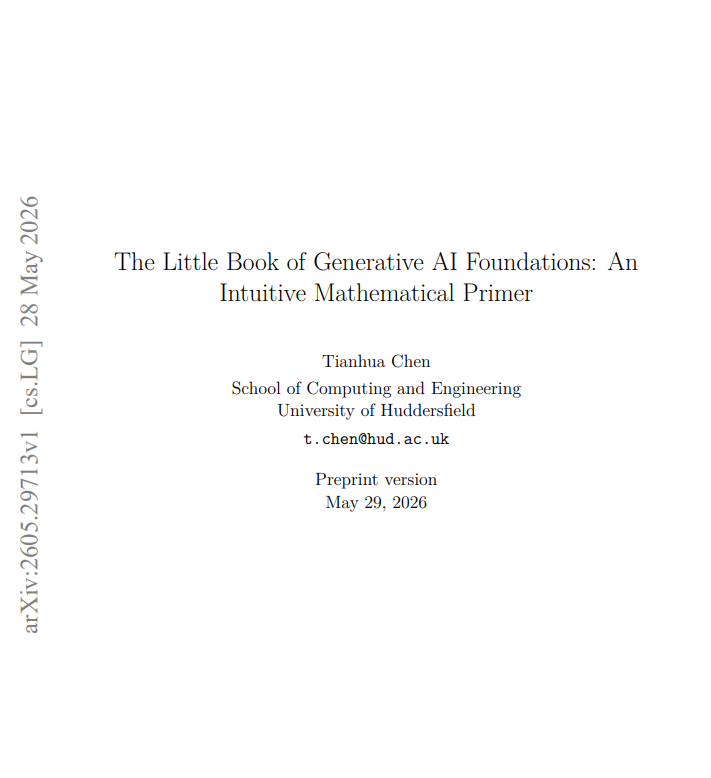
A must-read survey to refresh math and gen AI basics → The Little Book of Generative AI Foundations: An Intuitive Mathematical Primer
It shows a clear walkthrough of how gen AI learns to understand, model, and create complex data, covering:
- Latent algebra foundations: PCA, SVD, autoencoders
- Latent models: PPCA and VAEs
- VAEs: ELBO, inference, reparameterization
- Diffusion: the way from noise → denoising
- Score-based and continuous-time generative modelling
- Density models: flows, autoregression
- GANs and energy-based models beyond likelihoods
Rubik's cube. Let R be the 90° CW rotation of the side to the right, and U be the 90° CW rotation of the top layer. Repeatedly apply (UR). That is First R and Then U. Consider (UR)ⁿ. Is there an n when it'll return to its unscrambled position? Answer this for a 14 year old.
🚨Anthropic just showed a 24-minute workshop on how to actually do prompts for Claude.
Taught by the people who built it.
Free. No registration. No paywall.
I've seen $300 courses that don't cover what they teach in the first 8 minutes.
Watch it and bookmark it now!
In mathematics, many results boil down to bring creative about counting.
You count the same thing in two different ways and equate the result.
Voila. You get a nice theorem.
Example: Combinatorial proof of Frrmat's little theorem.
Buddha on the art of counting:
Buddha said:
Son, Don't count your eggs
Or the chickens before they are hatched.
Learn to Count.
Count the same thing in more ways than meets the eye.