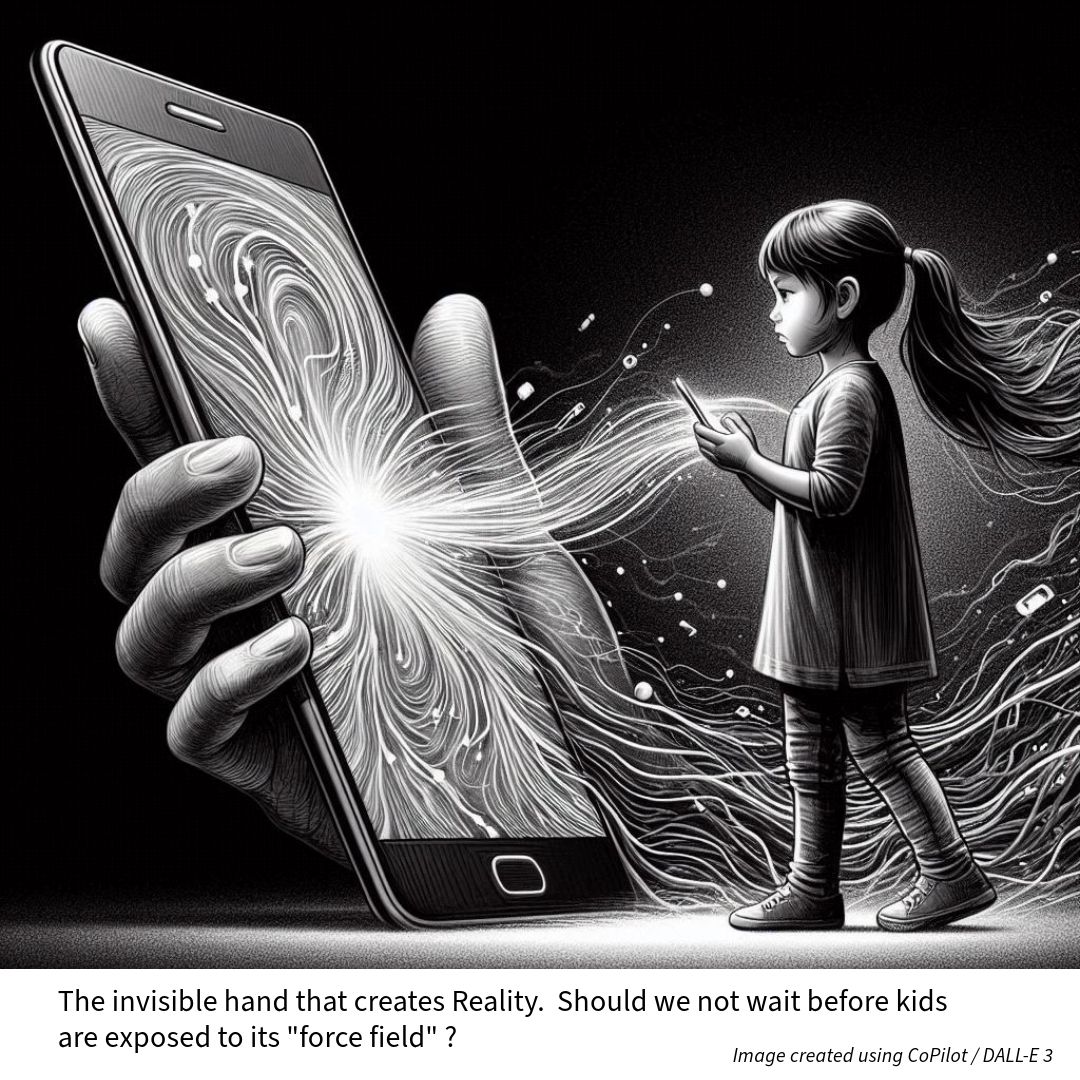
8 Reasons why Dumbphones are a Smart Choice for Your Child's Well-being
Smartphones are debasing human childhood in profound ways.
Children raised on a steady diet of gaming, videos, and porn (for boys) or social media and video content (for girls) become malformed pseudo-adults.. I’ve observed their disastrous effects as a teacher over the past five years, and as a parent, I am concerned about where we’re all headed. One of the best articulations of their effects and dangers can be found in the 2023 best-seller The Anxious Generation by @JonHaidt.
A lot needs to be said about the dangers of smartphones for kids under 16. I’ve strived to build a compelling argument, and I hope it prompts you to reflect deeply on this pressing issue of our times.
Yes, we need to start mandating politicians and senior bureaucrats to keep their families inside the same public systems they run.
Think about it. The day the Education Minister's child sits for the same NEET exam your child does, paper leaks get fixed in a week. The day the Health Minister's parent depends on a government hospital, those hospitals transform. Skin in the game changes everything.
Versions of this exist around the world.
Norway.
There's no formal law, but the social norm is so strong that ministers genuinely use public hospitals and send kids to public schools.
A Norwegian minister caught using private healthcare would face career-ending backlash.
Finland.
Private schooling is so socially frowned upon that even the wealthy use public schools. T
The result is the public system became world-class because the powerful had no exit.
Sweden.
Senior officials' perks and housing are tied to public infrastructure. They live in the systems they manage.
Singapore.
Lee Kuan Yew deliberately sent his own children to ordinary local schools and made it a public principle that leaders use national systems.
It signalled that the system was good enough for everyone, including the top.
Now how can we actually implement this;
> One.
A legal requirement that any minister, MP, MLA, or senior bureaucrat holding a portfolio must have their dependent children educated in Indian institutions while they hold office.
Education Minister's kids in Indian schools and universities. Non-negotiable.
> Two.
Tie it by portfolio. The Health Minister's family uses public or Indian hospitals for routine care. The Railway Minister travels by train in general classes periodically.
The minister responsible for a system must be a user of that system.
> Three.
Public disclosure. Every elected official declares annually where their children study and where their family receives healthcare.
Just like asset declarations. Transparency creates accountability.
> Four.
Link performance reviews of senior bureaucrats to the public systems they run.
If you head school education, your evaluation is tied to public school and board exam outcomes, including security and paper-leak prevention.
There is an argument that "You can't punish a politician's child for the parent's job." Fair.
But nobody is banning quality. You're saying if you choose to run the country's education system, your family experiences it too.
If it's not good enough for your child, fix it, because it's not good enough for anyone's child.
Systems improve fastest when the people designing them cannot escape them. The Indian elite built private parallel systems precisely so they never have to feel the failures of the public ones.
Mandate that the people running India's systems live inside them. Everything else follows.
Every single time I see Audrey Truschke speak about Hindu civilizational continuity, there is this unmistakable pattern:
Anything that suggests continuity, sophistication, indigenous development, or spiritual depth in Bharatiya civilization is immediately treated with suspicion, ridicule, or external attribution.
And honestly, it is NOT “neutral scholarship.”
It is a vile poisonous agenda!
Now she claims the Pashupati seal is “more likely adapted from proto-Elamite iconography” and not Shiva.
The audacity!!
Even mainstream historians and archaeologists admit the connection.
John Marshall - former Director General of ASI - identified it as a Proto-Shiva/Pashupati figure because of:
• the yogic posture
• association with animals
• ascetic symbolism
• horned deity imagery
• and continuity with later Shaiva iconography
Thomas McEvilley specifically discussed the posture as resembling Mulabandhasana - the not just random sitting.
Even scholars who disagree with Marshall STILL acknowledge:
• yogic symbolism
• ritual significance
• “lord of animals” motifs
• and striking parallels with later Shaiva imagery.
Even after this, what Audrey does repeatedly is present speculative external-origin theories with an air of certainty while portraying Hindu continuity arguments as primitive nationalist fantasy.
That is not balanced scholarship.
And this is where many Indians are exhausted.
Why is Bharat perhaps the ONLY civilization where continuity itself becomes controversial?
Egyptians can speak of continuity.
Chinese civilization can speak of continuity.
Greco-Roman continuity is endlessly explored.
But if Indians point to continuity between the Indus civilization and later Hindu traditions, suddenly:
“dangerous nationalism”
“appropriation”
“myth-making”
“revisionism”
Why?
Because for decades Indian civilization has been filtered through frameworks that instinctively distrust native memory while privileging external explanations.
But dismissing the Shiva interpretation as though it is some laughable WhatsApp theory is historically dishonest and frankly vile considering now their reasons behind doing so are exposed.
It has existed in archaeology and Indology for nearly a century.
What makes this worse is the sheer arrogance with which these claims are delivered to Indians - as though Indians themselves are uniquely incapable of understanding their own civilizational symbols.
And then comes the funniest part.
Comments disabled.
Quote tweets disabled.
Why?
If the argument is so academically robust, why shut down public scrutiny?
Afraid people may respond with:
• ASI references?
• archaeological counterpoints?
• Shaiva continuity studies?
• @IndicMeenakshi ’s work on civilizational continuity?
• counter-evidence from iconography?
• or simply point out how selectively “skepticism” gets applied?
Because that is what many of us are noticing now:
the skepticism is never neutral.
Hindu interpretations are interrogated aggressively.
External-origin theories are treated as sophisticated by default.
And over time, this constant framing creates something poisonous:
a civilizational inferiority complex.
An entire generation of Indians is subtly taught:
• your memories are myths,
• your traditions are appropriations,
• your sacred symbols came from elsewhere,
• your civilization is mostly borrowed,
• and continuity itself is suspect.
That is why people react strongly.
Not because debate is unwelcome.
We are a civilization who invented Debate.
But because the contempt underneath these narratives has become impossible to miss.
Indian history IS amazing, wonderful, and fantastic.
Which is exactly why people are no longer willing to silently accept ideological distortions masquerading as objective scholarship.
There is absolutely no doubt that this is indeed ‘Pashupati’, a form of Shiva. There are several evidences visible in the seal itself.
- The yogic posture of the deity, seated in Mulabandhasana, closely matches the descriptions found in Hindu scriptures such as the Kalpa Sutra.
- The symbolism resembling a trident-like headgear is significant. Similar iconographic elements can also be seen in later-period Shaiva sculptures.
- A similar seal from the same civilisation depicts a similar deity along with the Saptamatrikas, providing further evidence for identifying the figure as Shiva. Comparable iconographic panels of Shiva with the Saptamatrikas appear in later Hindu temples across India.
- The deity is surrounded by animals, clearly aligning with the very meaning of the name Pashupati, “Lord of Animals.” Even in later Dakshinamurthy panels, Shiva is often depicted along with animals such as deer, tiger, and other creatures.
No matter how much certain Westerners attempted to deny or misinterpret it, this remains a powerful symbol of Bharat’s cultural continuity across thousands of years, exactly as observed by @MinOfCultureGoI
Cultural Imperialism on full display. A firang authoritatively tells the Ministry of Culture of a Foreign nation, what is Shiva and what isn't. Because of course as an "expert", she can't NOT know.
This isn't Shiva. It's more likely adapted from proto-Elamite iconography, showing an Eurasian deity "lord of animals."
Indian history is amazing, wonderful, and fantastic -- It's well worth getting it right.
I think the CJP is heading towards becoming an offline political movement with a different name, no matter the bans on their SM handles by the GoI.
That's fine in a democracy as long as it remains peaceful and lawful. But the issue is, I fear, that the movement and their politics will be launched out of Gen-Z protests and anarchy.
This is the 'familiar path' the USDS takes to push new politics in democracies whenever they find gaps - like in India, where GenZ are disillusioned with both the government and the opposition over their issues.
The DS do this to try dilute control in a democracy like India and make it their politically weak, economically malleable large market. Nothing good ever comes out of such revolutions. Things only become worse for the target country.
Gen-Z must just look at countries around India - Nepal, Sri Lanka, Pakistan, Bangladesh, Maldives - to understand how such revolutions to overthrow their existing govts ruined their economies and stalled even the little bit of development they had.
The DS always start with the destabilization of the existing political power structure by exploiting the right timing - like now where they may be temporary issues caused by global crises and AI-driven job losses. And by doing massive psyops to instigate the public.
Which is what I believe they are doing now. I may be wrong, but some patterns are hard to miss.
Their strategy is to use local issues (some of which may even be created by sabotage) along with global crises to instigate their target population and turn it into their political base.
In 2012, they tried the same thing. They used issues like corruption and crimes to agitate the public, amplifying their discomfort with the then INC government many times above normal levels.
All done to weaken the existing political power structures and launch nationwide movements and protests to enable the DS's political push.
But fortunately, one nationalist had already captured the gap among Indians by then, much to their disappointment. He derailed their plans, even though they tried to stop him using all means possible.
They could never really recover after that to capture India nationally. The man and his government have derailed their plans ever since. Their enabled political movement and party couldn't become pan-national as they had imagined.
Now, they are sensing another gap and an opportunity to relaunch their mission using another movement, with another set of protests and anarchy, this time targeting a new generation to dilute India politically so that we end up with weak, malleable coalition governments.
Some say this is going to be done by fully utilizing Meta platforms and Reddit - their favorite tools for mass psyops and political upheaval around the world.
By now it's just hard to miss how these two companies seem to turn a blind eye to meddling in democracies by some actors. Experts claim they work hand in glove by allowing millions of bots, paid follower scams, AI fake videos, and tuning their algos to favor certain narratives.
It’s a losers mindset. We carry the enormous burden of trying to prove to the world how seckoolar we are, at Real cost to our own security. Shameful, @DefenceMinIndia
How a watchmaker's lathe & a burger-joint's logic blind-sided a $200 medical monopoly. Dr. V was so severely afflicted with Rheumatoid Arthritis that his fingers were permanently gnarled & twisted. He could not even hold a pen properly. Yet, this man, who could barely use his own hands, designed a system that gave millions of people their hands back by restoring their sight. He was a doc who could not hold a magnifying glass, so he built a machine that let the whole world see through it.
The world's giants claimed that Polymethylmethacrylate (PMMA), the clear plastic used for lenses was a secret medical grade material that justified a $200 price tag. PMMA is the same material used in plexiglass & aircraft windows.
Dr. Govindappa Venkataswamy (Dr.V)'s team at Aurolab realized that the purity was the only thing that mattered. They sourced high-purity monomer & developed their own polymerization & cast-molding process in Madurai. Instead of buying expensive western lense-making machines, they repurposed precision diamond-turning lathes used in high end watchmaking & optics.
They realized that a lens does not care if it was made in a medical factory/a watch factory, as long as the refractive index & surface smoothness were perfect. A lens has tiny legs called haptics that hold it in place inside the eye. Traditional lenses had haptics glued/fused on, which were points of failure.
Aurolab perfected the Single Piece Lens design. They carved the entire lens, body & legs from a single disc of PMMA. This removed the risk of the legs snapping off inside the eye. It was simpler, safer, & most importantly cheaper (< $5-10) to manufacture at scale.
Dr. V famously visited the Hamburger University at McDonald's. He was not there for the food; he was observing the Standardization of Motion. In the West, 1 surgeon did everything from prepping the patient to the final stitch. This was artisan work, slow & expensive.
Dr. V designed a OT with 2 operating tables side by side. As the surgeon finished the critical internal step on Patient A, they would literally pivot their stool to Patient B, who was already prepped & draped by a team of highly trained paramedics.
This is the part Harvard Business School obsessively studies. Dr. V also created a self-sustaining Robin Hood model that required zero govt grants. ~30% of patients pay a market rate. 70% pay nothing/a very nominal fee.
Because their assembly line efficiency made the cost of surgery so low (~$25 total), the profit from 1 paying patient could fund the surgeries of 4 poor patients.
Today, Aravind is 1 of the most profitable hospitals in the world/sq. foot, despite giving away the majority of its services for free. Aurolab's quality is so high that they supply 10% of the world’s total demand. They have helped restore sight to 55M+ people. The cheap plastic from Madurai ended up being the gold standard for the World Health Organization (WHO).
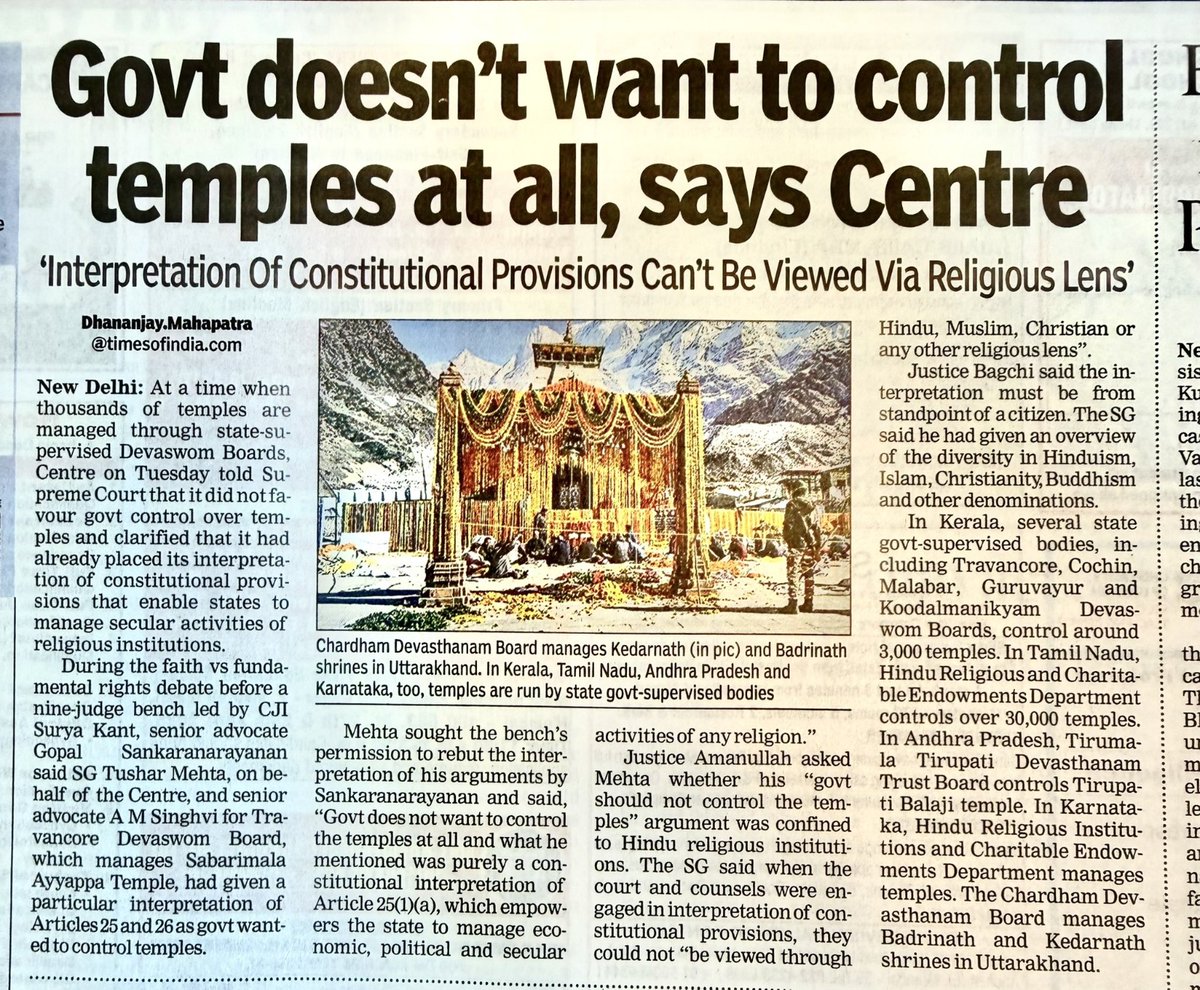
“We don’t want to control temples”? Then stop controlling them.
The headline is clever. The article says the Govt (HR&CE, Dewaswom etc) does not want to control temples “at all.” But then it quietly adds the real claim: the State can still control the temple’s economic, political and secular activities. Misleading Journalists in the click-bait age - put the real thing in the fine print.
Now come to the word doing all the dirty work here: secular.
As @jsaideepak often points out, this word is not native to Sanatana Dharma. It comes from a Western Christian history. The word comes from the Latin saeculum and originally referred to the temporal, worldly sphere as opposed to the spiritual or ecclesiastical sphere. That is also why Christianity developed the category of “secular clergy” - clergy who lived and worked in the world, unlike monastic or “regular” clergy bound to a religious order. So yes, even in its old usage, “secular” was not some universal Indian truth. It was a Christian civilizational distinction.
Now apply that to a Hindu temple.
A Hindu temple is not a church building plus a separate office block. It is not “religion” in the sanctum and “secular” everywhere else. The temple is a living sacred institution. The deity is supreme. Everyone else - trustee, manager, priest, donor, worker - is a sevaka. In the Dharmic view, administration is not outside devotion. It is part of devotion. Service is not separate from worship. It flows from worship.
So how exactly is temple administration “secular” if it is seva out of Bhakti to the Bhagawaan?
Now why exactly is temple economy “secular”?
When a devotee gives money to the hundi, he is not paying tax. He is not making a market transaction. He is not funding a neutral public institution. He is making an offering in bhakti bhava. That money belongs to Bhagawaan. And if it belongs to Bhagawaan, it can obviously be used for Bhagawaan’s ecosystem: Vedic schools, Sanskrit learning, goshalas, anna dana, temple arts, classical music, sculpture, textiles, heritage crafts, dharmic publishing, yoga centres, Ayurveda, pilgrimage infrastructure, IKS startups, board games teaching Itihasa, cultural education platforms, devotional cafés, temple-themed hospitality, artisan businesses, and every other activity rooted in Dharma and dedicated back to the deity. That is not “secular economy.” That is sacred circulation.
The article quotes that the constitutional interpretation cannot be seen only through a “religious lens,” and that states may manage economic, political and secular activities. But this is exactly the problem. It assumes, without proving, that these parts of temple life are separable from dharma in the first place.
They are not.
Temple land is for the deity. Temple funds are for the deity. Temple administration is in service of the deity. Temple festivals are for the deity. Temple institutions exist because of the deity. Remove Bhagawaan, and the entire structure loses meaning. So what “secular aspect” is left? Nothing meaningful. Only a bureaucratic excuse.
That is why this headline is misleading. It wants readers to think the government is stepping back. It is not. It is simply saying: “We won’t control the obviously religious part, but we will continue to control everything else by calling it secular.” But for a Hindu temple, that “everything else” is also religious, devotional, and Dharmic.
So let us call this what it is.
This is not neutrality.
This is not reform.
This is not distance.
This is state control hiding behind borrowed Christian vocabulary.
If secular really means what the West originally meant, then a secular is also a Christian and it does not fit the Hindu temple. If secular means “non-religious,” it still does not fit the Hindu temple. And if nothing in temple life is truly secular in that sense, then the government’s moral claim to manage temples collapses.
So the answer is simple:
If the State truly does not want to control temples, it should remove its hands completely - not rename control as “secular administration.”
One year of Pahalgam terror attack, the man behind the massacre is the toast of the West.
In my latest, I look at how western media has laundered Asim Munir's sins to deliver a squeaky clean "man of peace". /1
@SanjeevSanskrit The most asinine name ever - do @TataCompanies imply that the rest of their funds were Unethical?? Only being Shariah compliant makes one Ethical ? This is total surrender to Islamo-fascism. Is this what the Tata brand stands for, after all these years? Disappointing
Ouch. Would’ve preferred this without the swear words, but What a Takedown of @peyushbansal and @Lenskart_com damage control PR.
Lenskart isn’t actually sorry for anything - they’re just sorry they got caught doing utterly shameful things.
What happes now?
Delimitation WILL STILL HAPPEN after the first census post-2026. The 84th Amendment has frozen only until 2026. Once the constitutional mechanism kicks in, you'll have delimitation based on population, and the enacting act will require a simple majority.
This Forced-alienating from one's own culture and roots is what we freed ourselves from the British for. These neo--colonialists in corporate clothing are a very dangerous breed and every legal opportunity ought to be used to course correct or shut them down. Product is a commodity in any case.
Daily volume of ship transits through the Strait of Hormuz, highlighting the pre-war baseline, the immediate collapse upon the start of hostilities, and the nascent recovery currently underway. Source: Real-time shipping trackers from platforms like Kpler, MarineTraffic, and IMF PortWatch. Still so many open-ended questions!
So I confirmed, this is genuine. This is what @peyushbansal tells his employees, hijab is okay, but bindi/tilak/Kalawa is not, for @Lenskart_com, a company that exists in Hindu majority Bharat, where most of the employees and consumers are Hindu! What do you say to this? This is page 11 of the Lenskart style guide for employees. You can find the link here. https://t.co/KOaQq9u11Y
@ddmeyer has been sharing excellent insights for quite a while on the general inability of EdTech to be meaningful. This obituary of Khanmigo ought to serve as a wake up call to AI in Ed enthusiasts who have never actually tried teaching in a classroom and are clueless on what students actually need https://t.co/malDDPXiUp