Responding more effectively to public health emergencies.
Two @UF & @UF_EPI faculty are part of a new CDC-funded outbreak analytics and disease modeling network, designed to improve our nation's response to the outbreak of infectious diseases. https://t.co/JjjLy2uSa1
Florida’s controversial surgeon general Joseph Ladapo — who is also a tenured professor of medicine at UF — is at odds with the university over whether the public should receive new COVID-19 boosters.
https://t.co/2YDv8jMD4Q
A short 🧵on a recent study by @MaggieLind2 with @MHitchingsEpi @datcummings Albert Ko et al. Data show that immunity induced by vaccines, prior infection or both (hybrid) protects against SARS-CoV-2 infection when viral exposure is low to moderate (1/)
https://t.co/NTtrvcxxVX
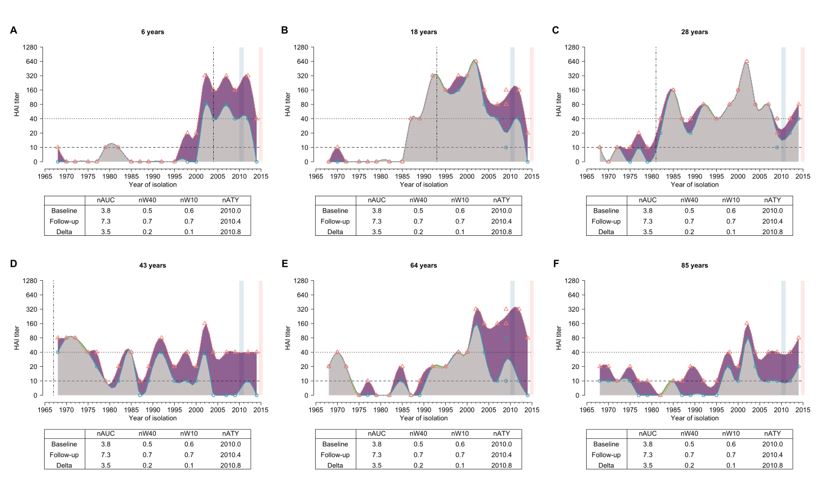
Our new Fluscape work is out @eLife. We reported long term intrinsic cycles in individual antibody responses against 21 A(H3N2) strains that were isolated between 1968 and 2014. https://t.co/j4VnGgQ9Q5
👏🏽 Bachir Assao, coordinateur épidémiologie du Centre de Recherche du Niger🇳🇪 qui débute son doctorat à l’Université de Floride @uf_idd.
Objectif ▶️mieux modéliser et anticiper les épidémies qui sévissent régulièrement dans ce pays.
https://t.co/8ykMKpY9jW
New research by @UF_CLAS and EPI biologist @datcummings shows that as populations of people gain immunity to dengue, it drives evolutionary pressures that select for viral evolution—and newly susceptible hosts. https://t.co/WqZrDDWZQY @UFNews@UFExplore
May reflect evasion of heterotypic immunity but lots of work to do to understand selective pressures that could give rise to this pattern. With @hsalje Steve Whitehead @wrair Ana Coello @HuangAngkanaT @ufidd and others. 2/2
New work led by @LeahKatzelnick characterizing antigenic evolution of dengue viruses over 20 years in Thailand https://t.co/YMgHe7hFXH We found that dengue viruses became more antigenically distant from each other over time. 1/2
Our work about individual NPI policies’ effects on COVID-19 spread in the US counties is now out @NatureComms. We found, earlier in the pandemic, multiple interventions were needed to bring Rt below 1. Relaxing some NPIs needs counterbalanced by others.1/3 https://t.co/oYVo2gOeQT
UF investigators coauthored the first study to determine the CoronaVac vaccine is 50% effective at preventing COVID-19 in Manaus, Brazil where the P.1 variant is widespread. 👉 https://t.co/4EtIAFLPLU
(Nice work @uf_idd @MHitchingsEpi @datcummings!) @UFNews@UF_CLAS@UFExplore
CONGRATS to @datcummings & @HuangAngkanaT! Their review on "antibody-mediated immunity to coronaviruses" is the 7th most read paper at Nature Communications in the life & biological sciences category for 2020! https://t.co/LT8b20Jydp @UFExplore@UF_CLAS@UFNews#NCOMTop50
U of Illinois did 1.3% of total testing done in the US last week – w/ a low-cost saliva-based test they developed to test 50K students & faculty, 2x/wk, with <6 hr turnaround.
Is this science fiction?
👉No. They had the will to try.
What's your school doing?
@OpenCovidScreen
A new study published today in PLOS-Pathogens deepens our understanding of how past exposures to flu affect our body’s response to new or currently circulating strains and seasonal flu vaccines: https://t.co/ihVxoJ1nHL @UF_CLAS@uf_idd
I am calling on tenured faculty across academia to use their status, stand up to the universities, and protect graduate students/adjuncts/postdocs/non-tenured faculty/staff/contract workers/other vulnerable individuals at universities.
In the past 24 hours, several senior American generals have spoken out to remind Americans that they serve the constitution, not the president. Where are the senior Republicans? Why don't they offer a similar message? Here is my explanation:
https://t.co/06GFXlVbmI
Mean number of days between someone getting infected with #COVIDー19 and their *infector* showing symptoms is negative 0.19 days! Suggesting most transmission is happening from pre-symptomatic individuals and masks are critical. https://t.co/8tnt6QM34n