Right now, MPs and leaders of the INDIA alliance are peacefully heading to Gandhi Smriti on Tees January Marg.
We go to remember the students we lost - the children driven to take their own lives after the NEET paper leak.
And we go to stand with the students who lie injured today - beaten for peacefully demanding justice and accountability.
India’s students are not alone. The entire Opposition stands with them and their demands.
अभी, INDIA गठबंधन के सांसद और नेता शांतिपूर्ण तरीके से तीस जनवरी मार्ग पर गांधी स्मृति जा रहे हैं।
हम उन छात्रों को याद करने जा रहे हैं जिन्हें हमने खो दिया - वे बच्चे जिन्हें NEET पेपर लीक के बाद अपनी जान देने के लिए मजबूर होना पड़ा।
और हम उन छात्रों के साथ खड़े होने जा रहे हैं जो आज घायल हैं - जिन्हें न्याय और जवाबदेही की शांतिपूर्ण मांग करने पर पीटा गया।
भारत के छात्र अकेले नहीं हैं। पूरा विपक्ष उनके और उनकी मांगों के साथ खड़ा है।
There is a memory I carry with me from my years as a civil servant. It has never left me....
Back then, I had just been transferred as Collector to Mangalore, a city then shadowed by communal violence and a menacing sand mafia. Before I left, word came that the Chief Minister wished to see me personally. It was unusual. Collectors don't typically get called in. I walked into his chamber with a knot in my stomach.
He looked at me, that familiar, unreadable face. Steady. Unhurried.
"Banri…" he said. (Come in.)
"Nimage ondhe kelasa… alli ennum communal aaga baradhu."
(You have only one job there. No communal incident should happen.)
That was it. No preamble. No politics. No performance. Just a Chief Minister, alone with a young IAS officer, telling him exactly what mattered. In that single sentence lived an entire philosophy of governance. one rooted not in optics, but in the protection of ordinary people from extraordinary hatred.
Fifteen days later, Mangalore erupted. Two communal murders, two communities, one city on edge. He called me again. Just as directly.
"DC... Do what is required. Take anyone into custody, even our party people. Don't bother. But stop this within a day."
To a young collector, those words were everything. They were permission. They were protection. They were political will at its most honest.
I have known the contrast too. Under a different dispensation, in a similar crisis, the instruction from the top was the opposite. Do nothing strongly. Let things fester. …That silence said everything about who governs for whom.
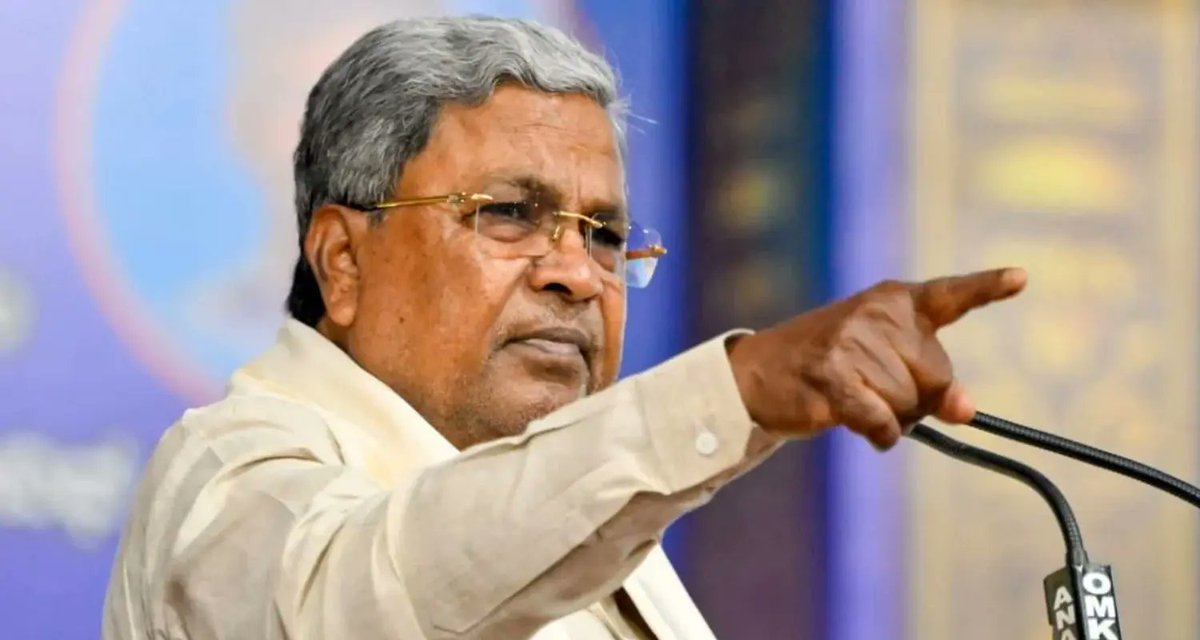
Siddaramaiah Ji was never that kind of leader.
He carried government finances in his fingertips and social justice in his spine. He refused to tour places that reeked of feudalism. He spoke plainly, governed sharply, and stood on the side of the last person in the room.
If there was one political figure I have genuinely admired, from the stage and up close, it has been him. His legacy is not in the schemes he launched or the budgets he read. It is in the kind of Chief Minister he chose to be when no one was watching. . On that quiet phone call. In the way he asked a nervous young officer to go out and keep the peace.
And now, as he steps back with the same quiet dignity with which he always led, I find myself moved. He has handled this transition with the grace of someone who always knew that principles outlast positions.
Siddaramaiah Ji....long life, good health, and please keep guiding us. The Congress, and this country, still needs the kind of moral clarity only you carry so naturally.
Staying in India all your life and still being a good person is the greatest achievement a person can hope for.
Indian society/culture punishes goodness like anything.
Kindness, empathy, generosity etc are not virtues in India, they are weaknesses to be exploited.
I have the utmost respect and love for people who live decades in India and don't become callous, unfeeling, transactional, selfish etc.
India today finds itself in a paradoxical position. Everyone wants to work in India, build businesses here, and tap into its enormous market potential and yet few want to live in India. Our wealth creators, entrepreneurs, and professionals increasingly aspire to base themselves overseas in places like Dubai, London, or Singapore while continuing to run their ventures from here.
The reason isn’t a mystery. The opportunity to expand is massive given India's huge consumption driven market in every sector. It’s not about taxes or regulation alone. It’s about quality of life. People seek cleaner air, smoother roads, reliable infrastructure, safety, and efficient public services. In short, they want to live in places where life feels easier, not harder.
If India truly wants to attract global talent and retain its own, we need to focus less on grand narratives, and more on the everyday experience of living here. Because when a city or country becomes genuinely liveable, economic progress follows naturally.
Look at nations like Australia. They don’t dominate global manufacturing or technology, yet people from around the world want to move there. Why? Because they offer what India often lacks: clean air, efficient public transport, civic discipline, and a sense of dignity in daily life.
If India can fix its infrastructure, air quality, urban planning, and governance, it won’t have to chase talent, talent will come here on its own.
The real goal is simple:
Make India not just a place to work, but a place to live well.
One of the most prominent pioneers of the parallel cinema movement in India, #ShyamBenegal passes away at 90.
His groundbreaking storytelling, social commentary and complex characters will continue to inspire generations of filmmakers and audiences.
Rest in peace Shyam Babu 🙏
Sardar Patel has been much misunderstood and misrepresented.
Some have used him to attack the Nehruvian vision and policies, others have made him out to be the archetypal rightist.
Both have been wrong. Patel was undoubtedly the main leader of the Congress right wing. But his rightist stance has often been grossly misinterpreted.
Like Nehru, he fully shared the basic values of the national movement: commitment to democracy and civil liberties secularism, independent economic development, social reform and a pro-poor orientation.
He stood for the abolition of landlordism but through payment of compensation. A staunch opponent of communalism, he was fully committed to secularism. In 1946-47 he took ruthless action against the rioters. In 1950 he declared:
"Ours is a secular State. We cannot fashion our policies or shape our conduct in the way Pakistan does it. We must see that our secular ideals are actually realised in practice... Here every Muslim should feel that he is an Indian citizen and has equal rights as an Indian citizen. If we cannot make him feel like this, we shall not be worthy of our heritage and of our country."
He was also utterly intolerant of nepotism and corruption. Patel's conservatism, however, found expression with regard to the questions of class and socialism.
Patel and Nehru had temperamental as well as ideological differences. Yet, the two continued to stick and pull together and there was no final parting of ways. This was because what united them was more significant and of abiding value than what divides them .Also, they complemented each other in many ways. One was a great organizer and able administrator, the other commanded immense mass support and had a wide social and development perspective.
If anything, Patel buttressed Nehra's role even while challenging it in some respects. Besides, there was considerable mutual affection and respect for each other and each recognised the indispensability of the other.
Patel argued successfully both for stimulus to private enterprise and the incorporation of the right of property as a fundamental right in the constitution. Thus, the right-wing stance of Patel was basically a matter of social ideology. But his positive approach to capitalism and the capitalists was combined with total personal integrity and an austere lifestyle.
He collected money from the rich for the national movement but none dare offer him a paisa for his own or his family's use.
Patel would argue his case, sometimes strongly, would win it sometimes, but when he could not, he would invariably yield to Nehru.
Throughout Patel remained Nehru's loyal colleague, assuring him of complete support for his policies.
After Gandhiji's death, he repeatedly described Nehru as his 'leader'.
On 14 November 1948-Nehru's birthday he was to say
'Mahatma Gandhiji named Pandit Nehru as his heir and successor Since Gandhiji's death we have realised that our leader's judgement was correct.'
And Nehru reciprocated: 'The Sardar has been a tower of strength; but for his affection and advice I would not have been able to run the State.'
This exactly is the power of #IndianNationalCongress Party. It is one of the most accurate reflections of the social ethos of our country. There is space for contradiction, mutual respect and for working in harmony , unitedly, for the Nation and the values that define it.
Cuba is the most moral country in the world for sending over 400.000 doctors abroad since 1963 to help the poorest. Fidel Castro: "Our country does not drop bombs on other people...instead our country sends doctors to those most lost corners of the world."
She was groomed by dark-money lobby groups working for Big Tobacco, Big Oil and foreign oligarchs. Now Liz Truss is in office and trashing this country on their behalf.