What does “feeling stuck” in depression look like in the brain?
In our new paper in Nature Communications, we used 7T resting-state fMRI + diffusion MRI to study how the brain moves between activity states in Major Depressive Disorder (#MDD).
https://t.co/QbwsUHvqn3
Happy to share that our paper on objective quality assessment for "precision" fMRI is now out in @NeuroCellPress .
A recap of what it does, what's new since the preprint, and code you can run on your own data.
https://t.co/OngwPOK3PY
Excited to share this work from the amazing team at @IcahnMountSinai@MountSinaiNYC illuminating the brain dynamics underlying #depression. Major depressive disorder remains one of the leading causes of suffering worldwide. Our new work in @NatureComms uses advanced brain imaging and mathematical modeling to better understand how the depressed brain may become trapped in maladaptive patterns. The ultimate goal of our work is improving #antidepressant #treatment outcome patients.
Overall, our findings support a dynamical systems perspective on depression, suggesting that reduced flexibility in brain-state transitions.
This result may underlie the feeling of being “stuck.”
What does “feeling stuck” in depression look like in the brain?
In our new paper in Nature Communications, we used 7T resting-state fMRI + diffusion MRI to study how the brain moves between activity states in Major Depressive Disorder (#MDD).
https://t.co/QbwsUHvqn3
This showed high-energy state-trajectories are the ones where brain gets stuck in the MDD group, while low-energy alternatives exists in the HC group but less utilized by the MDDs.
This is further evidence for system entrapment. Changes in diffusionMRI tracked changes in fMRI.
CHECK OUT the FULL STUDY - "Spatiotemporal asymmetries on brain energy landscape uncover system entrapment related to depression severity" - @ulgenklc, Jenna Jubeir, Priti Balchandani, @JMurrough, Laurel S. Morris & Yael Jacob OUT NOW @NatureComms👉 https://t.co/fMf97JKo58
Researchers @icahnmountsinai have ID'd distinctive patterns in how the brain transitions btwn activity states in people w/ #Depression, providing new insight into why depressive symptoms can feel persistent & difficult to overcome. PRESS RELEASE 👉 https://t.co/t1Lyrm0FOa
NEW RELEASE:
Today we're releasing CortexMAE: a family of fMRI foundation models trained on 2.1K hours of open fMRI data.
We're also releasing Brainmarks: an open benchmark suite for evaluating fMRI foundation models.
Full paper is on arXiv (accepted to ICML 2026)
A thread:
Two papers in Nature present AI systems that can assist throughout multiple processes involved in scientific research. The systems are designed to assist researchers in accelerating scientific discovery, not to replace them.
https://t.co/JuvyumVGPN
https://t.co/wztQgV2Ist
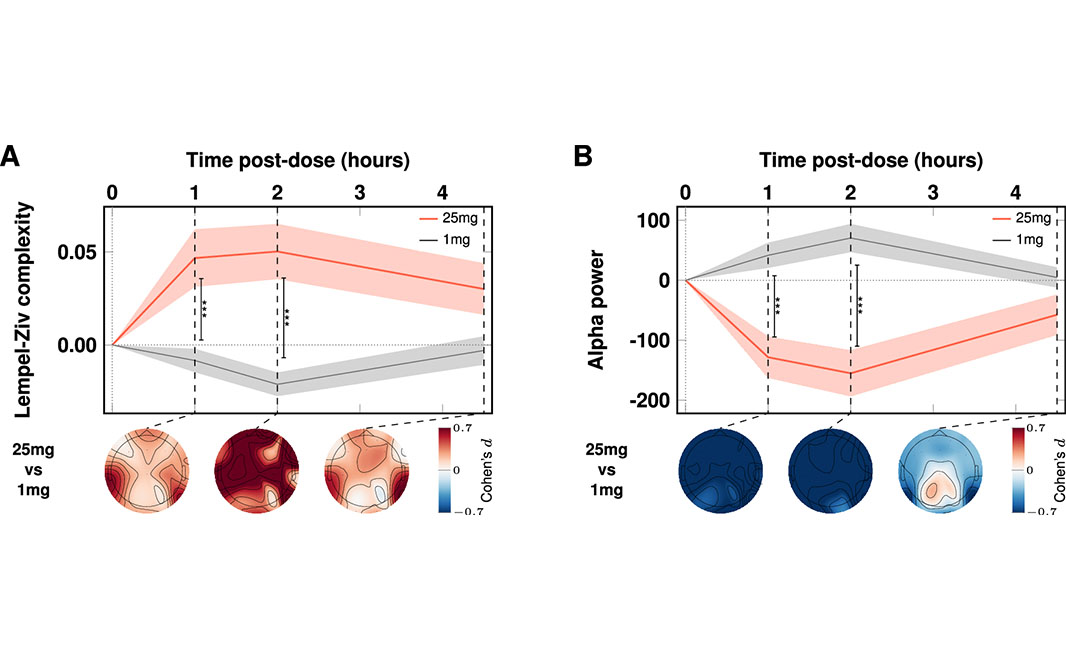
A study in Nature Communications tracks the induced anatomical and functional brain changes detected one hour and one month after healthy adults were given their first psychedelic experience, 25mg psilocybin. https://t.co/yYuaL5hcPR
Neural networks might speak English, but they think in shapes.
Understanding their rich *neural geometry* is key to understanding how they work – and to debugging and controlling them with precision.
Starting today, we’re releasing a series of posts on this research agenda. 🧵