@FinPlanKaluAja1 A company is exempt from charging and collecting Value Added Tax (VAT) if it qualifies as a small company with an annual turnover of ₦100 million or less, deals exclusively in VAT-exempt goods or services
I stumbled on this VIDEO of the House of Reps Committee on the Capital Market interrogating Mrs Dame Atunma Oteh, the then Director-General of the Nigerian Securities and Exchange Commission (SEC).
It refreshed my memory of how Nigeria’s criminal political class conspires to bring down competent and upright office holders who fail or refuse to do their bidding.
In 2012, Mrs Arunma was summoned by the House Committee for refusing to pay a bribe of N5 million to the Committee Chairman, Herman Hembe, to fund a public hearing. The Committee proceeded to recommend her removal, accusing her of mismanaging agency funds.
They further connived with some Board members and senior staff of the SEC to pressure the Presidency to bend to their demand to send Mrs Arunma on compulsory leave and audit her activities as the SEC Director-General, particularly the “Project 50” event held in December 2011.
Expectedly, the probe validated Mrs Arunma’s integrity and commitment to national interest, and brought shame to the House Committee. It took the insistence of Dr Ngozi Okonjo-Iweala and the approval of President Jonathan for her to be reinstated.
After her office expired in 2015, Mrs Arunma got immediate international engagements, from people who genuinely valued her worth. Nigeria lost her and her wealth of knowledge and experience.
Currently, she holds three standout international posts, amongst many. One, as an Executive in Residence at the Saïd Business School, University of Oxford. Two, an Academic Scholar at St. Antony’s College, Oxford. Three, the Chairperson of the Royal African Society.
This is a reminder of how corrupt politicians in Nigeria conspire to frustrate and chase away competent and honourable public and civil servants who refuse to bend to their criminal will and interest.✍️
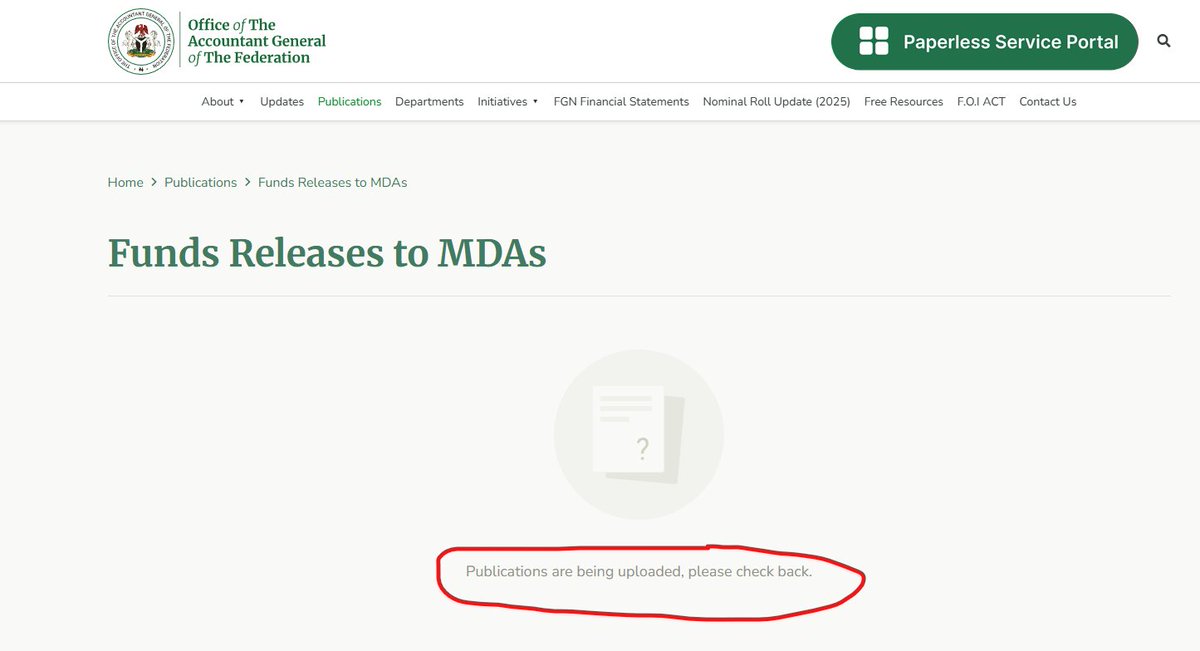
There is no current record of income and spending of the Federation today.
None
Budget Office, DMO, CBN, MoF: no Federation record of income, Expenses, Assets, or Liabilities is current up to a 30-day cycle. I know where to check, nothing is current.
So how can citizens like myself "hold" my government to account?
Can you imagine going to a PLC and pulling up their accounts page and seeing "please check back"
Under China's #zerotariff policy for 53 African nations (effective May 1, 2026), Nigerian cattle bone pellets now enter the Chinese market duty‑free.
This marks a promising start for Nigerian agricultural exports to China under this zero‑tariff arrangement. @NigeriaMFA@NGfmafs@fmitiofficial@Ngfmld
China has also upgraded "green lanes" for African agricultural and food imports, streamlining quarantine procedures and adopting risk‑based management for faster market access.
These benefits are expected to extend to more Nigerian premium products, boosting export revenues, creating rural jobs, and strengthening the nation's agricultural value chain.
A solid step forward for China‑Nigeria trade cooperation and bilateral relations. 🇨🇳🤝🇳🇬
"Until death, all defeat is psychological." - Marcus Aurelius
Refuse everything that would lead most people to give up.
Refuse it.
Rise from the dead 1000 times.
Commit to never stay down & never give up.
Everything you want is on the other side of struggle.
🇨🇳🇳🇬 China’s industrial muscle turns Nigeria into net exporter of refined petroleum
👉 For decades, Africa’s biggest oil producer couldn’t refine its own fuel — until China helped flip the script.
💰 The catalyst was the $20 billion Dangote Petroleum Refinery, built leaning on Chinese engineering, procurement, and construction contractors.
🟠 Operating at ≈ 94% of its 650,000 barrels-per-day capacity, the Lagos-based refinery covers domestic demand, with excess sent abroad
🟠 Roughly 44,000 barrels of gasoline per day were exported in March alone; a single shipment of 317,000 barrels reached Mozambique—its first delivery to East Africa (historically supplied by the Middle East)
🟠 Output is projected to hit 1.4 million barrels per day within three years, which would make it the largest single-site refinery globally
Replacing the Strait of Hormuz: How the UAE Will Become the World’s Most Valuable Energy Corridor
The chances that Iran’s stalemate becomes permanent are high. Trapped in ideology, Tehran is unlikely to act pragmatically, meaning the closure of the Strait of Hormuz could last indefinitely. The world needs a new route. Enter the UAE.
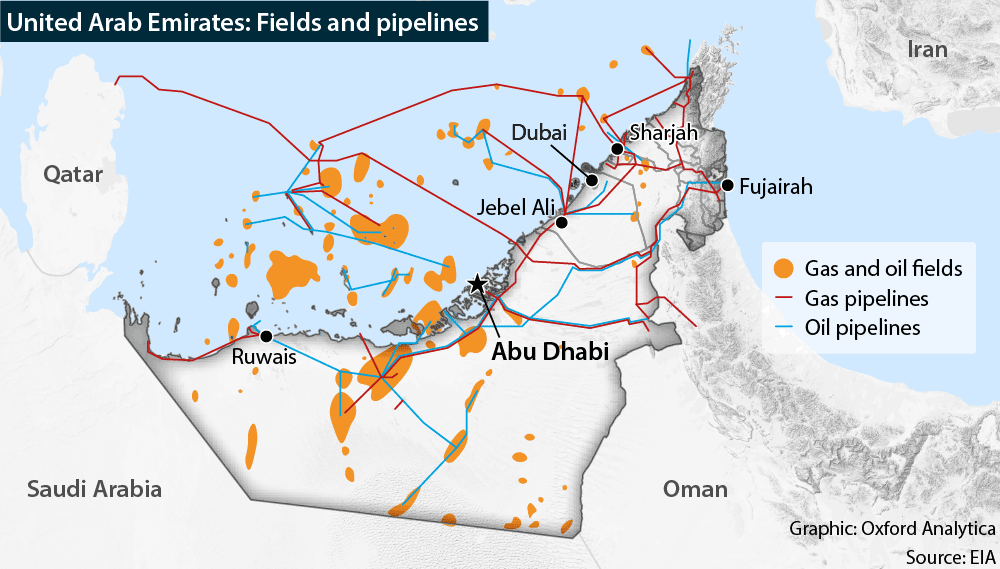
Thanks to ports on both the Gulf and the Arabian Sea, the UAE can bypass Iran’s chokehold. Its key asset is Fujairah Port on the Arabian Sea, home to the world’s largest energy storage facility.
Before the war, only half of UAE oil exports went through Fujairah via the 1.8 million bpd Habshan pipeline; the rest sailed through Hormuz. A new 1.5 million bpd pipeline from Jabal Dhanna to Fujairah, already planned pre-war, will let the UAE export its full 3.3 million bpd OPEC quota without touching the strait.
With superior low-carbon production, world-class pipelines, massive storage, and port capacity, the UAE now becomes the region’s energy hub. Kuwait can dock its 3 million bpd at Jebel Ali and pipe it to Fujairah. Iraq can do the same for its 4 million bpd (perhaps pipeline expansion will be required). Qatar, if it distances itself from Iran and the Muslim Brotherhood, can repurpose the Dolphin Pipeline to export LNG through Fujairah.
The same Emirati corridor can handle non-energy imports for Kuwait, Bahrain, and Qatar.
Result: the Strait of Hormuz becomes redundant. Iran can keep it closed forever.