https://t.co/8Smbo4Xkoa
For this year's edition of the @aisongcontest we explored the Studio in @moises_ai and paired human vocals with brutal Portuguese generated screams!
Great work by @archi_mickey! SubRoformer achieves SOTA music source separation with DSP-based subband filters, outperforming Fourier-based frontends! https://t.co/K3dTbNkjjN
Tomorrow I'll be joining the Barcelona MIR day at the MTG-UPF. I'll be participating in the panel in the afternoon and I'll present our #ISMIR26 paper on behalf of @r_oguz_araz in the morning.
Program: https://t.co/cQ6cUsgufM
Paper: https://t.co/nDpDkguN4L
🔊 Check out AudioFM, Google's new contrastive audio representation model that tops benchmarks across general audio, speech emotion, medical acoustics, and bioacoustics.
It also powers Google Home, making ~2 billion predictions/day!!
📄 Paper: https://t.co/fPMFicshMv
MIR needs a better MNIST!
Check out FreeTZAN on 🤗 HF. Toy genre detection dataset w/ 1000 tracks, 10 labels, permissive license
A drop-in replacement for the storied GTZAN dataset, derived from Free Music Archive
Vibed up an interactive TUI for a new real-time piano model I've been working on over the last few months.
Play a prompt, interrupt it with real-time AI takeover, and then re-roll the continuation.
Louis Bradshaw, Irmak Bukey, Daniel Chenyu Lin, John Thickstun, Chris Donahue, "PianoBench: Evaluating Musical Perception and Reasoning in Language Models" https://t.co/xHAaZpV0xU
We ran Happenstance on all 119 queries of PeopleSearchBench, the open benchmark for AI people search, and scored 84.7 out of 100.
The next best score on its leaderboard was 65.2, from @lessie_ai, the company that built the benchmark.
“Start a sweep worker. As runs finish, compare results and launch the next useful experiment. Use only the allocated GPUs and keep a record of every decision.”
Powered by Cortex: https://t.co/PRbHnG2hmI
Core contributions of MIDI-REPA (https://t.co/wfzjr8OEEP) by my RA @vaclis_:
1. AMTFlow: instrument tagger + MuScriptor for transcription
2. JamendoMIDI: audio data with transcribed MIDI
3. MIDI-REPA: align DiT hidden states with MIDI
4. TTM trainable on an RTX 3090 in 1.5 days
Turn a simple piano demo into a full pop song! We introduce `Piano2Pop` (https://t.co/j9ZC2TURnd), a pianoroll-conditioned flow-matching model trained on psuedo piano-pop pairs generated by MuScriptor and PicoGen. Work done by my students @hhhhaura__, @ZionHzh & @tanchihpin0517
Our paper: Equivariant Music Transformer has been accepted to ISMIR 2026 (Best Paper Award Nominee). We show that music transformers become less equivariant as they scale or train longer, suggesting they memorize each musically-shifted version of the same data separately. 🧵👇
1/12 Introducing Music Lenses!
Something cool you can do with our recent sparse-inversion work is prompt a dense music space for concept-conditional similarity. You want similar vocal character, rather than just similar songs? Well, now you can!
https://t.co/26qaoHpEIH 🧵
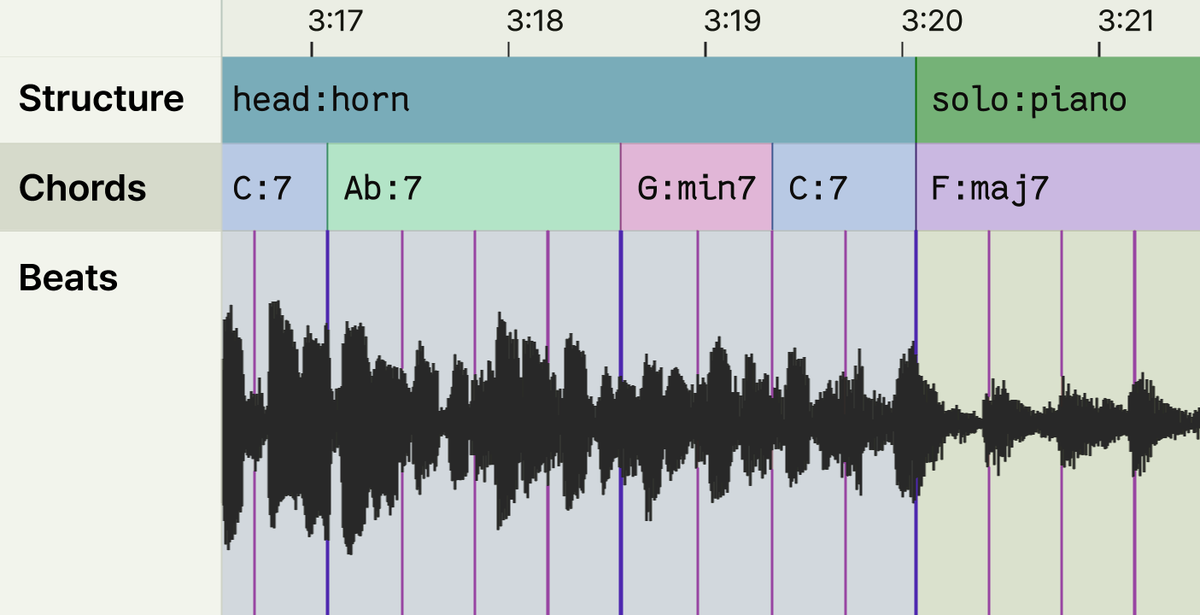
Jazz dataset alert! 🚨 Introducing JSIR (Jazz Standards dataset for Information Retrieval), an audio-aligned dataset of jazz recordings containing beat/downbeat, chord, and structure annotations. Repository, demo, and preprint out now: https://t.co/4Ve87nOfjK