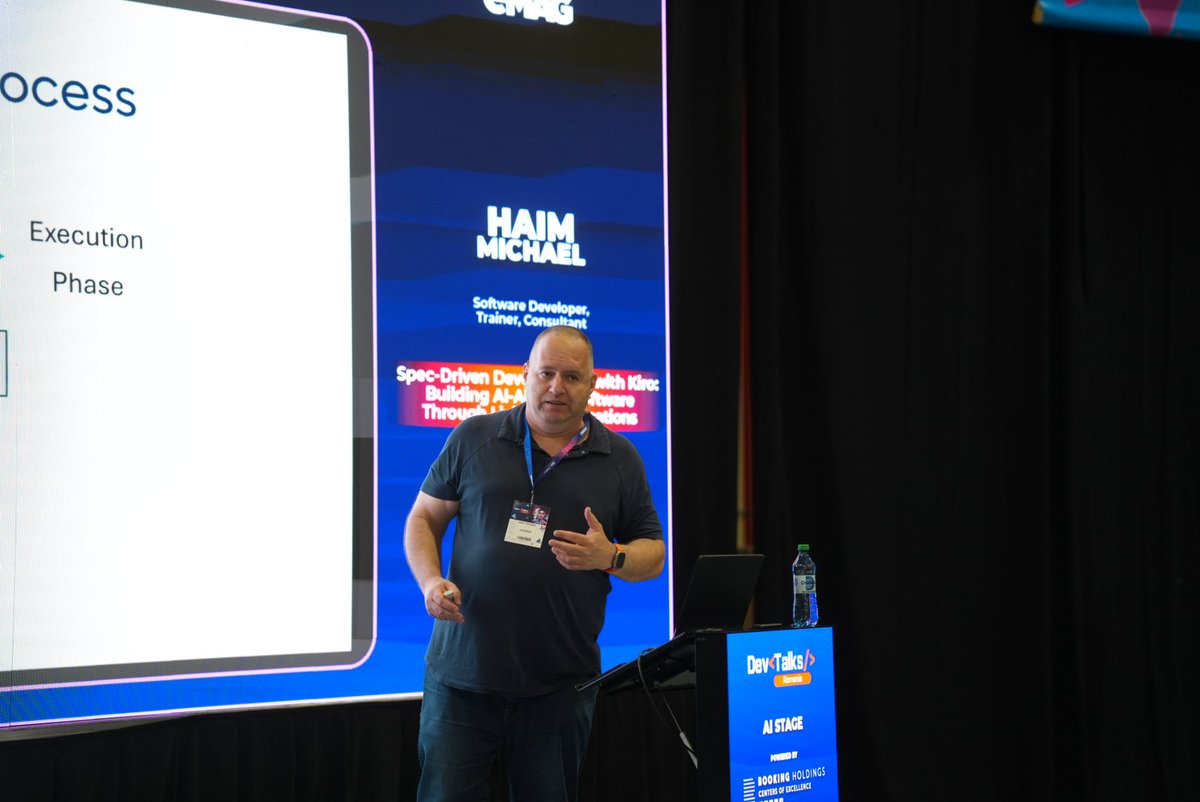
Thank you, Haim Michael, for bringing a fresh perspective on AI-driven software development to the AI Stage at DevTalks Romania 2026.
Through “Spec-Driven Development with Kiro”, Haim explored how living specifications, agentic IDEs, and AI-aligned workflows are changing the way modern software gets built.
One key takeaway?
The future of development is moving from writing every line manually to orchestrating systems through clear, intelligent specifications.
@krzyzanowskim@RhysSullivan Right you need methodologies to remind vagueness and ambiguity from requirements. Here's our strategy: https://t.co/CmlUWyfQXS
In case you missed it, @kirodotdev launched Analyze Requirements — leveraging automated reasoning to catch ambiguities, conflicting constraints, and logical gaps in requirements. What gaps have you missed in the design phase? #Kiro
Version control the spec. Not just the code.
If the spec is the source of truth, your app can be built from scratch, rebuilt or refactored. By AI that knows exactly what you intended.
This is the spec-driven development Kiro @kirodotdev trying to bring. You start with intent, not code. Record what features does, why it was built that way, the architecture decisions behind it. All living under the specs folder. Only then AI start building.
It reminded me of something my senior used to drill into me. "Don't just write what you did in the pull request and commit message, write why you did it."
Three new features shipped in kiro this month.👻
1️⃣ Kiro Web:
It's the agent, in your browser, at app . kiro . dev. Start a session, give it a prompt, and it can work across multiple repos in one go and open the PRs for you. Use collaborative mode if you want to drive the conversation, or flip on autonomous mode if you want it to own the whole task.
2️⃣ Analyze Requirements:
After Kiro generates your requirements, you can run a deep analysis pass that uses automated reasoning to catch contradictions and gaps before you ever write code. Kiro flags it, asks the question, and updates the spec when you pick.
3️⃣Parallel Task Execution:
When you click Run all Tasks, Kiro analyzes the dependency graph of your task list and runs the independent tasks concurrently, in waves.
Let us know what you think 👇
Get started now: https://t.co/0nwaWxOgfJ
Sometimes *removing* something is a feature. One that customers have been asking about. Yesterday we removed the requirement to add a code repo to launch a @kirodotdev Web session. Because all sessions need a prompt but not all sessions need a repo!
Kiro Web joins the ways you can build with @kirodotdev. Read all about it in the blog post https://t.co/0uPgrBoBgP
If this sounds familiar it is the evolution of our thinking around autonomous agents which we announced last year. In there was a little nugget that gives you a sense of where we are headed.
In case you missed it, @kirodotdev launched Quick Plan — a new Spec mode that generates requirements, design, and tasks in a single pass without approval gates between phases. Are you ready to skip the review? #Kiro
Love how Kiro troubleshoots all bugs.
It creates write property-based tests that prove a bug exists before writing any fix.
Now I fix with AI confidence.
I spent March teaching an AI coding agent how to build AI agents.
How?
I built a Power for Kiro and used it to build more AI agents. In Kiro powers are essentially a specialised context layer you can load into Kiro on-demand. Think of it like a skill for Claude Code, but deeper, and with MCP tool integration baked in.
Why Kiro specifically?
Because Kiro is built around two things I believe matter in AI-assisted engineering: specs and tests. I don’t believe AI replaces software engineers, it amplifies them.
You cannot build, deploy, and maintain a real software system by winging it with short, vague prompts. You need:
- Detailed context so the agent understands the problem.
- Clear acceptance criteria so it knows when it's done.
- Well-designed guardrails so it doesn't drift or do things it shouldn’t.
Kiro's spec-driven development handles the context. Its property-driven testing provides some of the guardrails. Powers tie it together by providing additional context that guides the agent toward best practices and the right tools.
So what did I build?
I built a Kiro Power to guide Kiro through building AI Agents with Pydantic AI and Logfire. You can find it and the other Powers available for Kiro on the Powers page here: https://t.co/gOObxNP8Nv
Like many Kiro powers it’s a public GitHub repo, so if you have suggestions for improvements feel free to add an issue or raise a PR.
@kirodotdev@pydantic
My brain is reeling with the implications. I keep having these revelations and I'm beginning to wonder when they will stop.
It turns out that property testing is yet another hardening technique that the agents can profitably engage. Agents can determine whether a function is appropriate for property testing, and can specify the range and domain of those tests. They can implement them quickly, run them, and fix any detected issues.
I just found two production bugs this way. Property testing is going to be part of my normal practice, along with Crap analysis, Function mutation, acceptance test mutation, Dry analysis, etc.
My take: the next big skill for developers won't just be "using agents." It'll be writing clearer intent, spotting ambiguity early, and knowing when the tool is making decisions you never actually made.
AI coding tools are getting faster, but AWS Kiro's new requirements analysis feature points at the bigger issue:
Most bad AI-generated code starts before code exists.
Vague prompt -> vague spec -> hidden assumptions -> brittle implementation.