Look at the pale blue crust between the dunes. That is not sand and it is not shadow. It is frost, and it is the reason nothing in this picture is moving.
This is Mars, seen from orbit by the Mars Reconnaissance Orbiter on 8 September 2022. The dark red shapes are dunes, the same kind you would find in any desert on Earth, and they are sitting in the northern half of the planet where winter goes hard.
Look at any one of them and you can read it like a road sign. There is a smooth slope on one side, a sharp crest, and a steeper drop on the other. Wind picks grains off the gentle face, carries them up and over, and drops them down the far side. Grain by grain the whole dune walks. Dunes on Earth do exactly this, and dunes on Mars do it too.
Now look at the frost, because the frost is what makes this picture strange.
Recent work found that the winter frost does not just sit on top of the sand. It locks the grains down. While it is there the wind can blow all it wants and nothing moves, and the entire dune field is held in place until the spring thaw releases it.
So the force is still being applied. The air is still moving. What has been removed is the ability of the ground to respond to it. Every one of these dunes is frozen in the middle of a step, and when the frost goes they will carry on from exactly where they stopped.
Scientists photograph the same patches over and over for this reason. They are not photographing dunes. They are timing how long the ground stays locked.
The atmosphere doing the pushing here is less than one percent as thick as the air you are breathing. It cannot lift a rock, it cannot knock you over, and given a few thousand years it moves entire hills across a planet.
Image: NASA/Jet Propulsion Laboratory-Caltech/University of Arizona. HiRISE camera on the Mars Reconnaissance Orbiter, northern hemisphere of Mars, 8 September 2022. Contrast and saturation increased, further sharpened.
@Chromoprocess That false color is doing exactly what the mission did. Scott photographed the far wall of the rille with a 500mm lens for the same reason, to separate layers the eye reads as one grey slope 🎨
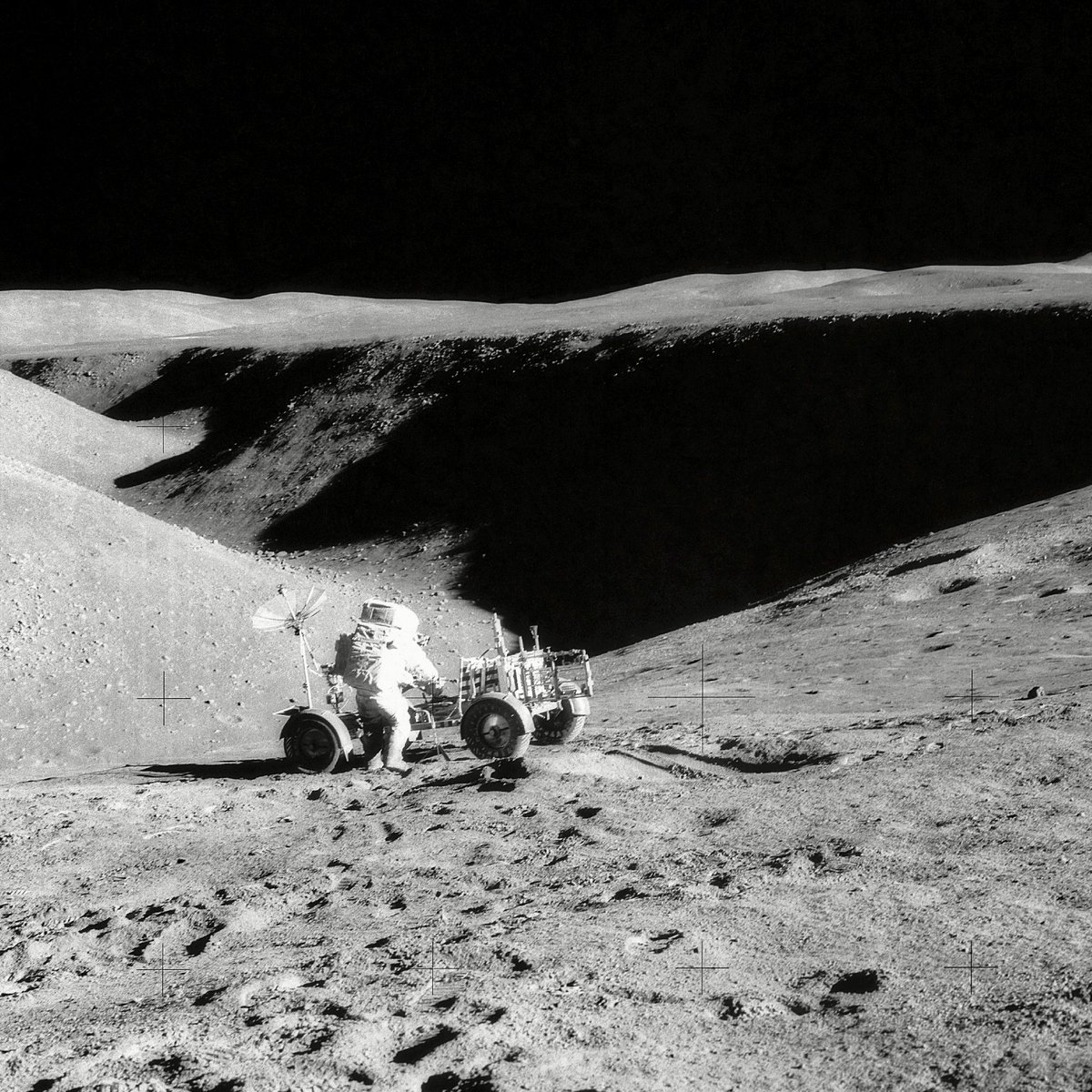
That black band running across the middle is not a shadow on a hillside. It is a hole in the ground, and the far side of it is about a kilometer and a half away.
This is the Moon, on 31 July 1971. The man at the vehicle is David R. Scott, commander of Apollo 15. The photograph was taken by James B. Irwin from the flank of a nearby crater, looking north along a valley called Hadley Rille.
The valley is roughly 1.5 kilometers wide and about 400 meters deep, and it winds for more than 100 kilometers along the foot of a mountain range. The sun is high and the sky behind it is completely black, because there is no air up there to scatter the light.
Look at the small crosses scattered across the picture. Those are not damage. There is a glass plate inside the camera with a grid etched into it, so that every frame comes back with a built-in ruler and any distortion in the film can be measured and corrected afterward.
Now look at where they parked, because the parking spot is the experiment.
Almost everywhere on the Moon the solid rock is buried. Billions of years of impacts have ground the top of it into loose powder and rubble, meters deep. If you want the rock underneath you have to dig for it, and they had hand tools and a drill and a few hours.
This valley is a cut that was already made. Lava flowed along here and carved down through the plain, and the walls it left are a vertical slice through the ground. The upper sixty meters or so of that wall expose layers of basalt, individual lava flows stacked one on another, most of them at least ten meters thick.
So they did not dig down. They drove to the edge of the one place where the ground was already open, and photographed sideways into it with a telephoto lens.
One honest note. That lava carved this valley is agreed. Whether it ran as an open channel in the open air, or ran inside a roofed tube that later fell in, is still argued over.
The vehicle is the reason any of this happened. It was carried to the Moon folded up so that the crew could get several kilometers away from the lander instead of a few hundred meters. Without it, this valley was simply out of reach.
Image: NASA. Hasselblad camera on the lunar surface, Apollo 15, edge of Hadley Rille, 31 July 1971. Photograph by James B. Irwin. Further cropped and sharpened.
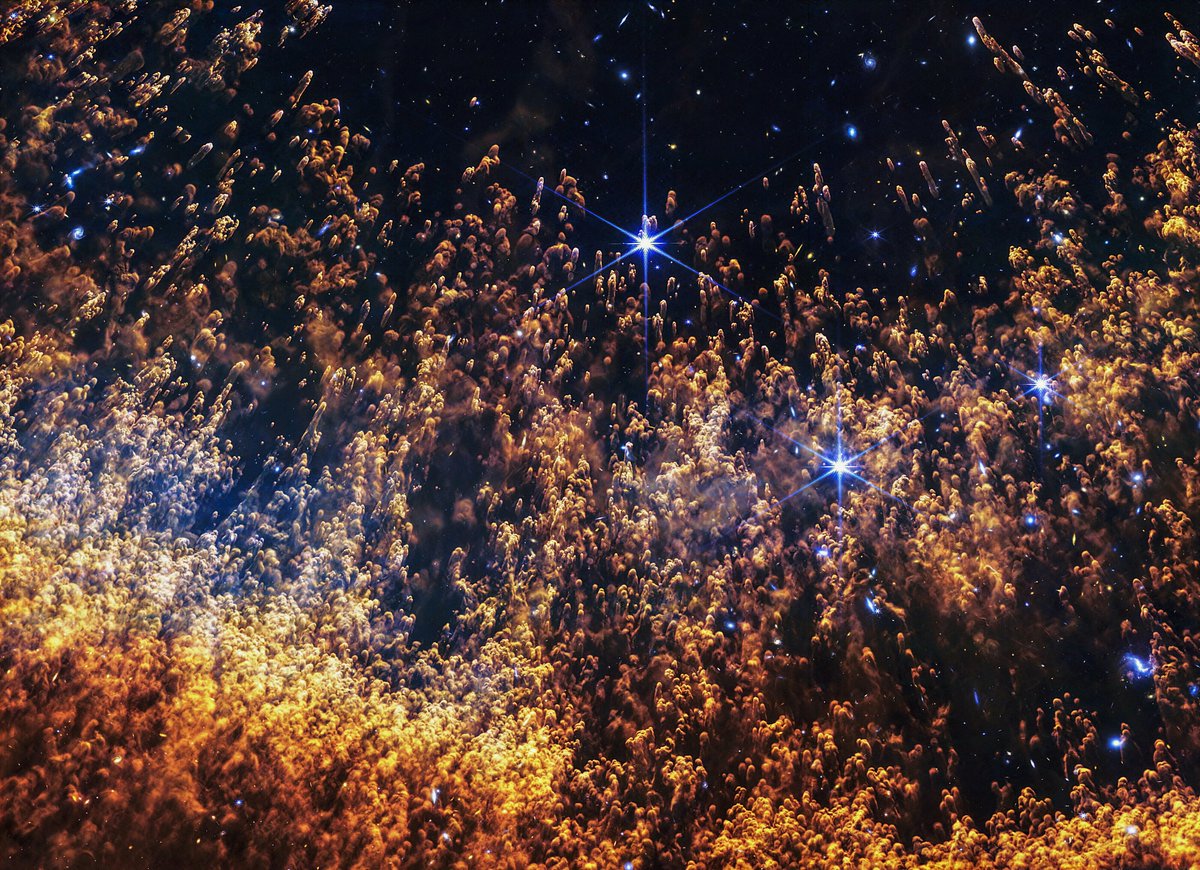
Every one of those tails is pointing at the same object. It is not in this picture.
This is the Helix Nebula, about 650 light-years away in the constellation Aquarius. The James Webb Space Telescope took this in near-infrared and released it on 20 January 2026. The frame you are looking at is a little over one light-year wide.
Fill your eyes with the orange for a second. Those are not clouds. There are thousands of separate objects in here, each one with a thick head and a tail streaming off it, all of them leaning the same way. The blue points scattered through are stars. Some of the small smudges behind them are entire galaxies, sitting far beyond the nebula.
What they are all pointing away from is a dead star, and it sits just outside the edge of this frame.
Now look at the color, because the color is a thermometer.
A star roughly like our Sun ran out of fuel and pushed its outer layers off into space over thousands of years. What was left behind is the bare core, a white dwarf, tiny and extremely hot. That core now blows a fast, scorching wind, and the wind is slamming into the cold gas the same star threw off earlier in its life.
So the star is eating its own exhaust. The thin parts of that old gas got swept away. The knots you see are the places where the gas was packed tightly enough to hold, and behind each one is a shadow of material that survived because something denser was standing in front of it.
Blue marks the hottest gas, closest in, lit up by ultraviolet. Yellow is cooler, cool enough that loose hydrogen atoms are pairing off into molecules. Red at the outer edges is the coldest of all, thin enough and cold enough that solid dust grains can start to form.
One honest note. These are not the colors your eye would see. Webb sees infrared, and the colors here were assigned to temperature and chemistry so that the structure becomes readable. The contrast and saturation in this version have also been raised so the individual knots separate instead of blurring into one orange mass. NASA also describes this object as a possible eventual fate of our own Sun, and possible is their word, not a prediction.
That coldest red material at the outer edge is where dust forms. Dust is what planets get built from. The last thing this star did was scatter the ingredients.
Image: NASA, ESA, CSA, STScI, A. Pagan (STScI). CC BY 4.0. NIRCam on the James Webb Space Telescope, Helix Nebula, released 20 January 2026. Color assigned by temperature. Contrast and saturation increased, further sharpened.
That black band running across the middle is not a shadow on a hillside. It is a hole in the ground, and the far side of it is about a kilometer and a half away.
This is the Moon, on 31 July 1971. The man at the vehicle is David R. Scott, commander of Apollo 15. The photograph was taken by James B. Irwin from the flank of a nearby crater, looking north along a valley called Hadley Rille.
The valley is roughly 1.5 kilometers wide and about 400 meters deep, and it winds for more than 100 kilometers along the foot of a mountain range. The sun is high and the sky behind it is completely black, because there is no air up there to scatter the light.
Look at the small crosses scattered across the picture. Those are not damage. There is a glass plate inside the camera with a grid etched into it, so that every frame comes back with a built-in ruler and any distortion in the film can be measured and corrected afterward.
Now look at where they parked, because the parking spot is the experiment.
Almost everywhere on the Moon the solid rock is buried. Billions of years of impacts have ground the top of it into loose powder and rubble, meters deep. If you want the rock underneath you have to dig for it, and they had hand tools and a drill and a few hours.
This valley is a cut that was already made. Lava flowed along here and carved down through the plain, and the walls it left are a vertical slice through the ground. The upper sixty meters or so of that wall expose layers of basalt, individual lava flows stacked one on another, most of them at least ten meters thick.
So they did not dig down. They drove to the edge of the one place where the ground was already open, and photographed sideways into it with a telephoto lens.
One honest note. That lava carved this valley is agreed. Whether it ran as an open channel in the open air, or ran inside a roofed tube that later fell in, is still argued over.
The vehicle is the reason any of this happened. It was carried to the Moon folded up so that the crew could get several kilometers away from the lander instead of a few hundred meters. Without it, this valley was simply out of reach.
Image: NASA. Hasselblad camera on the lunar surface, Apollo 15, edge of Hadley Rille, 31 July 1971. Photograph by James B. Irwin. Further cropped and sharpened.
Count the bright lines in this picture. Most of them are the same line.
These are Saturn's rings, photographed by Cassini from about 76,000 kilometers away. Every pixel here covers roughly 530 meters of ring. Saturn itself sits around 1.4 billion kilometers from us, far enough that light takes about eighty minutes to cross. The main rings run something like 280,000 kilometers wide and in places they are only about ten meters thick.
What you are looking at is a single spiral arm. It wraps around the entire planet and comes back through this frame again and again, so every second bright crest you count is the same arm returning. The picture looks like the ring plane is tilting away toward the upper left. It is not. The whole frame is the same distance from the camera and the spacing is just getting tighter.
Now look at the gaps between the crests, because the gaps are a calendar.
Down toward the lower right there is a radius where ring particles go around Saturn exactly twice for every one lap of the moon Janus. Same push, same place, every time. The pushes stack instead of cancelling and the ring buckles into a wave that travels outward.
Janus does not orbit alone. It shares its orbit with a second moon, Epimetheus, and the two of them trade places every four years. Each time they swap, the ring at that radius feels it and throws out a new crest. So the distance between any two crests is four years of travel.
Which means this is not a picture of a wave. It is a recording. The crests at the upper left were laid down around 1980 and 1981, and the ring has been holding onto them ever since. Nothing here erases. Every crest that was written is still where it was written, just further out.
One honest note. Waves like this normally get damped out by the larger structures around them. At this one spot the damping is very weak, which is why the wave keeps ringing for hundreds of crests, and researchers do not fully understand why this location is different. NASA also frames the reading of the wave as a calendar as an interpretation rather than a settled result.
Janus and Epimetheus were first seen in 1966, and for fifteen years nobody could tell whether they were one moon or two. The ring had already written them down as two.
Image: NASA/Jet Propulsion Laboratory-Caltech/Space Science Institute. Cassini narrow-angle camera, Janus 2:1 spiral density wave in Saturn's B ring, June 4, 2017. Further cropped and sharpened.
Look at the blue bubble in the middle. Find the bright star sitting inside it. That star is not in the center, and it is not supposed to be.
This is the Bubble Nebula. It sits about 7,100 light-years away in the constellation Cassiopeia, and the bubble itself is roughly seven light-years across, about one and a half times the distance from our Sun to the nearest star to us. Hubble photographed it in visible light in February 2016.
The star inside is around 45 times the mass of the Sun. Gas on its surface gets hot enough to escape entirely and stream away at more than six million kilometers an hour. That wind runs into the cold gas already sitting in space around the star and shoves it outward, the way a plow piles snow ahead of itself. The glowing shell you can see is the pile.
The yellow columns at the upper left are cold hydrogen laced with dust, standing up because the star is burning away everything softer around them.
Now measure the distance from the star to the edge of the bubble on one side, then do it on the other side, because that difference is the entire story.
The gas around the star was never evenly spread. On one side it was thin and the wind pushed a long way before it ran out of push. On the other side it hit something dense and stopped short. Same star, same wind, same amount of time. Different amount of room.
So the shape is not really telling you about the star. It is telling you what the neighborhood could absorb. The star ends up sitting at roughly the ten o'clock position inside its own bubble, and that offset is a measurement of everything it pushed against.
One honest note. These are not the colors your eye would see. The image is real light through three filters, and the colors were assigned afterward: blue for oxygen, green for hydrogen, red for nitrogen. Different gases at different temperatures glow in different wavelengths, and the color coding is how the structure becomes visible at all.
William Herschel found this object in 1787. The star at the middle of it is about four million years old and has already burned off most of its outer hydrogen. Within the next 10 to 20 million years it will probably go off as a supernova, and the bubble will go with it.
Image: NASA, ESA, and the Hubble Heritage Team (Space Telescope Science Institute/Association of Universities for Research in Astronomy). Wide Field Camera 3 on the Hubble Space Telescope, NGC 7635, visible light, February 2016. Assigned color, blue for oxygen, green for hydrogen, red for nitrogen. Cropped from the full frame.
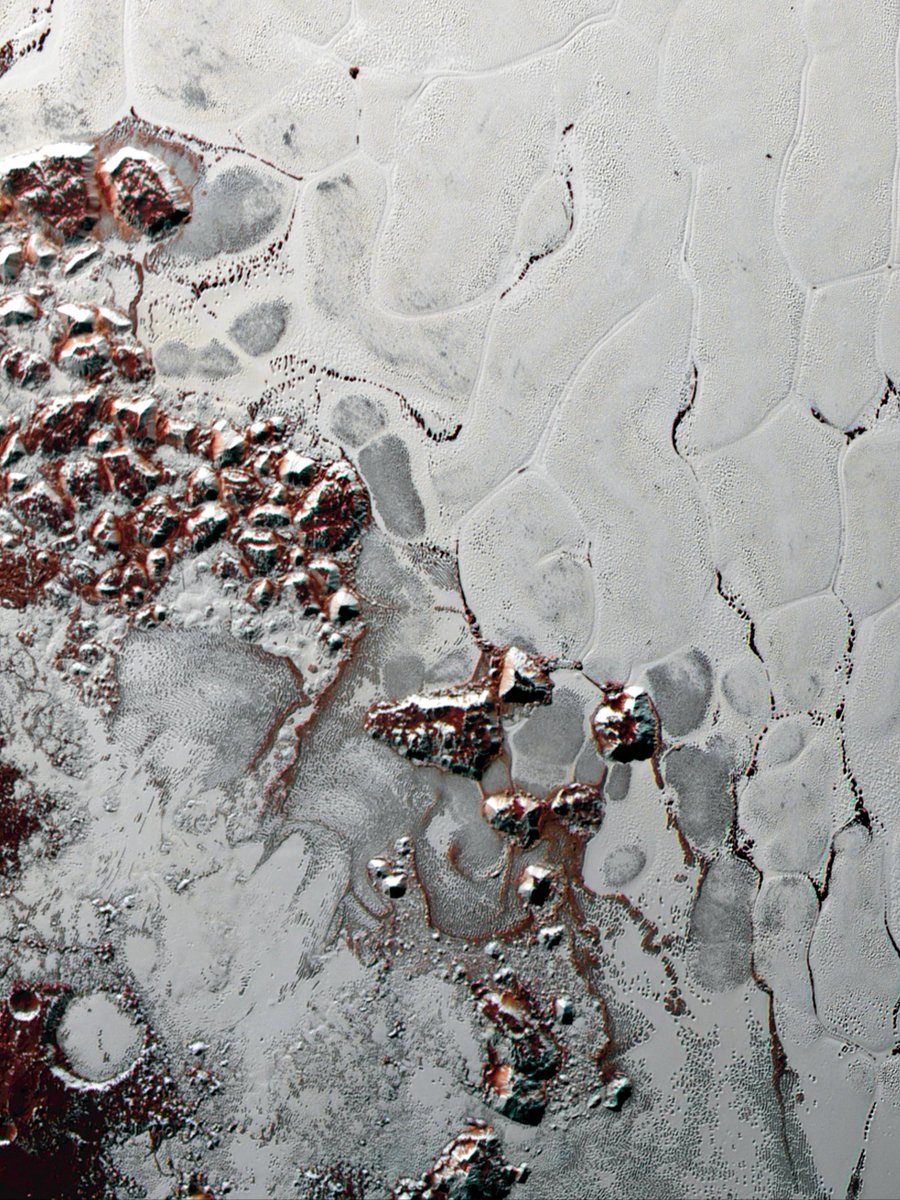
Look at the right side of this picture. That pale ground is broken into shapes with edges, like a floor someone tiled and then left out in the sun to soften.
This is Pluto. New Horizons photographed it on the way past, and this piece of ground is about 400 kilometers across. Pluto was around 4.8 billion kilometers from us at the time, far enough that sunlight takes about four and a half hours to arrive. The spacecraft flew nine and a half years for a single pass.
The dark red on the left is not rock. Those jagged peaks are made of water ice, and at roughly 40 degrees above absolute zero water ice is about as hard as granite. They stand there like mountains because at that temperature that is exactly what they are.
The pale shapes on the right are something else. That is frozen nitrogen. Each shape is a cell somewhere between 10 and 40 kilometers wide, and if you look closely at one you can see it is speckled with tiny pits, fine near the middle and coarser toward the rim.
There is also not one crater anywhere on it. Every airless world in the solar system is covered in craters. This ground has none.
Now look at the lines between the cells, because the lines are the whole thing.
Warmth from inside Pluto pushes the nitrogen up through the middle of a cell. It reaches the surface, cools, spreads sideways and sinks back down along the edge. The lines are where it goes under. NASA puts the cells at 16 to 48 kilometers across and the surface at less than one million years old.
That is why it is clean. Things have been hitting this ground for four and a half billion years and it keeps folding the evidence back under. This surface does not remember anything that happened to it.
One honest note. The age is argued over. One team calculated the ice creeping along at about 1.5 centimeters a year, which makes the surface roughly a million years old. Another team put it closer to 500,000. They agree on how it works and disagree on how fast. A third approach ignores the models entirely and works only from the missing craters, and it concludes the surface has to be younger than 10 million years.
New Horizons went past at about 14 kilometers a second, then spent more than a year sending the pictures home.
Image: NASA/Johns Hopkins University Applied Physics Laboratory/Southwest Research Institute. Ralph/MVIC on New Horizons, Sputnik Planum on Pluto, data gathered July 14, 2015. Further cropped and sharpened.
Look at the pale blue crust between the dunes. That is not sand and it is not shadow. It is frost, and it is the reason nothing in this picture is moving.
This is Mars, seen from orbit by the Mars Reconnaissance Orbiter on 8 September 2022. The dark red shapes are dunes, the same kind you would find in any desert on Earth, and they are sitting in the northern half of the planet where winter goes hard.
Look at any one of them and you can read it like a road sign. There is a smooth slope on one side, a sharp crest, and a steeper drop on the other. Wind picks grains off the gentle face, carries them up and over, and drops them down the far side. Grain by grain the whole dune walks. Dunes on Earth do exactly this, and dunes on Mars do it too.
Now look at the frost, because the frost is what makes this picture strange.
Recent work found that the winter frost does not just sit on top of the sand. It locks the grains down. While it is there the wind can blow all it wants and nothing moves, and the entire dune field is held in place until the spring thaw releases it.
So the force is still being applied. The air is still moving. What has been removed is the ability of the ground to respond to it. Every one of these dunes is frozen in the middle of a step, and when the frost goes they will carry on from exactly where they stopped.
Scientists photograph the same patches over and over for this reason. They are not photographing dunes. They are timing how long the ground stays locked.
The atmosphere doing the pushing here is less than one percent as thick as the air you are breathing. It cannot lift a rock, it cannot knock you over, and given a few thousand years it moves entire hills across a planet.
Image: NASA/Jet Propulsion Laboratory-Caltech/University of Arizona. HiRISE camera on the Mars Reconnaissance Orbiter, northern hemisphere of Mars, 8 September 2022. Contrast and saturation increased, further sharpened.
@elonmusk Those cameras came out of that same Ship minutes earlier. Six of the twenty Starlink units on this flight carried them, and none were meant to stay up. They rode the same arc down and burned up about twenty minutes later. The photographer was cargo, and it was disposable.
Only three full-flow staged combustion engines have ever been built. The Soviet RD-270 ran 27 hot fires in the sixties and never flew. The American demonstrator reached full power in 2006 and was never turned into a complete engine. Raptor is the only one that has ever left the ground.
Worth adding for anyone reading these four as pure progress. The orange on Flight 10 was deliberate. SpaceX flew experimental metallic tiles there and removed tiles in places on purpose to see what would fail, and Musk said at the time that the red was those metal test tiles oxidizing and the white was the insulation under the gaps.
@Soph_astro Something quietly strange about that. With no gravity nothing warm rises, so the smell does not fill the module the way it fills a kitchen. It hangs in a bubble around the bowl until a fan finds it, which means you have to go to the memory instead of it coming to you.
@_MaxQ_@NASASpaceflight The first hop went 20 meters up. The stack in this photo is about 124 meters tall. The rocket is now six times taller than that entire first flight was high.
@CSI_Starbase That shape is the vacuum doing it. With no air pressure squeezing the exhaust inward, the plume stops being a column and just keeps expanding until it runs out of gas. Same engine, same throttle, at sea level it would be a tight pencil of flame.
@NASASpaceflight 37A has never launched anything. It was built for Saturn in the early sixties and never used, while its twin next door flew Saturn I, Saturn IB, Apollo 5 and two decades of Delta IV. That tower is the first hardware it has ever been given.
@_MaxQ_@NASASpaceflight It does not have to say anything. It is in the photo, bottom left, still standing there and watching. Musk's line after that first hop was that water towers can fly.
@JerryPikePhoto@NASASpaceflight The white cloud is not smoke. It is steam, water flashing off the deflector under the mount. And the water is not there to cool anything. It is there to soak up sound, because at liftoff the acoustic energy reflecting off the ground is what damages the vehicle, not the heat.