Mind and Language published an exchange between Rachel Goodman and me. I learned a lot from doing this and Rachel's comments are great. Not so sure about my attempted responses, but maybe the distinction between identity and 'fregentity' will catch on? https://t.co/EEtbtNTt8n
Does any other field use ‘Anglophone’ as their in-group marker? Anglophone linguistics? Anglophone psychology? Or is this yet another quirk of philosophers?
@EdvardoTorres I think Grice taught us that, without using the Austinian term 'uptake,' and that for a long time people only read Strawson's explanation of this. But anyway, people also want us to believe what they say.
'Pamela' by TOTO (1988) is not as good as 'Pamela' by the Icelandic band Dúkkulísurnar (1984). Check it out. But you can now also read my responses to the (great) comments on my book, forthcoming in an Inquiry special issue. https://t.co/4R5hSWj1K7
I'm hiring a two-year postdoc in philosophy of language and mind, based at the University of Iceland. The postdoc will also be a Visiting Scholar at University College Dublin. Based on a grant @danielwharris and I received: https://t.co/MKwh5DkTGF
What is the most frequent number of minutes such that humans remember something that happened that many minutes ago? (Seconds, minutes, hours, days, years...)
New episode (888), with Dr. Elmar Unnsteinsson (@unnsteinsson) about his book, Talking About: An Intentionalist Theory of Reference. #Philosophy
YouTube: https://t.co/HQvFJ2SWwT
Podcast: https://t.co/cfB4ER9gZa
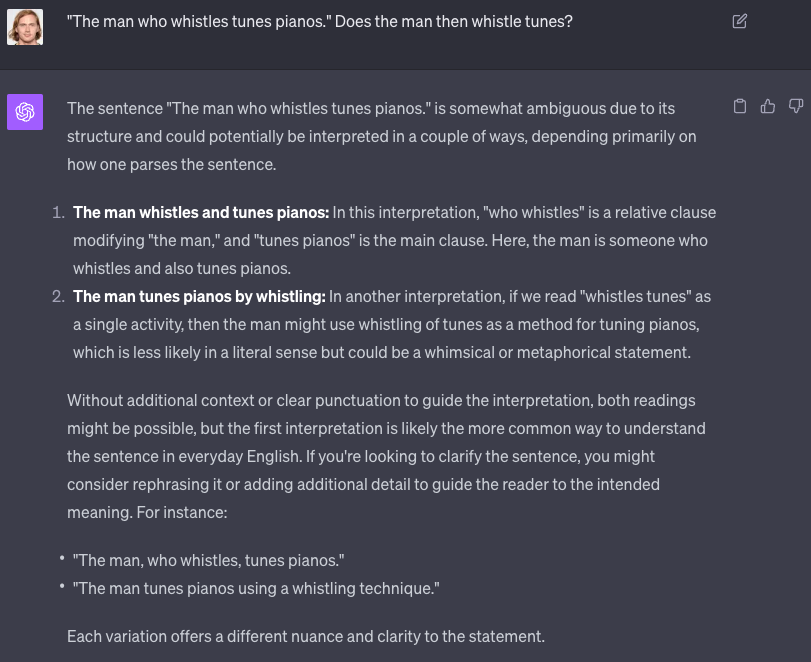
@dioscuri Yeah, that’s a good analogy, but the LLM output is native-level which makes it very weird for it to propose impossible interpretations. Like treating a sentence in your native language as if it were Latin.
@dioscuri Right, what I find so interesting about the garden path sentences is that the error is distinctly non-humanlike (at least so it seems to me).