NO HIIT FOR ME ANYMORE
I'm not doing high-intensity interval training anymore. Not the four-minute Norwegian method, not the classic HIIT protocols everyone talks about. I switched a while ago to repeated sprint training, and I'm not going back.
Here's why. When you do traditional HIIT, you're under load for three to eight minutes at a time. Several times.
Your body floods with cortisol and other stress hormones. Recovery takes longer. The metabolic cost adds up. Yes, it works for VO2 max gains, but the price is higher than most people realize.
Repeated sprint training gives you the same gains without the metabolic beating. You sprint all-out for five to ten seconds. Then you rest. Not full recovery, just 30 to 60 seconds. Then you go again. Every minute, another sprint. Ten minutes total and you're done.
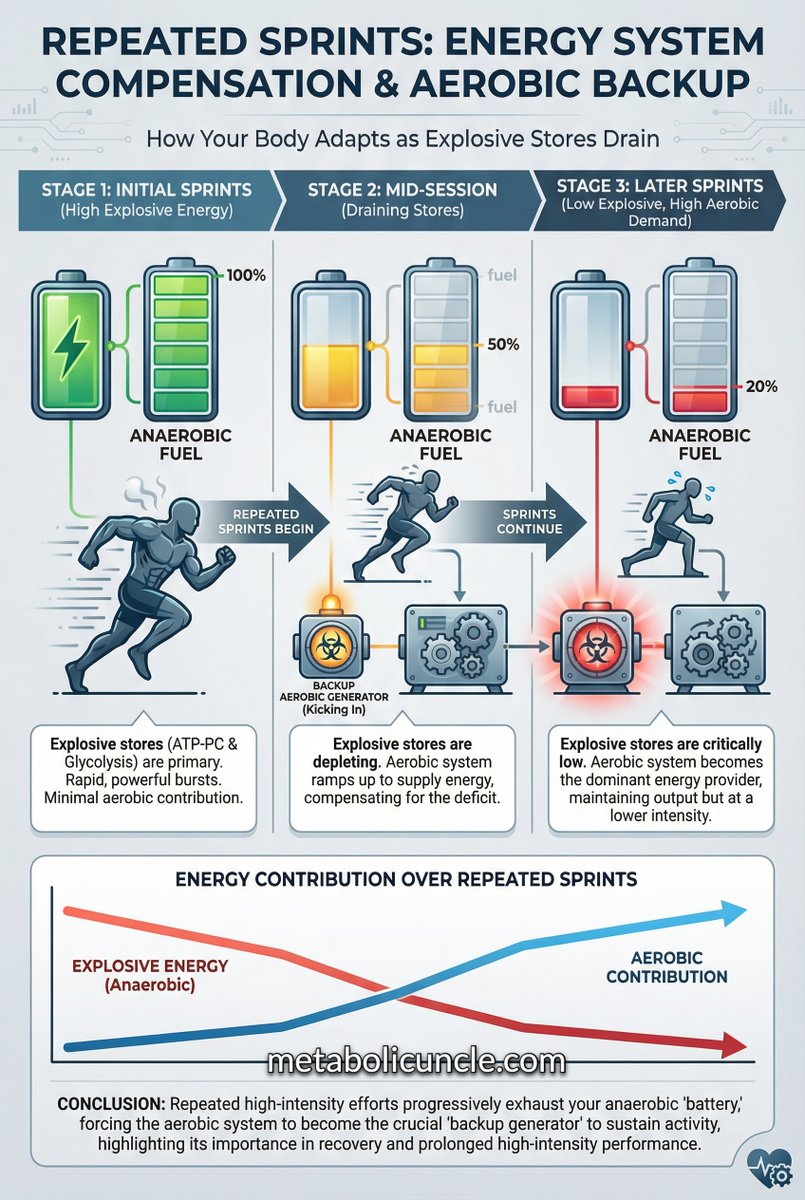
The beauty is in what happens physiologically. Short sprints rely almost entirely on your phosphocreatine system. This is the fastest energy pathway your body has.
When you jump, lift heavy, or explode into a sprint, phosphocreatine donates a phosphate group to ADP molecules, instantly regenerating ATP. No oxygen needed. No lactate buildup. Just pure, fast energy.
But here's the trick. Your phosphocreatine stores deplete fast during that first sprint. Maybe 60 percent gone in ten seconds. Then you rest, but not enough to fully recover.
After 30 or 60 seconds, your stores are still partially depleted. So when you sprint again, your body can't rely on phosphocreatine as much. It has to pull more energy from your aerobic system.
Sprint after sprint, this pattern intensifies. Your phosphocreatine contribution drops. Your oxygen consumption rises. By the final sprints, you're hitting close to your VO2 max, even though each individual sprint is only five to ten seconds. You're training your aerobic system through repeated explosiveness.
It doesn't matter that your sprints get slower. With this training method, the all-out effort is what counts!
Research backs this up. A 2024 meta-analysis looked at 51 studies and over 1,200 athletes. They compared repeated sprint training, traditional HIIT, sprint interval training, and continuous endurance work.
Repeated sprint training and HIIT tied for the biggest VO2 max improvements. Both showed large effect sizes, statistically significant and biologically meaningful, with RST having a slight edge in effectiveness.
But repeated sprint training has even more advantages HIIT can't match. First, time efficiency.
Ten minutes versus 30 or 40 for a full HIIT session. Second, metabolic stress. Short sprints don't flood your system with cortisol the way sustained high-intensity efforts do.
Third, skill and power development. Every sprint trains explosiveness, speed, and total-body coordination. You're engaging every muscle fiber, not grinding through sustained discomfort.
Fourth, repeated sprint training can actually increase your total daily energy expenditure. After a session, your metabolism stays elevated.
Two or three sessions per week and you're always burning more calories at rest, not fewer. Traditional HIIT can suppress metabolism if you overdo it. Repeated sprints avoid that trap.
The mechanism makes sense when you think about muscle fiber recruitment. Short, maximal efforts activate fast-twitch fibers. These fibers have huge growth potential and high metabolic demand.
You're training power and endurance simultaneously. Over time, your body adapts. Phosphocreatine stores regenerate faster. Your aerobic system gets better at supporting repeated efforts. Your nervous system learns to recruit fibers more efficiently.
If you're already fit, you can use a cluster approach. Do four to six sprints every minute on the minute. Then rest two to four minutes. Repeat the cluster two or three times. This lets you maintain higher power outputs across the session while still accumulating the aerobic stimulus.
The key is insufficient recovery between sprints. If you rest too long, your phosphocreatine stores fully recover and you're just doing power training. Useful, but not the same stimulus. The magic happens when you force your aerobic system to step in because your anaerobic system can't keep up.
I'm not saying abandon endurance training entirely if you like it. Long, slow Zone 2 cardio is ineffective for VO2max, but it builds capillary density around muscle cells, improving oxygen delivery, which will level up the effect of your RST.
That matters for long-term aerobic development. But for time-efficient VO2 max gains with minimal metabolic downside, repeated sprint training alone wins.
Ten minutes. Full-body engagement. Speed, power, and aerobic capacity in one package. No cortisol overload. No metabolic suppression.
Just clean, effective training that makes you faster, stronger, and fitter without the recovery cost of traditional intervals.
That's why this is my preferred method now. I get the same gains in less time with fewer downsides. For anyone serious about improving VO2 max without accumulating unnecessary stress, repeated sprint training deserves serious consideration.
“One of the painful things about our time is that those who feel certainty are stupid, and those with any imagination and understanding are filled with doubt and indecision.” ― Bertrand Russell
Once in awhile I get annoyed about the fact that I have no real privacy. No where I can go and not be registered. I know that, somewhere, everything I do, think and dream of is recorded. I just hope that nobody will use it against me.
https://t.co/c4jPRixuMl
So there's Bitcoin, stablecoins, and meme coins now.
Bitcoin is worth two trillion dollars.
And it's rapidly becoming the premier store of value for individuals, corporations, and nation states.
It's eating a $100T+ addressable market and is on a path towards millions per coin.
Stablecoins are for transferring USD without a bank.
And meme coins are for pure gambling.
Both of which are big use cases as well, although far smaller than storing value.
Solana is currently the fastest and cheapest "casino" which enables all the meme coin gambling.
And Tron is the cheapest network for transferring stable coins (for now).
Meanwhile, Ethereum is still somehow the second most valuable coin, worth 16% of BTC?
But with essentially zero use case?
ETH is a more expensive and slower casino than Solana, and a more expensive network to transfer stablecoins than Tron.
And yet it still has a higher market cap than Salesforce, SAP, Coca-Cola, Chevron, Toyota, Alibaba, and Nestlé?
What is the ETH bull case? Can anyone actually justify the $330 Billion market cap?
The last narrative was that ETH was "ultrasound money" with a deflationary supply.
But the ETH supply has gone vertical recently.
Seems the monetary policy is even less predictable than a central bank?
Not trying to kick ETH investors while they're down, but if you're still holding ETH bags I'd hope you'd have a pretty solid argument to justify what appears to be a gross overvaluation of $330 BILLION for something that has yet to do anything useful besides enable a bunch of ICO scams and NFT pump and dumps.
I guess it makes sense if you like being repeatedly kicked in the nuts and dumped on by Vitalik, but let me know if there's a use case I'm missing
“A nation that does not trust its people is a nation that is afraid of its people.” A government that withholds information is inherently fearful of its citizens’ ability to make informed decisions and participate actively in democracy.
THE AGE OF SCAMBLING
Trump Coin and the Wild West of Non-Bitcoin Crypto
By @coryswan
January 20, 2025
Bitcoin continues to mature into a stable and resilient network—a digital fortress of sound money immune to the whims of the powerful. Meanwhile, its lesser imitators, generally known as “crypto,” have taken a different turn, one characterized by a mix of scamming and gambling. This can be termed “SCAMBLING,” where dubious non-Bitcoin cryptocurrencies and digital assets blend hype, speculation, and outright fraud. Aided by lax oversight and a newly cozy relationship with legislators and regulators, scambling is set to flourish on a massive scale.
TRUMP Coin vs. Altcoins
Non-Bitcoin crypto assets, from Ethereum’s so-called “world computer” to the newest memecoins, are products of a hyper-speculative market, where the lines between innovation and exploitation blur more every day. Nothing embodies this trend more brazenly than the launch of the TRUMP and MELANIA tokens, originated by Donald Trump and his family.
Without the baggage of false innovation promises that saddle traditional altcoins, these memecoins draw gamblers in through a cult of celebrity, combining political allegiance with the thrill of high-stakes digital betting. There’s no value other than the thrill of hoping a greater fool buys in at a price higher than what you paid. And meanwhile the coin’s creators and insiders got their coins for free or cheap, and dump their coins on the gamblers. It’s scambling at its finest.
The celebrity-backed token is the natural outcome of a landscape where scambling is allowed to thrive. Crypto has managed to normalize an environment where hype takes precedence over substance, and the potential for a quick buck outweighs saving and investing.
Sports Gambling and Crypto Gambling
The overarching trend here is the continued bifurcation of society, with the wealthy focused on saving and investing, and the middle and lower classes increasingly drawn to sports betting and crypto gambling.
We’ve seen this play out over the past decade in Turkey. When the economy was working for the poor and middle classes, Bitcoin dominated the exchanges. As the economy suffered and the local currency weakened, the crypto market was overrun by memecoins and other pump-and-dump schemes. With little savings to put into buy-and-hold investments, most people now play markets like the lottery or a 7-step parlay, hoping for a short-term windfall.
In the United States, sports gambling and crypto gambling have increasingly merged. Their apps look the same. Their advertisements look the same. They sponsor the same types of shows, sporting events, and stadiums, and cross-advertise on each other’s media outlets. This is to be expected. They are both negative-sum games for the participant, but with anecdotes of some people winning big flooding advertising and social media channels, the urge to gamble is strong.
The Crypto Wild West
Cryptocurrencies other than Bitcoin exist in a murky regulatory space, one where the rules are unclear, and enforcement is often weak or nonexistent. Recently, a wave of lobbying has enabled crypto groups and companies to exercise unprecedented influence in Washington. Donations from the crypto industry now flood campaign coffers, ensuring that the powers-that-be take a softer approach. This new, light-touch regulatory framework for non-Bitcoin crypto projects is the direct result of millions of dollars spent on political donations, lobbying efforts, and influence campaigns by companies like Coinbase, Andreessen Horowitz, Circle, and the Ethereum Foundation, all of whom have managed to buy themselves more leeway.
The crypto companies and VCs have taken a page from the playbook of big tech and traditional finance, knowing that political contributions are the surest way to tilt the system in their favor. As these projects receive a pass, it is retail investors who pay the price when these house-of-cards schemes eventually crumble.
This newfound freedom for crypto has ushered in a modern-day “Wild West.” With lax oversight, non-Bitcoin crypto projects are free to grift without the constraints of consumer protections. Rigged token sales, celebrity endorsements, and thinly-veiled ponzi schemes are all allowed to proliferate under the guise of “innovation.” At first glance this might seem bullish for crypto, but let’s be clear: it’s a bonanza for scambling, not for actual innovation.
Bitcoin Stands Alone
Bitcoin, however, remains in a different category. It’s the only cryptocurrency that doesn’t need a lobbyist or a politician’s favor to survive and thrive. While scambling tokens maneuver to win the approval of regulators, Bitcoin operates on its own terms, outside the reach of centralized control. Bitcoin’s ethos is that it’s decentralized and permissionless; nobody controls it and it doesn’t need government regulation because its rules are both clear and inviolable. As regulators and politicians extend preferential treatment to the shiny new tokens paying their way into favor, they are inadvertently amplifying Bitcoin’s core value proposition: financial sovereignty and true decentralization. Bitcoin doesn’t need lobbyists because Bitcoin doesn’t need government to look the other way.
Despite the scandals and hype cycles that have come and gone in the broader crypto industry, Bitcoin stands apart. Unlike the TRUMP coins, Bitcoin has no marketing team, no PR machine, and no centralized authority hyping its value. It is held up by the community that runs its protocol and the decentralized network that emerges. This is why Bitcoin will nonetheless thrive in this era of scambling, despite Bitcoin being the only honest player at the table. As the market for scambling inevitably collapses under the weight of its own false promises, Bitcoin will remain, unshaken and resilient.
Fortunately, as the Age of Scambling proceeds, more people will see the value of Bitcoin’s slow-and-steady, deliberate design. Bitcoin was never intended to be a get-rich-quick scheme, and its value comes not from empty promises but from the integrity of its protocol and the community that upholds it. Every crypto token that crashes and every rug-pull scandal that unfolds serves as a reminder of Bitcoin’s resilience.
In the end, Bitcoin doesn’t need celebrity endorsements, marketing gimmicks, or political handshakes to survive. It is inherently different from crypto. It has withstood every market cycle, every regulatory threat, and every wave of speculative mania. While regulators continue to court crypto lobbyists and embrace this age of scambling, Bitcoin’s role becomes even more apparent: a reliable, unyielding store of value for those who recognize the difference between substance and spectacle. The Age of Scambling may have arrived, but it will be Bitcoin that endures.
Thank you for reading. Please consider sharing this post.
We've had, as you'd expect, a flurry of questions as to how Autonomi is different from other technology such as IPFS, Filecoin, Arweave, the ICP etc.
First off… this is all cool tech, that moves us all forward.
But as we've pointed out before… do we want to settle for Web 2.5, or go the whole hog? 🧵