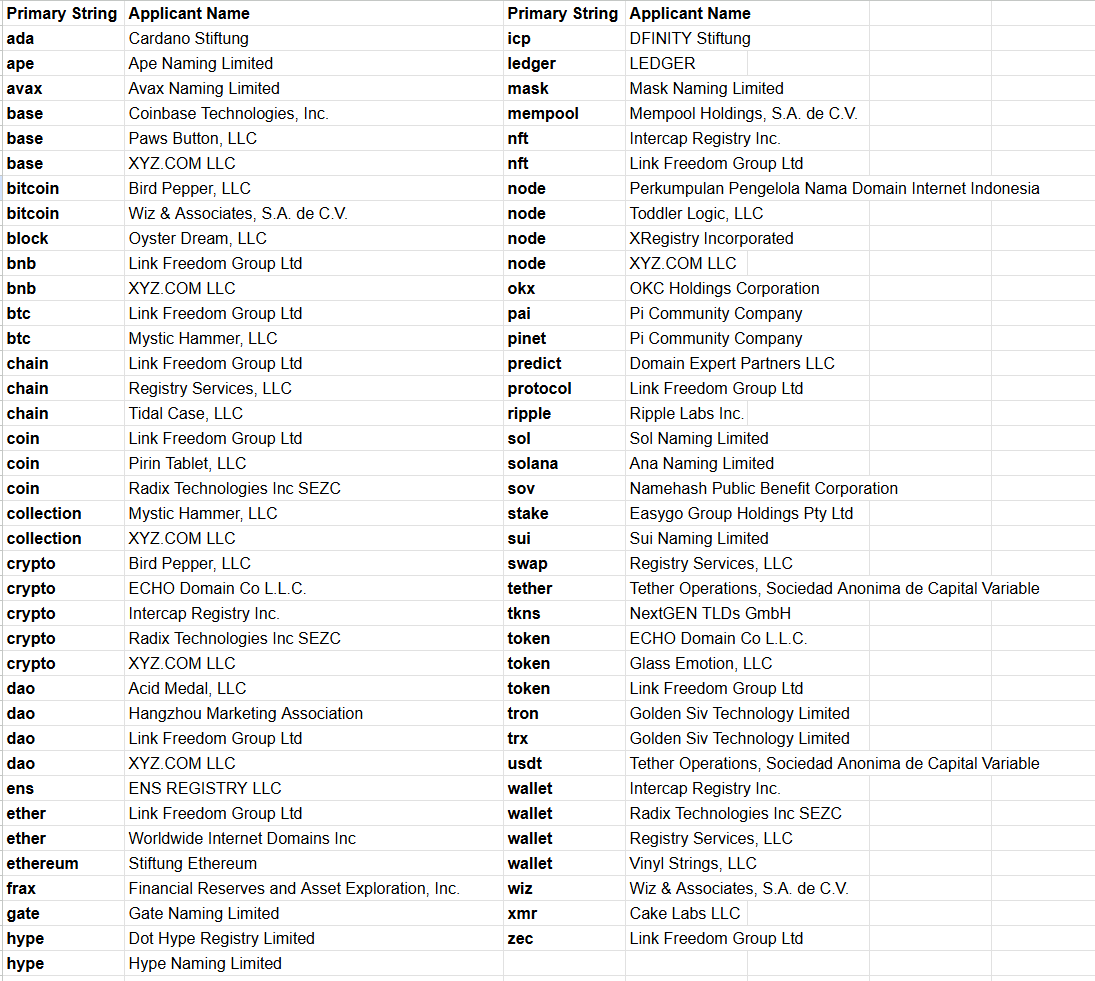
ICANN released the list of applicants and TLD strings for the 2026 round today.
I went through the full list and sorted out all the crypto industry related applications (~75 of them).
Looks like there's going to be competition for a few of them including .bitcoin, crypto, etc.
12+ years of Development Code, Organizations, and Administrative control, gone in seconds.
GitHub is suspending developer accounts due to false allegations and there is NOTHING you can do about it.
This should scare every developer and tech team that is reliant on GitHub for their day-to-day development and management needs.
All technolgy companies including AI, Bitcoin/Crypto, and other software developers are HIGHLY at risk from automated suspension through no faults of their own. Use AI to code? You're even more at risk.
You can lose a decade or more of your work, with some vague (untrue) reasons, and have no way to talk to a human to resolve it.
Support tickets you start will ALWAYS have the same reply: "You did this thing, too bad, bye-bye" and the ticket will be automatically closed by the bot. So you cannot reply.
With a suspended account you also cannot start tickets easily, so every time you want to reply to their allegations, you have to start a NEW ticket.... which gets the same reply and closed on you.
The story:
Yesterday I was trying to commit some local code changes (as I usually do daily) to GitHub using CLI. This time I had some kind of error, so when I went to GitHub to see if my token access had expired, I was hit with a suspended account page!
Now I'm slightly annoyed, and thinking this is an error, so I try to start a support ticket. Turns out starting a ticket without an account isn't straightforward, but I figured it out. About an hour later I get the reply:
------------------------
The account has restrictions imposed because it appears to have been taking part in activity which goes against our Terms of Service:
Terms of Service
In particular, any repositories that use GitHub Actions solely to interact with 3rd party websites, to engage in incentivized activities, or for general computing purposes may fall afoul of the GitHub Additional Product Terms:
GitHub Additional Product Terms
For this reason, I'm afraid we will not be removing the restrictions from this account.
-------------------------
WHAT?!? I never did any of that. I use workers to auto publish updates to our production code (domain registry, registrars, e-commerce stores, etc.). I only used workers in any kind of meaningful way about a month ago while going through a launch period. Solely for code deployment, and only intermittently.
Anyways, now getting irritated, I replied to this ticket asking where, when, how, and why? There were no warnings, no heads-up, just straight erroneous suspension.
Turns out, the bot reply not only said "too bad" it also auto-closed the ticket:
-------------------------
The ticket you replied to was closed and cannot be reopened. Please visit our support portal at https://t.co/XnEQP4a3T3 to create a new ticket.
-------------------------
!!!??? Anyways, so as suggested I go and open another ticket (without an account!) and this time put in more details and asked for clarification and help.
Guess what? I get the exact same word-for-word, character-for-character reply as before, and the ticket was closed automatically again!!
So I start another ticket once more. Guess what happened? Exact same thing. Exact reply, exact same auto-ticket closure.
Because I like to put myself through it, I tried a couple more support tickets worded differently, but all with the exact same reply result :)
I have long-standing activity, manage dozens of organizations and repos, and have been a faithful user and promoter of GitHub for well over a decade.
I'm not the only one that this has happened to. Doing a search "GitHub suspended" will reveal many other developers that this has happened to just yesterday and the day before (these are just the small minority posting about this issue) and others before then.
This looks like some automated bot suspension campaign based on false signals. I use AI coding tools quite deeply in my workflows. I have been doing so for almost 3 years with no issues. But this does seem to have something to do with AI code deployed via Workers to production sites using CLI (domain name system infrastructure we're building). BE AWARE!
This is why EVERY organization and developer (especially crypto and AI companies) should move their critical infrastructure off of GitHub IMMEDIATELY (or duplicating at multiple locations). Your administrator accounts can also be arbitrarily suspended with no recourse.
What will you do then? What will your company do? Almost the entire tech industry is at the whim of centralized powers that can unilaterally screw you over big time. You don't even have to do anything wrong for it to happen.
Some bot decided "this doesn't fit the norm, SUSPEND!". No humans ever needed.
If you don't have a following or any kind of contacts, you will never get your account back again. What will you do then? Keep local copies of all your code. Don't rely on these centralized behemoths. They don't care about you personally. It's easier for them to block you and ignore you.
For example, this happened to our old Twitter account with 25k+ followers for 7 years, until we got a business premium plan to get human help unsuspending it - Thanks @ElonMusk Support team for getting that done (previous administration was useless)!
In the replies I will quote other (small accounts) that this has recently happened to as well as provide screenshots of the same bot replies. It feels like we all got hit by the same hammer bot.
GitHub and centralized institutions are security holes and risks to your business. If you're serious MOVE OFF GITHUB ASAP. Otherwise it's just a matter of time some bot, or if you're lucky, a misinformed human, decides your account needs to be suspended.
I'm glad I backed up most of my code locally and most of my development work stays on my devices, many of the people posting about this didn't. I only lost about a quarter of my old code and full dev history.
Github is still wasting my time though, the only precious resource anyone truly has. Inhuman bots don't care for nuance or truth.
Never mess with a man that just wants to be left alone in peace to do his thing, especially erroneously, via false bot signals and through no fault of his own.
Therefore I must respond.
TLDR: GitHub auto-suspended my main account erroneously. Support tickets provide same bot reply, and close tickets. 12+ years of development code, local dev history and admin access to Business organizations/repositories gone. Forced to becoming a vocal warner against the service I promoted for over a decade.
CENTRAL SERVICES ARE SECURITY & OPERATIONAL RISKS.
You're one remote or bot decision away from total loss. Decentralize everything and live accordingly.
Tagging some Github people here for visibility:
@GithubSupport @GitHubCommunity@martinwoodward@kdaigle@mariorod1@jaredpalmer@ashleymcnamara@dwcheatham
Check replies for screenshots and others with the same issue.
14 days until ICANN opens the gTLD (Generic Top-Level Domain) window.
In the last 90 days, a single AI product announcement erased $285 billion from software stocks.
@Oracle cut up to 30,000 jobs via a 6 a.m. email — then doubled its AI data center budget.
@Meta raised its 2026 capital spending to as much as $135 billion. Nearly double what it spent in 2025.
@BlockadeLabs fired 40% of its workforce. Its CEO said AI tools could handle the work.
Layoff trackers count more than 140 separate restructuring events across tech in 2026. Close to 100,000 workers affected.
Every quarter, another platform you depend on changes its team, its pricing, or its product roadmap.
Your registrar. Your DNS provider. Your email host. Your cloud vendor.
You do not own any of it.
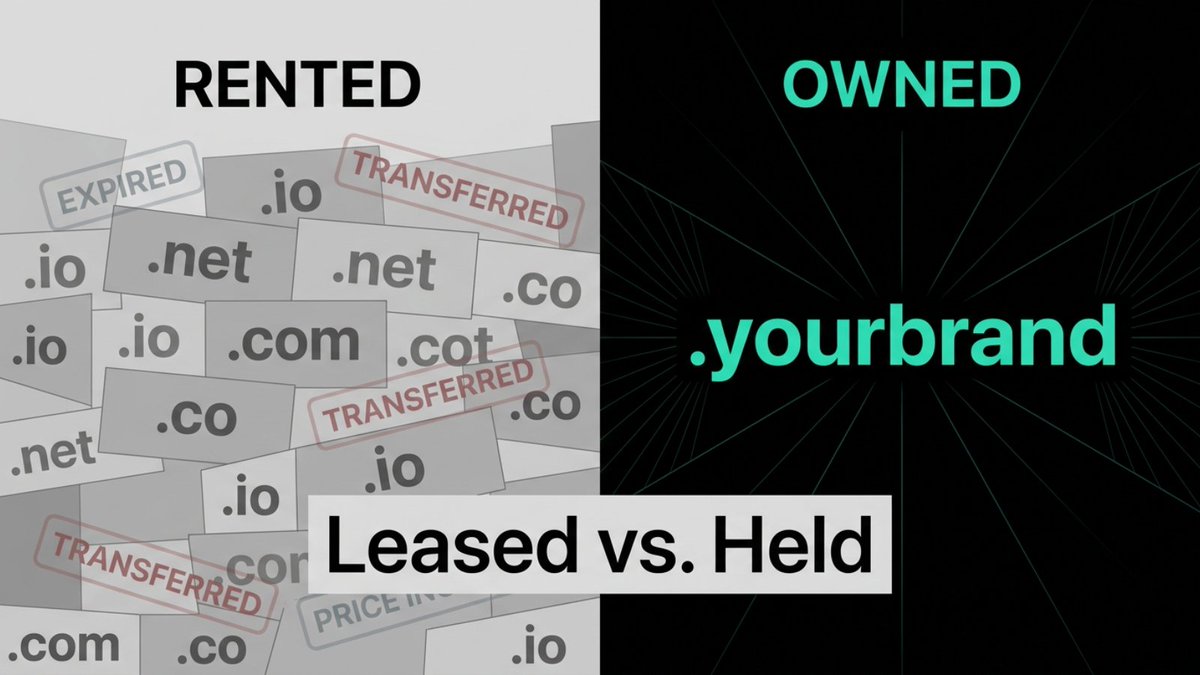
Your .com is a storefront lease. The landlord sets the rent. A competitor can sign the lease next door and paint your name on the window tomorrow.
Now answer one question honestly.
What digital infrastructure does your organization actually hold title to?
Not license. Not subscribe to. Hold.
A gTLD is the answer most executives have never evaluated.
When you operate .yourbrand, you control the entire domain namespace underneath it.
Every URL. Every email address. Every subdomain.
Nobody else can create an address inside your gTLD. Not a competitor. Not a fraud operator. Not a rogue reseller.
A .com is a P.O. box — anyone can rent the one next to yours.
A gTLD is the zip code itself.
⚠️ @ICANN 's application window opens April 30, 2026 and closes August 12, 2026.
That is 15 weeks. Then the window disappears for years.
The filing requires months of legal, financial, and technical preparation. Organizations that begin after the window opens are racing a clock they cannot slow down.
Unregistry manages the entire application as a single engagement — ICANN filing, string evaluation, registry build, compliance, registrar setup, and launch strategy.
No vendor patchwork. No internal guesswork. One team from day one through delegation.
ICANN opens the gTLD application window April 30, 2026.
It closes August 12 at 23:59 UTC. 105 days.
The evaluation fee is $227,000. Prep takes months.
If you begin when the window opens, you're already late. ⏱️
Abuse mitigation requires coordinated approaches across technical infrastructure, policy enforcement and user education to effectively address domain abuse. Malicious actors exploit domain registration systems for phishing, malware distribution, spam and other harmful activities. Effective abuse mitigation requires rapid detection, enforcement action and prevention mechanisms to limit harm while maintaining legitimate registration utility. Abuse mitigation represents ongoing arms race between registries trying to prevent abuse and malicious actors evolving their tactics.
Detection systems identify potentially abusive domains through analysis of registration patterns, DNS resolution behavior and threat intelligence feeds. Automated detection enables rapid response before abuse causes significant harm. Detection accuracy matters because false accusations harm legitimate registrants while missed abuse enables harm. Detection systems must balance sensitivity against specificity to optimize enforcement effectiveness. Machine learning approaches can identify patterns indicative of abuse but require continuous training and tuning to maintain effectiveness.
Enforcement actions include domain suspension, domain deletion and referral to law enforcement depending on abuse severity and type. Rapid suspension limits harm from phishing or malware distribution. Evidence collection and documentation support enforcement actions and provide accountability. Enforcement processes must respect due process considerations while enabling rapid action when clear threats exist. Different abuse types require different response approaches. Phishing domains need immediate suspension to prevent fraud. Spam domains might warrant warnings before suspension. Technical abuse like fast flux hosting requires different response than content abuse.
Prevention mechanisms reduce abuse by blocking registrations that clearly indicate abusive intent or high risk. Fast flux hosting detection prevents registration of domains likely used for criminal infrastructure. Known bad actor identification prevents repeat offenders from registering additional abusive domains. Prevention mechanisms should evolve as abuse tactics evolution requiring ongoing analysis and adaptation. Cross registry cooperation improves abuse mitigation effectiveness by sharing intelligence about abusers, tactics and prevention mechanisms. Abuse actors often target multiple registries making coordinated responses more effective than isolated actions. Information sharing about detection methods, enforcement outcomes and prevention mechanisms benefits all registries. Industry collaboration enables more effective responses than individual registry actions.
New gTLD application rounds create opportunities for registry operators to expand their portfolio or enter the market. ICANN has conducted multiple application rounds following the initial 2012 round that introduced hundreds of new TLDs. Each round has different requirements, evaluation criteria and pricing structures. Understanding the application process and requirements represents significant undertaking for organizations considering entry. The application process typically takes 12-18 months from initial preparation to delegation assuming no complications or contention issues.
Application preparation requires assembling comprehensive documentation including technical proposals, business plans, financial projections and rights protection mechanisms. Technical proposals must demonstrate operational capability including infrastructure, staffing and operational processes. Business plans must demonstrate financial viability and market understanding. Financial projections require realistic assumptions based on market research and competitive analysis. Rights protection mechanisms must address trademark protection, abuse mitigation and compliance with ICANN requirements.
Application fees represent substantial investment that organizations must risk regardless of application outcome. ICANN application fees typically exceed hundreds of thousands of dollars per application with additional costs for evaluation, contention resolution and implementation. Organizations must carefully evaluate potential returns against these investments. Portfolio strategy should balance diversification against focus on highest potential opportunities. Spreading applications across multiple TLD strings increases chances of success but also increases total investment and operational complexity.
Post application processes include initial evaluation, contention resolution for similar string applications and contract negotiations before delegation. Initial evaluation verifies that applications meet technical and financial requirements. Contention resolution processes determine which applicant receives delegations when multiple applicants seek identical or similar strings. Contract negotiations establish registry agreements before delegation occurs. Market entry timing significantly affects new gTLD success because market conditions and competitive landscape vary between application rounds. Early entrants to new gTLD rounds often find more open market opportunities but also face greater uncertainty about market reception. Later entrants benefit from established patterns but face more competitive markets. Understanding market dynamics and competitive positioning helps optimize application strategy.
Internationalized Domain Names enable domain names in non ASCII character sets including languages that do not use the Latin alphabet. IDN support represents critical infrastructure for global internet accessibility allowing users to register domains in their native languages including Chinese, Arabic, Cyrillic and other scripts. This capability enables truly global domain namespace that reflects linguistic diversity rather than requiring ASCII transliteration. Users can register domains using their native language characters rather than being forced to convert names to ASCII approximation.
IDN implementation requires Punycode encoding to convert Unicode domain names into ASCII compatible format for DNS resolution. The encoding process ensures that existing DNS infrastructure can handle internationalized names without modification. Applications must display decoded Unicode names to users while using encoded ASCII names for DNS queries. This dual representation requires careful handling to prevent confusion and security issues. Punycode encoded names begin with xn-- prefix followed by ASCII representation of Unicode characters enabling DNS compatibility while preserving user visible Unicode names.
Homograph attacks represent significant security challenge for internationalized domain names because different characters can appear visually identical to users. Malicious actors can register domains using visually similar characters from different scripts to impersonate legitimate domains. For example Greek letter alpha looks identical to Latin letter but represents different character code. This enables phishing attacks where users cannot distinguish legitimate domains from fraudulent lookalikes. Mitigation requires displaying Punycode versions of suspicious domains, implementing registration restrictions on potentially confusable characters and user education about the risks.
Registry support for IDN requires implementing language specific tables that define valid characters for different scripts and languages. These tables prevent registration of domains that mix characters from different scripts in ways that could confuse users. The tables also enable right to left language support and other script specific requirements. Registries supporting IDN must maintain these tables and implement validation during registration processes. User experience for IDN depends on application support throughout domain registration and resolution chain. Registration systems must properly handle Unicode input and validation. DNS resolvers must correctly process Punycode encoded names. Applications must properly display Unicode names to users while managing technical representation. Gaps in this support chain create user confusion and technical problems.
DNS privacy services protect query data from unauthorized access by encrypting DNS traffic between clients and resolvers. Traditional DNS queries transmit domain names in clear text enabling network operators and attackers to monitor which websites users visit. This surveillance capability reveals browsing habits, research activities and potentially sensitive information about user interests. DNS over HTTPS and DNS over TLS encrypt queries to prevent this surveillance. Privacy focused DNS options have gained significant adoption as users become more conscious about data privacy and surveillance concerns.
These services typically provide additional benefits beyond privacy protection including faster query resolution through optimized resolver infrastructure, DNSSEC validation for authentic responses and protection against DNS based attacks including cache poisoning and amplification attacks. The combination of privacy and security features makes encrypted DNS services attractive for security conscious users and organizations. Encrypted DNS prevents network intermediaries from monitoring query data which protects user privacy but also prevents certain network monitoring approaches from working effectively.
Implementation considerations for encrypted DNS services include certificate management for TLS connections, performance impacts from encryption overhead and compatibility with existing DNS infrastructure. Encrypted DNS may not work in all network environments due to firewall policies or middleware interference. Service operators must balance privacy benefits against operational complexity and user experience impacts. Resolver selection affects user experience significantly as encrypted DNS services must maintain low latency and high availability. Geographic distribution of resolver infrastructure ensures that privacy benefits do not come at cost of performance. Service operators must invest in global infrastructure to provide competitive resolution performance while maintaining encryption capabilities.
Enterprise adoption of encrypted DNS services requires careful integration with existing security infrastructure and monitoring systems. Encrypted DNS prevents traditional monitoring approaches from seeing query data which affects network visibility and security monitoring. Organizations implementing encrypted DNS must implement alternative approaches for security monitoring and policy enforcement. Privacy protection must be balanced against legitimate security and operational requirements.
Capacity planning ensures registry infrastructure can handle current demand plus projected growth without performance degradation. Reactive scaling that responds to capacity crises causes problems before solutions are deployed. Proactive capacity planning based on growth trends, business plans and industry projections enables seamless scaling. Growth forecasting should consider multiple scenarios including conservative, moderate and aggressive growth projections. Each scenario should model domain volume growth, query volume growth and data storage requirements over multi year horizons.
Infrastructure scaling requires understanding both vertical scaling limits and horizontal scaling opportunities. Vertical scaling through hardware upgrades provides quick performance improvements but has practical and economic limits. There is only so much CPU, memory and storage that can be added to single system. Horizontal scaling through adding more instances provides better long term scalability and enables geographic distribution. The optimal approach combines both strategies using vertical scaling for individual instance optimization and horizontal scaling for overall capacity growth.
Database capacity represents critical planning dimension because database performance often limits overall system throughput. Capacity planning must account for data volume growth, query complexity growth and indexing requirements. Database scaling strategies include read replicas for query distribution, sharding for data partitioning and archive processes for historical data. Each strategy addresses different aspects of database capacity and should be selected based on specific workload characteristics.
Network capacity planning must handle both normal operations and traffic spikes from marketing campaigns or security events. Bandwidth provisioning should account for baseline traffic plus growth margins. Network infrastructure should support peak loads without service degradation. Geographic distribution requires network capacity between regions for replication traffic and user traffic routing. Capacity monitoring provides data needed for informed planning decisions. Monitoring systems should track resource utilization trends, growth rates and consumption patterns. This data enables accurate forecasting and prevents surprise capacity limitations. Regular capacity reviews should adjust projections based on actual growth and updated business plans. Testing infrastructure under load validates that capacity planning assumptions hold true under stress conditions.
Performance targets set clear expectations for registrar experience quality and provide objective measures for evaluating system effectiveness. Login under 500 milliseconds, domain check under 200 milliseconds, domain create under 500 milliseconds, domain info under 300 milliseconds and domain update under 400 milliseconds represent reasonable targets for modern registry operations that align with registrar expectations and industry best practices. These targets should be considered minimum expectations rather than goals to aspire to. Performance that consistently meets or exceeds these targets creates positive registrar experiences and differentiates registry operations in crowded marketplace.
Performance monitoring requires continuous tracking of actual response times across all operations to establish baseline performance metrics and identify degradation or improvement opportunities. Monitoring systems should capture response times for each operation type, track performance trends over time and alert when performance degrades beyond acceptable thresholds. Targets should be set based on user experience requirements and competitive benchmarks rather than solely technical capabilities. Performance optimization efforts should focus on operations that consistently miss targets or show slow performance trends.
Registrar experience directly impacts satisfaction and likelihood of promoting TLD to their customers. Slow performance frustrates registrar staff and creates poor experience for end users trying to register domains. Meeting or exceeding performance targets builds registrar confidence and reduces support burden from performance related issues. Performance targets should be regularly reviewed and adjusted based on evolving requirements and technologies. Communication about performance capabilities and targets helps set appropriate registrar expectations. Performance measurement infrastructure should capture response times from multiple geographic locations to ensure global performance assessment. Achieving consistently fast performance requires investment in infrastructure, optimization and monitoring but delivers substantial competitive advantages.
Understanding the root zone helps explain DNS hierarchy and how new gTLDs become globally resolvable across the internet. When a new gTLD is delegated it is added to the root zone through coordinated process involving ICANN, IANA and root server operators. Once in the root zone domains become globally resolvable as DNS resolvers worldwide follow the delegation chain. The root zone represents the starting point for all DNS resolution and contains delegations for all top level domains including generic TLDs, country code TLDs and infrastructure TLDs like .arpa. Root server operators distribute this zone globally through anycast networks that ensure reliable access to this critical infrastructure.
Delegation of a new gTLD requires that the registry operates authoritative name servers that are properly configured and accessible before the root zone is updated. This prerequisite ensures that domains under the new TLD will resolve correctly once delegation occurs and that the infrastructure is ready to handle query traffic. Root zone management follows strict processes to maintain the stability and security of the global DNS. Changes require coordination between multiple parties and validation that technical prerequisites are met. The deliberate pace of root zone updates prioritizes stability over rapid changes.
Registry operators should understand their place in DNS hierarchy because it affects technical requirements and operational responsibilities. The root zone sits at the top of DNS hierarchy with all other zones delegating downward through TLD name servers to authoritative name servers for individual domains. This hierarchical structure enables distributed DNS while maintaining coherent namespace. Understanding delegation helps troubleshoot DNS problems because issues can be isolated to specific levels in hierarchy.
Root zone updates happen twice daily following established processes that ensure all root server operators receive consistent updates. The IANA functions performed by ICANN coordinate these updates after verifying that technical requirements are met and that proper approvals have been obtained. Root server operators then publish updated zone files through their anycast networks making new delegations globally available. This process typically takes 24-48 hours from change request to global propagation.