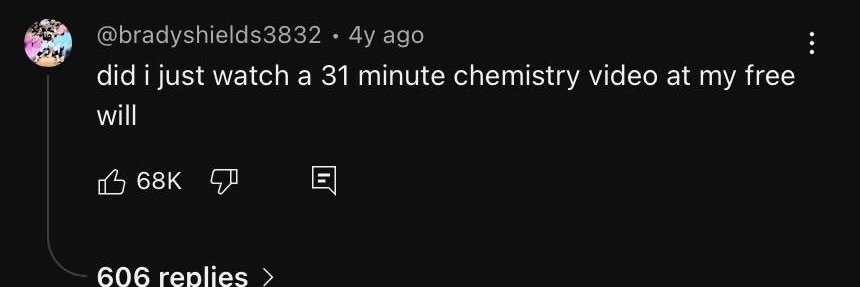
it’s so easy to find examples counter to this it’s comical.
think of the best non-fiction book you’ve ever read. think of all that it taught you. now consider: was it entertaining to read?
There is no successor to the smartphone. It's the terminal form factor. Much like the car is the terminal form factor for human transportation.
Tesla has improved 1000x over the Model T but you still have the same cab riding on four wheels, because it's the optimal solution given the jobs to be done and constraints of reality.
The smartphone has the most intense product market fit of any product ever for a reason: a computer you carry in your pocket and hold in your hand, with a screen you manipulate with your fingers, cannot be meaningfully improved upon for the jobs people want done.
This doesn't mean there's not room for awesome new devices, especially with AI opening up new vistas.
We have motorcycles, mopeds, scooters, e-bikes, and those funny one-wheeled vehicles you see whizzing through Golden Gate Park.
We will have smart glasses, pendants, pucks, and whatever device Hark has in store.
Hark seems like an S-tier team with an amazing vision, and I will probably buy their product. Moreover, I wouldn't want to live in a world where crazy ambitious visions aren't pursued with convert's zeal.
Nevertheless, I'm writing this because every time I see a venture that explicitly or implicitly promises to supersede the smartphone, I think the same thing:
It wouldn't matter if Jony Ive teamed up with the ghost of Steve Jobs and raised an army of the greatest HCI designers that ever walked the earth. It's structural. The smartphone is terminal.
Bill Gurley just identified the only career advantage that AI cannot commoditize.
It isn’t talent. It isn’t your degree. It isn’t your network.
Gurley: “The thing that will differentiate you more in your career than anything else is to be the most hyper curious person that’s trying to do this thing.”
For centuries, knowledge was gatekept. Elite institutions. Expensive mentors. Geographic luck.
The information existed but access to it was the moat.
That moat is gone.
Gurley: “You have no excuse not to be the most knowledgeable person, because the information’s all out there.”
Every question you can formulate now has an answer available instantly.
Every industry. Every domain. Every skill you want to acquire.
The playing field didn’t just level. It inverted.
The people who used to win by controlling access to information now compete against anyone willing to ask better questions.
Gurley: “I can’t make you the most talented person in your company or your field.”
Talent is genetic. It’s luck. It’s the variable you cannot control.
But knowledge is a choice. And curiosity is a compounding asset.
Gurley: “If you are the most curious person that’s constantly learning in your field, you will do extremely well.”
This was always true. What changed is the multiplier.
Gurley: “That advantage is put on steroids with these AI tools.”
A relentlessly curious person with access to all human knowledge and the ability to interrogate it in real time doesn’t just outlearn their peers.
They outlearn entire institutions.
The gap between the curious and the incurious was always there.
AI just made it insurmountable.
you can tell this is actually direct musk convo with grok because grok seems to be pulling and referencing elon’s own tweets specifically in its responses (presumably they’ve programmed it to be more personal by checking tweets of the user)
kind of interesting to see Musk asking leading questions in the chat, and excitedly sharing grok being a bit sycophantic (e.g. “excellent framing” “you’re right to push back” etc)
@karpathy@theJayAlto karpathy you’re very smart. pls don’t feed into this rhetoric
edutainment is the only way we’re going to make humanity as a collective species smarter
this entertainment vs education is a false dichotomy. it’s a spectrum
people think the choice is watching a mark rober video or sitting down and doing 3 hours of focused research
the choice is watching a mark rober video or scrolling through AI slop videos on tiktok
stop villainizing edutainment
there's an epidemic of fake learning. duolingo, tiktok, youtube. it's all entertainment cleverly disguised as education. real learning is hard. it's uncomfortable. if it feels 'fun', you probably aren't learning anything.
@krispuckett for the acquihire maybe, not sure what else would be valuable to them
they have infinite distribution, infinite data to train on, and infinite ability to make great partnerships
i.e with anthropic
Prediction: Apple will release a full iOS vibe-coding platform powered by Claude at WWDC 2026 called Create
Anyone will be able to make basic native iOS apps for themselves, on their phones, iPads and Macs. It’ll be a more robust and AI-focused version of Swift Playground
A number of people are talking about implications of AI to schools. I spoke about some of my thoughts to a school board earlier, some highlights:
1. You will never be able to detect the use of AI in homework. Full stop. All "detectors" of AI imo don't really work, can be defeated in various ways, and are in principle doomed to fail. You have to assume that any work done outside classroom has used AI.
2. Therefore, the majority of grading has to shift to in-class work (instead of at-home assignments), in settings where teachers can physically monitor students. The students remain motivated to learn how to solve problems without AI because they know they will be evaluated without it in class later.
3. We want students to be able to use AI, it is here to stay and it is extremely powerful, but we also don't want students to be naked in the world without it. Using the calculator as an example of a historically disruptive technology, school teaches you how to do all the basic math & arithmetic so that you can in principle do it by hand, even if calculators are pervasive and greatly speed up work in practical settings. In addition, you understand what it's doing for you, so should it give you a wrong answer (e.g. you mistyped "prompt"), you should be able to notice it, gut check it, verify it in some other way, etc. The verification ability is especially important in the case of AI, which is presently a lot more fallible in a great variety of ways compared to calculators.
4. A lot of the evaluation settings remain at teacher's discretion and involve a creative design space of no tools, cheatsheets, open book, provided AI responses, direct internet/AI access, etc.
TLDR the goal is that the students are proficient in the use of AI, but can also exist without it, and imo the only way to get there is to flip classes around and move the majority of testing to in class settings.
@signulll you’ll never be able to tell if someone’s really paying attention to you, so you’ll be skeptical or avoidant of anyone wearing them
not sure this is a deal breaker though, seems inevitable
@signulll true and accurate. but oboe isn’t it unfortunately
ppl don’t want courses and notion-style text UX. they want multimedia games and short form entertainment
check out what we’re building. you might agree
after a decade of tools optimizing for convenience, distraction, & pure consumption, the next wave of stuff will reframe itself explicitly as augmentation.
ai that makes *you* sharper.
going from pseudo entertainment to enhancing active cognition. this is in the territory of we think about ai software too. true super charged bicycles for the mind if you will.
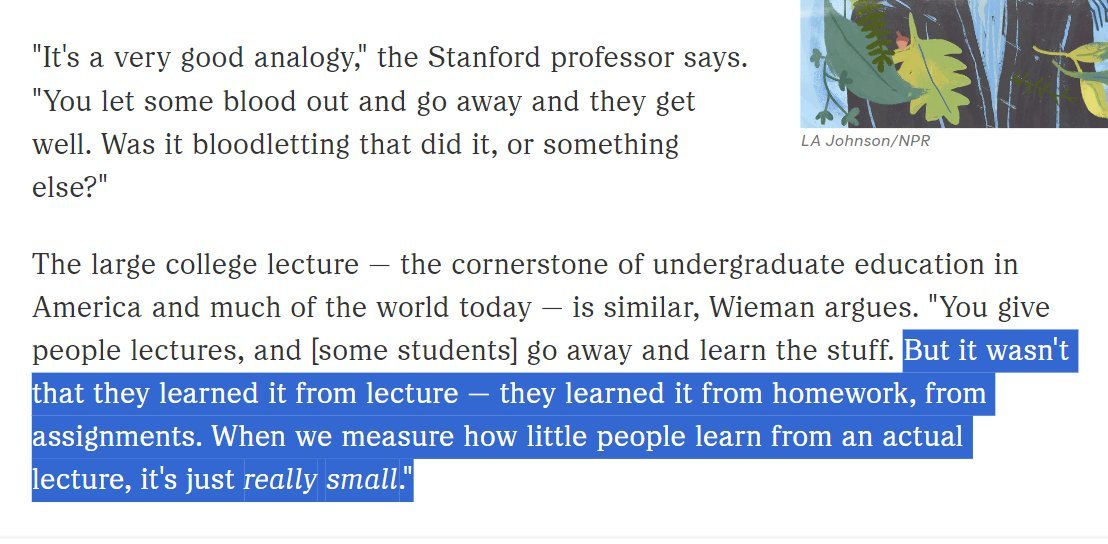
🎯 "Traditional lectures are terrible ways to transmit content. And elite universities are no better than anyone else at this."
As Carl Wieman put it: traditional lecturing is the educational equivalent of bloodletting.
What's better? Rapidly alternating between minimum effective doses of guided instruction and active practice.
Sometimes tiny features can have a huge impact.
We realized parents didn't understand how much Mentava was accelerating their child because most parents don't have a baseline understanding of how long schools take to teach a kid to read
So we began displaying grade level progress after each activity and now we get messages like this:
Prediction: Apple will release a full iOS vibe-coding platform powered by Claude at WWDC 2026 called Create
Anyone will be able to make basic native iOS apps for themselves, on their phones, iPads and Macs. It’ll be a more robust and AI-focused version of Swift Playground
Codegen space is so wild, and so finicky..
Like Claude Code only launched only a few months ago and it’s already the new darling.
v0 is the “new” choice for a lot of vibe build customers.
Just goes to show we’re in the very early innings of the parabolic rise of software.