I've spent the last few weeks going through @RobinhoodCrypto Chain one project at a time.
Not charts. Docs, contracts, holder distributions, commit history where there is any.
Five projects deep now and $STONKBROKERS is the one I keep coming back to.
Here's something in it nobody has written down.
Some of what that turned up along the way:
a project with 244,000 lines of code sitting behind 4 GitHub stars one paying real yield that quietly fell from 950% to 25% APR in three weeks one whose entire pitch is "verify" that publishes nothing to verify
Different projects, same lesson: The docs say more than the timeline does.
So. StonkBrokers.
Everyone is explaining how it works the vaults, the ERC-6551 wallets, the Clock In engine.
Nobody has checked whether the activation tiers are actually worth buying.
I ran the numbers from their own docs. The cheapest tier is 7.5x more capital-efficient than the most expensive one.
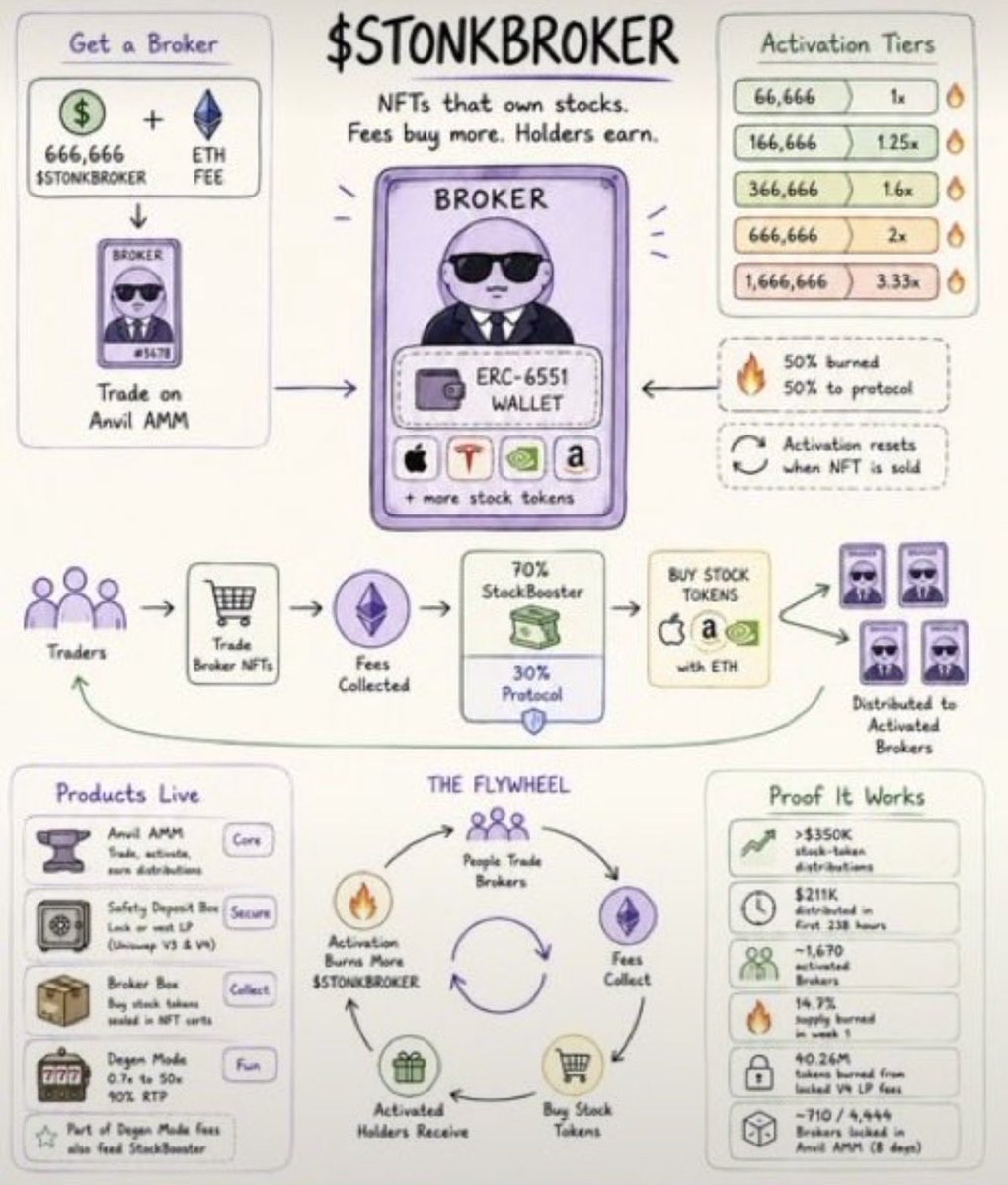
Activation is how a broker starts earning. You pay $STONKBROKER, you pick a tier, and that tier sets your weight in every Clock In distribution.
Five tiers, straight from the docs:
Base 66,666 → 100x
T1 166,666 → 125x
T2 366,666 → 160x
T3 666,666 → 200x
T4 1,666,666 → 333x
Read those two columns again.
T4 costs 25x more tokens than Base.
T4 pays 3.33x the multiplier.
Twenty-five times the capital. Three times the reward.
Same table, expressed as multiplier per token committed:
Base 0.00150
T1 0.00075
T2 0.00044
T3 0.00030
T4 0.00020
Every tier you climb, each token does less work for you.
Base T4 is a 7.5x drop in efficiency.
My read: this isn't a flaw, it's deliberate and it's good design.
Activation fees are 50% burned. Higher tiers burn far more supply per unit of reward paid out.
Whales who want the big number subsidise everyone else's float.
But if you're optimising yield per dollar, the answer is boring: activate at Base.
Second thing nobody mentions.
The Loan Vault lets you lock a broker and borrow exactly 666,666 tokens the same amount the Anvil AMM charges to buy one.
So you can hold the NFT, or the tokens. Not both.
That's a hard tether between NFT floor and token price.
Which means the two can't drift apart indefinitely.
Floor far below 666,666 tokens' worth buy the NFT, borrow against it. Floor far above do the reverse.
Not free money: the loan charges 15% APR in $ETH upfront, and that carry sets how wide the gap has to open first.
But it closes. Watch the spread, not just the chart.
Not a call to buy anything, and I hold a small bag weigh it accordingly.
This is just what I wanted to know before I touched it, and couldn't find written down.
Next: same treatment for a few more projects on this chain.
If you're building here and you'd rather I get your mechanics right than guess at them come talk to me.
I'll publish either way. I'd just rather publish it accurate.
stonkbroker is bringing the next major crypto season to us
as a complete innovator
defi summer + nft cycle + meme supercycle
all in on
pay attention because this is going to be huge
$stonkbroker
I spent some time digging into StonkBrokers because at first glance it looks like another NFT project.
It isn't.
The easiest way to understand it is this:
StonkBrokers is building an NFTFi ecosystem on Robinhood Chain where the NFT itself becomes a financial account.
There are 4,444 StonkBroker NFTs.
But each one is more than a collectible.
Every Broker has its own ERC-6551 wallet, meaning the NFT itself can hold assets.
So instead of owning just an image, your NFT can actually accumulate tokenized stocks, ETH, and other assets inside its own wallet.
And if the NFT changes hands, that wallet moves with it.
This is where $STONKBROKER comes in.
The token is used across the ecosystem, but one of its most important utilities is activating your Broker.
Why activate it?
Because only activated Brokers can participate in Clock In distributions.
Activation has different tiers, and higher tiers carry more weight.
Part of the $STONKBROKER used to activate a Broker is permanently burned.
So the basic loop starts to look like this:
Buy a Broker
↓
Use $STONKBROKER to activate it
↓
Part of those tokens are burned
↓
Your Broker becomes eligible for Clock In
↓
The NFT can start receiving assets
Now let's talk about Clock In, because this is probably the most important part.
Different products across the Stonk ecosystem generate fees.
Those fees help fund a reward pool called StockBooster.
When enough value accumulates, a Clock In can happen.
That capital is then used to acquire assets and distribute them among activated Brokers according to their tier.
And each Broker can choose what it wants to receive.
For example:
70% tokenized Google
20% tokenized SpaceX
10% ETH
Or simply 100% ETH.
Those assets are sent directly into the NFT's own ERC-6551 wallet.
So the Broker is effectively building its own onchain portfolio over time.
That alone already makes the NFT model very different from the usual:
NFT → stake → print token → sell token.
Here the model is closer to:
Ecosystem activity → fees → real assets → NFT wallet.
And StonkBrokers isn't just one product either.
They're building several financial tools around the same ecosystem.
There is the Anvil NFT AMM, where Brokers can be bought and sold directly against $STONKBROKER.
There are loans, where a Broker can be used as collateral.
There's Broker Box, where activity also contributes fees back into the ecosystem.
And they're expanding into token launches, liquidity infrastructure, an exchange, pools and covered calls.
So the NFT becomes more than a PFP.
It becomes the center of a financial account connected to an entire onchain ecosystem.
And $STONKBROKER becomes the asset connecting acquisition, activation, liquidity and token burns.
The flywheel is pretty clear:
More ecosystem activity
↓
More fees
↓
More value entering StockBooster
↓
More Clock In distributions
↓
More value accumulating inside activated Brokers
↓
More incentive to own and activate Brokers
↓
More demand for $STONKBROKER
↓
More tokens burned
Of course, none of this guarantees profit.
The whole model still depends on people actually using the products and generating real activity.
But conceptually, I think this is one of the more interesting attempts I've seen at giving NFTs financial utility beyond staking or speculation.
Instead of asking:
"How do we add utility to an NFT?"
StonkBrokers seems to be asking:
"What if the NFT itself became the financial account?"
That changes the conversation.
Is this closer to where NFT utility is actually heading?
Seeing a lot of cope on the timeline right now.
"I missed it." And then the obvious "it won't last"
You didn't miss anything.
Did you miss the first 1000x? Maybe. But you're watching people ape into garbage with no product, no users, no reason to exist, while a clear winner sits right in front of them this early.
And here's what most people get wrong: it's not the price action.
It's the tech and the ecosystem being built around it.
$STONKBROKER isn't a chart. It's:
• 4,444 broker NFTs, each a real on-chain account holding tokenized stocks
• Stonk Launcher, a launchpad projects are already building for.
• Its own exchange rail
And so much more coming.
Now look at where it sits:
Stonkbroker 21,438 holders, $80m
PEPE: 571k holders, $1.2B
VIRTUAL: 1M+ holders, $368M
WIF: 225k holders
StonkBrokers is at ~4% of PEPE's holder base. ~2% of Virtual's.
All of this at a sub-$100M cap.
That's not "you missed it." That's page one.
If you are new to $STONKBROKER
Here is probably the easiest way to understand the entire ecosystem from zero:
StonkBrokers is basically an attempt to turn NFTs into complete onchain financial accounts built around Robinhood Chain.
And there are two completely different assets you need to understand first:
- The StonkBroker NFT
There are only 4,444 StonkBroker NFTs, each one is an ERC-721 NFT but every NFT also has its own wallet through ERC-6551.
ERC-6551 basically allows an NFT to control its own onchain account.
That wallet can hold:
- Stock tokens
- ERC-20 tokens
And potentially anything else supported by the chain.
So StonkBrokers is basically trying to build an NFT-financial ecosystem directly around the biggest narrative Robinhood Chain is pushing (RWA)
But here is where most people misunderstand the ecosystem:
Simply owning $STONKBROKER does NOT give you stock token rewards.
The rewards belong to activated StonkBroker NFTs.
That difference is extremely important.
If your thesis is:
“I want to receive stock tokens”
You need the NFT.
If your thesis is:
“I want liquid exposure to the growth of the StonkBrokers ecosystem”
Then $STONKBROKER is the easier asset to trade.
Now let’s understand the token.
Its utility currently revolves around things like:
- Buying brokers through the Anvil AMM
- Activating brokers
- Borrowing against brokers
- Participating in future ecosystem products
And potentially governance around the future Stonk Exchange.
The first major part of the system is the Anvil NFT AMM.
Users can swap between StonkBroker NFTs and $STONKBROKER through the Anvil AMM.
The reference value used by the system is 666,666 $STONKBROKER per broker
Plus a fee paid in ETH.
Demand for the token can increase with it.
But buying the NFT is only step one you then have to activate your broker.
Activation is one of the most interesting token sinks in the entire system.
Users pay a one-time activation fee in $STONKBROKER.
(There are several activation tiers)
Why would anyone pay more?
Because your activation tier determines your weight when stock token rewards are distributed.
So whales can commit more $STONKBROKER in exchange for a larger percentage of future distributions.
And 50% of every activation fee is burned.
Sick.
And there is another mechanism that makes this even more interesting.
Activation is connected to the broker itself under the current ownership state, when the broker is sold or transferred the activation can be removed.
Meaning the next owner needs to activate the broker again if they want rewards.
So transfers can potentially create recurring demand for $STONKBROKER.
Now we get to the most important part of the entire ecosystem:
- StockBooster.
This is basically the reward engine.
Trading activity inside the Anvil AMM generates ETH fees.
70% of the trading fees generated from buying and selling brokers can be routed toward StockBooster.
That ETH accumulates.
Once enough has accumulated
The system can execute what they call Clock In.
And interestingly
This is not necessarily something only the team can execute.
The mechanism is designed so that any wallet can trigger it once the conditions are met.
The accumulated ETH is then used to buy tokenized stocks available on Robinhood Chain.
- Stonk Launcher.
The idea is to create a native launchpad for Robinhood Chain projects.
There is also a Community Jackpot mechanism referenced in the ecosystem.
16.5% of trading fees from launched tokens can potentially be routed into a community pot.
Then comes probably the biggest roadmap catalyst:
Stonk Exchange.
The current target referenced for launch is August 29.
The idea is to create a broader vDEX / trading layer inside the StonkBrokers ecosystem.
In case you foolish feminists are wondering why your parents' and grandparents' marriages actually lasted - this is why.
It was two poor, hard-working people who understood duty. The man broke his back in a coal mine 12 hours a day to keep a roof over their heads, and the woman held down the home with cooking, cleaning, and raising the kids. They were a TEAM.
You think a coal miner coming home covered in black dust, coughing his lungs out to feed his family, wants to hear his wife say cooking and cleaning is "slavery" and "oppression"?
They didn't have time for your feminist victim games. They had real problems. They stuck together because they needed each other.
That's why their marriages lasted 50 years and yours can't last 50 days.
In case you forgot what happened after BAYC launched.
The same will happen for $STONKBROKER.
Like BAYC before, Stonkbroker is starting the new meta:
Interchangeable tokens (NFT: 2.0) × Financial Assets (RWAs).
I remember the pain I felt for missing BAYC.
But it spawned many amazing opportunities in the months after that did a 10-1000x.
Some of the ones I caught were: Pudgy Penguins, Clonex, World of Women, VeeFriends, Neo Tokyo, and many more.
This time will be same same, but different. New twists. New experiments. New narratives and new rugs too. We will see a whole new narrative that will take the world by storm.
So don't just cope on the sidelines. Get in the fucking game. Hunt for the next Pudgies, Azuki and Doodles.
Just realize they will look different this time. Much less like NFTs and more like Financial Products or Infrastructure that HAS interchangeable tokens.
For those who heed the call, generational wealth awaits.
Clock TF In.
Are people not tracking the volume on solana:92LKNLj4aU9sjUKkgH5mQCuQTPSr42HwF2QrdWDApump lol?
I keep seeing people say it “needs a healthy correction”
It’s been having massive sell offs each leg up, but buyers have been right there each time making for healthy distro
This isn’t a meme coin it doesn’t need to have one massive sell off to be “healthy”
study virtual run to 3 billion in a matter of weeks..any significant correction didn’t happen until like 300-500m and they didn’t last long
The StonkBrokers token $STONKBROKER is currently sitting at a $79 million market cap.
Please understand that Shiba Inu $SHIB hit an ATH market cap of $41 billion back in October 2021.
41 fucking billion.
Your targets are NOT high enough for StonkBrokers.
Genuinely.
Is @realstonkbroker only getting started. 📈🔥
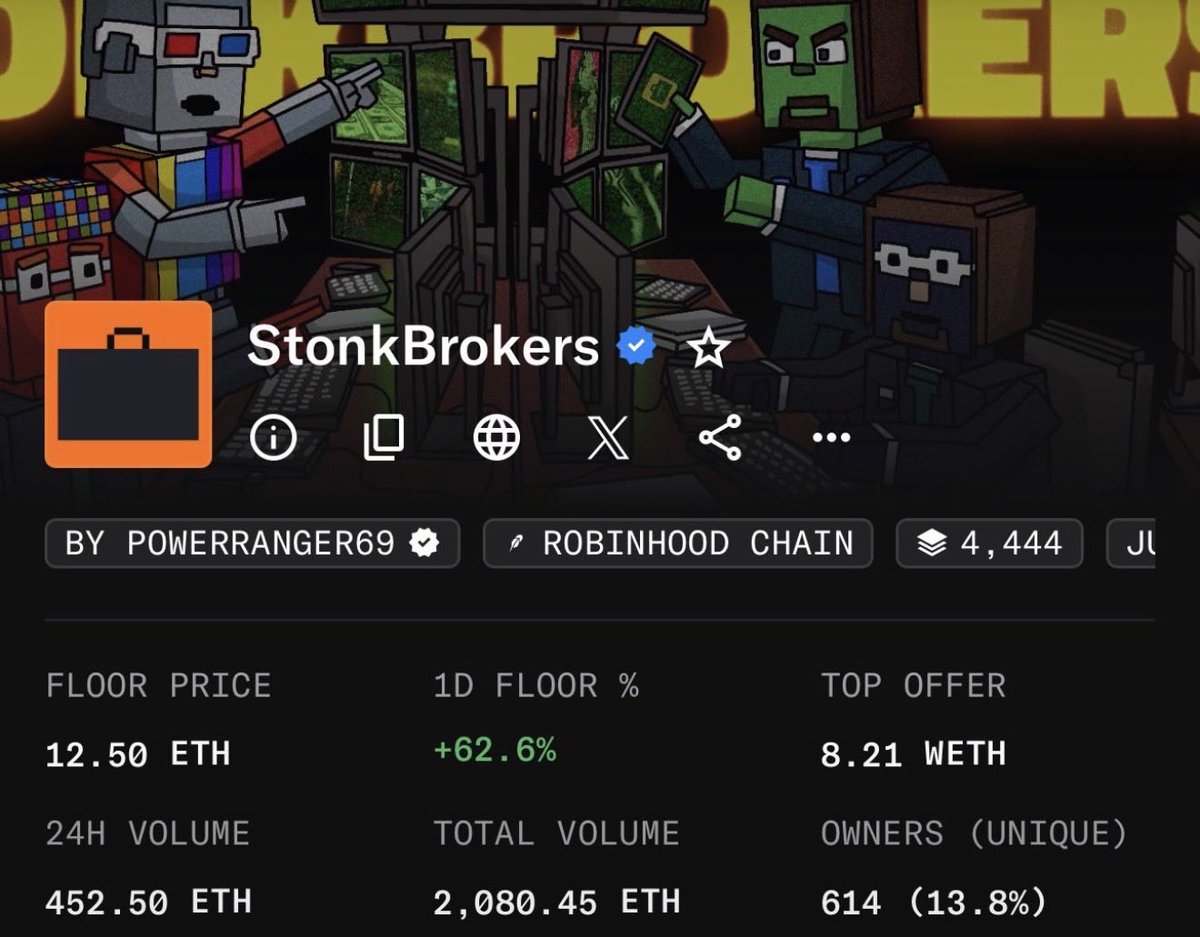
StonkBrokers has pushed into blue chip territory.
✅ Robinhood Chain heating up.
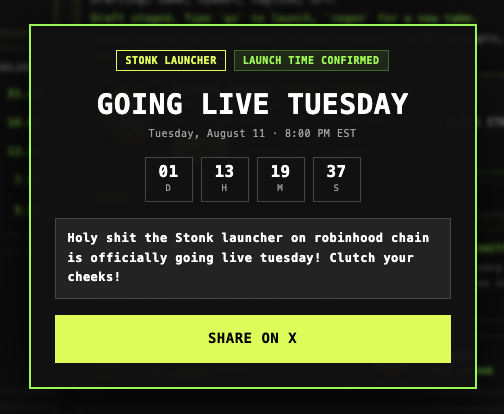
✅ Stonk Launcher about to go live.
✅ The ecosystem keeps expanding.
Imagine a 25/35+ $ETH StonkBroker NFT floor while $STONKBROKER starts chasing a $250M–$500M market cap. 👀
The numbers start getting VERY interesting.
STILL SIDELINED... 🕘📈