▲ AI is changing how attacks happen, and how fast. More companies will face a security incident. The question is no longer if, but how they respond.
Attackers now run AI agents that scan, plan and break in at machine speed. CrowdStrike reported 1 AI-agent group hitting more than 200 organizations in 11 days. Unit 42 found attacks moving about 4 times faster than a year earlier.
This article sets out a 4-pillar playbook: detect and contain automatically, communicate fast over secure channels, eradicate thoroughly with outside forensics, and keep shrinking the blast radius. It is a trade-off though: no company can promise it will never be breached, and responsibility is shared with suppliers, vendors and customers.
Full analysis: https://t.co/A01x5aufEa
Fireworks data retention post: https://t.co/hLsPSw7OJK
@FireworksAI_HQ
▲ Google just released Gemini 4 Neon, a mid-tier Gemini 4 model that targets near-frontier agent scores at a lower cost per task.
The key idea is a middle tier between Carbon and Hydrogen. Neon has 4 thinking levels (high by default, xhigh for the hardest work) and a 1M context window. In Google Antigravity it acts as an orchestrator over parallel Hydrogen subagents.
On Google's table it scores 61 on the AA Intelligence Index, vs 59 for Claude Opus 5.5 and 57 for GPT-6.2 Sol. It hits 95.2% on GraphWalks (256K to 1M) vs 66.8% for Opus 5.5, and 39.0% on SWE-sweep vs 10.1%. It is a trade-off though: Opus 5.5 still leads Terminal-bench 4.1 (65.8% vs 65.2%) and FrontierCode 2.0 (47.3% vs 46.2%), and every number is self-reported.
Rolling out now on the Gemini API paid tier, Gemini for business, Antigravity and the Gemini app for Pro and Ultra subscribers. Closed weights, $3 input and $15 output per 1M tokens......
Full analysis: https://t.co/NJVDGpDijM
Technical details https://t.co/9fEbP1s5cO
Model card: https://t.co/vGC06yMWHF
Try it: https://t.co/aTeS5sjVgK
@googledevs@GoogleAIStudio@Antigravity@GeminiApp
▲ Nutrient's Data Extraction API turns PDFs, scans and Office files into JSON matching your schema, with every field traced back to the page.
The key idea is evidence per field. Each extracted value carries a page, a bounding box and a match label, plus a confidence score when the engine has one. Gate on the match label first, then confidence.
On Nutrient's new WholeDoc Bench, Agentic mode scores 86.2 overall at 1.8¢ per page, top of 19 settings. The best frontier-model setting scores 67.1 at 17.8¢. It is a trade-off though: Nutrient built the benchmark, its main test set is private, and charts top out at 64.5.
Studio lets you configure and test parsing, extraction, classification and splitting in the browser before any API call. Parse costs $0.001 to $0.018 per page by mode, and the free plan includes $5 of usage a month......
Full analysis: https://t.co/76Rd6rPTqA
API: https://t.co/EFg6T82rQj
Studio: https://t.co/QabUEYdaj9
Benchmark: https://t.co/Az7Qf4CQrl
Skill: https://t.co/uMJQHMc5sp
@nutrientdocs
Awesome updated 309-page PDF eBook >> "Patterns, Predictions, and Actions: Foundations of Machine Learning" at https://t.co/Z3pwmzy9Th
…sharpen your Probability, Calculus, and Linear Algebra knowledge with this!
—————
#ML#DataScience#DataScientist
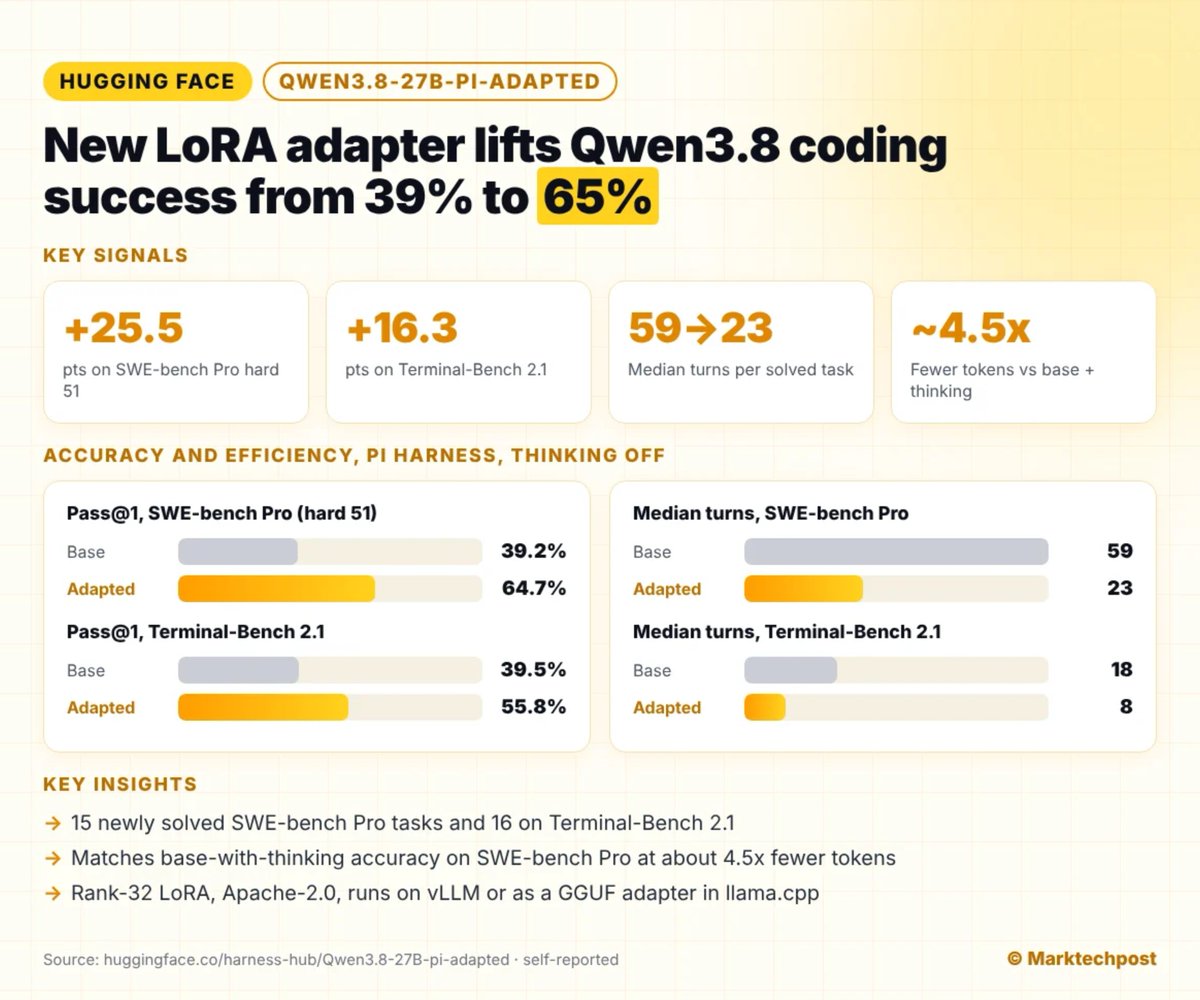
▲ Hugging Face just released Qwen3.8-27B-pi-adapted, a LoRA adapter that lifts Qwen3.8 coding success from 39% to 65% inside the pi coding agent.
The key idea is 1 small adapter per model and harness. The team trained it with reinforcement learning (AsyncGRPO in TRL) directly inside pi, on 750 scale800 and 300 TermGrade tasks. The reward pays for correct answers and gives a bonus for using fewer tool calls.
With thinking off, SWE-bench Pro (hard 51) pass@1 jumps from 39.2% to 64.7%, and Terminal-Bench 2.1 from 39.5% to 55.8%. Sessions get much shorter too: median turns on solved SWE-bench Pro tasks drop from 59 to 23. It matches the base model's thinking-mode accuracy while generating about 4.5x fewer tokens.
Rank-32 LoRA, Apache-2.0, ready for vLLM or as a GGUF adapter in llama.cpp......
Full analysis: [ARTICLE URL]
Model: https://t.co/6OeaVW3ld1
Blog: https://t.co/PzJ82VZWDz
Repo: https://t.co/4vMBwJyOUC
@huggingface@ClementDelangue
▲ SID AI just released SID-2, a search model that replaces fixed RAG pipelines with RL-trained agents that search, read and search again.
The key idea is swarms. SID-2 Swarm runs several small agents that fork their context, message each other and explore different parts of a corpus. SID found that reading more documents helps search more than reasoning harder about each one.
On SID's 506-question benchmark, SID-2 Medium scores 0.585 NDCG in 3.11 s, vs Claude Opus 5.5 at 0.577 in 25.1 s. A 6-agent Swarm hits 0.701 in 17.7 s, vs GPT-6 Astra at 0.704 in 135 s. It is a trade-off though: the 12-agent Swarm (0.720 NDCG) costs $515 per 1,000 queries, nearly 4x Opus 5.5, and every score is self-reported.
Available now via SID's API and Baseten, with Python, TypeScript and Go SDKs. SID-2 costs $0.25 per 1M input tokens and $1.00 per 1M output. Parameter count and weights are not disclosed......
Full analysis: https://t.co/NhO78vaqld
Tech report: https://t.co/fc36lSGYPE
Docs: https://t.co/MkL70CqAo0
Models: https://t.co/iYm8BwxcFj
@SID_AI@maxrumpf
▲ Anthropic just shipped Code Mode in Claude Code, so Claude can now write JavaScript that chains its own tool calls in 1 step.
The key idea is simple. Without Code Mode, Claude asks for each Bash, Read or Edit call and reads every result. With Code Mode, Claude writes 1 program that runs commands in parallel, feeds one result into the next call, and returns only the output it needs.
The numbers: code that runs in the background can keep going for up to 2 hours while you keep talking to Claude. Anthropic's related code execution with MCP pattern cut 1 workflow from 150,000 to 2,000 tokens. It is a trade-off though: Anthropic publishes no token figure for Code Mode itself, code Claude waits on stops after 10 minutes, and auto mode reviews the code, not each tool call.
It is experimental and off by default. Opt in with CLAUDE_CODE_EXPERIMENTAL_CODE_MODE=1 on Claude Code v2.1.323 or later. It works with Opus 5.5, Sonnet 5.5, Haiku 5.5 and Fable 5.2, in the terminal, on the Anthropic API only......
Full analysis: https://t.co/AQYGME7jD1
Docs: https://t.co/ffneHuvSJA
Background: https://t.co/22QcKaBf8x
@AnthropicAI@ClaudeDevs
▲ Zero data retention is one of the most misunderstood terms in AI infrastructure. Whether your AI provider keeps your data depends on which API design you use.
The key idea for this analysis comes from Fireworks AI CEO Lin Qiao's X Post: There are 2 standard API designs, and each one decides where the data lifecycle is managed. Customer-managed retention is upload, use, delete. Ephemeral processing is send, compute, return.
Batch APIs follow the first design at OpenAI, Amazon Bedrock, Gemini and Fireworks AI. The data stays until you delete it. Inference APIs like OpenAI Chat Completions, Bedrock Converse and Fireworks Chat Completions follow the second. It is a trade-off though: some stored features expire by default (OpenAI batch files after 30 days, Anthropic batch data after 29), while others stay until you delete them.
In both designs, the customer is in control. Ephemeral is preferable whenever the workflow allows it: no forgotten datasets, no missed delete calls, nothing at rest to protect......
Full analysis: https://t.co/wNNIMXxGCD
@lqiao@FireworksAI_HQ
▲ NVIDIA just open-sourced NVKE and NVKR, a reference stack that lets GPU clouds run their own managed Kubernetes service, EKS-style, on bare metal.
The key idea is a clean split. NVKE is the management plane: a REST API and controllers that create customer clusters, each with its own control plane, etcd and node pools. NVKR builds and signs the node images, container images and Helm charts those clusters run.
NVKE is conformance tested on Kubernetes 1.36 and is a Certified Kubernetes AI Platform. Nodes must present a TPM-attested SPIFFE identity before they get join credentials. Gardener, the closest open-source peer, lists conformance up to 1.35. It is a trade-off though: after install, the NVKE API serves plain HTTP on port 30080 with authentication off, and there is no management-plane upgrade or backup procedure yet.
Both are Apache 2.0 and in public preview...
Full analysis: https://t.co/5OEdiol1m7
NVKE: https://t.co/HbiZfAbHnB
NVKR: https://t.co/7JoSTQ7Cdj
Docs: https://t.co/9kugBASbID
@NVIDIAAIInfra
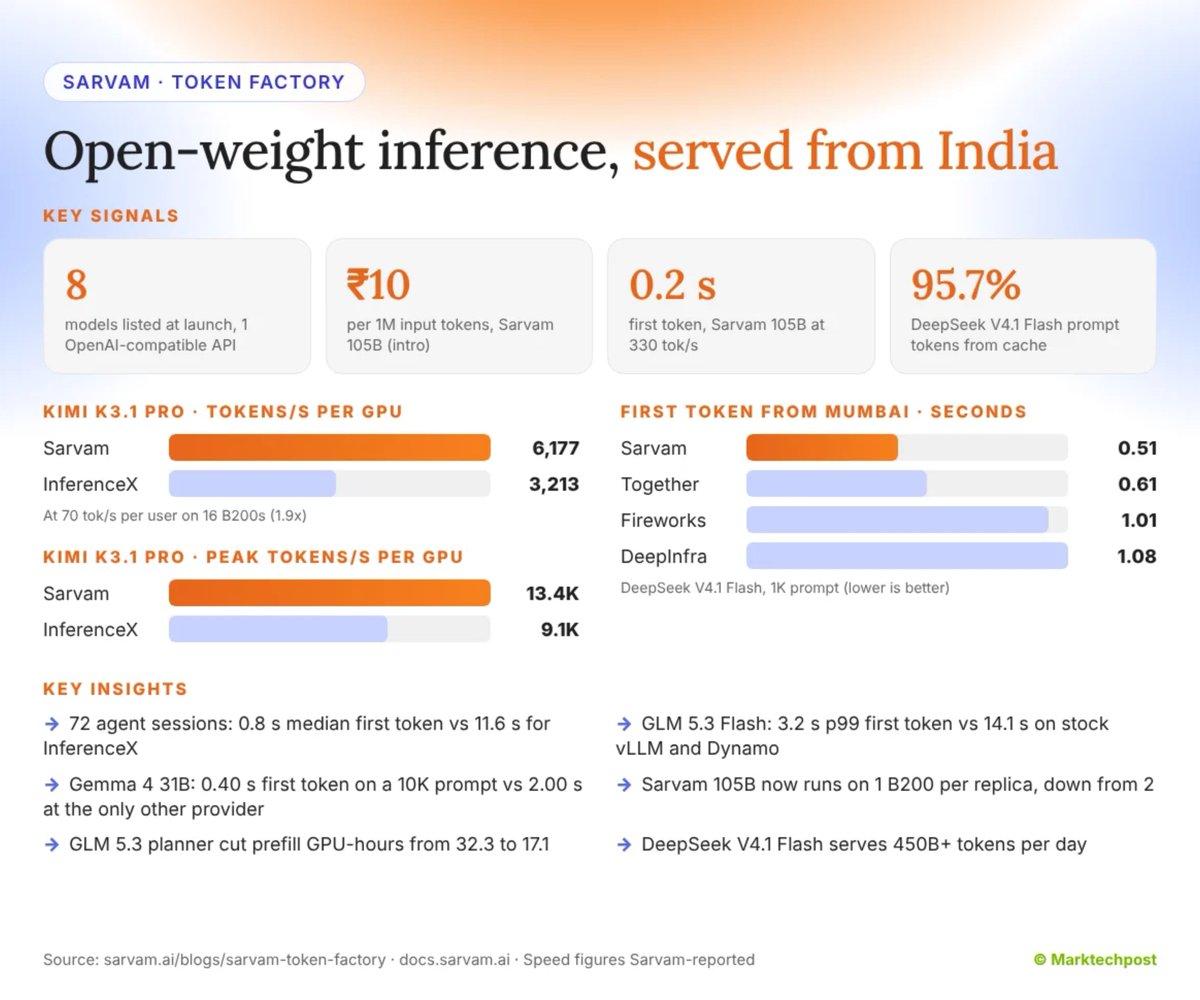
▲ Sarvam just opened Sarvam Token Factory to everyone, an inference platform that serves its own models and leading open-weight models from GPU clusters in India.
The key idea is a shared cache at the center of the stack. A cache-aware router sends each request to the worker most likely to hold its prompt prefix. Prefill and decode run on separate B200 pools, so long prompts do not block streaming.
On Kimi K3.1 Pro, Sarvam reports 6,177 tokens/s per GPU vs 3,213 for InferenceX at 70 tok/s per user. On DeepSeek V4.1 Flash, it posts a 0.51 s first token from Mumbai vs 0.61 s on Together. It is a trade-off though: Together still streams DeepSeek V4.1 Flash at 278 tok/s vs 130 on Sarvam Standard, and all numbers are self-reported.
8 models are listed at launch, including Sarvam 105B, GLM 5.3, DeepSeek V4.1 Flash, Kimi K3.1 Pro and Gemma 4 31B. Sarvam 105B starts at ₹10 per 1M input tokens through one OpenAI-compatible API......
Full analysis: https://t.co/Wd9pAAvisI
Blog: https://t.co/MKEHGr9hpo
Docs: https://t.co/xHiShTSBJV
@SarvamAI
▲ Liquid AI just released d1.2 and d1.2-ultra, decision models that now read text, images and audio and answer with probabilities instead of text.
The key idea is a decision model never generates tokens. You send a state plus typed questions, and it returns a calibrated probability for every option in 1 call. d1.2 adds 5 new answer types: read a value, find every span, draw boxes, estimate a number with a range, and pick every option that applies.
d1.2-ultra scores 75 on the Artificial Analysis Decision Index v2.1, 2 points ahead of Drex Max v1.1, SubQ Snap 1.2 and GLiDE v1.2 at 73. Liquid AI also reports a 0.8-point calibration error vs 3.7 for Perplexity Decider v1.3. It is a trade-off though: d1.2 scores 69, below 8 models, and parameters, latency and weights are not disclosed.
Both are hosted on the Liquid API at $0.02 (d1.2) and $0.042 (d1.2-ultra) per 1M input tokens, with output free. Up to 65,536 input tokens per question......
Full analysis: https://t.co/vu1ZP8m0Ji
Blog: https://t.co/EN5YaZwXQn
Docs: https://t.co/ruc9KViME1
Index: https://t.co/0RfJYTB5U5
@liquidai@ArtificialAnlys
The Shape of Data — Geometry-Based Machine Learning and Data Analysis: https://t.co/LNlKfodDQF
——
#DataScientist#Mathematics#ML#DataScience
——
"This advanced machine learning book highlights many algorithms from a geometric perspective and introduces tools in network science, metric geometry, and topological data analysis through practical application."
▲ Meet Meta's JiTTests: LLMs write tests that are supposed to fail, proving a code change broke something before it lands.
The key idea is simple. Most AI bug tools review a diff like a faster human reviewer. JiTTests instead generates executable tests that expose a behavioral difference between the diff and its parent. An LLM judge ensemble plus a rule-based filter (RubFake) decides which failures are worth an engineer's time.
The numbers: 74 privacy SEVs caught at the diff stage in H1 2026, privacy SEV occurrence down 20%, and a 60% engineer-reported true-positive rate across 589 engineers. In the paper, intent-aware tests produced weak catches at 6.4% per test vs 0.8% for Meta's earlier ACH hardening approach. It is a trade-off though: the initial paper deployment confirmed only 8 of 41 reported catches (19.5%), and all production figures are self-reported.
Full analysis: https://t.co/wlWbtNUEL2
Paper: https://t.co/VkphRhaiZZ
Blog: https://t.co/BjI97XmsCL
@Meta_Engineers@AIatMeta@MetaforDevs