Today we're excited to announce that Uranium Digital has closed a $16.5 million Series A. The round was led by @bcap, with participation from existing investors.
The investment will support the expansion of product offerings and technology, as we work to meet growing institutional demand for access to the uranium market.
Learn more at https://t.co/tcrANH088m
🥰Interest in #Nuclear power is growing—and with it, demand for #Uranium to fuel reactors.⚛️⛽️🛒 But uranium still requires traders to call brokers for prices, sign contracts & work with storage facilities to transfer ownership.😩 Startup @UraniumDigital_ is changing that!😃🤠🐂
Big milestone for our portfolio company, @uraniumdigital_!
Uranium Digital operates the world’s first institutional-grade, 24/7 spot market for uranium trading - bringing speed, efficiency and transparency to a market that, frankly, has remained bureaucratic and antiquated for far too long.
For more background, check out my blog post from last year:
https://t.co/dxGTzmA9HM
The bull case for Uranium now is a given — what most do not see behind the scenes is the 4 years in the making from founder Alex Dolesky and his team, that "whacky" startup crazy enough to take on the nuke industry.
Being contrarian is never easy — especially when you are in the midst of it, not knowing how much longer you will have to be "early" until you are "right."
When the time comes, you clean up.
Uranium is now a critical asset class, especially as nuclear power grows in importance. The current uranium market structure is broken, and tokenization can help fix it. Read about how below. Excited to back @uraniumdigital_
Alex and team get uranium like no other, we're super excited to support @uraniumdigital_ as they build modern market infrastructure to support the nuclear buildout
As nuclear technology continues to advance, the uranium market remains stuck in a paper-based past.
We’re excited to lead @uraniumdigital_ Series A and back Alex’s vision to build a uranium trading platform for physical participants and financial investors.
nuclear can power far larger AI systems and a new era of industrial growth. getting there means building reactors, financing new mines and securing fuel for decades.
the uranium market still runs on phone calls and private quotes. @uraniumdigital_ is building a modern market to support that nuclear buildout.
very happy to be leading Alex and team’s $16.5m Series A. @h_joshua_rivera and i wrote more about why @bcap invested below.
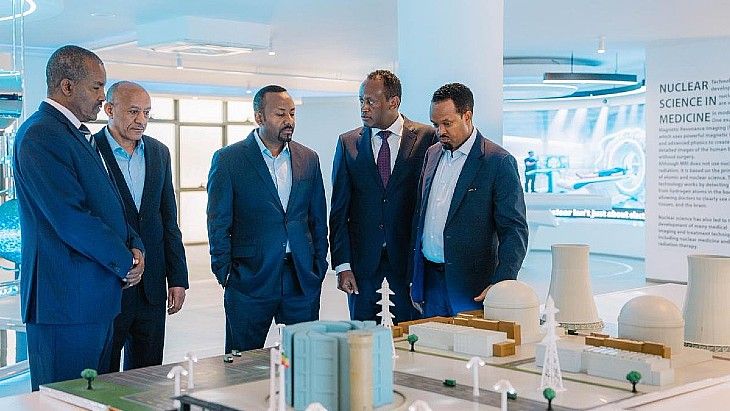
Ethiopia's Prime Minister Abiy Ahmed Ali announced plans to build two 1,200 MWe nuclear reactors, with three candidate sites already identified from an initial list of more than 30. The Ethiopian Nuclear Energy Commission was established last year to build the institutional and workforce foundations for the program.
Russia has been Ethiopia's primary nuclear partner since a 2019 intergovernmental agreement, with a Rosatom strategic roadmap signed as recently as March. The two countries are now coordinating a draft agreement on the fundamental principles of cooperation for plant construction, the signing of which would initiate design and engineering work.
Ethiopia joining the pipeline of African countries pursuing nuclear is part of a broader continent-wide pattern. Rosatom is simultaneously in advanced discussions with Egypt, Togo, Namibia, and Tanzania on floating units, while building El Dabaa in Egypt. The number of African nations moving from policy interest into formal nuclear programs is accelerating, and the technology and financing partnerships being formed now will define the continent's energy mix for decades.
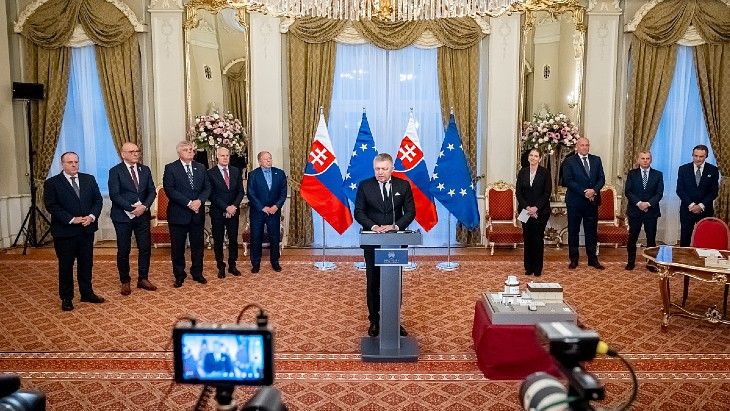
Westinghouse has been awarded a Front-End Engineering and Design study for a potential AP1000 reactor at Slovakia's Bohunice site, partially funded by the US State Department's FIRST Program. The six-month study will assess site conditions, licensing status, and produce a preliminary schedule and budget, giving Slovakia's state-owned project company JESS the technical foundation to decide on next steps toward a 2040 target completion date.
The FEED award follows Slovakia consolidating state ownership of the project after Czech utility CEZ sold its stake in JESS earlier this month. With that ownership question resolved, the government is moving into formal technical planning under an intergovernmental agreement with the US signed in January.
Slovakia is already the most nuclear-dependent country in Europe, with nuclear covering more than half its electricity today and approaching 77% once Mochovce 4 reaches full capacity. Adding an AP1000 at Bohunice would extend that position well into the second half of the century and deepen the country's energy independence from Russian supply chains.
Rosatom is in advanced discussions with at least four African countries (currently Egypt, Togo, Namibia, and Tanzania) on supplying floating nuclear power units, according to company executives speaking at a Russia-Africa Summit. The offer is structured as a power purchase agreement, with Rosatom retaining ownership and handling servicing and refueling in Russia over a 60-year operating life.
The pitch is straightforward: 38 of Africa's 54 countries have sufficient coastline to host a floating unit, the infrastructure requirements on land are minimal, and the PPA model eliminates the need for host countries to build their own nuclear capabilities or carry the asset on their balance sheets. Rosatom is positioning floating nuclear as an entry point into the nuclear club for countries that could not otherwise afford a conventional plant.
This follows the Indonesia agreement announced earlier this month and reflects a deliberate Rosatom strategy to use floating units as a market-opening tool across the developing world. Whether these African discussions translate into signed contracts is an open question, but the pipeline is expanding faster than most observers expected a year ago.
The Department of Energy announced $10.1 billion in loan commitments this week, with $5 billion going to Constellation Energy to finance uprates and modernization across its nuclear fleet in Illinois, Maryland, and Pennsylvania.
The Constellation commitment covers plants including Braidwood, Byron, Clinton, Dresden, LaSalle, Quad Cities, Calvert Cliffs, and Limerick, targeting nearly 1.1 GW of added capacity in PJM and MISO markets.
DOE has now identified 95% of the 5 GW uprate and restart goal it set for the existing US nuclear fleet. The Constellation loan is a direct expression of that strategy: adding gigawatts from plants already built, already licensed, and already operating, without the lead times and costs of new construction.
India's nuclear program has recently hit several milestones. Geotechnical investigations have begun at the Kakrapar site in Gujarat for units 5 and 6, two 700 MWe pressurized heavy water reactors that will add to the four already operating there. Separately, India's Nuclear Fuel Complex completed its 12th set of steam generator tubes for the fleet construction program, cutting manufacturing cycle time from 181 days to 81 days.
On the SMR front, NPCIL and the Bhabha Atomic Research Centre released the Detailed Project Report for the SMR-55, a 55 MWe pressurized water reactor co-developed domestically. The design is targeting remote electrification, data centers, and industrial captive power applications.
India has set a target of 100 GWe of nuclear capacity by 2047, a number that requires building out an entire domestic supply chain. The combination of fleet-mode PHWR construction, supply chain localization, and indigenous SMR development reflects a program that is increasingly building the industrial depth to match its ambitions.
The Philippines is targeting 1.2 GW of nuclear capacity by 2032 and 4.8 GW by 2050, with the government working through site assessments, regulatory development, technology selection, and financing frameworks to enable its first project. Energy Secretary Sharon Garin cited the country's 51.5% dependence on imported primary energy as a core driver, alongside electricity demand growing at 3.6% annually in an economy expanding at 6%.
Meralco PowerGen has secured a $2.8 million USTDA grant and is working with Sargent & Lundy on an SMR feasibility study covering potential sites and technology options, with a final report expected in mid-2027. Aboitiz Power is also evaluating nuclear as part of its long-term generation portfolio. Both companies framed nuclear as complementary to the country's renewable targets, not competing with them.
Southeast Asia is becoming an increasingly active front in the global nuclear expansion story. With Indonesia in discussions with Rosatom on floating nuclear and the Philippines building toward a formal program, the region is moving from policy conversations toward early commercial decisions -- and the technology and supply chain partnerships being formed now will shape which vendors and which designs gain a foothold.
AEP, Amazon, and X-energy have signed a joint development agreement to evaluate a 960 MW advanced nuclear project at a former coal plant site in Sullivan County, Indiana. The design calls for 12 units of X-energy's Xe-100 small modular reactor, each at 80 MW, configured in groups of four. Amazon has committed development funding and intends to purchase the power under a long-term contract covering the full cost of the facility.
The project follows a pattern that is becoming familiar: a tech company anchors the financing through a power purchase agreement, a utility brings the operating expertise and grid interconnection, and an advanced reactor developer provides the technology. Amazon's involvement means the capital risk does not fall on Indiana Michigan Power ratepayers.
The site in Sullivan County recently joined Indiana's Advanced Nuclear Ready Communities Program. AEP brings roughly 50 years of nuclear operating experience to the partnership. If the project reaches a final investment decision and moves through construction, it would operate for more than 60 years on a site that previously generated power from coal.
Rosatom has signed the world's first export agreement for electricity supply from a floating nuclear power unit with Indonesian company PT Pembangkit Listrik Nuklir. Two FPU-100 units carrying a combined 200 MW will be deployed off Halmahera Island in eastern Indonesia, with power delivery targeted within five years.
Rosatom will retain ownership and operate the units, with the customer paying only for the electricity generated. No host-country nuclear infrastructure investment is required. For island nations and remote industrial sites with limited grid connectivity, that structure removes some of the biggest barriers to nuclear adoption.
Rosatom is framing this as the first step in a two-phase approach for Indonesia: floating units first, followed by land-based large reactors. With the Philippines also advancing SMR plans and Southeast Asia's electricity demand growing rapidly, the region is emerging as one of the most active new frontiers for nuclear deployment globally.