Morpho Midnight's orderbook is going to be one of the venues that matters most for reading DeFi rates. It gives crypto credit something it's never had: a term structure. Fixed rates at fixed maturities, set by an orderbook instead of a utilization curve.
TradFi has always priced credit this way. An overnight rate anchors the front (repo, the policy rate), and a curve of term rates prices duration out along bills, notes, and bonds. DeFi has lived entirely at the overnight point, floating rates that reprice every block. Midnight adds the rest of the curve.
Liquidity is still thin, but the appetite is already visible on both sides. Borrowers and lenders are quoting real size, and the lend curve slopes up with duration: longer maturities clear at higher rates, the same contango shape a healthy bond market prints when lenders want a premium for locking up.
The cbBTC book on Base is clearing fixed borrow rates around 3-6% depending on tenor today. I expect discovery across maturities to get far more efficient as market makers move in, and the front of the curve to converge with Morpho Blue, which is the perpetual floating DeFi rate right now. Currently, BTC loans are at 3%-5% yield on Ethereum and Base on Blue.
It's early. This is a three-point curve on one collateral, and the far tenors are barely quoted. But the direction is clear: crypto is getting a market-priced yield curve.
People ask me what's different about our format @stabledash, and the honest answer is nothing.
Live media has been around for decades.
ESPN turned live sports coverage into a machine.
Dave Ramsey turned a call-in show into a personal finance empire.
When we started Stabledash Live, we didn't try to reinvent the wheel.
There's a lot of great coverage of tokens and the crypto sphere already.
What stablecoins and modern money hadn't gotten was that same format applied with depth and consistency: showing up live, day after day, putting founders, innovators, and builders who rarely get the spotlight in front of the camera, the ones quietly building the infrastructure and the products actually finding product-market fit to move this space forward.
New (Old) Media for New Money.
First Digital Assets Fundamental Crypto Index is live!
✨ Massive kudos to @0xpampa the absolute blockchain data / fundamentalz 🐐 at @artemis for spearheading the data work on our side ⭐️
Please give him a follow, the most criminally under followed person in digital finance.
Big shout out as well to Artemis goated analysts @kaviish@zhengjielimm and our head of biz ops @isaiah_wash and former Artemis @blstamm11@OnchainLu who put their blood sweat and tears to make this happen too.
Awesome collabing @SPDJIndices@PanteraCapital on making this happen!
So fun working with @masonnystrom@ejwallach@0xhopydoc the investing 🐐
Lastly, thank you for spearheading and bringing us all together to make this happen @cosmo_jiang .
Without your leadership, this wouldn't have happened.
Aave has ~$10.6B in active loans, more than all other EVM lending protocols combined.
Over $100M of that is now on Aave V4, which just reached a new all-time high.
Great analysis of Aave V4's borrowing composition.
"The economy needs money its agents can hold and move at machine speed (in enormous volume and in tiny increments) without stopping on every transaction to ask whether the money itself is any good. That requirement points to a specific, old-fashioned-sounding answer: full-reserve money, settled with finality, on an open network. Here is why each word matters. At machine speed, money that carries risk is dangerous, because a panic that once took weeks can now happen in seconds. So the base money has to be fully backed and worth exactly one dollar to everyone, everywhere, with no need to check. The objection writes itself: banking creates credit by lending the same dollar many times over, so wouldn't full-reserve money starve the economy of credit? No. Credit doesn't vanish; it gets rebuilt on top, and made more powerful. Velocity replaces leverage. When money turns over fast enough, the same dollar can do the work that lending it many times over used to do, without manufacturing hidden risk."
The Essential Read — from The Agentic Economy https://t.co/sCJStXLKXo
Aave has no exposure to Resolv USR.
Resolv is a liquidity provider on Aave, supplying its backing assets to the protocol. These assets remain safe, as the backing itself was unaffected. Resolv will be able to exit gracefully and already started to repay the debt.
There are no adverse effects on Aave liquidity providers, and zero impact on the Aave Protocol.
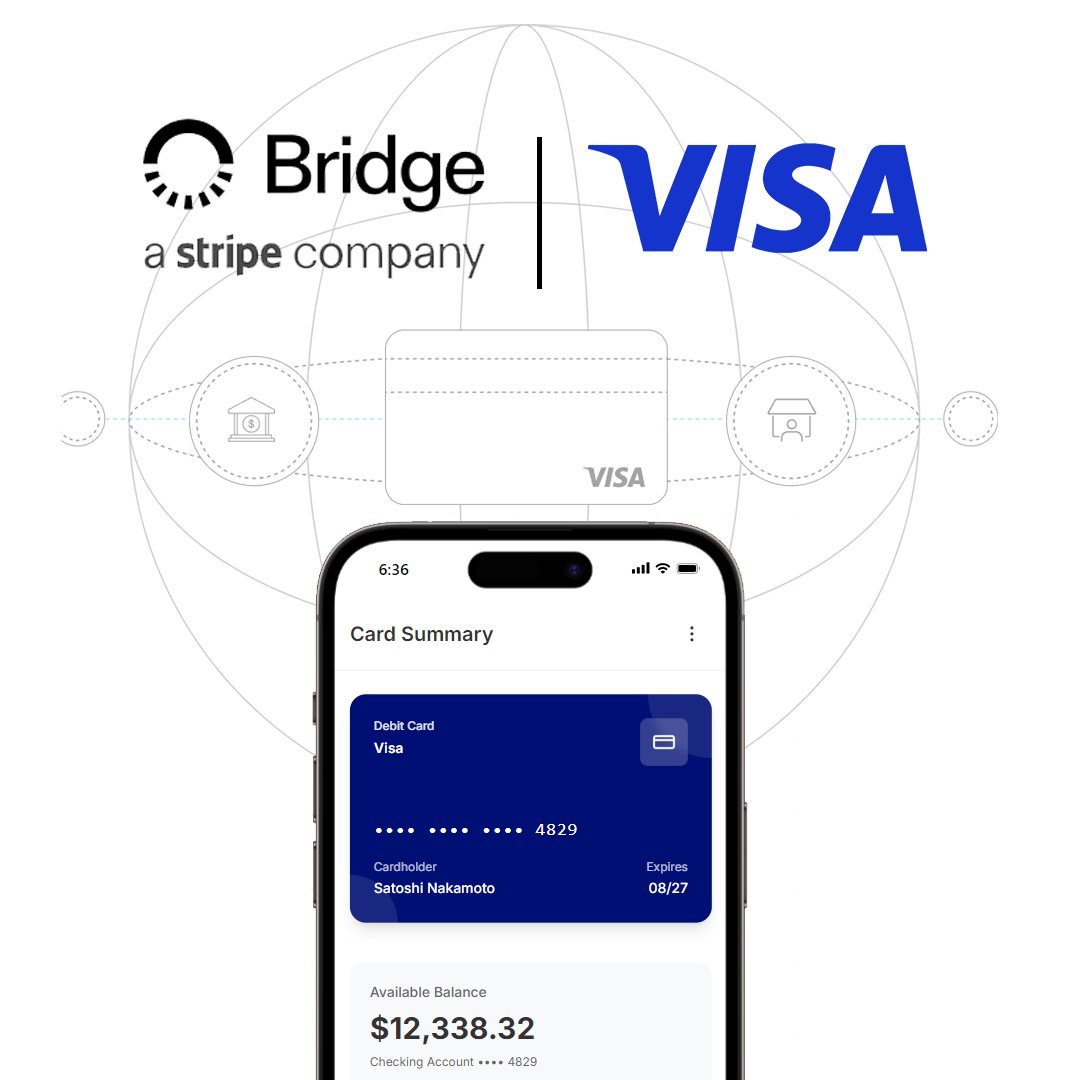
🚨𝗝𝗨𝗦𝗧 𝗜𝗡: @Visa is expanding its partnership with Bridge to bring stablecoin-linked cards to 100+ countries by the end of this year.
This is bigger than it sounds.
Bridge enables fintechs and developers to issue stablecoin-backed Visa cards, allowing consumers to spend directly from their stablecoin balances at Visa’s 175M+ merchant locations worldwide.
The program is already live in 18 countries, with rapid expansion planned across Europe, APAC, Africa and the Middle East.
But the real story sits behind the scenes.
Through Bridge’s partnership with Lead Bank, issuers participating in Visa’s stablecoin settlement pilot can now settle transactions with Visa onchain.
That means reconciliation and fund movement can happen via supported blockchain networks instead of relying solely on traditional correspondent settlement flows.
Visa says the pilot is focused on three things:
👉 Expanding settlement optionality for issuers
👉 Improving operational efficiency via on-chain reconciliation
👉 Testing how infrastructure players like Bridge simplify blockchain interactions for institutions
In simple terms: this isn’t about “crypto cards.”
It’s about integrating stablecoins into the plumbing of global card settlement.
If Visa, the largest card network in the world, normalizes stablecoin settlement across its ecosystem, the implications go far beyond Web3 wallets.
It could reshape how issuers, FinTechs and program managers think about treasury, liquidity and cross-border value movement.
We’re watching the gradual merging of card rails and blockchain rails in real time.
The question is no longer if stablecoins plug into global payments infrastructure.
It’s how fast it scales from pilot to default.
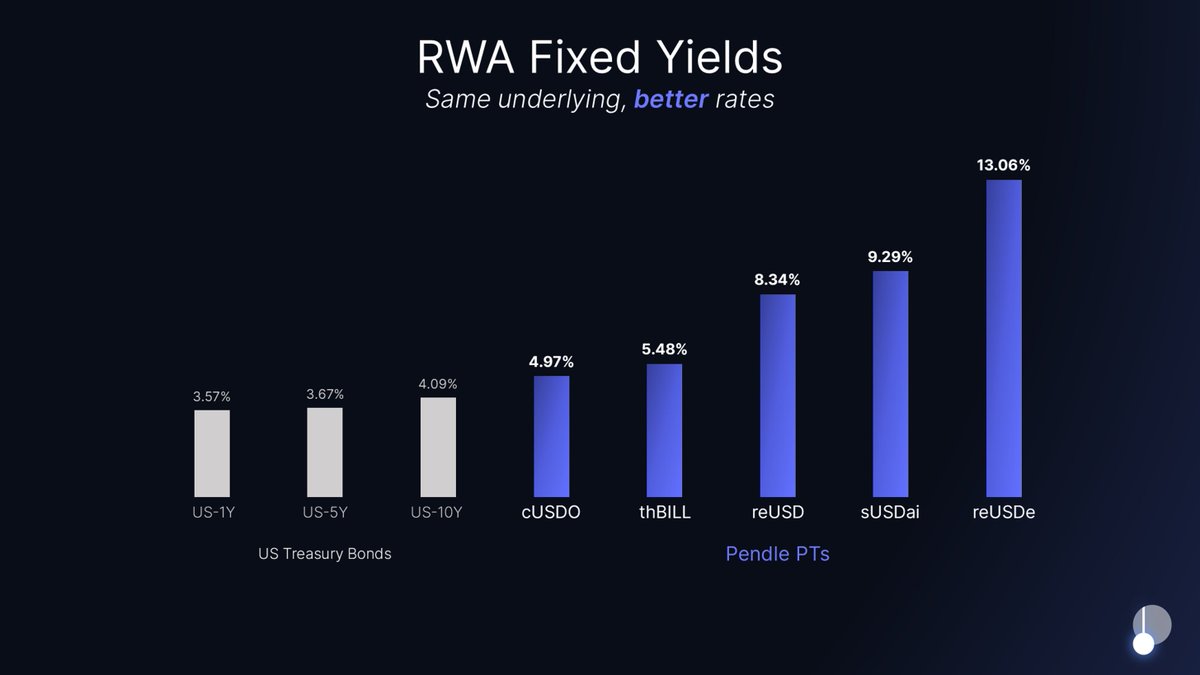
Pendle Finance offers the highest RWA fixed yields in DeFi.
US treasury bonds typically offer 3.5-4.5% fixed yield.
RWA Principal Tokens (PTs) on Pendle Finance offer the same underlying exposure, at markedly better rates.
1️⃣ cUSDO (OpenEden): 4.97% fixed - yield-bearing stablecoin primarily backed by US Treasury Bills
2️⃣ thBILL (Theo Network): 5.48% fixed - basket of institutional-grade tokenized US Treasury Bills, anchored by Standard Chartered Libeara's T-Bill token
3️⃣ reUSD (Re Protocol): 8.34% fixed - principal-protected stablecoin backed by US Treasury Bills held in a regulated §114 Reinsurance Trust
4️⃣ sUSDai (https://t.co/hEbLQPQmke): 9.29% fixed - synthetic dollar backed by AI compute infrastructure, currently ~99% collateralized by PayPal PYUSD, itself backed by USD deposits and US Treasuries
5️⃣ reUSDe (Re Protocol): 13.06% fixed - junior capital in Re Protocol's §114 reinsurance trust, yield sourced from real-world insurance underwriting profits
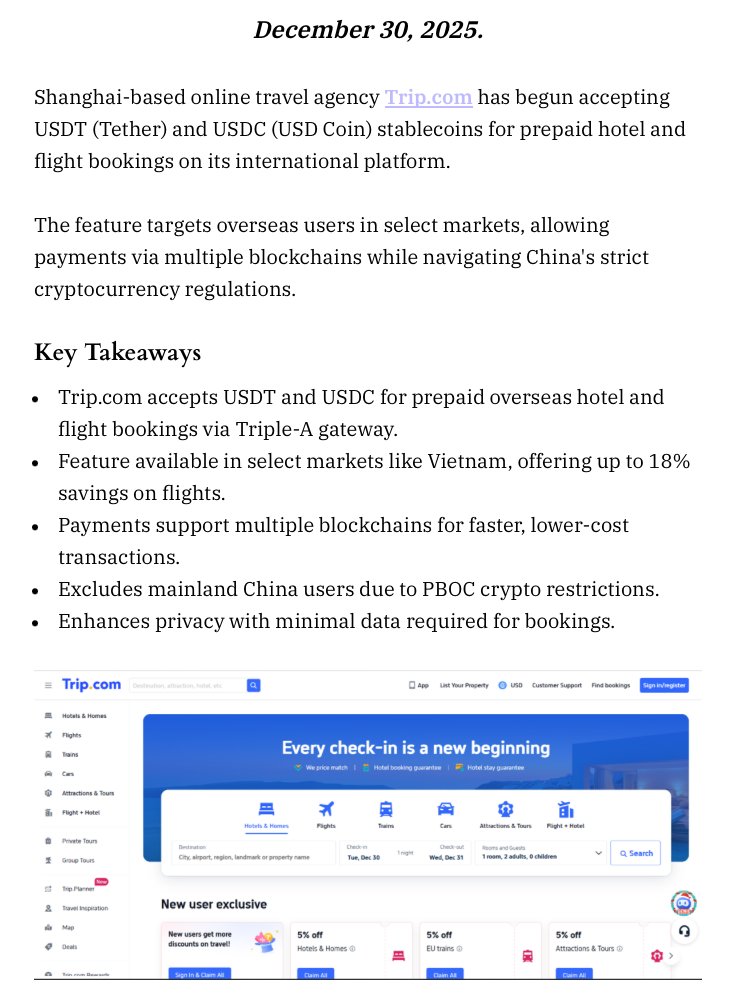
https://t.co/MkiHjz0Ayk, the global brand of Ctrip Group, has integrated stablecoin payments through Singapore-licensed payment gateway Triple-A.
International users can now complete transactions using USDT or USDC across networks including @ethereum , @trondao , @0xPolygon , @solana , @arbitrum , and @ton_blockchain .
The pilot excludes users in mainland China, aligning with Beijing’s cryptocurrency restrictions. This cautious rollout mirrors how other Chinese firms are testing crypto applications offshore avoiding direct conflict with domestic policy.
Read the full article at https://t.co/PwmsKZ2Wlj
Aave is the DeFi Protocol with the highest level of bankification
If you look at key numbers like TVL, active loans, and revenue, @aave clearly dominates the DeFi lending market.
- 59% of the DeFi lending market
- 61% of all active loans
- $885M in fees generated this year
- 52% of all lending protocol fees
⤷ More revenue than the next 5 competitors combined
This scale puts Aave at bank level, making "Bankification" the clear next step.
Besides, DeFi is clearly pivoting
- Away from emissions farming
- Toward real fees, RWAs, and stablecoin layers
- Stablecoins and vaults will be a major 2026 trend
- Institutions want transparent, programmable yield
- Surveys show 74% of institutions plan to enter DeFi within 2 years.
This fits a much bigger trend in 2025–2026 DeFi ➞ The move toward real, sustainable yield and bank-like products.
⤷ Aave App may be the first DeFi product that truly reaches a real bankification level
It turns Aave from a complex DeFi protocol into a simple savings app, similar to a neobank:
- Available on the App Store
- 5%+ yield on savings
- Fiat deposits
- Simple, passive experience
Aave App creates a powerful loop: Users save money → More deposits → Deeper liquidity → Cheaper borrowing → More institutional demand→ More stable yield → Attracts more users
⤷ This app is a Trojan horse for DeFi adoption.
If Aave succeeds, it will open a new DeFi cycle called Bankification.
In the early days, DeFi was built by pioneers like Aave, @Uniswap and @Lidofinance
Today, Aave may also lead the next generation, alongside newer names like @ethena, @pendle_fi and @alturax
It is about mainstream adoption, passive savings, and real yield.
Aave is positioning itself at the center of that future.
Defi will win and Just use Aave
Sky Frontier Foundation released its first State of Sky Ecosystem report, a 2025 year-end analysis of Sky Protocol.
Highlights:
• Stablecoin (USDS) supply +86%
• $168M annualized protocol net profit (+24.4% YoY)
• Operating expenses down 61.5%
• Buybacks: $367K → $92.2M
A powerful milestone in the mainstream adoption and acceptance of USDC, with Visa announcing that all US card issuers (banks, fintechs, crypto firms) can now settle directly with Visa using USDC. Visa also working with Circle to prepare for launching on @Arc.
Dollar digital currency flowing from users, to Visa, and soon enough we think to merchants -- especially those that prefer to settle in digital dollars -- is more evidence that we are upgrading to a new internet financial system.
We are proud of our longstanding collaboration with Visa, and excited by their input as a design partner of @Arc, as the world's leading payment companies help us to shape and eventually operate a new Economic OS for the internet.
https://t.co/uRUsLyNvwt
New Listing: mF-ONE
mF-ONE is a tokenized certificate issued by @MidasRWA.
It provides onchain exposure to @FasanaraDigital’s F-ONE private credit strategy.
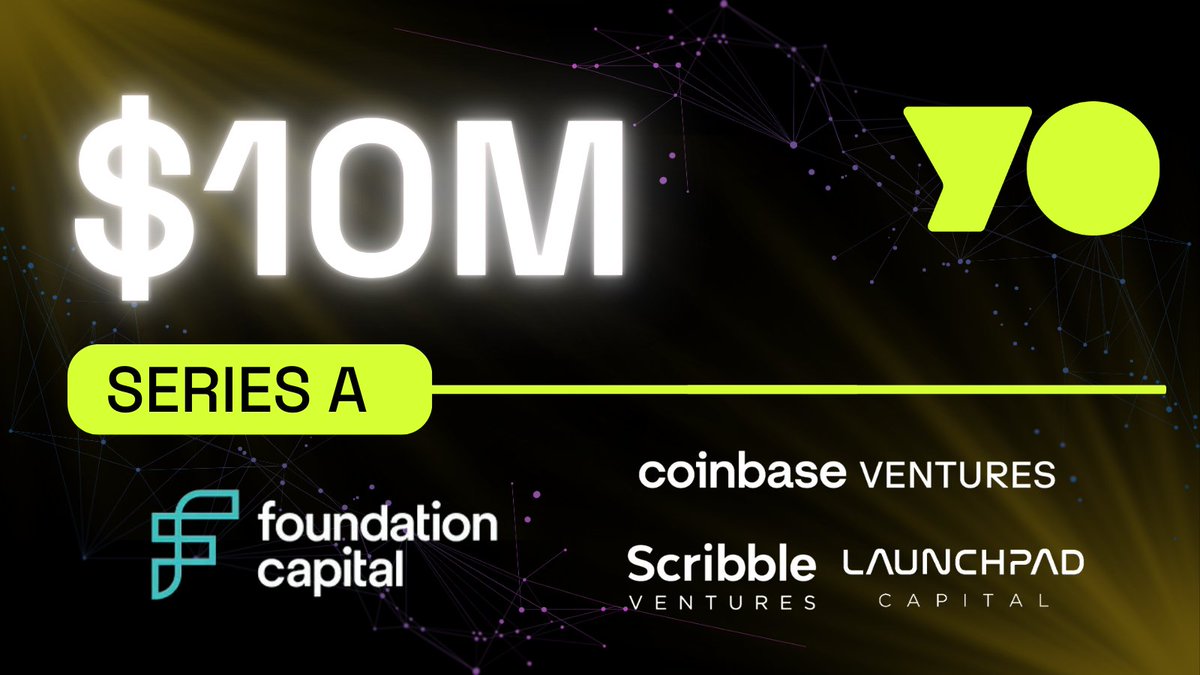
YO Labs has secured $10m in Series A financing, led by @FoundationCap with participation from @cbventures, @ScribbleVC, and Launchpad Capital.
The raise will accelerate YO’s unified, risk-optimized yield platform as it powers the next generation of crypto and fintech apps.