Now in print! Neural fingerprints of Computer Science curriculum in student brains track learning and predict exam scores, revealing a “central limit theorem” of knowledge https://t.co/cYDmB9bkiU
We're looking for a research specialist! This is a great opportunity for someone to get more research experience before graduate school. Please apply! https://t.co/Joc1ruNw6H
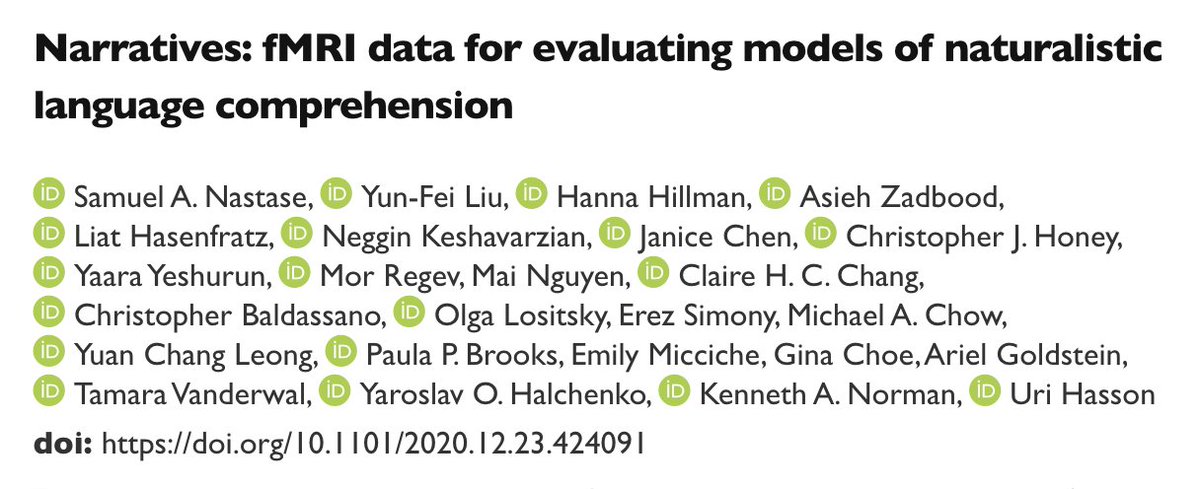
Excited to (finally!) share our preprint describing the "Narratives" collection—compiling 7 years worth of naturalistic story-listening fMRI datasets from @HassonLab and @ptoncompmemlab at @PrincetonNeuro: https://t.co/Rc1JiTm2EK
Excited to share our comprehensive overview of BrainIAK: The Brain Imaging Analysis Kit https://t.co/bqpojLkqEI via @OSFramework This work includes new example Jupyter notebooks for all methods in BrainIAK.
New @UseBrainIAK preprint is live! Huge team lead by @PrincetonNeuro and @IntelAIResearch. The paper summarizes the key functions in our Python toolbox along with links to a set of really cool demo notebooks.
Preprint: https://t.co/Var2Jeb3vp
Code + Data: https://t.co/HPvxTCTvbR
Our modeling framework for fMRI data is now available through @UseBrainIAK.
The main idea is that we formalize a host of fMRI analysis techniques into a single generative model that is essentially a matrix factorization problem. 1/2
Code from 2018 AISTATS paper "Matrix-normal models for fMRI analysis" w/ Michael Shvartsman Narayanan Sundaram, @mikio_aoi , Ted Wilke & Jon Cohen is now merged into BrainIAK @UseBrainIAK https://t.co/MXGu8dsVXz ! Same MN framework for bias-free RSA, SRM etc.
Here's some #WednesdayMotivation by featuring @UseBrainIAK.
The Brain Imaging Analysis Kit is a package of Python modules useful for neuroscience, primarily focused on functional Magnetic Resonance Imaging (fMRI) analysis.
https://t.co/nnQlUm9iFX
#neuroimaging
Want a hands-on introduction to decoding, RSA, and more advanced fMRI analyses, with ready-to-use datasets, open source and free? Come to our poster #1046 at #OHBM2020. @UseBrainIAK
New #OHBM2020#Brainhack project submitted! 👩🏽💻
Learn and Enhance BrainIAK Tutorials: From Basics to Advanced fMRI Analyses. Wanna help people learn fMRI analyses & enhance BrainIAK Tutorials? Join this project! https://t.co/8k3oNesKtt
#109 #OHBMHackathon#hub_EMEA@UseBrainIAK
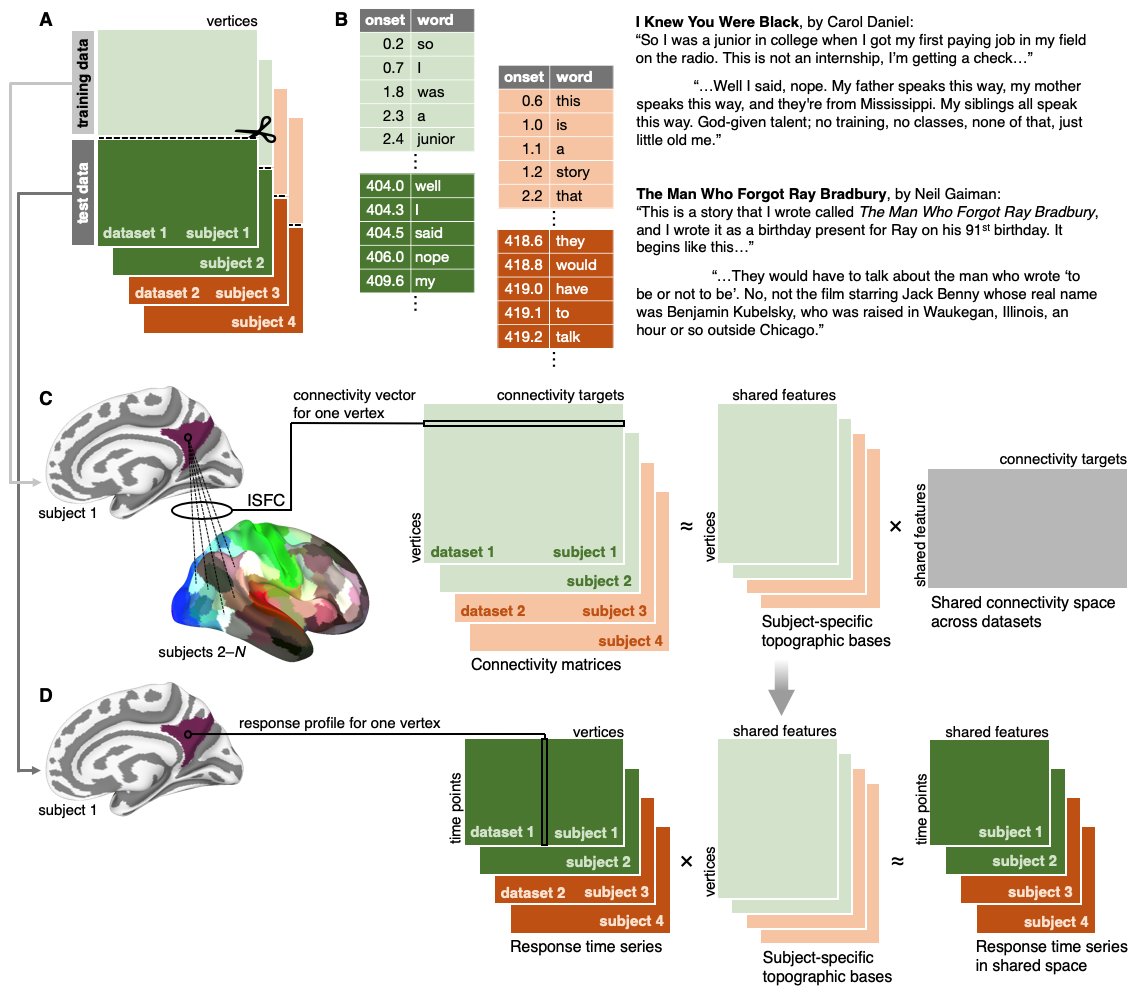
Our paper on connectivity SRM w/ @YunFeiLiu3 @hannahillman@ptoncompmemlab@HassonLab is now out in the @NeuroImage_EiC special issue on naturalistic imaging. We use cSRM to estimate a single shared response space across 10 story-listening fMRI datasets. https://t.co/5AcSVSabEn
New preprint! In "Think like an expert", we measure understanding in student 🧠 and use it to predict and assess learning outcomes in a STEM course. The good news? Classmates are guide to success! With @ptoncompmemlab@HassonLab@PrincetonCS [1/4] https://t.co/0x7odBY7Fb
Back in 2016 @CameronTEllis and I were frustrated that there was no easy way to simulate realistic fMRI data with python. The tool that Cameron put together is now a fully-featured package, paper out today! https://t.co/VtUyJ9dIn1
w/ @AnnaSchapiro, @mingbocai, Jon Cohen
Excited to share the final version of our paper: BrainIAK tutorials for advanced fMRI analysis. https://t.co/lLQg2Dw8l5
Freely available tutorials @ProjectJupyter and datasets at https://t.co/JicUgAZGeR. Run these on local servers or on the cloud @GoogleColab@UseBrainIAK. 1/N
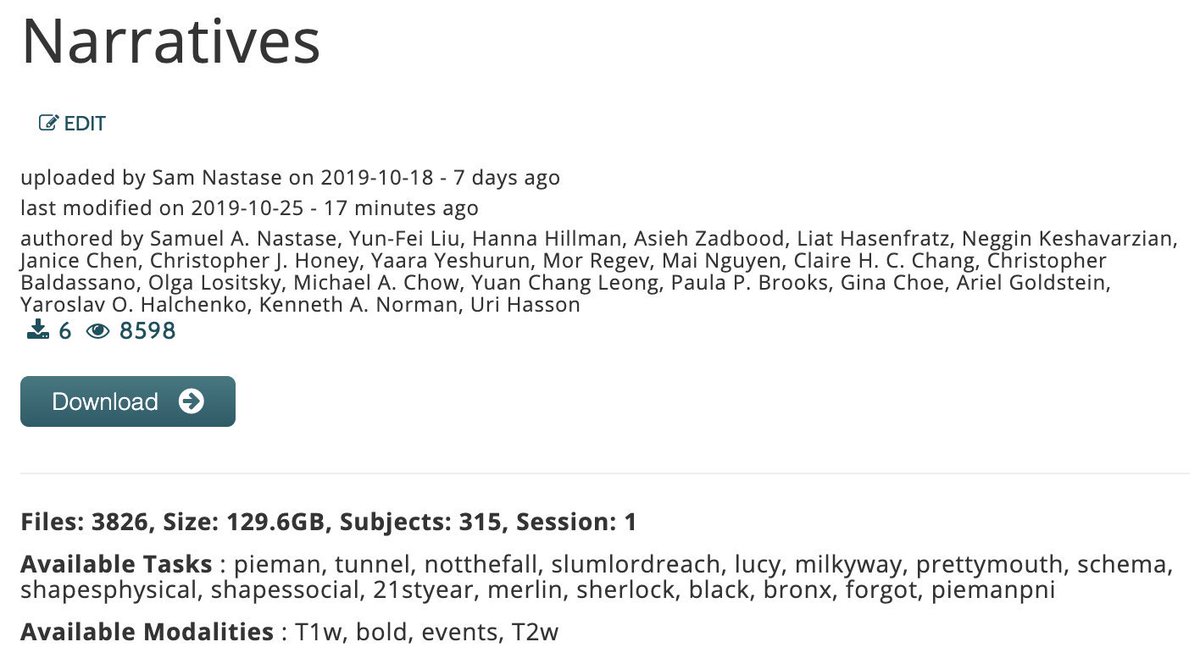
In case you missed my talk at #SfN19: We're rolling out the "Narratives" collection with fMRI data for 300+ subjects listening to 20+ naturalistic spoken stories (750+ functional scans from @HassonLab@ptoncompmemlab). Data now available on @OpenNeuroOrg: https://t.co/cNdiwHtnvt
Hasson Lab is seeking a skilled research programmer to join a project aiming to develop machine learning methods for understanding how language is encoded in "big data" neural activity patterns (i.e., large volumes of ECoG data): https://t.co/kIr26ZaVPe