A motley crew of science nerds trying to understand the inner workings and limits of human memory. Plus some Bayesian stuff...and 🧁. Director: @jeremyRmanning
Since you typically know more about your *own* past than your future, this affects what you say and do. And your "biased" knowledge of your own autobiographical timeline is transmitted to other people when you communicate!
Now out in @NatureComms (lead: @Xu_Xinming)! How do conversations shape how (and what) people guess about the unknown past and future (e.g., in other people's lives)?
Paper/code/data: https://t.co/rUYJCi4O85
From examining millions of real and fictional human conversations, we found that people refer to past events ~1.5 more often than future events, on average. This affects what other people *learn* (or infer) from our conversations.
New research uncovers how the brain dynamically shifts its activity in response to mental challenges, revealing surprising insights into its adaptability. The study sheds light on a hidden mechanism that helps optimize our cognitive abilities in real time. https://t.co/6kqWrsVWwV
We also did some digging to get at the specific networks that seem to exhibit this mode switching process most strongly (DMN!) or weakly (primary sensory cortex!) and also used some cool @neurosynth analyses to help us interpret the results.
New study out in @PNASNews (lead: @LucyLongOwen)!
Our brains comprise billions of tiny components interact via trillions of connections, changing at sub-ms timescales. How is it so robust to injury and noise?
Paper: https://t.co/yjReM2pbd0
Code/data: https://t.co/2CbFj9pnv9
We've been doing some @LeetCode together to help hone our coding skills. We've set up a project for going through the daily problems: https://t.co/DHcttu4kQw
We welcome participation from "outsiders" too; instructions are at the link above if you'd like to participate! 🧑💻
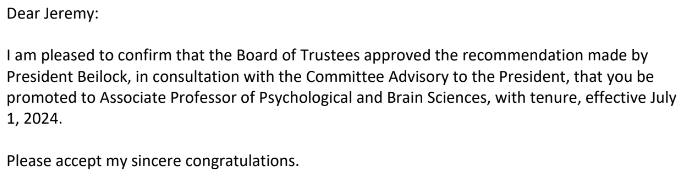
I'm feeling very happy, lucky, and grateful to have reached this next career milestone (tenure!) with the support of my family, lab, and colleagues! Special thanks to my current grad students @paxt0n4 and @Xu_Xinming for their incredible work, creativity, and general awesomeness!
We've (lead: @paxt0n4) added an awesome new system for automatically managing dependencies, that's isolated from the runtime environment.
Davos now turns your notebook into a "fully enclosed" + shareable doc (w/ code/figures/data/text) that installs its own dependencies!
Excited to announce the latest release of our "Davos" Python package (v0.2.3)! 🎉🥳
Add Davos to a Jupyter notebook by inserting a new cell with this code at the top:
%pip install davos
import davos
Then replace all uses of "import" with "smuggle"
https://t.co/eyCIUOu2kg
We're also grateful to @OpenAI, @huggingface, and @Meta, whose awesome LLM wizardry gives Chatify its brain powers 🧠💕🪄, and to the developers of @ProjectJupyter, LangChain, and GPTCache for providing a solid foundation for creating such neat tools!
We're excited for the alpha release of our Chatify 🤖package in collaboration with @neuromatch! Chatify adds an LLM-powered "AI tutor" widget to Jupyter notebooks.
Try it by adding this code to the top cell:
!pip install chatify
%load_ext chatify
Link: https://t.co/f4fxgN8Rgq
Special shoutout to our core developers 🧑💻🧑💻🧑💻🧑💻: @HemuManju, @jeremyRmanning, @j6m8, and @KordingLab 🥳, and to all of our (many, many) pre-alpha testers 🧪🏅!