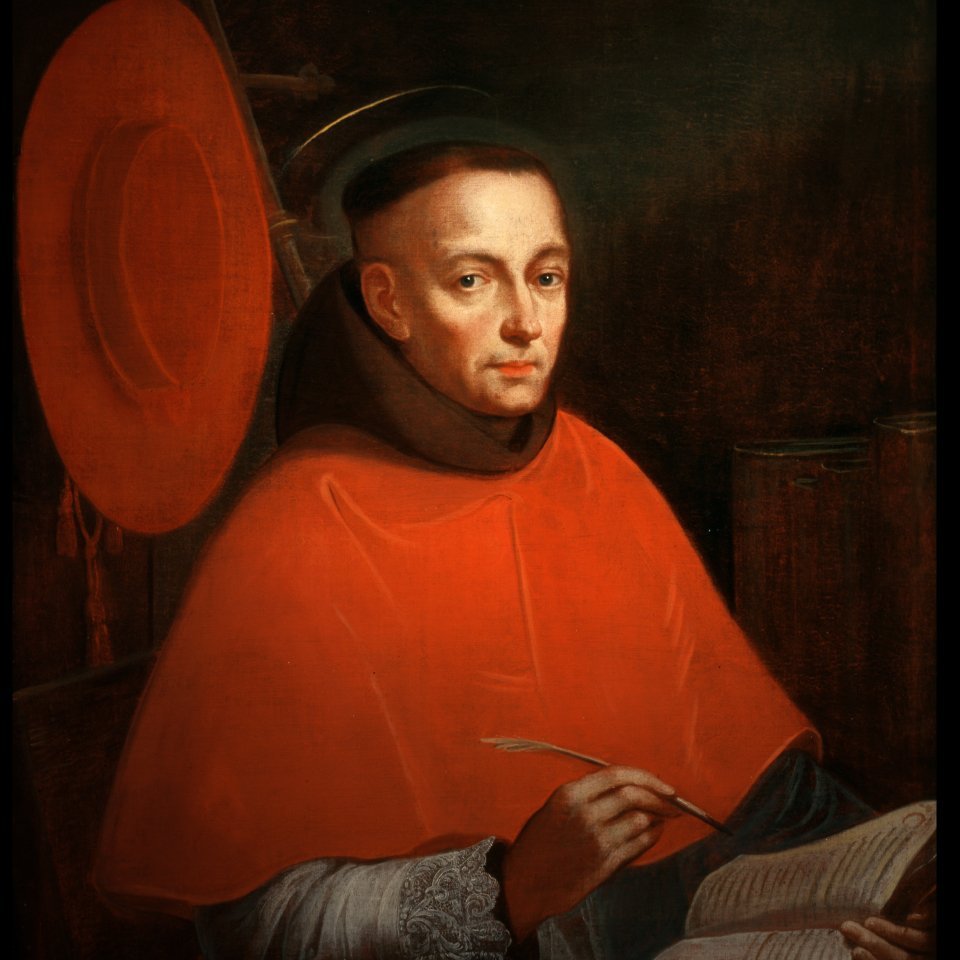
"Physical force, which preserves one's native land from barbarians or defends the sick of one's household or one's relatives from thieves, is fully just."
- St. Bonaventure and St. Ambrose (In Lucam, VI.69; De officiis ministrorum I.27.129)
As everyone could have guessed, many of the 50 000 illegal migrants who crossed into Ceuta and Melilla yesterday spent the night by breaking into homes, looting stores and clashing with the Spanish police
🇪🇸
obsessed with this painting of christ’s resurrection from the early 1500s… it was painted by matthias grünewald, who was forgotten until the 19th century. only 10 of his paintings survive, most lost in a shipwreck at sea. he was a mysterious loner who had no master or pupils.
I like how if you’d read the Pentateuch without knowing anything about it, you might would be tempted to think God always shows mercy, letting the Israelites “get away” with their rebellion. “How long will they keep complaining against me?” — and for a while, he does nothing.
But when you get to the episode of the Golden Calf and 23,000 are slaughtered, you’d realize that’s clearly a misconception lol. By the time you get to Numbers, he’s wiping out thousands of Israelites left and right, and finally decrees that none of them among the first generation will make it out of the desert.
When I was Muslim studying Christianity to refute it. I’d read deep treatises from Christians so I wouldn’t straw-man its position, I once read a Syriac theologian, “Elias of Nisibis” & made a convincing argument against Islam, even for me at the time. You’ll never see such an argument on YouTube.
He made an argument On Orthodox Christian Tawḥīd and Islamic Tawḥīd, wherein it basically goes as such :
God is one in essence (ousia) and known in three hypostases (aqānīm): the Father, the Son, and the Holy Spirit.
The question is not whether God is one, but what kind of unity belongs properly to the perfect and complete Creator.
The divine essence is not an empty unity but the fullness of being. The one divine essence eternally subsists in the three hypostases, without division or composition. This differs from created substances, where multiple individuals share a common nature, because the divine essence is uniquely one and undivided.
The Christian claim is therefore that God is a Triad within Monad : one essence, three hypostases.
Islamic theology also affirms that God possesses eternal perfections, such as knowledge, power, will, mercy, hearing, sight, wisdom, and speech. However, the Christian critique is that these descriptions do not sufficiently distinguish between those realities that belong to the very constitution of divine subsistence and those that describe divine operations or perfections.
Life and Word are not merely among many attributes. They are foundational realities.
A lifeless thing cannot possess knowledge, mercy, compassion, or wisdom. An inanimate object may have qualities such as size, weight, or colour, but it does not possess the realities that belong to living rational existence. Likewise, speech and reason distinguish rational beings from irrational beings. Humanity is called “speaking” (nātiq) because rational speech belongs to the nature of human beings and distinguishes them from animals.
Therefore, Life and Word reveal something more fundamental about the nature of a living and rational substance than qualities such as hearing, sight, mercy, generosity, or power considered individually.
We observe among created substances that these latter qualities can be present or absent without changing the identity of the substance itself. A person may be merciful or unmerciful, generous or ungenerous, seeing or blind, hearing or deaf, while remaining the same kind of substance. These qualities do not constitute the very reality of the substance.
But Life and Word belong more deeply to the distinction of living and rational beings. A lifeless body is not a living being, and a being without rational speech is not a rational creature. Therefore, Life and Word have a unique relation to substance itself.
For this reason, the Christian confession does not place Life and Word among ordinary attributes. Rather, the divine Life and divine Word belong to the eternal subsistence of God Himself.
The other divine perfections; knowledge, wisdom, power, mercy, goodness, and all others are not separate beings, nor are they divided from God. They belong inseparably to the one divine essence and are perfectly possessed by the Father, the Son, and the Holy Spirit.
Life & Speech are inherently original to the substance, and not accidental; therefore they belong to the hypostatic reality and not merely among the attributes listed.
Thus Christianity arrives at the confession of the Trinity not by dividing God, but by recognising that the fullness of the divine essence includes eternal hypostatic distinction: the Father as the source, the Son as the eternal Word, and the Spirit as the eternal Life-giving presence.
The Creator is therefore not a solitary unity lacking internal fullness, nor a collection of separate realities, but one God whose perfect essence eternally subsists in three hypostases.
Not this nonsense again.
You don’t care what Jerome says. You only care to find an instance in his life and in his personal capacity where his opinion becomes dogma for you (but none of his other opinions).
even still, the evidence grates against the Protestant who wants to claim Jerome for himself.
He constantly quotes deuterocanon as scripture and it becomes obvious his mind changed from earlier opinions.
Even in the prologue to Tobit and Judith you see how he defects to the church, which also shows how the church did not consider the contemporary Jewish “canon” as the same as the church’s canon.