NEW WP: "Regimes of distributive conflict and inflation spirals" w/ G. Dosi & M.E. Virgillito
How do distribution & prices co-evolve? 📉
Map wage/profit regimes in US
Model bargaining & shifts ⚙️
Inflation emerges from income share conflict 🧵
https://t.co/1P4e5kosmv (1/14)
Officially Dr. Pellegrini 🎓
One of the proudest moments of my life. As a first-generation college student, this milestone means so much. We don't talk enough about how hard it is to navigate academia without a roadmap. I'm forever grateful to everyone who helped me get here 🙏
Recently accepted by #QJE: “The Effects of Mandatory Profit-Sharing on Workers and Firms: Evidence from France,” by Nimier-David (@ElioNimier), Sraer, and Thesmar (@dthesmar): https://t.co/TjKqiF3bIG
And his monopolistic competition model indirectly led to a now-widely used monosponistic competition model in the labor market, via Card Cardoso Heining Kline 2018.
I'm hard pressed to think of another economist with more generative research in the past 50 years. https://t.co/W6cWpgV6XH
📣🚨Very happy to share my research, "Reassessing the Cross-Sectional Fiscal Multiplier: Evidence From U.S. Defense Procurement, 1966-2019," now published in the Journal of Applied Econometrics! Proud to add my voice to a vivid academic debate on the macro role of fiscal policy!
New working paper on the California Fast-Food minimum wage (will come out as NBER WP soon but posting now).
Big increase in wages. Big drop in separations. Little change in jobs. (Bonus: sheds light on QWI vs QCEW measurement of jobs.)
This looks like a must-read!
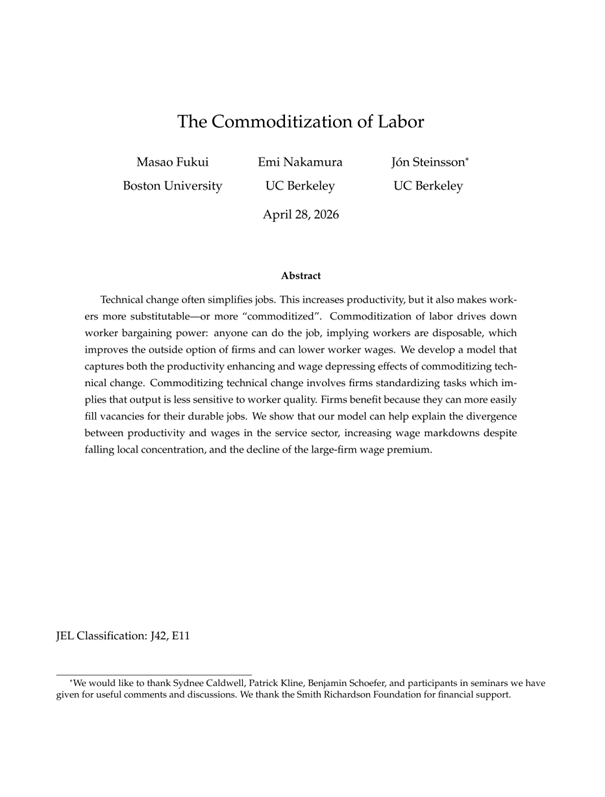
"The Commoditization of Labor" by Masao Fukui, Emi Nakamura, and Jon Steinsson.
"Technical change often simplifies jobs. This increases productivity, but it also makes workers more substitutable—or more “commoditized”. Commoditization of labor drives down worker bargaining power: anyone can do the job, implying workers are disposable, which improves the outside option of firms and can lower worker wages. We develop a model that captures both the productivity enhancing and wage depressing effects of commoditizing technical change. Commoditizing technical change involves firms standardizing tasks which implies that output is less sensitive to worker quality. Firms benefit because they can more easily fill vacancies for their durable jobs. We show that our model can help explain the divergence between productivity and wages in the service sector, increasing wage markdowns despite falling local concentration, and the decline of the large-firm wage premium."
https://t.co/2dtikDgJIs
My dad, brother, and sister have a Ph.D. My grandfather and aunt have a Ph.D. My sister-in-law has a Ph.D. My great-aunt, great-uncle, and their daughter (who's my age) have PhDs. Her husband has a Ph.D.
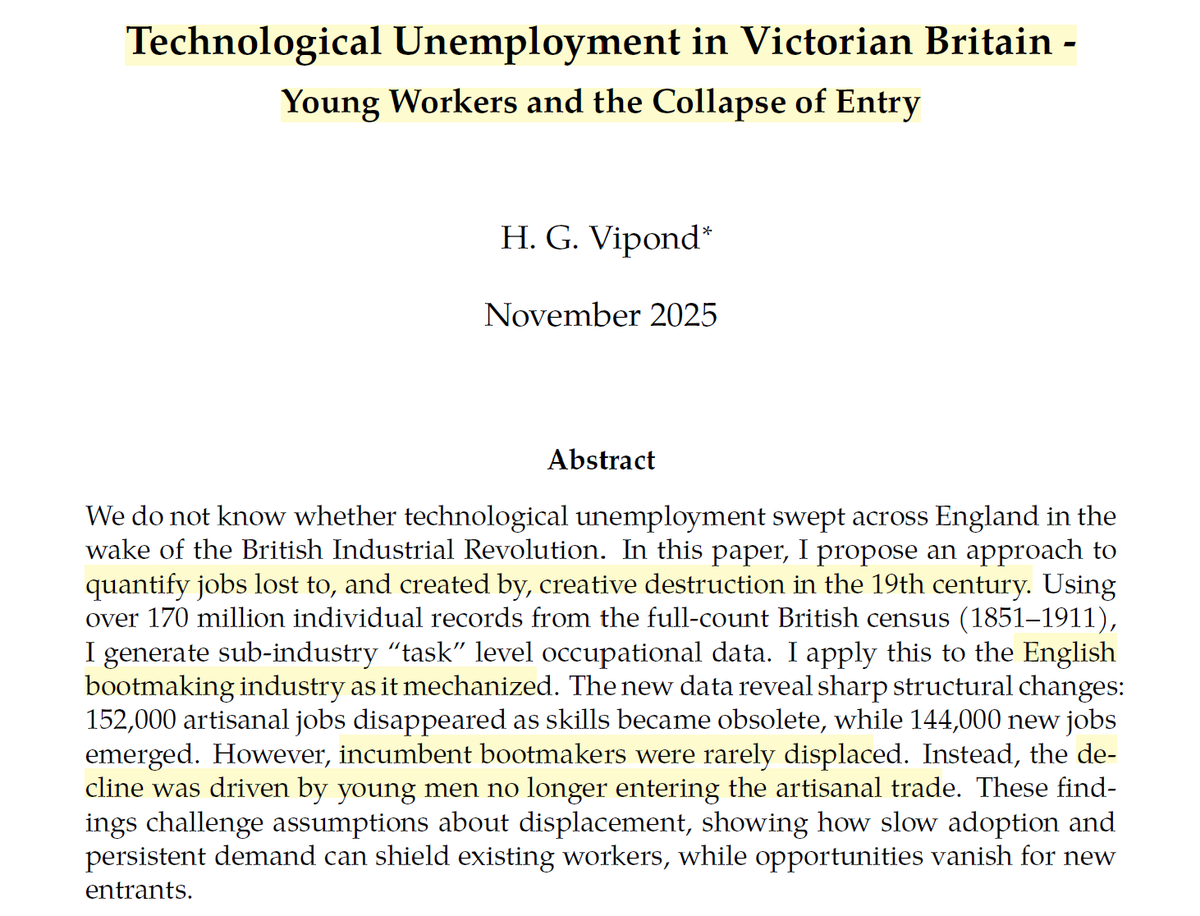
Really fascinating historical research by @hillaryvipond:
“Technological Unemployment in Victorian Britain - Young Workers and the Collapse of Entry”
Analysis of the bootmaking industry of Victorian England shows that the impact of mechanization was not so much to displace incumbent workers. Instead, the shock primarily affected a changing set of opportunities available to young people.
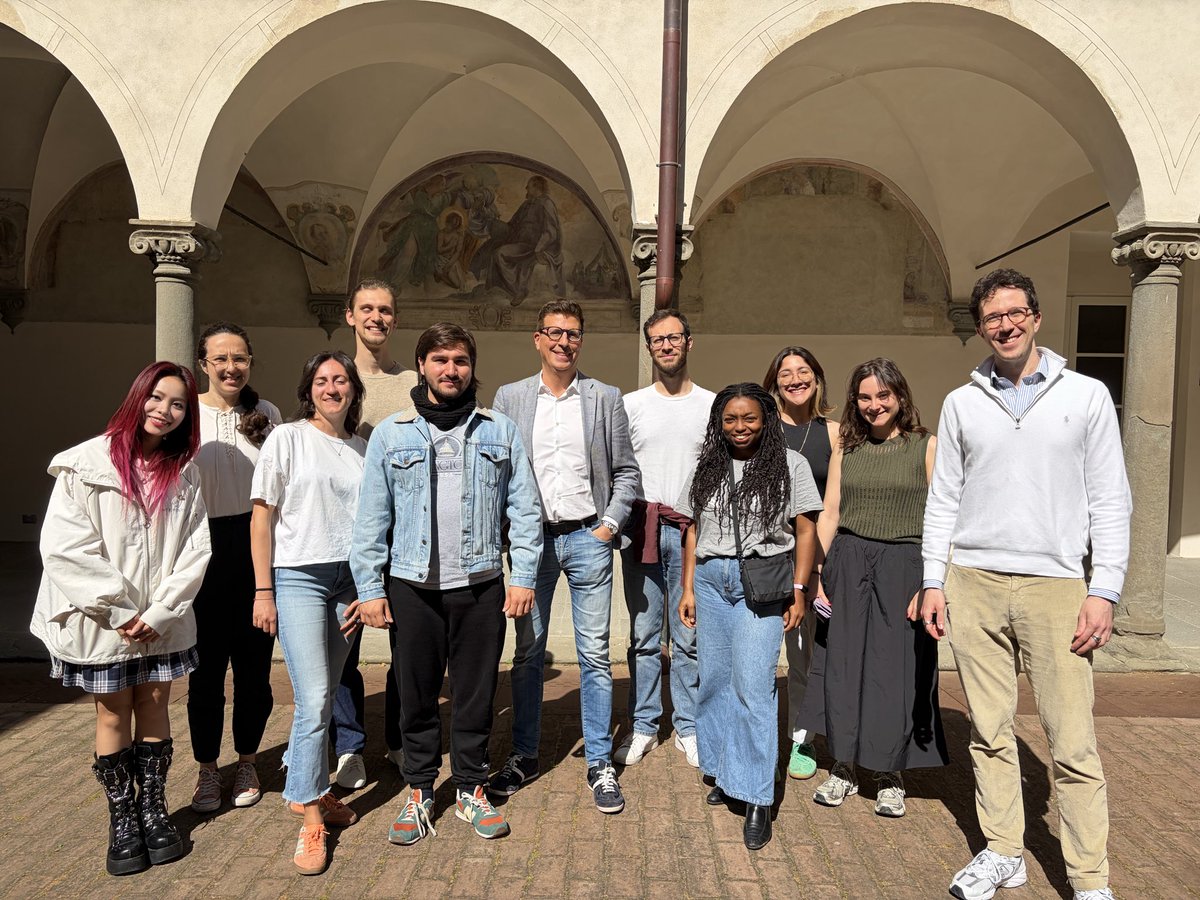
Prof. @nmaffeifaccioli and I are super happy to be @SantAnnaPisa for our annual course on Empirical Macroeconomics. Nicolo’ teaches econometrics of SVAR models while I teach applications (Phillips curve, inflation surge, hysteresis, inequality, labor share, immigration). Pisa 🥰
My book, The Wage Standard, is dedicated to Frank Morley, someone who taught me a lot about economics when I was in grad school.
Frank's place of work was the Harvard Economics Department.
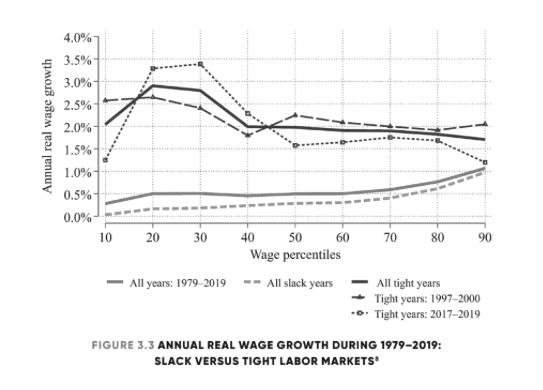
A striking fact I learnt researching my book: For those in the bottom half, much of the real wage growth between 1979 and 2019 happened over just 7 "tight" years.
For top wages, full employment wasn't a big deal. For bottom wages, it was the nearly the whole game.
Arindrajit Dube new book , The Wage Standard: What's Wrong in the Labor Market & How to Fix It
How did the labor market stop working for so many in the workforce? https://t.co/3WCieIFW35
@annastansbury Many thanks for this analysis. Our colleague Camille Peugny also found another inequality in France. A graduate from a working-class background has significantly more difficulties to obtain a job than one with the same degree, but from a middle-class/upper-class background.
Think about it. A single decision when I'm 19 years old ends up impacting my entire career trajectory.
And many kids just don't know about these recruiting pipelines, so they miss them and are disadvantaged going into full-time recruiting their senior year.
I was lucky I had a friend who grew up wealthier that told me all this so I didn't miss out.
We often think that the effects of class background are washed out by education. But we show that two people who did the same subject at the same university at the same time, and got the same grade …. end up earning quite different amounts when they enter the labour market
Institutional labor economists in the mid 20th century understood why competitive pressures were not strong enough to get rid of wage differences for similar jobs across companies; like Richard Lester's "range theory" of wages. https://t.co/HybY2ITXfS
We will be launching our new research tomorrow at @resfoundation
We find that in the UK, even when comparing two people who graduate from the same uni degree, with the same grade, socioeconomic background still affects later life earnings
Come in person or to the webinar 👇
Many of us are trying to figure out where the AI labor market transition may be going. But that's fundamentally unknowable. So instead of trying to predict the future we can instead look back to try to figure out what may be coming...by reading 19th c english literature 1/