@DaveShapi It’s certainly not “meaning,” because there’s just as much meaning in a (well-crafted) piece of AI content, whether a comic strip or music video. “Presence” is much more accurate as a description of the one remaining point of human superiority.
A prominent coupon code field on an ecommerce checkout page might seem standard, but it often hurts website usability and conversion. When shoppers without a promo code see that big empty box, they feel they are missing out. Instead of buying, they leave the site to search for coupons on the Internet. This breaks the checkout flow. Often, this search leads them to find another site where they buy. Otherwise, they return feeling cheated because they have to pay full price while others get a discount. This frustration may lead them to not buy at all, abandoning their carts entirely.
My full article about the two worst conversion-killers in ecommerce design 👉 https://t.co/3QqyjD6mfC
@suno Sorry to be negative, but I much prefer that you spend the resources on improving the *creation* experience (plus, of course, the underlying generation model). The UI itself can stand much improvement, especially for editing.
The Three Layers of 𝗔𝗜 𝗨𝘀𝗲𝗿 𝗘𝘅𝗽𝗲𝗿𝗶𝗲𝗻𝗰𝗲 𝗔𝗿𝗰𝗵𝗶𝘁𝗲𝗰𝘁𝘂𝗿𝗲
As software shifts from apps to AI agents, mature intent-based systems will settle into a triple-layered design model:
🎯 𝗜𝗻𝘁𝗲𝗻𝘁 𝗦𝘂𝗿𝗳𝗮𝗰𝗲: Where users state outcomes. Context-aware and multimodal, this layer increasingly infers implicit intent from ambient signals, drafting the prompt so users just confirm.
🔍 𝗢𝗿𝗰𝗵𝗲𝘀𝘁𝗿𝗮𝘁𝗶𝗼𝗻 𝗦𝘂𝗿𝗳𝗮𝗰𝗲: The negotiation layer. Agents reveal plans, seek consent, and provide post-action receipts. In enterprises, it resolves collaborative intent; flagging conflicts, enforcing policies, and showing who's affected before execution.
🖐️ 𝗗𝗶𝗿𝗲𝗰𝘁 𝗠𝗮𝗻𝗶𝗽𝘂𝗹𝗮𝘁𝗶𝗼𝗻 𝗦𝘂𝗿𝗳𝗮𝗰𝗲: The GUI lives on as a fallback for inspection, correction, and override. But users now manipulate plans, not raw controls; retaining hands-on agency at a higher level of abstraction.
My full article on designing the new AI user experience 👉 https://t.co/OV6E5HuEa1
🛒 Two killer 𝗲𝗰𝗼𝗺𝗺𝗲𝗿𝗰𝗲 mistakes: prominent coupon code fields (sending shoppers off-site to hunt deals) and forced registration without a guest checkout option
📱 𝗦𝗼𝗰𝗶𝗮𝗹 𝗺𝗲𝗱𝗶𝗮 dominates media consumption (13.5 hrs/week) but has become less social: Now used to fill time, not to connect with others
🤖 𝗔𝗜 𝗮𝗴𝗲𝗻𝘁𝘀 flip UX from articulation to oversight: users become Creative Directors managing autonomous workflows, not micro-managers
🎮 𝗧𝗲𝗮𝗺-𝗯𝘂𝗶𝗹𝗱𝗶𝗻𝗴 idea: render colleagues as video game characters (try GTA6 NPCs)
📊 𝗥𝗮𝘁𝗶𝗻𝗴 𝘀𝗰𝗮𝗹𝗲 rule of thumb (1–7): 5.8+ good, 5.2 average, below 4.0 poor (acquiescence bias inflates scores)
🦸 My 𝗨𝗫 𝗛𝗲𝗿𝗼: Ben Shneiderman, pioneer of UI research
These stories and more in my full newsletter 👉 https://t.co/SbJjZs41B3
@Artedeingenio I like those Viking mood scenes, especially the ones set during the winter. (Though of course they must have had nice summers, since that’s what Scandinavia gets today. So good that you included some pleasant weather too.)
🤖 The Internet 𝗽𝗮𝗰𝗶𝗳𝗶𝗲𝘀 us. AI 𝗮𝗰𝘁𝗶𝘃𝗮𝘁𝗲𝘀 us.
GWI surveyed 50 countries comparing Internet vs AI usage. Both share the top reason: "Finding Information" (60% vs 59%). After that, everything diverges dramatically.
📱 𝗧𝗼𝗽 𝗜𝗻𝘁𝗲𝗿𝗻𝗲𝘁 𝘂𝘀𝗲𝘀 (after info):
👥 58% connecting with friends/family
📺 53% watching videos/TV/movies
📰 51% reading news
🎵 45% listening to music
⏰ 44% just "filling spare time"
🧠 𝗧𝗼𝗽 𝗔𝗜 𝘂𝘀𝗲𝘀 (after info):
💡 38% getting advice on problems
📚 37% learning or improving skills
🎨 34% creating images/video
⚡ 33% saving time and boosting efficiency
✍️ 30% creating written content
The Internet became "lean-back" entertainment. AI is "lean-forward" creation.
Why? The interface dictates the mindset. You can't doomscroll a blank ChatGPT box. AI demands intent; feeds demand nothing. The attention economy turned the web into a digital couch because passive users are easier to monetize.
When we designed the web in the 90s, we envisioned an empowering creative tool that would turn everyone into a creator. AI gives us a second chance.
But commercial pressure will push toward addictive AI-generated feeds. Our responsibility in UX: keep AI a tool of human agency, not pacification.
The future doesn't happen to us. We make it happen. 🚀
My full analysis of this data 👉 https://t.co/rS8KVTBBpK
Standard usability testing finds interface flaws. Deprivation studies reveal whether your product should exist at all. 🤯
The premise is simple: ask habitual users to abstain from your product for days or weeks. Then study the gap left behind.
Why traditional research falls short here:
📊 Analytics can't separate a forced click from a delighted one, since value and captivity look identical
💬 Focus groups reward performance over honest behavior
📋 Surveys generate wishlists for features users will never actually use
🧠 You can't ask users to describe the value of air until you start suffocating them
What you'll uncover:
👻 Phantom limbs: users reflexively reaching for deleted apps reveal your product's core behavioral anchors
🔧 Duct-tape workarounds: sticky notes and spreadsheets disaggregate your true value. If the workaround is faster, you're over-engineered
💀 Ghost features: the modules nobody mourns are candidates for demotion or deletion
😌 Relief: if users feel calmer without your product, you're surviving on dark patterns, not genuine value
🎭 Identity shifts: some tools shape how users see themselves
Use this before redesigns, pricing changes, or feature cuts. Skip it for prototypes and safety-critical systems.
Deprivation doesn't just debug software. It debugs your assumptions about what users actually need.
Full article on how to conduct deprivation studies, with case study of smartphone deprivation 👉 https://t.co/0NDFRACaw3
#Apple Computer celebrates its 50-year anniversary this year. As shown in my graphic, Apple has been behind many of the most significant advances in usability.
We can divide Apple's history into 4 periods:
⭐ 𝟭𝟵𝟳𝟲-𝟭𝟵𝟴𝟱: Garage (Apple I) to GUI (Macintosh) (10 years)
⭐ 𝟭𝟵𝟴𝟲-𝟮𝟬𝟬𝟬: The Wilderness & Return of Steve Jobs (15 years)
⭐ 𝟮𝟬𝟬𝟭-𝟮𝟬𝟭𝟬: The Digital Hub from iPod to iPhone & iPad (10 years)
⭐ 𝟮𝟬𝟭𝟭-𝟮𝟬𝟭𝟲: Services & Beyond (15 years)
The first and third of these 4 periods were characterized by insane innovation, and maybe 80% of Apple's total contributions happened during these 20 years.
Periods two and four mainly saw cosmetic advances, and maybe 20% of Apple's contributions happened during these 30 years.
To simplify:
⭐ Innovative decades: 4% per year
⭐ Cosmetic decades: 0.67% per year
In other words, 𝗔𝗽𝗽𝗹𝗲 𝗰𝗼𝗻𝘁𝗿𝗶𝗯𝘂𝘁𝗲𝗱 𝟲 𝘁𝗶𝗺𝗲𝘀 𝗮𝘀 𝗺𝘂𝗰𝗵 𝗽𝗲𝗿 𝘆𝗲𝗮𝗿 during its two decades that emphasized UX revolutions, relative to what it did during the three decades of cosmetic shine-ups.
My full analysis of Apple Computer history 👉 https://t.co/Ngf965aIc4
My video on the history of graphical user interfaces 👉 https://t.co/7NOJvRI4sG
🚀 OpenAI's $4B DeployCo bet on Forward Deployed Engineers (𝗙𝗗𝗘𝘀) to bring AI into enterprises. But engineering alone won't unlock AI's true value.
⚡ Speeding up one task by 40% means nothing if the next step remains a bottleneck. Local optimization ≠ business transformation.
🎯 Enter the Forward Deployed Designer (𝗙𝗗𝗗): part ethnographer, part service designer, part AI strategist.
🔍 FDDs question 𝘸𝘩𝘺 workflows exist, not just how to make them faster. They redesign decision rights, not just interfaces.
🤝 FDD + FDE = unbeatable pod for AI-native enterprise transformation.
👔 But both fail without executive sponsors willing to retire obsolete rituals.
𝘞𝘪𝘭𝘭 𝘺𝘰𝘶 𝘣𝘦𝘤𝘰𝘮𝘦 𝘢𝘯 𝘍𝘋𝘋?
Full article 👉 https://t.co/grvgfwYXLq
AI in education can help OR hurt learning. It all depends on how students use it.
❌ When AI does the work FOR students, 𝗹𝗲𝗮𝗿𝗻𝗶𝗻𝗴 𝘀𝘂𝗳𝗳𝗲𝗿𝘀. Finishing assignments fast feels good, but the goal isn't the deliverable, it's the journey. Students learn by working through problems, not by receiving handed-down solutions.
✅ When AI acts as a tutor, guiding students, explaining tough concepts tirelessly, offering hints when stuck, 𝗹𝗲𝗮𝗿𝗻𝗶𝗻𝗴 𝗶𝗺𝗽𝗿𝗼𝘃𝗲𝘀. Studies show better exam performance, plus faster curriculum progression.
💡 Bottom line: AI is a powerful learning tool when it supports thinking, not when it replaces it.
My review of one more new research study with this conclusion 👉 https://t.co/05EgFfp1xL
You could afford a home of the same size and amenities of the starter homes that people bought 50 years ago. The problem is that people’s expectations have increased to gigantic sizes and luxury amenities. (Admittedly, plus the high costs brought about by zoning and other regulations that we could abolish.)
🎥 DeepMind just demoed voice input combined with mouse pointing: say "𝘮𝘢𝘬𝘦 𝘛𝘏𝘐𝘚 𝘣𝘪𝘨𝘨𝘦𝘳" while pointing. Natural and powerful.
🕰️ This echoes Richard Bolt's 1980 "𝘗𝘶𝘵-𝘛𝘩𝘢𝘵-𝘛𝘩𝘦𝘳𝘦" system at MIT Media Lab, which treated speech and gesture as a single communicative act.
💻 46 years later, DeepMind brings this to your own computer with your own data, no special projection room required.
✍️ Similar in spirit to PenPoint (1992), where writing "𝗕" on a word made it 𝗯𝗼𝗹𝗱, unifying command and target in one gesture.
🚀 AI is finally unlocking the promise of these pioneering techniques.
♻️ History repeats itself, but 𝗯𝗲𝘁𝘁𝗲𝗿 𝘁𝗵𝗶𝘀 𝘁𝗶𝗺𝗲.
👉 My full analysis, including DeepMind's video https://t.co/05EgFfp1xL
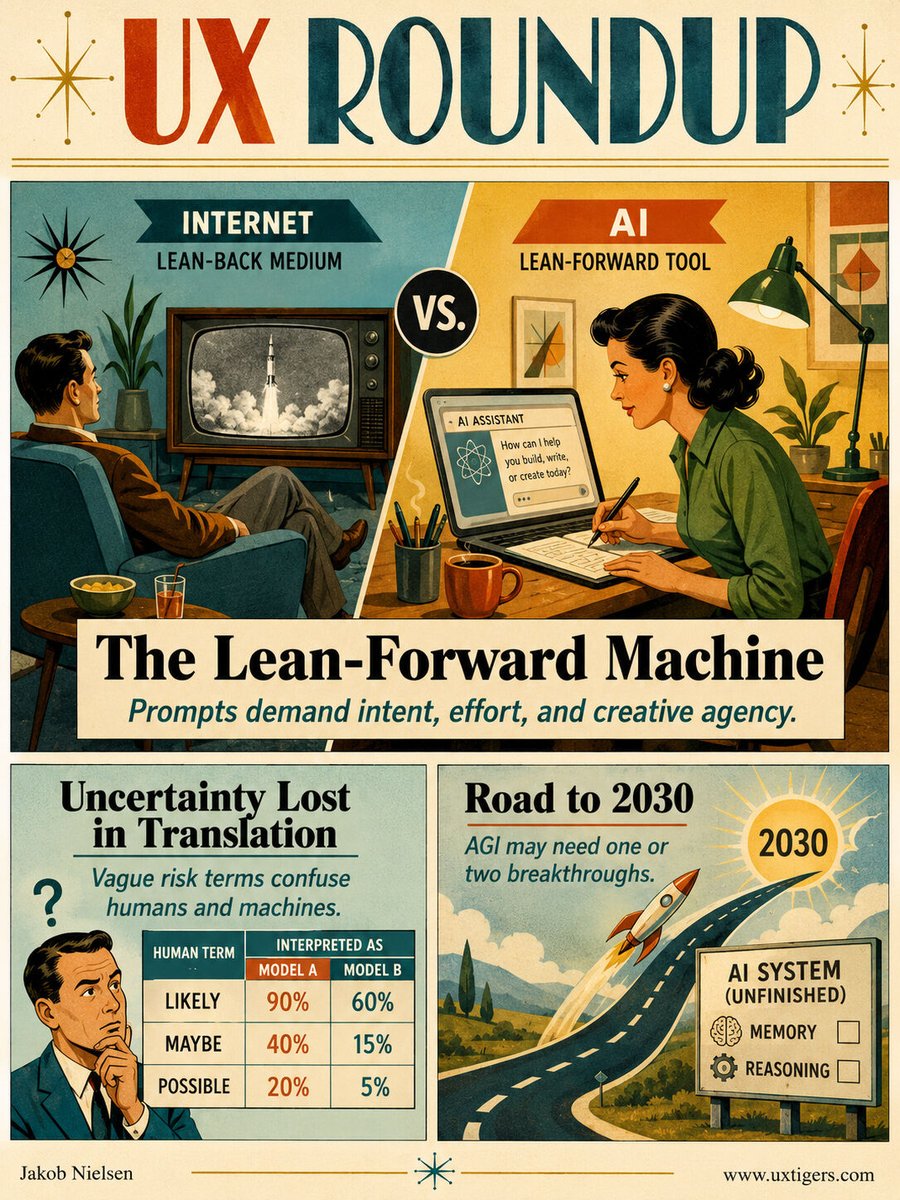
🧠 Demis Hassabis on AI: real progress, real gaps, no magic needed for AGI by ~2030. Memory, reasoning, and continual learning remain the key gaps.
📊 Humans vs. AI interpret probability words differently. "Likely" means 66% to humans but 80% to GPT-4. Designers, beware the misalignment!
⚡ Internet = veg out (passive consumption). AI = create & improve yourself (active engagement). 44% use the Internet just to "fill spare time." Don't let AI become the next doomscroll!
🎬 New scope creep video: featuritis is a usability disease! Less is more in product design.
🎮 Bonus: UX Design as a video game launch poster.
These stories and more in my full newsletter 👉 https://t.co/BZjooH9Ehg
@OfficialLoganK@HCSolakoglu Why should “developers” get better AI than other paying customers? Especially customers at the higher subscription tiers? (Free users are another story, of course. Fair enough to limit their compute use to lower thinking levels.)
𝘉𝘦𝘪𝘯𝘨 𝘢𝘯 𝘈𝘐 𝘊𝘳𝘦𝘢𝘵𝘰𝘳? You might feel like this octopus: script in one tentacle, camera in another, editing, scoring, directing, and steering all at once. 🐙
But here's the uncomfortable truth: true 𝗺𝘂𝗹𝘁𝗶𝘁𝗮𝘀𝗸𝗶𝗻𝗴 𝗱𝗼𝗲𝘀𝗻'𝘁 𝗲𝘅𝗶𝘀𝘁. Our brains simply aren't wired for it.
🎬 Every switch between tasks forces your brain to unload one context and load another
🎨 Working memory must reload project details, tools, and creative intent each time
🎥 Research shows "task-switching costs" can eat up to 40% of productive time
🎼 Creative flow shatters with every interruption, taking 15+ minutes to rebuild
📽️ The illusion of efficiency masks real cognitive fatigue
Even an eight-armed creator can't escape the one-brain bottleneck. Batch similar tasks, protect deep work blocks, and let tools handle parallel execution while you focus on one thing at a time.
My full article on creation workflows, past, present, and future 👉 https://t.co/k8r4LwbTDP
What if we could get a time machine to pull together all the main pioneers of AI for a single workshop? Wouldn't that be something to attend!
My full history of AI mentions many more early contributors, and since they couldn't fit into this group portrait, I realistically wouldn't be invited either. But I would watch the YouTube recording of the proceedings.
My full tour through AI history, including a 35-page comic book visualization 👉 https://t.co/34XJ32vO8r