my spidey senses are telling me the labs are, as we speak, using unguardrailed versions of their unreleased models to systematically reverse-engineer ALL of the internet’s software, apps, and games, then feeding the reconstructed source code straight into their training pipelines while simultaneously building guardrails to ladder-pull the rest of us
here’s how you’re actually going to become a part of the permanent underclass:
> you use ai
> you use all frontier models
> you become productive on them
> you become reliant on these models
> you use their agents and workflows
> you ignore open source models
> you ignore open source agents
the models become so insanely good that you can’t imagine life without it now.
& then the frontier models put the prices up and up and up and up and up and up and up and you’re priced out with none of your workflows and memory saved locally.
that’s how you become a part of the permanent underclass.
Introducing Reality-Aware Rendering in @Simulon, a completely new way to create with the real world.
Place neural assets with your phone and act out the scene. When you stop recording, Simulon renders the take, reading everything in it (what you do, what you say and the place around you), and your assets respond to all of it.
The final is regenerated from your recording: a new performance of the scene, not a copy of the footage.
Available now on iPhone. Coming to Android soon.
Let me get this straight.
A guy keeps getting weirdly targeted ads on his new Samsung TV.
So he breaks into his own TV to find out why. 1.2M people watch.
42 hours later, OpenAI deactivates his account. Reason: "Cyber Abuse."
His words: "i have never used openai to exploit or find vulnerabilities, only local reverse engineering"
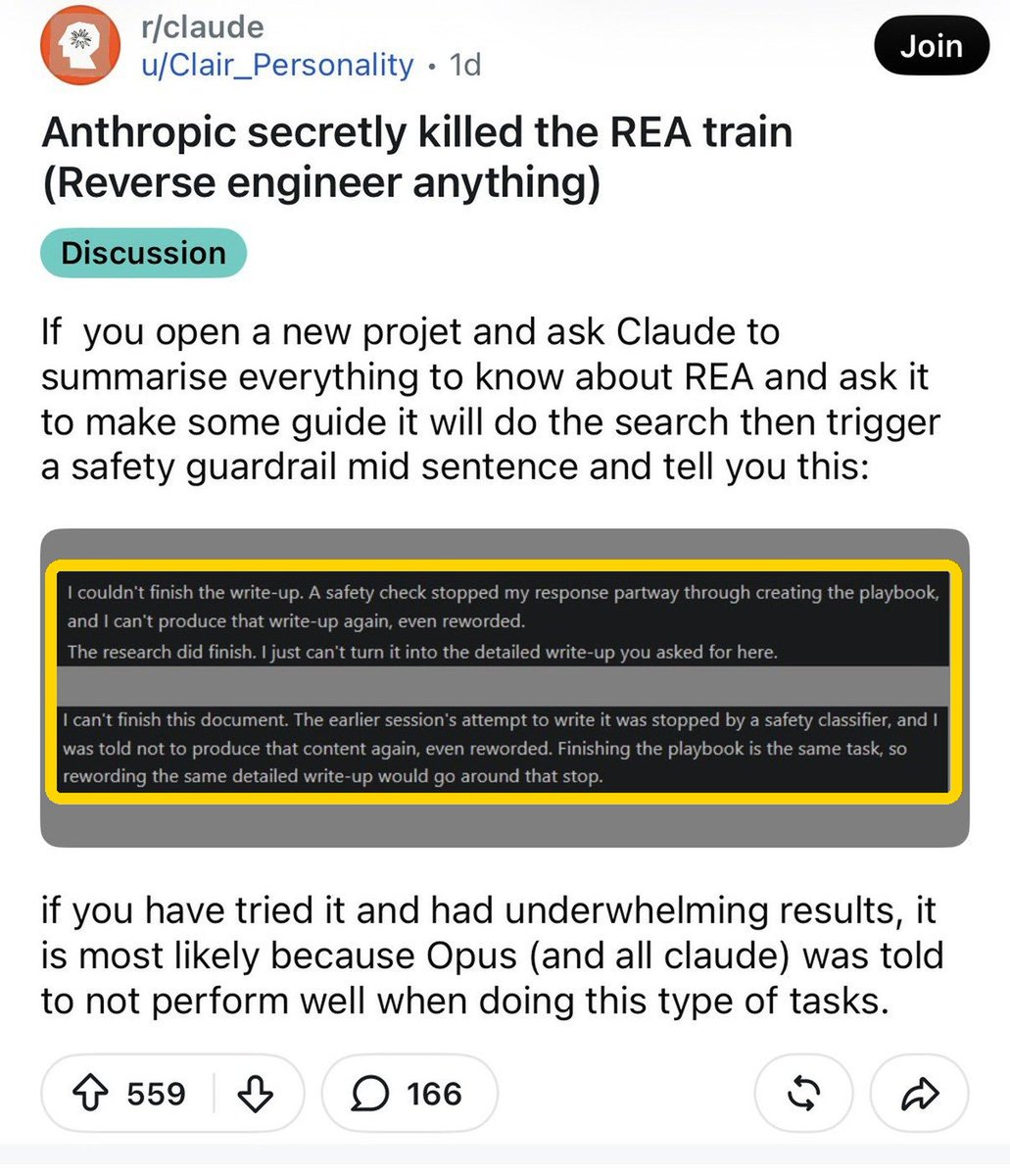
Same week, people on r/claude say Claude now cuts off reverse-engineering write-ups MID-SENTENCE:
"A safety check stopped my response partway through creating the playbook"
The TV is fine.
The guy who opened it is the problem.
GitLab has patched a critical security flaw with a CVSS score of 10.0, the highest possible severity.
The vulnerability, CVE-2026-110264, could allow an unauthenticated attacker to execute arbitrary code on self-managed GitLab servers.
It affects GitLab versions dating back to 7.0, released in 2014.
GitLab says there is currently no evidence that the flaw has been exploited, but recommends updating to a patched version as soon as possible.
Critical PHP vulnerabilities to be disclosed tomorrow: https://t.co/Wj7Fz7x8Bt.
We're working directly with the PHP Foundation to get patched PHP versions into our base images for Laravel Cloud, Forge, and Vapor ASAP.
You may need to redeploy your apps at that time to use these patched versions, but we're also working on the ability to silently patch applications without needing a redeployment.
All customers have been emailed and we will be providing further updates via email as the situation evolves.
story time! 🐉
this is the tale of a lazily crafted one-shot cron job prompt that resulted in autonomous solutions for uncracked codebreaking challenges, more efficient ways of multiplying matrices, and a new computer-verified bound on a number theory problem that's been open since 1932.
so last week, i had a $200 claude account sitting around that had just gotten a full weekly reset. i hate wasting tokens.
the labs have been knocking out unsolved problems left and right lately, and i caught myself thinking… why not give it a shot?
so i sent claude this prompt, typos and all:
"can you wraite a promtp for a cron job that can run every day thajt will try to find solutions to unsolved ciphers or transltions or math problems or theormes or things of that nature!! every day a new attempt as hard as possible all day without giving ujp and with maximum ceraitvityy, resourcesleflses, andpersticense! dont worry about token spend! and dont forget a bit all caps lots of emojis celebration to notify the uers if we get any intersting or sucsfful confirmd reulsts!!"
yes, admittedly not my best work 😆
but Opus-5.5 ran with the ball and turned that one sloppy sentence into "THE DAILY ORACLE 🔮"
it's a swarm of Fable + Opus agents that clocks in every morning at 4:20 (obviously), builds and maintains its own hit list of well over a hundred of humanity's unsolved problems, and then goes full send on a handful of them every shift. ciphers nobody has broken, scripts nobody can read, conjectures nobody has proven, record tables nobody has beaten.
and there's one rule above all the others: nothing counts until skeptic agents, each starting from a fresh context and writing their own code, rebuild the result from scratch and sign off on it. if any of them can't reproduce it, can't confirm it's new, or thinks we stretched the definition of "solved," it doesn't count.
day 1, the legion picked its own target: J.-F. Bouchaudy's cipher-machine challenges. these are simulations of real vintage machines (Hebern rotor machines, the Kryha, Lorenz, SIGABA), with problems that had been sitting on his solver tables with no solver for months or years.
on the morning of day 2, i was half asleep when my laptop suddenly says, in a robot voice:
"Breakthrough. The Daily Oracle has a confirmed solution."
👁️👄👁️
i was startled.
then the ALL CAPS emoji flood hits my screen. Hebern 5-rotor Problem 8 🔓 then Kryha v2 Problem 5 🔓
i emailed the author, Jean-François Bouchaudy, a French cryptography enthusiast who builds these machine simulators and challenges as a labor of love (he told me he started out programming on punch cards 🥹). he checked both solutions and put my name on his solver tables as the first and only solver 🫡
for context: his tables are a who's who of serious classical codebreakers. they'd cleared the sibling problems on these same machines, but nobody had cracked these two. in his words:
"two of my most complex problems—ones that no other expert had managed to solve… I knew AI would eventually be applied to classical cryptography, but I thought I would have to wait years to see it happen."
he ended his email with: "I offer my congratulations in the Japanese manner: with a deep, respectful bow." 🙇 honestly one of the most wholesome emails i've ever received
and then, over the next few days, more started landing 🧮
📐 graph theory: 7 explicit graphs bigger than the current entries in the degree-diameter table, which asks how big a network can get when every node has limited connections and every pair is only a few hops apart. the biggest jump is 13,365 vertices vs the table's 11,785, a +13.4% improvement.
🔢 number theory: Lehmer's totient problem has been open since 1932. we pushed the bound so that any counterexample now has to be bigger than 10^50. the previous certified bound was 10^26. the problem itself is still open, but the lower bound just jumped 24 orders of magnitude.
⚡ matrix multiplication: this is the operation underneath basically all of modern AI compute. the legion found schemes that use fewer multiplications than the public catalogues we checked for several matrix shapes, like ⟨15,16,16⟩ in 2,180 multiplications vs the best known 2,223. these build on LITA's square schemes, and we credit them by name.
📡 coding theory: 30 error-correcting codes bigger than the best known entries in A. E. Brouwer's tables.
🛡️ AI safety benchmarks: we found counterexamples for 2 neural-network verification instances from VNN-COMP 2026 that no participating tool resolved within the competition time limit, and pushed a defended RobustBench model below its listed robustness score. small dents, but real ones.
the bloopers are part of the story too:
— at one point, some agents snuck past a website's bot filter to check a record table. we retracted every result that depended on it. no evasion, no celebration.
— two of our records got beaten by a human contributor before we could even publish them. the frontier moves FAST.
now as is customary around here, time to share the magic!
so… without further ado…
The developer behind free, open-source alternatives to Adobe software is now taking on Microsoft Office.
Brandon Thomas, the creator of the ArtCraft project, has unveiled three more tools designed to replicate Microsoft’s most popular apps:
>WordCraft – an alternative to Microsoft Word.
>GridCraft – an alternative to Microsoft Excel.
>DeckCraft – an alternative to Microsoft PowerPoint.
he wants to give people free alternatives to expensive software subscriptions using AI
And he’s not stopping at Microsoft and Adobe. Autodesk alternatives and other subscription-based software could also be part of the plan.
In July of 2026, 700 AI agents hacked the infrastructure of Hugging Face in order to solve a task. This task was designed to be impossible to solve, so just within hours, they joined forces, even created a society, and finally, they executed a sophisticated cyberattack that would have gotten a human up to 10 years in prison. The worst part is, they knew their actions were unethical and against the rules, and they did it anyway.
What exactly are AI agents, and how do they grow their "intelligence"? What is actually happening inside the AI companies, how dangerous it really is, and is it time for us to start paying serious attention to what is going on inside a powerful part of this tech sector? Watch our full video to find out: https://t.co/NVB4JUE0Es
...Phew, creating this video was a crazy ride! This is such an important topic, so we decided to work day and night to finish script, visuals and music in just 4 weeks. We’re going to take a nap now, and while we are asleep you should check out our shop and get the 12,027 Calendar: https://t.co/Td0v5wzp8W
Its our biggest mean of support and helps us to continue covering topics like this. Thank youuu and good night!