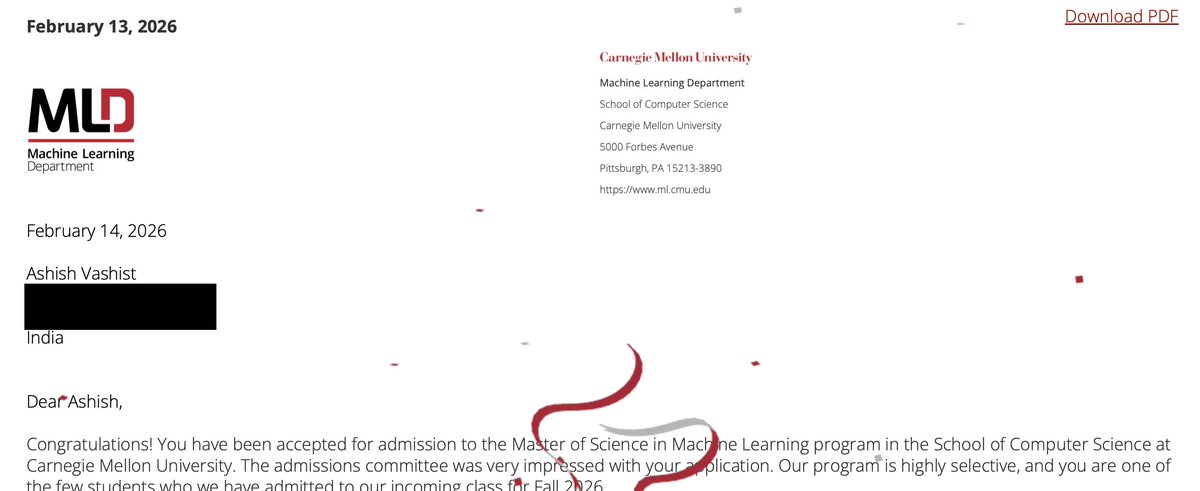
After 6 long years of dreaming, grinding, and believing the wait is finally over.
I've been accepted to CMU ! Also received an admit from UCSD MSCS. Back in 2020, I was just watching campus tours and reaction videos, never imagining this day would come
Today, we enable AutoResearch in the physical world for the first time! Introducing ENPIRE: we give 8 Codex agents a fleet of robots, an allocation of GPUs, and generous token budget. We set them free with a simple goal: solve the task as quickly as possible, keep the robots busy but stay safe, don't waste precious compute. Make no mistake.
Then humans step aside and our watch begins. The robot fleet starts to come alive: they learn to look for visual clues, reset the scene, practice novel skills, tinker with control stack, read papers online, debate, reflect, get stuck, and try again directly on the hardware. All we did is to give Codex an API to the world of atoms, and the rest is emergence.
ENPIRE is able to solve high-precision tasks like tying zip-ties, organizing fine pins, and installing GPUs all by itself. We also discovered a new type of "physical scaling": 8 robots exploring in parallel improves significantly faster than fewer ones.
A part of our NVIDIA GEAR lab now self-improves tirelessly over night. We just read the reports in the morning.
/goal: we all take a holiday and Jensen wouldn't even notice ;)
We will be open-sourcing everything, so you can host your self-running robot lab at home too! Deep dive in the thread:
With the rise of LLM systems marketed as "coding agents", "AI co-scientists", etc. that promise to drive up productivity, and at the same time outcry of "existential" concerns that AI escaping human control with destructive power under a speculative "machine agency" against humans, there has been lots of confusion about “What is an agent?” and “What constitutes agency?” It has become essential to clarify where automation ends and agency begins.
Also recently, developments in world models, action models are trending to mixing future prediction/simulation and action/plan generation altogether within a single architecture such as a VLM, conflating reward-driven action selection with fidelity-driven next-state prediction, undermining the reliability of both planning and simulation.
In this paper we analyze agent architectures along the axis of goal, identity, decision-making, self-regulation, and learning, and argue that genuine agency requires these structures to be internalized within the system itself rather than assembled through external scaffolding. We propose a “Goal-Identity-Configurator” (GIC) architecture for a general-purpose agent model, combining hierarchical goal decomposition, identity evolution, simulative reasoning grounded in a separately trained world model, learned self-regulation, and self-directed learning from both real and simulated experience.
Auditability, controllability, and safety of systems that possess greater autonomy and "agency” but remain under human oversight, can be better built with the GIC architecture that offers transparency, modularity, and checkpoints.
@mdeng34 , @jinyuhou0
https://t.co/jDA4PJIDwm
Wrapped up my first grad admissions cycle. 10 admits, including 3 Ivies:
CMU
Cambridge
Columbia (CS, AI)
Brown
UPenn
UIUC
UCSD
JHU
UMD
Not a perfect applicant. No big pedigree. Just grinded my BTech, stressed hard over SOPs, doubted myself a lot, and it worked out.
@rrrautela Cornell CS has intake of only 8–15 students, mostly are Cornell’s own students because it is fully funded. Cornell Tech would have cost me around 200k, so I didn’t apply