Every time we have a new model, I run the same simple prompt on all my projects:
"Read this entire project and find everything that’s broken, inconsistent, inefficient, or no longer needed. Fix what you’re sure about and list the rest for me to review."
highly recommend trying
When I was writing Unreal Engine 1, my time was divided as follows:
- Around 30% went to seriously deep coding on hard problems: assembly language texture mappers, C++ BSP trees, data persistence, object oriented systems design, and networking.
- Around 70% was just typing and refactoring large bodies of code needed for a complete engine feature set. This was not hard, and while I was doing it my mind was mostly on the deeper coding topics, thinking and planning for what's next. It didn't feel much different from vibe coding today, except that it was just me typing code on an IBM Model M keyboard rather than prompting it and reviewing the results.
So, it has always seemed perfectly logical that we would rely on AI for that 70%, once the AI could do it with a similar quality standard as we could, which has never been perfection. It came as no surprise that, after a few years of AI model evolution, it was able to take the reigns on that 70% and free up programmers' time for more valuable tasks.
What's more of a surprise is the emergence of AI as a sort of insta-Carmack able to solve hard technical problems quite cleverly and often cleanly, and that it's able to reason about and work in complex 3D scenes both by operating the tools and by directly understanding the raw data files.
I abandoned assembly language in 1998 when out-of-order CPUs made much simpler C/C++ code faster, and never I missed it. If prompting through architectural documents, concept art, and design plans can transcend typing code and tweaking vertices, that will enable developers to spend their time on higher-level, higher value technical and creative tasks.
What matters is the end product, whether it's a game or an engine. Anything developers can do to try out more ideas and make better software and games faster is a win for everyone.
@GergelyOrosz Used paid IntelliJ for years. Today it's Emacs + terminal. Navigation, refactoring, and inspections are no longer part of my workflow. AI handles that now.
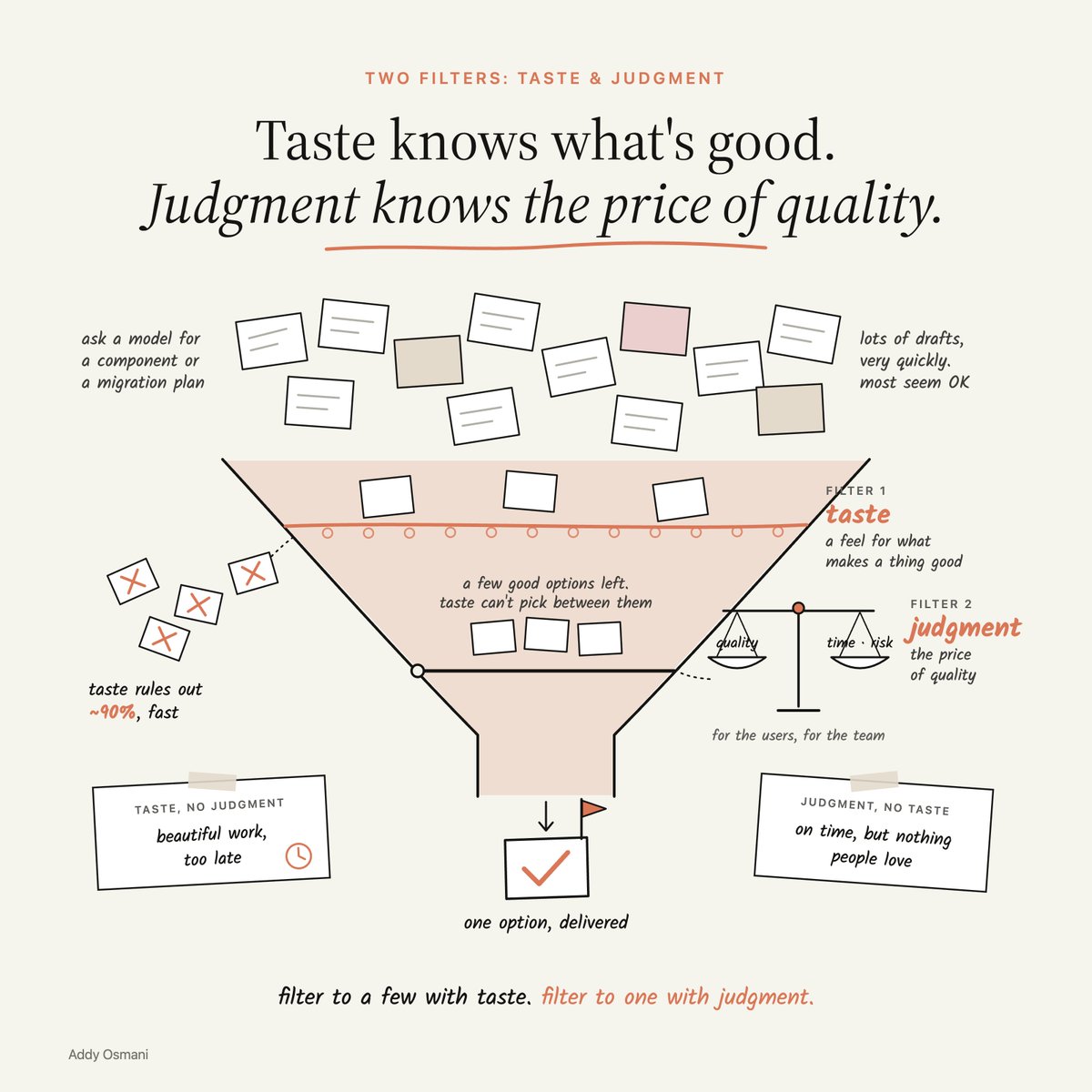
You need both taste and judgement. You need taste to know what is good, and you need judgement to understand the price of quality.
If you ask a model for a component or migration plan, it will create a lot of options, very quickly. Most of those drafts seem OK. So once you have a collection of work that meets the basic criteria, you can no longer use taste to select between them. You must choose.
I like to think of this as two filters. There is the taste, and there is the judgement. And I think a lot of people mix those up.
The first filter is taste. Taste is the feeling for what makes a thing good.
Taste is that feeling you get first, before you're able to put into words what is good or bad about something. You've had that experience where something is bad but you're not sure why, until you've worked it through and can describe it. "This user experience was really clumsy" or "that error message was really aggravating." Taste is built up by experience and practice.
It comes from looking at a lot of things, and making a lot of things, and remembering the good bits. Kant's great insight into aesthetic taste was that you could appreciate the form, without having a stake in the outcome. Engineers care about the outcomes much more than the forms, but the feeling is the same.
Taste can disqualify a lot. It can disqualify 90% of drafts very quickly. But it's not enough to make a decision between the few remaining options.
The second filter is judgement. Judgement is understanding the price of quality. The most perfect solution may not be finished by the time that you need it. The sanest architecture may require the users to migrate while you're in the middle of the final upgrade.
Judgement is the understanding of what you give up in time and risk to get good things, for the sake of the users, for the sake of the team. Judgement is made from domain knowledge and experience from previous decisions.
People with great taste but poor judgement make beautiful work too late. They make the right thing at the wrong time, or the wrong thing at the right time. People with judgement but no taste make on time but don't make things people love.
Both taste and judgement are essential. Filter to a few options with taste, and filter to one option for delivery with judgement.
I own land and property in exactly these areas and will keep buying land and property in these areas
This is exactly my post-AGI thesis too
Scarse coastal or mountain land with clean air
We'll be spending a lot more time trying to understand the outputs of language models. A few thoughts, tips & tricks:
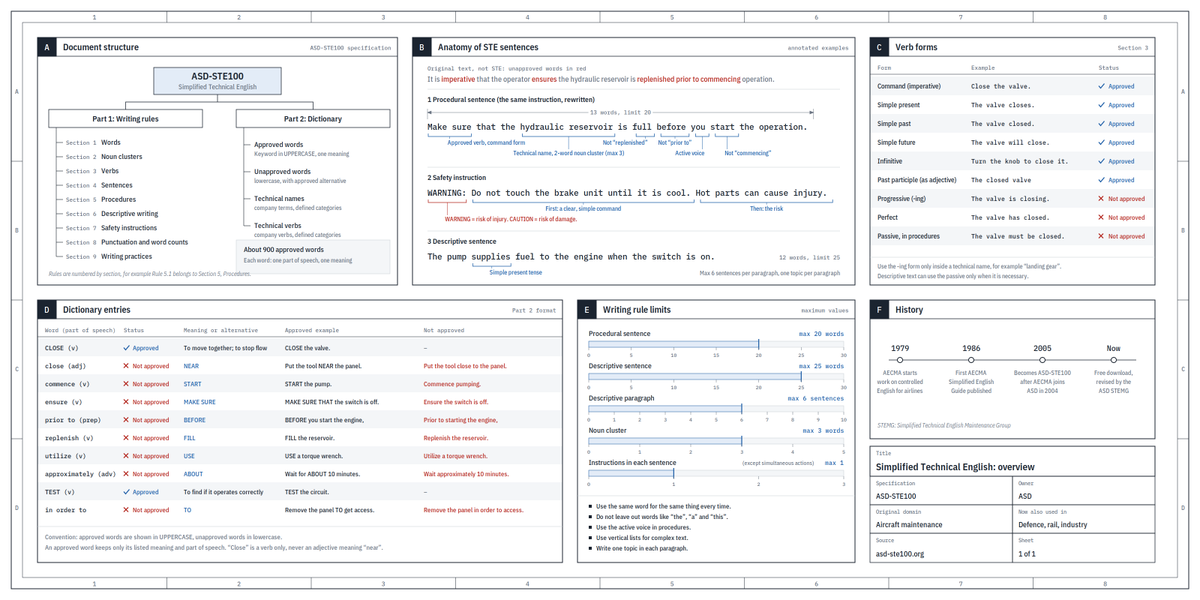
Writing. Something I've had success with: Ask your LLM to explain something in ASD-STE100, it's a controlled language specification originally developed for aerospace maintenance documentation. LLMs well-versed in this language and it comes with heavy constraints on clean writing style that I often find a lot more readable. Sometimes I've tried to soften it a bit e.g. ask for "80% of the way to ASD-STE100" because the spec is quite stringent. But even better:
Diagrams / images. Instead of writing, ask your LLM to create a diagram. These can be a lot easier to process, parse, and understand. But even better:
Web pages. Ask for output "in HTML" to get a beautiful, interactive webpage. LLMs are getting really good at frontend and can create beautiful experiences, animations, etc. But even better:
Explainer videos. The output format I am most bullish on is fully custom / bespoke explainer videos generated on any arbitrary topic. Experiment with things like "Create a 3b1b style video explainer on X. Use my ElevenLabs API key for audio narration". (you'd need an API key for the latter or you can ask your LLM to find you decent free alternatives that use your local compute). This is actually starting to work!
In summary:
- As LLMs get better, they will do more and more of the legwork autonomously, and a lot more of our work will rise up the abstractions into oversight and understanding.
- Luckily, LLMs can help here too because as intelligence and code are increasingly abundant, you can ask for large, custom, discardable software artifacts (e.g. web apps, video explainers) that would have never made sense to create before. Push the boundaries here and you'll be surprised.
For years, maybe a decade, I've wanted to build a writing tool that just did a few things I couldn't find anywhere else.
A system that mimicked how I think when I write. A system that provided clear affordances, features, and places to do the things I wanted to do. A way to play with my writing as I'm writing it. A way to settle into just the right way to say something.
It never made sense to make it a 37signals product because it's not commercially viable, nor would it be worth pulling people off their other work to hack on this. Plus, it would have taken months the old way.
So this weekend I just made it myself, with Claude's help.
It's called Write_On and the short video walks you through it.
Essentially it's "alternative control" at the word, sentence, and paragraph level, plus a way to dim stuff back, and stash stuff near by. Not version control, but alternative control. You'll see what I mean when you watch the video below.
So here it is. Write_On.
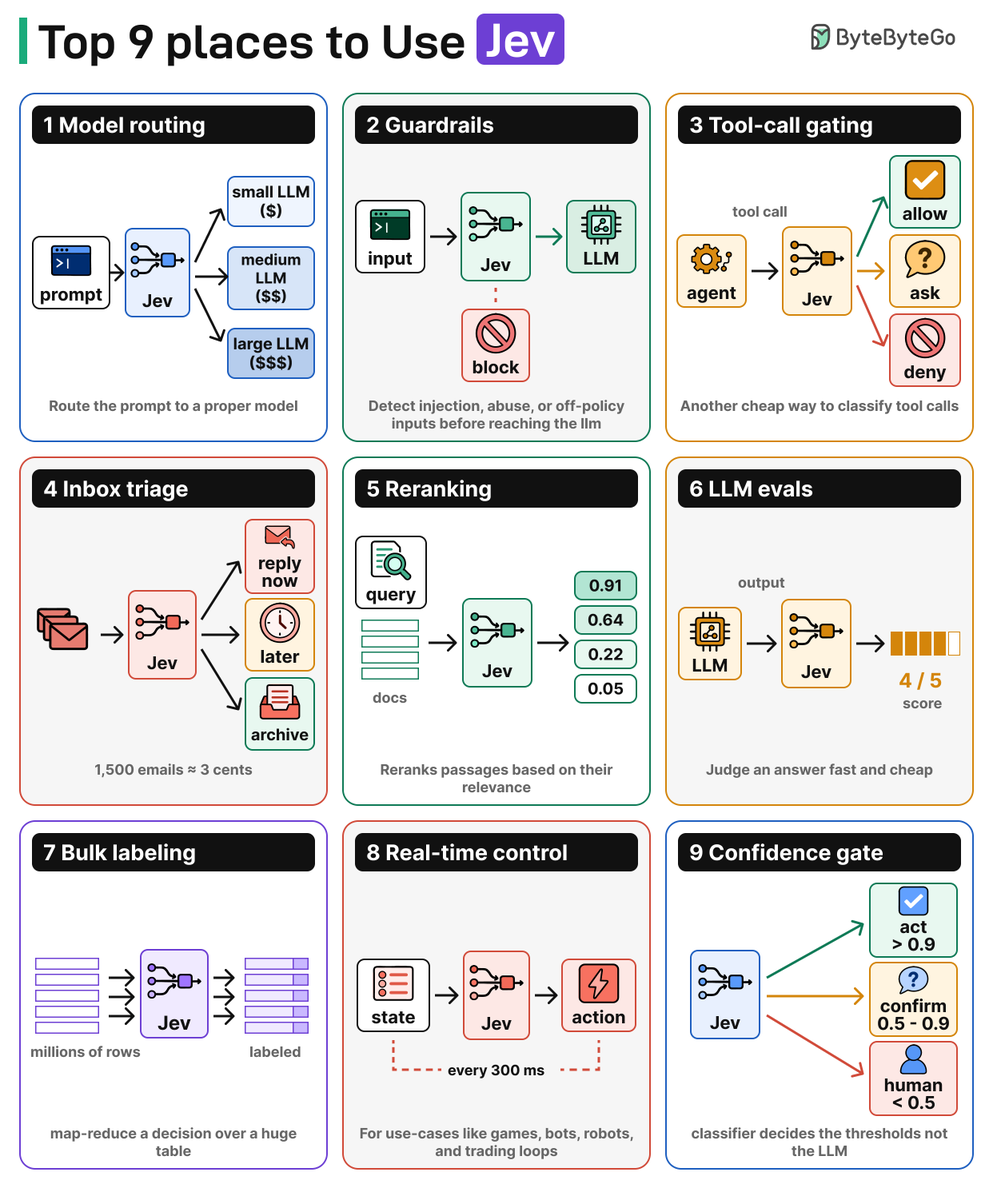
Jev is TypeSafe AI's first System One Model.
It is 100x faster and cheaper than frontier LLMs.
That opens up a lot of use cases people usually skip because the big models are too slow or too expensive for them.
Here are 9 use cases where we think Jev could be used instead of an LLM.
AI has collapsed the cost of building products, but not the cost of knowing what to build.
- The old loop: spec, scope, build
- The new loop: build, play, design, ship
Prototypes are cheap. Great products still require taste, judgment, and a clear understanding of what users actually need.
a16z's @joshelman on the artifact a product manager actually produces: https://t.co/neVI1kyCYY
@addyosmani Not sure, honestly. I'm on the $200 plan and use Sonnet models as subagents, but I still burn through my limit in 2-3 days despite fairly light usage.
I've seen my weekly consumption jump 10%+ in a single session.
Would appreciate any tips for reducing token usage.
I can’t stress enough how little an idea matters compared to the agency of the people executing the idea.
I have had the privilege of knowing and sometimes even working with some of the most successful people (by various metrics).
The difference between mediocre and excellent work and outcomes is predominantly one of agency.
In practice this means: they dont wait for things to happen to them they go out and make things happen for them.
They don’t wait for someone else to do something, for someone to teach them, for someone to give them the path, etc. They just go out and find a way to do it.
I think the single biggest superpower these people have is the realization/belief that the world around them is completely mutable. Most everything that happens is because a person made it happen.
I used to tell people to look around the room you’re sitting in. Look at everything. Every noun. It almost all exists because a person willed it into existence. Nothing is stopping you from doing the same.
I see people online all the time dismissing someone else’s success because “I had that idea first” or whatever. I mean… yeah? If so then the difference is… you. So a bit of a self own whenever I hear that.
Number one tip: act with agency.
Spotify's engineering team cut Claude Code token usage by 90% with a two-model routing approach they call Portal. The mechanism is worth understanding because it's not prompt engineering, it's hard blocks at the architecture level.
Two cheaper "assistant" models handle the tasks that don't need the expensive model: opening files, writing repetitive code, boilerplate. The expensive model only touches novel reasoning. Files over 350 lines get blocked from the expensive model entirely, not suggested away from it, blocked.
They tried rules-as-instructions first. It didn't hold. Engineers (and the model) found ways around soft rules. Hard blocks at the routing layer worked where prompt-level guidance failed.
90% token reduction is a big number. The implication is that most of what people use frontier models for in a coding workflow doesn't actually require frontier-level reasoning. Routing to capability level rather than defaulting to the best model available is a legitimate architecture pattern.
Article is worth reading in full.
https://t.co/4Kd8y24ILo
Training tiny models for special purpose use cases works so incredibly well if you have a great self improving recursive flywheel. Shopify ML team is on fire.
finetuned 0.8b model beats GPT 5.6-sol xhigh in this very specialized task.
@borkdude Just for fun, started rewriting my Emacs config using Agent yesterday, just to see how it goes - going great so far! Really appreciate this, thank you!
All you really need today to build a business is 100% free open source software that charges you $0/mo
+ a VPS server
+ an API to do some required AI stuff
+ some R2/S3 file hosting
They don't want me to tweet that because it destroys their businesses but I can't lie to you!