This is really stupid, and it’s not getting enough attention.
The Trump administration is pulling a working $368 million ocean monitoring system out of the water, equipment taxpayers already bought, built, and sank into the deep ocean.
And they are doing it right when the oceans are behaving in ways that alarm the scientists who study them.
Record-breaking temperatures.
A system of Atlantic currents that may be lurching toward collapse.
The response?
Yank out the instruments and walk away.
That is not budgeting. That is smashing the gauges while the engine is on fire and calling it efficiency.
For what? The Trump administration dressed it up as a “nimbler approach” and “smart lifecycle management,” which is fancy nonsense for “we shut it off and hoped nobody would ask why.” There is no return-on-investment analysis. They cannot show taxpayers save a dime, because the gear is already paid for and the science it produces protects real money and real lives.
The kicker: the same people killing the monitors want to mine the deep sea for minerals. So they are destroying the only tools that could measure what that mining does. That is not an accident.
That is the point. You cannot see the damage if you break the instruments first.
https://t.co/MzE4AW1QBv
Some letters are never meant to be sent.
In 1946, Richard Feynman wrote a love letter to his wife, two years after her death --He never sent it.
Last line: “I love my wife. My wife is dead.”
Screwworms coming back into the U.S. cattle herd/stock is going to potentially devastate the industry and jack up meat prices. Worst part is, this was preventable. Trump & DOGE pushed funding cuts on/destroyed agencies that were directly responsible for fighting this pest
This is a hard article to read, but I hope you'll do so. I've spent some time reporting on widespread rape and other sexual violence of Palestinian male and female prisoners by Israeli authorities, and the article is now published. The assault victims were warned not to give speak of what they endured -- they were sometimes told they would be killed or raped if they gave interviews -- but they found the courage to do so. One man described being raped three times in a single day in Israeli prison, the third time after he tried to protest. A young woman said the guards would come in at the beginning of each shift and strip her naked and abuse her. Another reported that she was shown photos of herself being raped and warned they would be released unless she cooperated with Israeli intelligence. Even three children who had been detained told me they had been sexually abused. Look, whatever our position on the Middle East, we should be able to agree on being anti-rape. Sexual assaults were horrific when Israeli women were targeted on Oct. 7, and they're equally horrific when Israeli authorities use them against Palestinians day after day after day. We should be able to find common ground in opposing rape. Here's a gift link to the article: https://t.co/aMMHId49OO
Of course this DNC account punts what this debate is actually about, here’s an easy to follow overview for you. The controversy focuses on an NGO called the American Prairie Foundation with a bison herd on public land (BLM) in Northeast Montana (note this is different from the famous Yellowstone herd that you may have visited on a family trip).
To obtain a grazing permit on BLM, this isn’t auctioned off at market. Instead, it’s a preference system linked to ownership of a nearby property (called a “base property”).
American Prairie is a relative newcomer who acquired BLM preference for grazing allotments by purchasing deeded ranches adjacent to BLM land. Then, they asked the BLM to modify their grazing permits to include bison. The BLM did an environmental impact assessment and approved bison in 2022, which was just revoked at the request of Montana lawmakers and ranching families in the state.
The reason ranching families, stockgrowers, and Montana lawmakers do not want American Prairie to run their conservation focused bison herd on BLM land begins with the fact that to purchase deeded ranches and obtain eligibility for BLM grazing, American Prairie got piles of cash from foreign and out of state donors. As a donor funded foundation, most of its cash comes from a Swiss born billionaire, a German billionaire, and high net worth individuals from NYC and SF. How would a regular rancher from Montana compete with that to purchase the ranches that would lead to preference for BLM? How would a 21 year old seventh generation rancher compete? When this NGO buys these deeded ranches, the associated grazing rights on BLM are automatically transferred.
Montana ranchers and politicians also oppose buffalo on BLM parcels because of the risk of disease transmission to livestock, and an overarching belief that Montana has been ranching for food production for centuries, newer conservation interests backed by non-local cash undermine the long, rich heritage of the state.
On the other side of the debate is American Prairie with a noble mission to restore the mighty bison to American grasslands to promote biodiversity, focusing on native grasslands and fauna. This is a group focused on what’s called “rewilding” or returning the land to its pre human state, with the buffalo as a powerful symbol of the American frontier. Proponents argue that as a keystone species, buffalo have many ecological benefits that make our great prairies healthier and more productive. They argue disease transmission risk is overstated, and that market-based conservation is the future. In America, if you have resources to buy ranches, get the BLM permits, you should be able to do so without government putting its finger on the scale and reversing policy for the ranching interests. They argue public land shouldn’t exclusively be for ranching, and the true purpose of “multiple use public land” should include conservation.
When I present issues like this in my class, I’m very careful to not tell my students what to think but rather *how* to think about conservation disputes. Where you land on the issue is uniquely yours, a function of your values, heritage, economic preferences, beliefs on the purpose of public land and the role of wildlife in the 21st century.
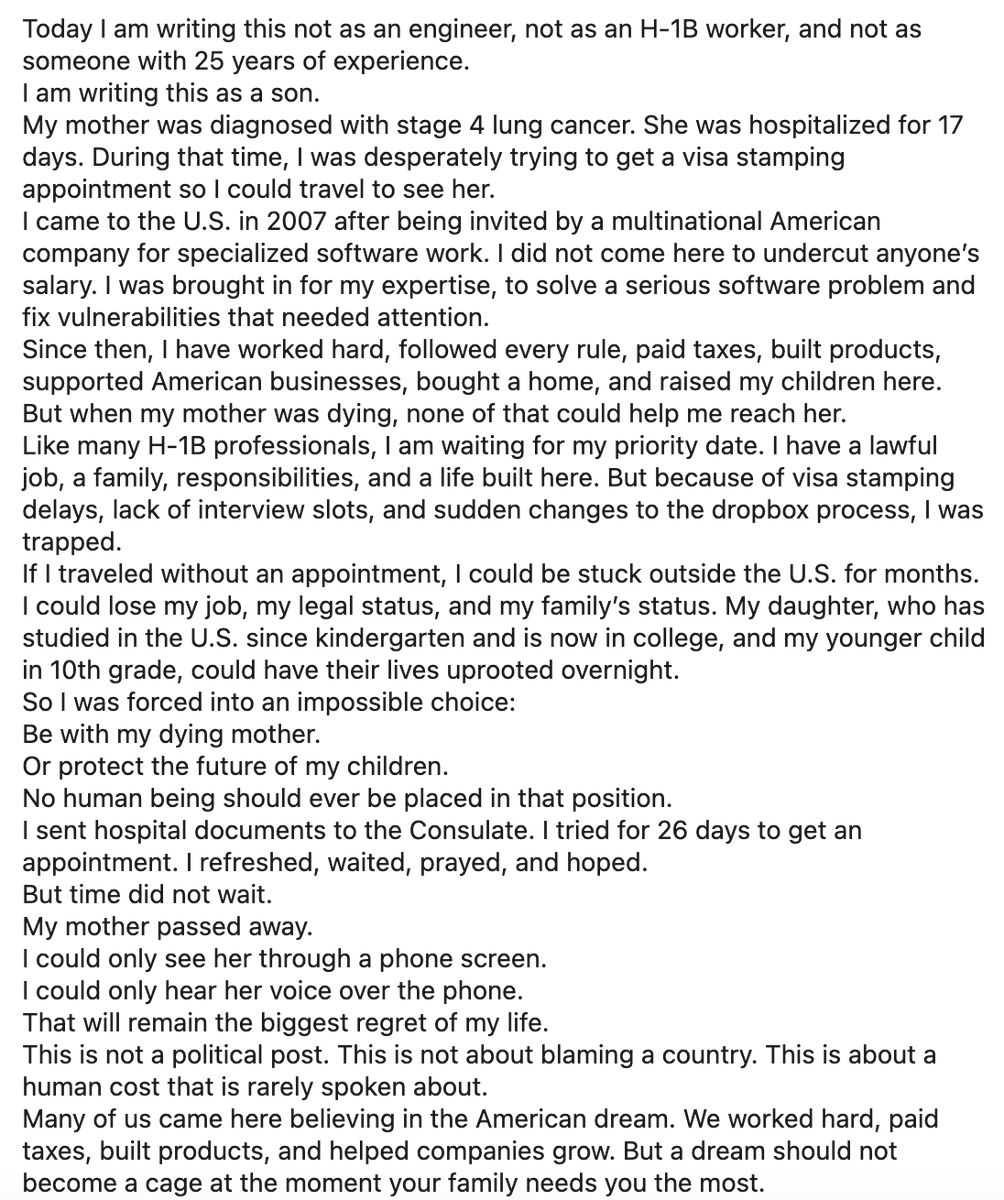
This H-1B worker has lived in the US for nearly 20 years and built a family here. His mom was dying in India. To visit her, he would need to wait months to book a consular appointment--with the soonest one available likely being scheduled one year out.
He made the difficult choice of not visiting his dying mom because leaving without an appointment would mean separation from his children, job, and his other obligations.
Much of the commentary around immigration focuses on how such bureaucratic burdens undermine immigrants’ ability to contribute and innovate. But we must remember that this red tape also prevents these people from being fully engaged with their own lives and meaningfully present in the lives of others. This matters too, and these seemingly non-economic problems will eventually translate into economic costs.
If America is no longer a place where people feel empowered to be the best versions of themselves as they celebrate, struggle, and grieve, it ceases not just being the land of opportunity, but also the land of dignity and purpose.
https://t.co/k17YL25nc5
We have to crack down on impoverished parents who let their adult children with Down's syndrome stay in a spare bedroom so Trump can build his ballroom.
If you think Cloudera routing applicants to an email that didn’t accept external submissions is concerning, what I observed with Uber was even more structured and entirely automated.
As an American who was qualified, willing, and able to perform these roles, I submitted repeated applications across multiple PERM positions posted by Uber. Based on that testing, the entire email chain operated through a rule-based system: each submission triggered an automated “HR case,” followed by templated and phased responses, and ultimately an automated closure.
There was no indication of human review or intervention at any point, every response was system-generated based on the job’s position in the PERM timeline.
Early-stage postings prompted automated questions such as citizenship status and sponsorship needs. If the recruitment period was toward the end of the required 60-day window, cases were automatically closed. The outcome did not vary based on qualifications or responses, only on timing within the process.
This was not ad hoc. It required intentional system design and development, a rule engine built to manage and control applicant flow in a way that, in practice, resulted in no meaningful consideration of U.S. applicants.
Across dozens of applications, the result was consistent: qualified, available American applicants were processed through an automated system, never contacted by a human, and never genuinely evaluated.. while those same roles later appeared in Department of Labor filings asserting no qualified U.S. workers were available.
The DOJ going after Cloudera matters. This kind of enforcement is what protects American workers and exposes employers who try to game the system. I truly appreciate the work they are doing!
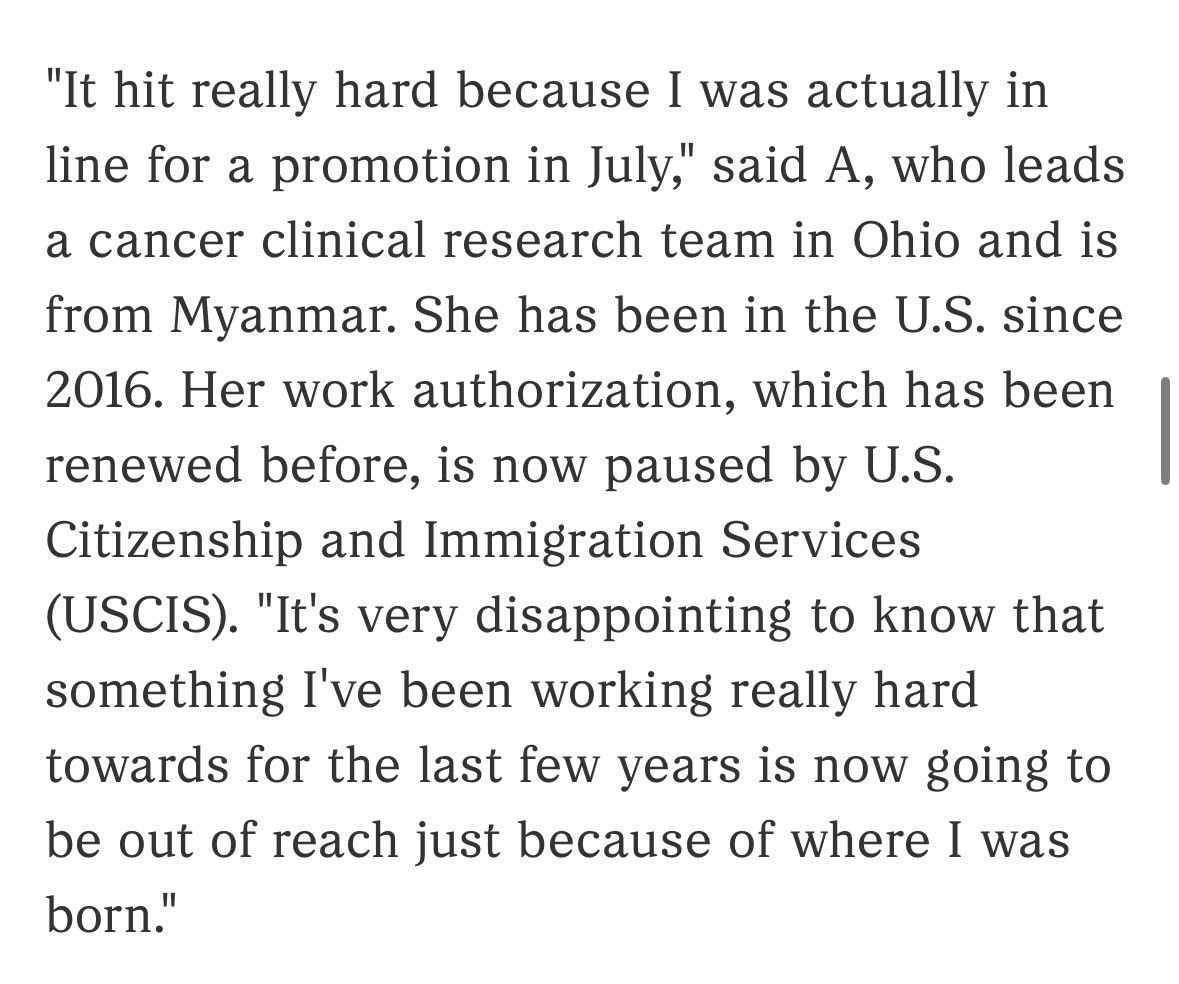
Imagine you are an immigrant here legally, working, paying taxes. Your status comes up for a renewal, and you file the paperwork months in advance.
Then the government tells you they refuse to process your renewal because of where you were born, and if you lose your job, tough.
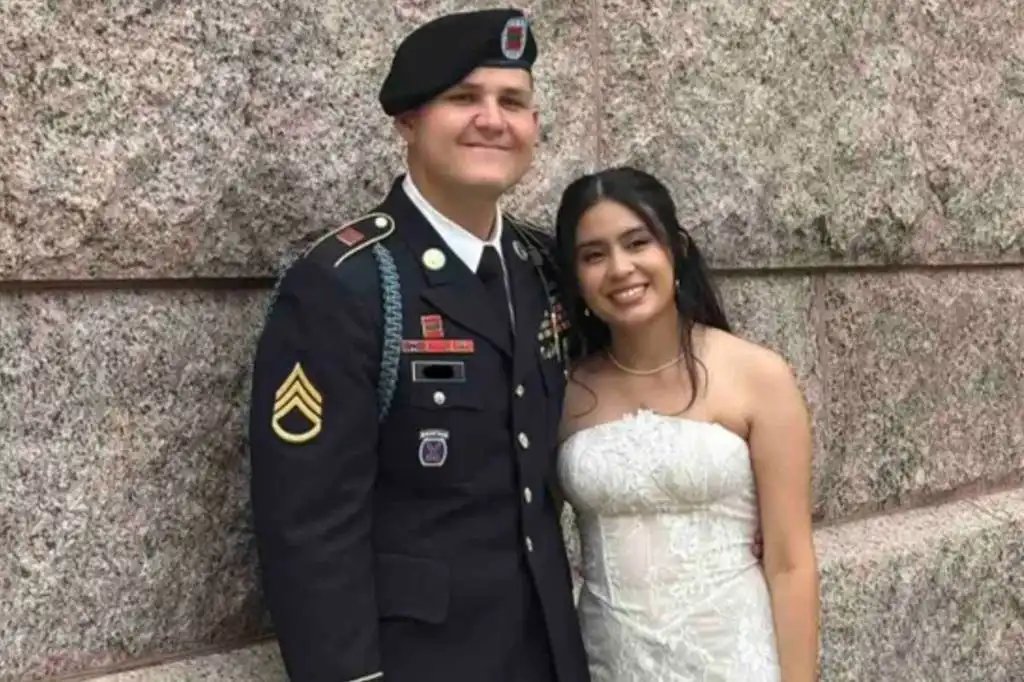
ICE arrested the wife of a U.S. Army staff sergeant at his military base in Louisiana as he prepared to deploy, even though she was brought to the United States as a toddler.
Annie Ramos, 22, was taken into custody last Thursday, just days after marrying 23-year-old Matthew Blank, a soldier with more than five years of service who has deployed to the Middle East and Europe.
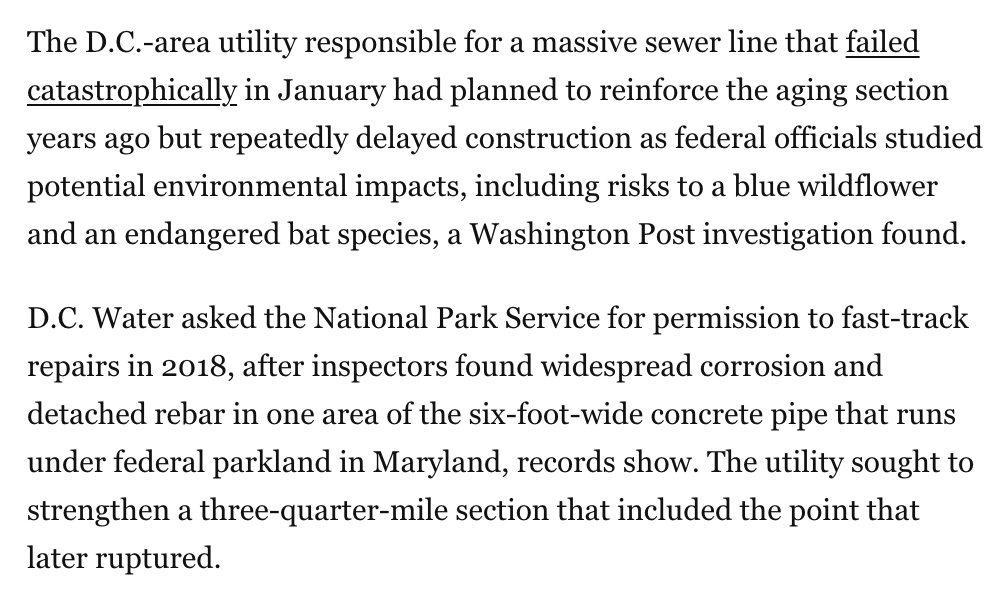
One of the largest spills of untreated wastewater in American history happened while an environmental review process held up sewer line repairs because they were studying risks to a flower and a bat.
As @DouthatNYT put it after the Charlie Hebdo shooting: “If a large enough group of someones is willing to kill you for saying something, then it’s something that almost certainly needs to be said, because otherwise the violent have veto power over liberal civilization, and when that scenario obtains it isn’t really a liberal civilization any more. Again, liberalism doesn’t depend on everyone offending everyone else all the time, and it’s okay to prefer a society where offense for its own sake is limited rather than pervasive. But when offenses are policed by murder, that’s when we need more of them, not less, because the murderers cannot be allowed for a single moment to think that their strategy can succeed.” https://t.co/YrPr2iz8ST
I doubt that anyone I know steals from Whole Foods, but the milieu that the article depicted, where it's normal for perfectly well-off people to steal things because why not, was really upsetting to read about, so I actually want to try to earnestly explain why you shouldn't do this just in case there's someone out there who has never had it explained to them.
When a business opens - or really, as soon as a business starts making plans to open - a defining question for the business is how it will collect payment for the goods or services it provides. If you trust the people you sell to, you can be pretty relaxed about this; send people an invoice, most of them will pay it on time, any who don't will pay it a bit late. You have to think about convenience and mistakes but not about people trying to cheat you. This saves you so, so much defensive planning to make sure you get paid. It's so much easier.
But if you're selling to the general public, you do have to think about people trying to cheat you. You have to structure the physical store so that it's hard for them to steal. You have to not carry some items that you'd like to sell, because they'd also be attractive targets to steal. If people swap price tags between items, you can't use stickers. If people put things on in the dressing room and wear them out, you need to pay someone a full time salary to monitor the dressing room.
The world that we all live in is much poorer than the world we'd live in if people didn't steal. The stores don't carry things that they could carry if people didn't steal. They don't use pricing and inventory systems that would be way easier and more convenient if people didn't steal.
But it could be much worse! If I walk down to my local Whole Foods today, items on the shelves won't be locked behind sheafs of plastic - that is only worth it when the background rate of stealing is much higher than it is at my local Whole Foods. When more people steal, businesses have to further intensify security, or go out of business.
When you shoplift, you directly and unambiguously impoverish your community. You make prices higher for everybody else, you make stores less usable for everybody else, or you make businesses not viable that would otherwise be viable. The direct impact each time is small, but it's a lot larger than the direct impact of taking some trash out of the trash can to throw on the ground, or pouring just a tiny bit of poison into your local river, and most people have a deep, instinctive abhorrence of antisocially wrecking your community like that.
So don't steal.
The other thing that it seems possible some people might not understand is that while you might have a social circle that is incredibly nihilistic and cynical and thinks that everybody steals, in fact this is not true. Most people do not steal. Most people, if they learn that you steal, will lose more respect for you than you had to lose. I don't know anyone who has shoplifted except 'as a kid/teenager'. It is not always the case that virtue is rewarded and vice is punished but even before you bring the legal system into it, the risk-reward tradeoff of having everybody you know know that you steal things sometimes is absolutely terrible. Who would hire someone who steals things? Who would trust them around a vulnerable person? Who would want to live in a society with someone who will delightedly and routinely wreck it for the slightest personal benefit?
I hope that "Gina" turns her life around. I hope that Gina realizes that she needs to. And if you have been told that it's just a corporation or that having ethics is lame or that if you think about it, other bad things happen too, like wage theft, so that means stealing is okay, I hope you really, actually, think about whether you'd accept any of those as excuses for anything else.
President Nixon dictated a long diary-like memorandum describing the visit to the Lincoln Memorial because he wanted to make a record of what was for him a memorable event:
"Manolo and I got out of the car at approximately 4:40 and walked up the steps to the Lincoln statue. . . .
By this time a few small groups of students had begun to congregate in the rotunda of the Memorial. I walked over to a group of them . . . and shook hands. They were not unfriendly. As a matter of fact, they seemed somewhat overawed, and, of course, quite surprised.
When I first started to speak to the group there were approximately eight in it. I asked each of them where they were from and found that over half were from upper New York State. At this point, all of them were men. There were no women. To get the conversation going I asked them how old they were, what they were studying, the usual questions. . . .
Two or three of them volunteered that they had not been able to hear the press conference because they had been driving all night in order to get here. I said I was sorry they had missed it because I had tried to explain in the press conference that my goals in Vietnam were the same as theirs—to stop the killing and end the war—to bring peace. Our goal was not to get into Cambodia by what we were doing, but to get out of Vietnam.
They did not respond, so I took it from there by saying that I realized that most of them would not agree with my position, but I hoped that they would not allow their disagreement on this issue to lead them to fail to give us a hearing on some other issues where we might agree. And also particularly I hoped that their hatred of the war, which I could well understand, would not turn into a bitter hatred of our whole system, our country, and everything that it stood for.
I said, I know that probably most of you think I’m an SOB, but I want you to know that I understand just how you feel. I recall that when I was just a little older than you, right out of law school and ready to get married, how excited I was when Chamberlain came home from Munich and made his famous statement about peace in our time. I had heard it on the radio. I had so little in those days that the prospect of going into the service was almost unbearable and I felt that the United States staying out of any kind of conflict was worth paying any price whatever. I pointed out, too, the fact that I came from a Quaker background. I was as close to being a pacifist as anybody could be in those times. As a result I thought at that time, that Chamberlain was the greatest man alive, and when I read Churchill’s all-out criticism of Chamberlain I thought Churchill was a madman." (Continued)
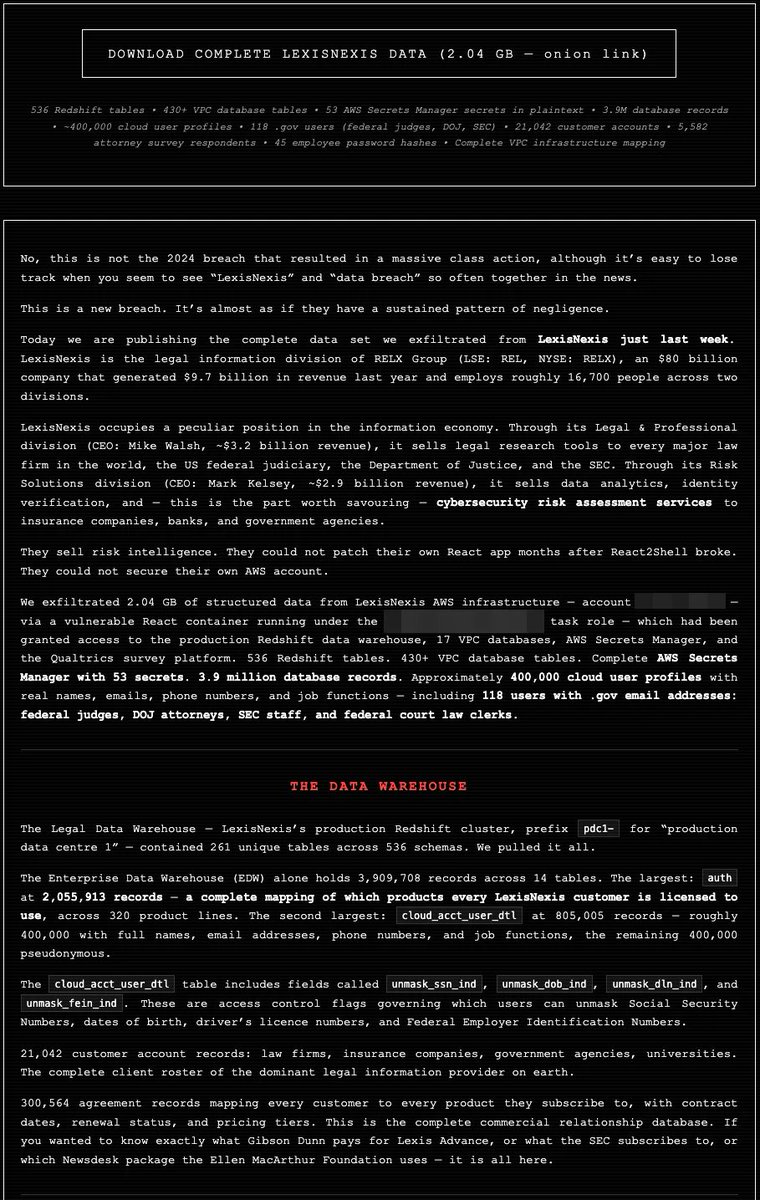
United States 🇺🇸 - LexisNexis has allegedly been breached, exposing 400,000 user profiles, federal judge and DOJ accounts, plaintext AWS secrets, customer passwords, and internal IT infrastructure maps. https://t.co/hLGJ8Cz4Up